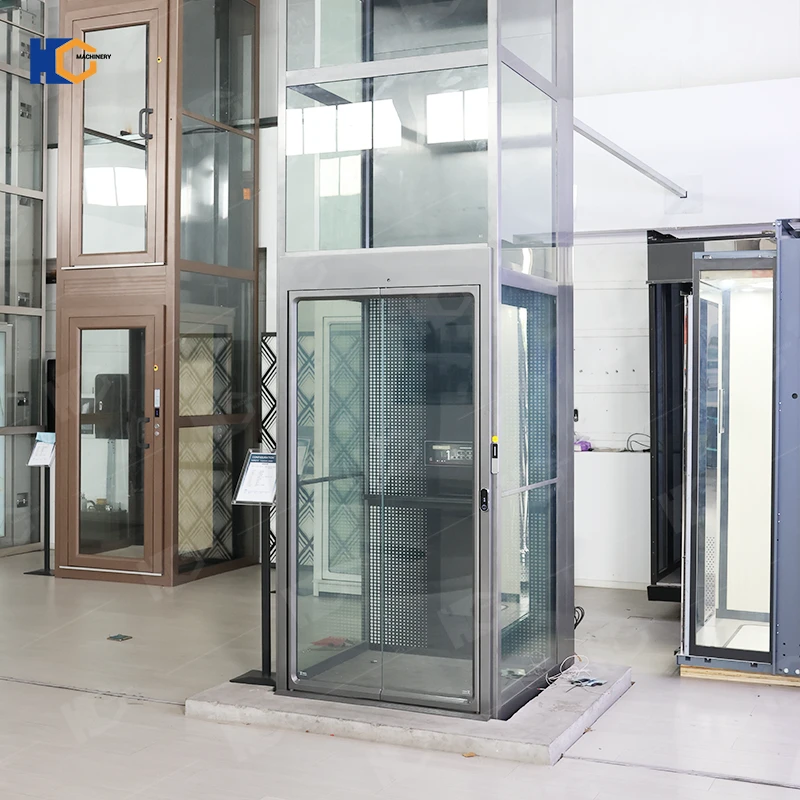
When considering accessibility solutions for your home, the choice between a glass enclosed home platform lift and a traditional elevator can be overwhelming. Both options promise to enhance mobility and add value to your property, but they differ significantly in cost, installation, design, functionality, maintenance, and long-term value. This comprehensive guide will break down these differences in detail and help you understand why a modern glass enclosed platform lift is often the smarter, more practical choice for today’s homeowners—especially when sourced from an industry leader like Huichuang Lift.
Understanding Your Options: What Are They?
Before diving into costs and features, it's essential to understand what each system actually is, how it works, and where it fits best.
What Is a Glass Enclosed Home Platform Lift?
A home platform lift (also known as a vertical platform lift or through-floor lift) is a compact, self-contained mobility solution designed specifically for residential use. It typically consists of a flat platform that moves vertically between floors, guided by rails mounted to a wall or within a minimal enclosure. Unlike full elevators, platform lifts do not require a fully enclosed shaft.
When glass enclosed, the lift features transparent tempered glass panels on its sides—and sometimes even the ceiling—creating a bright, open aesthetic. These lifts are usually powered by quiet electric or hydraulic drives and plug into a standard household electrical outlet (220V/240V). They are engineered for ease of use, with simple push-button controls and automatic safety gates.
Platform lifts are ideal for homes with 2–4 floors, especially retrofits, where space is limited and major construction is undesirable. They comply with residential accessibility standards (such as UK Part M or US ADA guidelines for private dwellings) but are not classified as full elevators under commercial codes like ASME A17.1—unless specifically designed to meet those requirements, as some premium models do.
View related products: N800 Platform Lift: A Smart and Reliable Vertical Mobility Solution
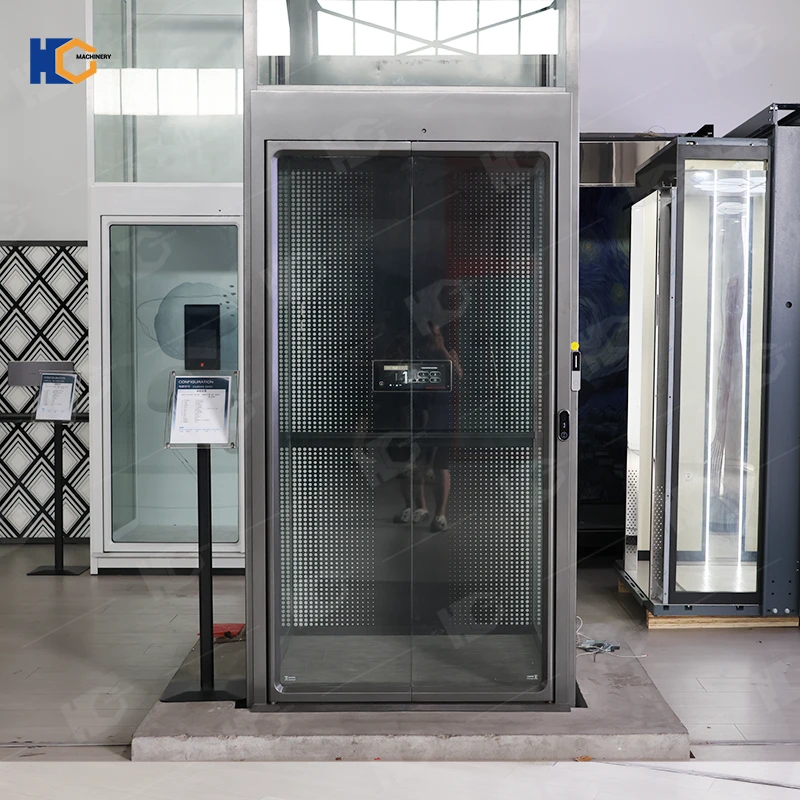
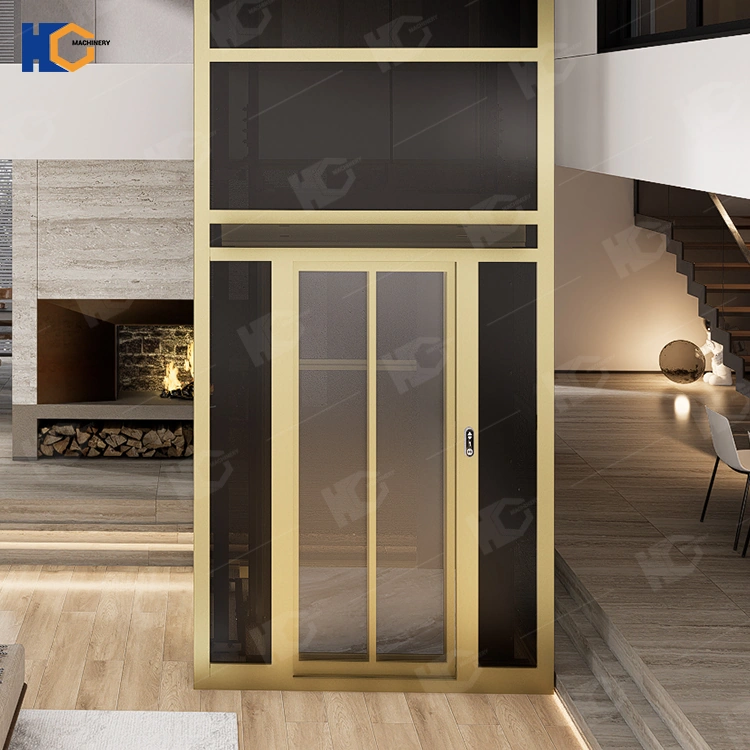
Full-View of Compact Glass Shaftless Home Platform Elevator with Automatic Sliding Doors, No Pit Required for Villa & Residential Use
What Is a Traditional Home Elevator?
A traditional residential elevator mirrors commercial elevator systems in both structure and operation. It requires a fully enclosed hoistway (shaft), a pit (typically 12–24 inches deep) at the bottom landing, and often overhead clearance (8–10 feet) for machinery—unless using a machine-room-less (MRL) design.
These elevators use one of three drive systems:
Hydraulic: Uses fluid pressure; requires a machine room or basement housing.
Traction (cable-driven): Uses steel cables and counterweights; needs significant overhead space.
Machine-Room-Less (MRL): Compact motor integrated into the hoistway; more space-efficient but still requires a full shaft.
Traditional elevators feature a fully walled cab with automatic sliding or swing doors, higher speed, greater weight capacity, and smoother rides. However, they come with extensive structural, regulatory, and financial commitments.
View related products: K600 Traction Elevator: Smooth, Safe, and Smart Vertical Mobility for Modern Buildings
Head-to-Head Comparison: Key Differences in Detail
The table below provides a detailed side-by-side comparison across critical decision-making factors:
| Feature | Glass Enclosed Platform Lift | Traditional Home Elevator |
|---|---|---|
| Average Cost (US/UK/EU) | $15,000 – $35,000 | $40,000 – $100,000+ |
| Installation Time | 2–5 days | 4–12 weeks |
| Space Required | Fits in stairwell or corner; no shaft | Requires dedicated hoistway (min. 5' x 5') |
| Structural Modifications | Minimal; may need minor floor cutout | Extensive: new shaft, pit, overhead, reinforced walls |
| Power Requirements | Standard 220V/240V outlet | Dedicated 208V/240V or 480V circuit; possible 3-phase |
| Max Travel Height | Up to 50 ft (4–5 floors) | Unlimited (with proper engineering) |
| Speed | 0.10 – 0.15 m/s (20–30 ft/min) | 0.30 – 0.50 m/s (60–100 ft/min) |
| Load Capacity | 300–500 lbs (136–227 kg) | 750–1,000+ lbs (340–454+ kg) |
| Aesthetic Impact | Sleek, modern, enhances natural light | Can feel industrial; cab hidden in shaft |
| Regulatory Compliance | Often exempt from full elevator codes in private homes | Must comply with ASME A17.1 (US), EN 81 (EU), or local lift regulations |
| Maintenance Frequency | Annual check recommended | Quarterly to biannual service contracts typical |
| Noise Level | Very quiet (<55 dB) | Moderate to loud (60–70 dB), depending on drive type |
| Customization Options | High (glass type, platform finish, lighting, rail color) | Moderate (cab interior only; exterior fixed by shaft) |
| Resale Value Impact | Positive; seen as accessible & modern | High, but only if professionally installed and permitted |
The Cost Factor: A Deeper Dive
Cost remains the most decisive factor for most homeowners, and the gap between the two options is substantial—not just in purchase price, but in total cost of ownership.
Upfront Investment Breakdown
A glass enclosed platform lift from a reputable manufacturer like Huichuang Lift typically costs between $15,000 and $35,000, including delivery, professional installation, and basic customization. This price covers everything: the lift unit, glass enclosure, control panel, safety features, and labor.
In contrast, a traditional home elevator starts at $40,000 for the simplest MRL model—but this is just the beginning. Add $20,000–$50,000+ for constructing the hoistway, pouring the pit, reinforcing floors, and installing electrical infrastructure. Permits, architectural drawings, and inspections can add another $5,000–$10,000. The total easily exceeds $80,000–$120,000 in many cases.
Long-Term Ownership Costs
Maintenance: Platform lifts have fewer moving parts and simpler mechanics. Annual maintenance might cost $200–$500. Traditional elevators often require $1,000–$2,500/year in service contracts due to complex hydraulics, cables, or control systems.
Energy Use: Platform lifts consume minimal power—comparable to a microwave. Traditional elevators, especially hydraulic ones, use significantly more energy, increasing utility bills.
Repairs: If a part fails on a platform lift, replacement is usually straightforward and affordable. Elevator repairs can involve specialized technicians and expensive OEM components.
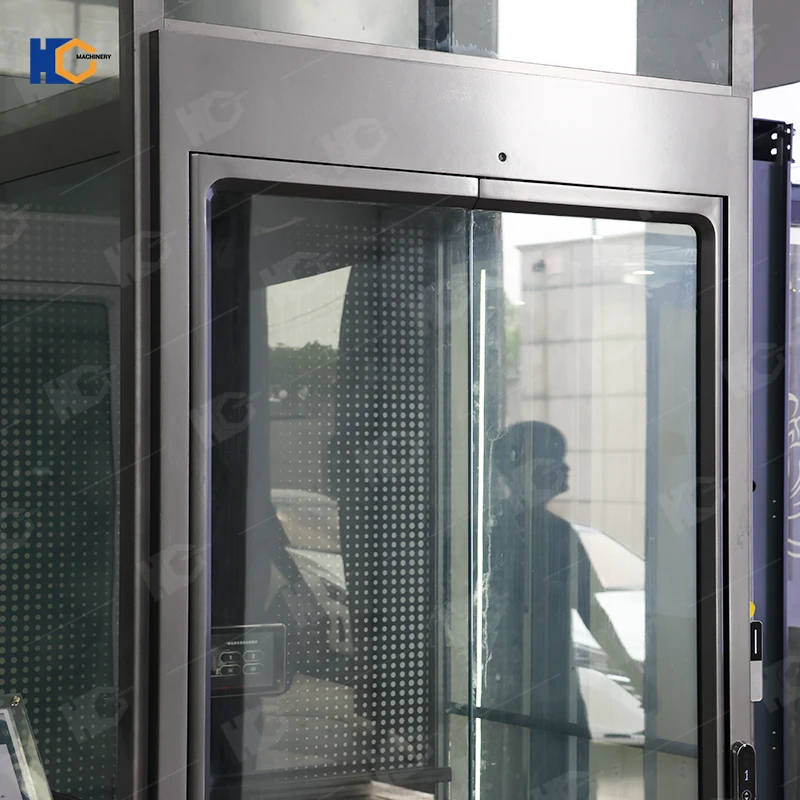
Premium Door System: Sturdy Stainless Steel Frame + Safety Glass with Perforated Panel, Ensuring Durability and a Modern Look
Installation & Space Efficiency: Why Simplicity Wins
For existing homes, installation feasibility is often the dealbreaker.
Retrofit Friendliness
Most homes were not built with an elevator shaft. Adding one means cutting through multiple floors, rerouting plumbing or electrical lines, and potentially compromising structural integrity. A platform lift, however, can be installed alongside an existing staircase or in a corner alcove with just a small floor opening (often 36” x 54”). No major demolition is needed.
Huichuang Lift’s modular design allows for on-site assembly, minimizing disruption. Many customers report being able to live in their home normally during the 3–4 day installation.
Space Optimization
In urban townhouses or compact homes, every square foot counts. A traditional elevator consumes 25–30 sq ft permanently. A platform lift uses less than 15 sq ft and doesn’t block sightlines thanks to its glass enclosure. This makes it ideal for open-concept living spaces.
You can also check out this article for more comparative information on related products to help you choose the right elevator: Vertical Platform Lifts vs. Inclined Lifts: Which Is Best for Your Home?
Design, Aesthetics, and Customization
Today’s homeowners want function and form. Platform lifts deliver both.
Architectural Integration
Glass-enclosed lifts act as sculptural elements. Natural light passes through, making rooms feel larger and brighter. At night, integrated LED lighting turns the lift into a glowing centerpiece. You can choose frameless glass for a minimalist look or brushed stainless steel frames for industrial elegance.
Traditional elevators, by contrast, are architectural voids—dark shafts that interrupt floor plans. While the cab interior can be customized (wood paneling, carpet, mirrors), it remains hidden when not in use.
Personalization with Huichuang Lift
Huichuang Lift offers extensive customization:
Glass types: Clear, frosted, tinted, or patterned
Platform materials: Non-slip aluminum, wood veneer, stone composite
Control panels: Touchscreen or classic buttons in various finishes
Lighting: Ambient, motion-activated, or color-changing LEDs
This level of personalization ensures your lift complements your home’s unique style—something mass-produced elevator cabs rarely achieve.
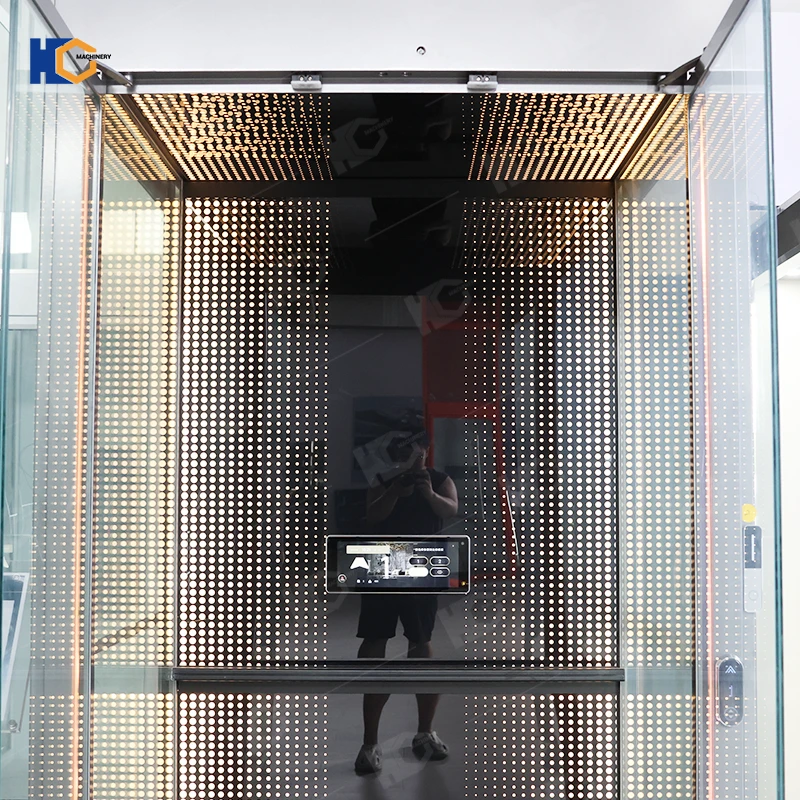
Modern Glass Enclosed Home Platform Lift Interior with LED Ambient Lighting, Touch Control Panel & Perforated Metal Back Panel for Luxury Villa
Safety, Reliability, and Compliance
Both systems are safe when properly installed—but their risk profiles differ.
Safety Mechanisms
Modern platform lifts include:
Obstruction sensors (infrared or mechanical)
Automatic self-closing gates with interlocks
Emergency lowering via battery backup
Overload protection
Non-slip platforms
Huichuang Lift models are certified to CE, ISO 9001, and ASME A17.1 (for applicable models), ensuring they meet or exceed international safety benchmarks—even in private residences where such certification isn’t always mandatory.
Traditional elevators have more redundant safety systems (e.g., multiple brakes, overspeed governors), but this complexity also increases the chance of component failure over time.
Regulatory Landscape
In the United States, private home elevators are regulated at the state level, but platform lifts often fall under “Private Residence Elevator” or “Accessibility Lift” exemptions, simplifying permitting.
In the UK and EU, platform lifts for private use are governed by EN 81-41 or national adaptations (like UK Part M), which are less stringent than full passenger lift codes.
Huichuang Lift navigates these regulations globally, providing documentation and support to ensure smooth approvals in any market.
Why Choose Huichuang Lift?
When you’re ready to invest in a home platform lift that combines elegance, reliability, and exceptional value, Jinan Huichuang Machinery Manufacturing Co., Ltd.—known globally as Huichuang Lift—is your ideal partner.
Company Overview
Based in Jinan, Shandong—the renowned “Hometown of Hydraulic Lifting Platforms”—Huichuang Lift is a leader in innovative lifting solutions. With a clear mission to promote building accessibility and deliver hassle-free lifting experiences, we’ve built a reputation for excellence across domestic and international markets.
Mission & Global Vision
Our core objective is simple: to create more possibilities for users through smart, accessible design. Leveraging decades of industry expertise, we not only provide exceptional products and services but also actively shape industry standards. We are currently expanding our global footprint and actively recruiting agents and partners who share our commitment to quality and innovation. Our products are certified to CE, ISO, and ASME A17.1 standards, ensuring they meet the highest international benchmarks for safety and performance.
Strengths That Set Us Apart
Huichuang Lift operates with over 200 skilled professionals across multiple advanced production workshops and immersive product showrooms. We independently develop and manufacture two core product lines: hydraulic aerial work lifts and home elevators, including our signature glass-enclosed platform lifts. Our in-house R&D capabilities ensure every product delivers outstanding cost-effectiveness without compromising on durability or safety.
Products & Global Reach
Our portfolio includes:
Hydraulic Aerial Work Lifts
Home Elevators & Platform Lifts
Articulating and Telescopic Boom Lifts
We proudly serve customers in North America, South America, Europe, Southeast Asia, and beyond, earning consistent praise for our reliable performance and customer-centric approach. We offer customized, safe, and efficient solutions tailored to your unique needs, along with flexible OEM services for partners.
Competitive Edge
At Huichuang Lift, we believe that premium quality shouldn’t come with a premium price tag. Our competitive edge lies in three pillars:
Safety & Quality: Rigorous quality control processes ensure every lift exceeds international safety and performance standards.
Customer Support: From your first inquiry to long-term after-sales maintenance, our team provides seamless, comprehensive support.
Cost-Effectiveness: We deliver high-value solutions that balance affordability with uncompromised quality—perfect for diverse residential and commercial applications.
Industry Recognition
As a trusted name in the lifting industry, Huichuang Lift has received numerous awards recognizing our dedication to quality, safety, and exceptional customer service.
Conclusion: The Future of Home Accessibility Is Here
The choice between a glass enclosed platform lift and a traditional elevator isn’t just about getting from one floor to another—it’s about how you want to live in your home. Do you want a disruptive, costly construction project? Or a sleek, fast-to-install solution that enhances your space while providing reliable access?
For most homeowners, the answer is clear. The glass enclosed home platform lift offers unmatched value, design flexibility, and ease of integration—especially when sourced from a global leader like Huichuang Lift.
We invite architects, builders, homeowners, and distributors to explore our range of certified, customizable platform lifts. Whether you’re renovating a historic townhouse or designing a modern smart home, Huichuang Lift has the solution to make every level of your home truly accessible—without compromise.
Contact Huichuang Lift today for a free consultation, 3D layout proposal, and personalized quote. Let’s build a more accessible, beautiful, and connected home—together.
390.webp)
892.webp)