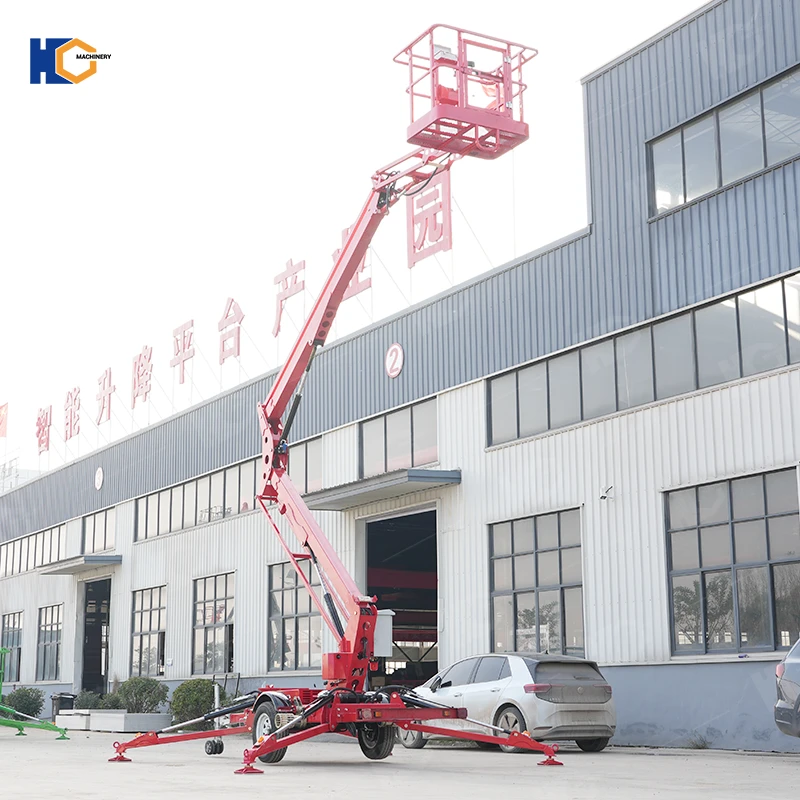
Towable boom lifts—also called trailer-mounted boom lifts or tow-behind cherry pickers—continue to be one of the most cost-effective aerial work platforms for maintenance, light construction, tree care, and facility service. As manufacturers roll out new safety features and more energy-efficient power systems, the global market is expected to see stable growth into 2026. Because of this, it’s crucial for buyers and rental companies to understand how prices are trending and what to expect in 2026 before committing to a new purchase.
This comprehensive guide explains what affects towable boom lift price in 2026, why prices are rising in some regions, typical cost ranges, and how to evaluate whether a towable lift is the right investment for your business.
1. What Is a Towable Boom Lift?
A towable boom lift is a lightweight aerial work platform mounted on a trailer chassis. It can be transported by most pickup trucks or SUVs using a standard trailer hitch. Unlike self-propelled boom lifts, towable models offer a lower purchase cost and simplified maintenance while still providing essential vertical and horizontal outreach.
Common working heights range from 34 ft (10 m) to 61 ft (18.5 m), with outreach of 12–30 ft depending on the model.
Towable boom lifts are popular in:
Tree trimming
Building maintenance
Sign installation
Roofing repair
Window cleaning
Light construction and electrical work
Rental business fleets
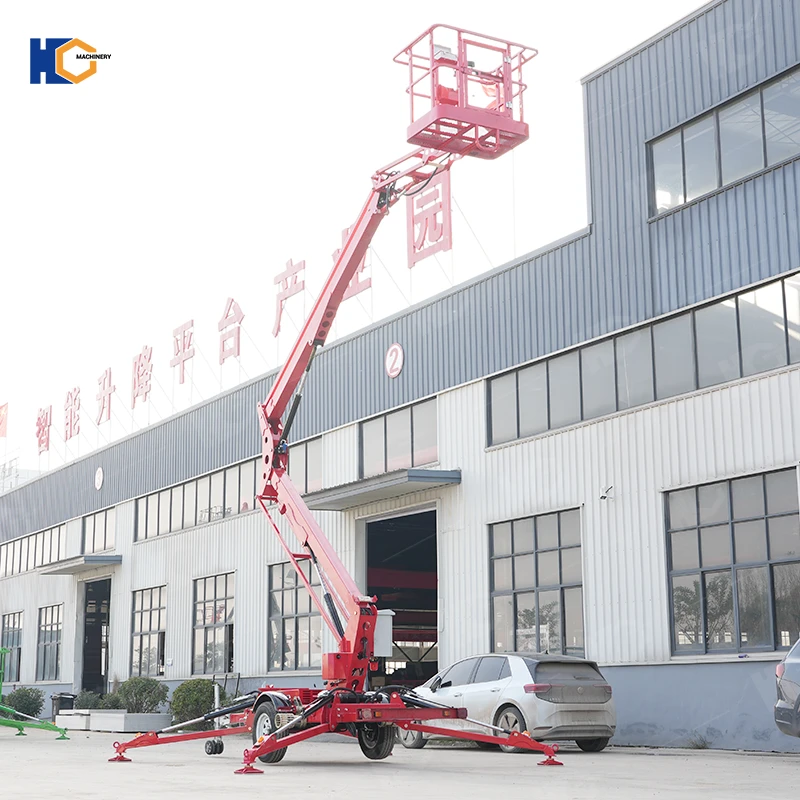
This trailer-mounted boom lift is the ideal choice for efficient aerial work. Equipped with a highly flexible articulated boom, it offers a wide working range and precise positioning, easily handling various angles and operating smoothly even in complex environments. The spacious platform ensures a safe and comfortable working space for operators.
Its superior mobility is a significant advantage – easily towed to a variety of work sites, from construction projects to maintenance and installation tasks, ensuring rapid deployment and reduced transportation costs. The rugged and durable design, coupled with a user-friendly operating system, guarantees reliability and productivity.
Invest in this trailer-mounted boom lift to enhance operational flexibility, speed up work, and strengthen your team's aerial work capabilities. We are the factory behind boom lift, offering factory prices.
2. Towable Boom Lift Price Trends Heading Into 2026
Several economic and industrial factors are influencing prices for 2026:
Raw Material Fluctuations
Steel, hydraulic components, and electronic control boards have seen periodic cost increases since 2023. Manufacturers project moderate price increases continuing into 2026.
Battery and Hybrid Technology
More towable boom lifts now offer optional:
Lithium-ion power
Hybrid charging systems
Low-noise electric motors
These upgrades add 10–35% to the overall cost compared to traditional gasoline or diesel power units.
Stricter Safety Standards
Manufacturers producing lifts compliant with:
ANSI A92.2
CE / EN280
ISO 16368
incur additional cost due to more robust structural designs and load-sensing platforms.
Global Shipping Costs
International logistics from China, Europe, and North America remain unstable, with a possible increase in freight charges through 2026. CIF prices may vary by port.
3. Towable Boom Lift Price Range for 2026
Below is a realistic, data-driven breakdown of typical market pricing:
Entry-Level Towable Boom Lifts (34–40 ft working height)
2026 Estimated Price: USD 10,500 – USD 14,800
Best for homeowners, contractors, small facility maintenance.
Mid-Range Towable Boom Lifts (45–50 ft working height)
2026 Estimated Price: USD 15,500 – USD 22,000
Most common among rental companies.
High-Reach Towable Boom Lifts (55–61 ft working height)
2026 Estimated Price: USD 23,000 – USD 34,000
Suitable for professionals who need extended outreach.
Hybrid / Lithium Battery Towable Boom Lifts
2026 Estimated Price: USD 28,000 – USD 42,000
Fully Customized / Premium Brand Models
Genie, JLG, Haulotte
2026 Estimated Price: USD 38,000 – USD 62,000
These numbers represent factory-direct pricing sources, distributor markups, and projected inflation levels through 2026.
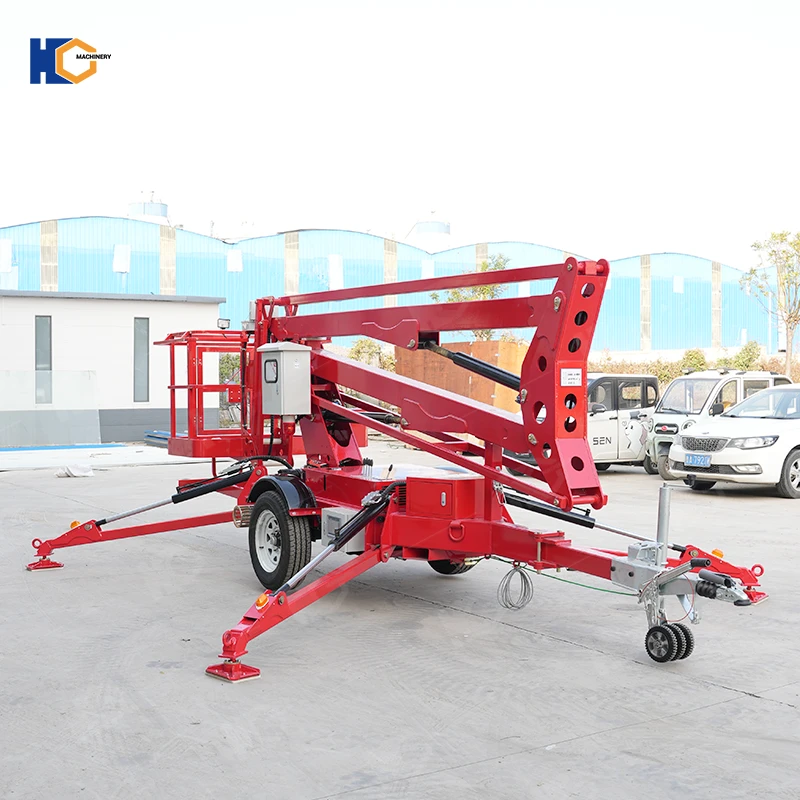
The image shows a red HuiChuang lift brand boom lift aerial work platform, model SEN, parked in an open area. The robotic arm has a clear structure, highlighting its high load-bearing capacity and flexibility. The red body stands out in the industrial setting, demonstrating its practicality.
4. Key Factors That Influence Price in 2026
1. Working Height & Outreach
Higher reach = more steel = higher cost.
Outreach is often the biggest price driver because it requires stronger booms.
2. Power System
Gasoline
Electric
Battery
Hybrid
Electric and hybrid versions cost more but reduce fuel expenses.
3. Brand Reputation
High-end Western brands cost significantly more than Asian manufacturers, but may offer:
Better resale value
Longer warranties
More refined hydraulic control
4. Safety Features
Expected in 2026:
Automatic load sensing
Tilt alarms
Advanced emergency lowering
Anti-entrapment design
More features = higher price.
5. Country of Origin
Towable booms from China are typically 30–45% cheaper than US/EU brands while maintaining competitive technology.
6. Batch Purchase Discounts
Rental companies and distributors often receive:
5–12% off for 5–10 units
15%+ for 20 units or more
5. Towable Boom Lift Price Comparison (China vs USA/EU) — 2026 Projection
| Working Height | China Factory Price (USD) | USA / EU Brand Price (USD) |
|---|---|---|
| 34–40 ft | $10,500–$14,000 | $22,000–$30,000 |
| 45–50 ft | $15,000–$20,000 | $28,000–$40,000 |
| 55–61 ft | $22,000–$28,000 | $38,000–$55,000 |
| Electric/Lithium | $26,000–$38,000 | $45,000–$62,000 |
The difference is especially large in higher-reach categories.
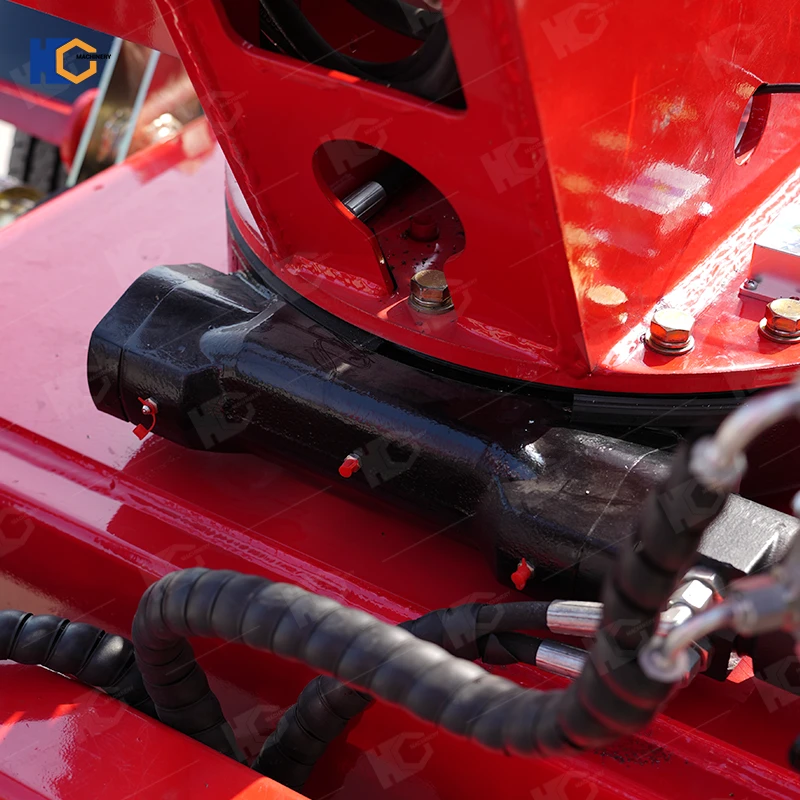
This is the key swivel joint connecting the boom and chassis of the aerial work platform. Its core function is to connect the fixed chassis and the movable boom, allowing the boom to achieve horizontal rotation and vertical luffing under hydraulic drive. It is the core motion hub that supports heavy loads, transmits power, and ensures the working range and flexibility.
6. Should You Buy or Rent in 2026?
Buy When:
You use the lift more than 80 days per year
You operate a service business or tree care company
You want full control over scheduling and maintenance
You plan to grow your equipment fleet
Rent When:
You need a boom lift only occasionally
You require multiple different height ranges
Your job locations are far apart
Typical Rental Rates (Projected for 2026):
Daily: USD 140 – 220
Weekly: USD 450 – 750
Monthly: USD 1,200 – 2,200
7. Cost of Ownership Beyond Purchase Price
Even the lowest-priced towable boom lift has operating costs. Budget for:
1. Maintenance
Annual service: USD 180–450
Hydraulic oil replacement: USD 120–300
Brake system & tires: USD 80–150
2. Battery Replacement (Electric Units)
Lithium battery packs last 6–10 years, but replacement costs in 2026 may be:
USD 1,200 – USD 2,800
3. Insurance
Commercial equipment policies run:
USD 200–400 per year
4. Operator Training
OSHA / CE-compliant training fees:
USD 50–180 per operator
8. How to Choose the Right Towable Boom Lift for 2026
When comparing models, focus on real job-site needs:
1. Working Height Requirements
Avoid buying a model that is “almost high enough.”
A lift that reaches 48 ft should not be purchased when the job requires 50 ft.
2. Outreach Needs
Outreach determines maneuverability around obstacles.
3. Surface Conditions
Towable booms work best on:
Concrete
Packed soil
Asphalt
For rough terrain, a tracked spider boom lift is more suitable.
4. Frequency of Use
If used daily or heavily, a self-propelled electric boom may be worth the extra cost.
5. After-Sales Support
Look for:
24/7 technical support
Easy spare parts supply
Local service partners
Clear 1–2 year warranties
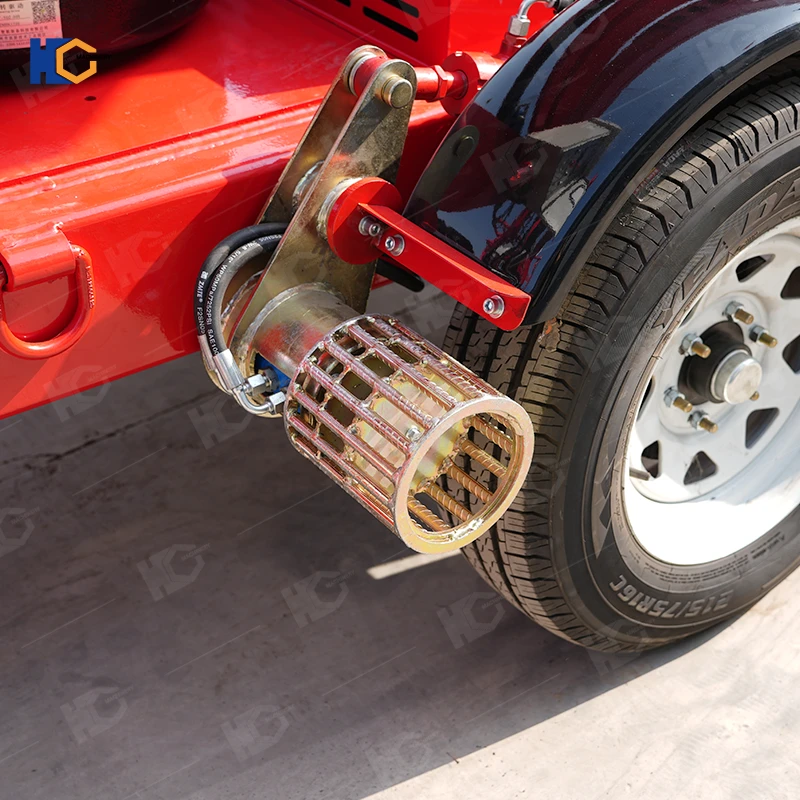
This is a close-up of the chassis and tire connection components of the Boom Lift aerial work platform. The red metal frame forms the main body of the walking mechanism, while the silver-black tire assembly includes the wheel hubs and fixing bolts. The compact and robust structure reflects its engineering load-bearing and mobility capabilities.
9. Are Towable Boom Lifts a Good Investment for 2026?
For most small businesses, towable boom lifts are one of the most affordable ways to access professional aerial work capabilities. They offer low upfront cost, easy transportation, and simple maintenance, making them ideal for contractors, rental companies, electricians, and facility managers.
With rising costs expected in 2026—mainly from materials and technology upgrades—early planning and factory-direct purchases will help secure better pricing.
Towable boom lifts remain one of the strongest ROI investments in the aerial lift market.
390.webp)
892.webp)