Custom Stationary Scissor Lift for Factory Cargo Lifting
- Lift height: 1-20m
- Load capacity: 1-100 Ton
- Brand: HUICHUANG(JNHC lift)
- Customization: YES
- Manual: YES
- Price: $1,500 – $20,000
- Payment Methods: TT
- Delivery time: 15 working days
 +8615628811021
 admin@jnhclift.com
Customized stationary scissor lift for factory cargo lifting.pdf
In modern factories, cargo does not politely stay at ground level. Raw materials arrive on pallets, semi-finished products move between production lines, and finished goods need to be transferred safely and efficiently. When forklifts are not precise enough and ramps waste space, a custom stationary scissor lift for factory cargo lifting becomes the most reliable solution.
Unlike mobile scissor lifts designed for people, stationary scissor lifts are engineered for pure lifting power, stability, and long-term industrial use. This article explains what they are, how they work, why customization matters, and how factories use them to improve workflow, safety, and productivity.
What Is a Stationary Scissor Lift?
A stationary scissor lift is a fixed vertical lifting platform installed at a specific location in a factory, warehouse, or industrial facility. It is designed to lift cargo—not people—between different heights such as floors, loading docks, conveyors, or production lines.
Key characteristics include:
- Fixed installation
- Hydraulic lifting system
- High load capacity
- Stable vertical movement
- Long service life
Once installed, it becomes part of the factory’s material handling infrastructure.
Our heavy-duty scissor lift table is engineered for reliability, safety, and versatility in demanding industrial environments. Designed to handle loads up to 4,600 kg, it offers precise vertical positioning for material handling, assembly, loading, and maintenance tasks across a wide range of sectors—from automotive manufacturing and warehousing to cold-chain logistics and mold workshops.
Why Factories Choose Stationary Scissor Lifts for Cargo Lifting
Factories operate on efficiency. Any delay or unsafe handling costs money.
Stationary scissor lifts are chosen because they:
- Reduce manual handling
- Improve workflow continuity
- Increase safety for workers
- Handle heavy and oversized cargo
- Integrate seamlessly into production lines
They lift vertically, smoothly, and predictably—exactly what industrial environments require.
Hydraulic System Performance
At the core of this lift table lies a robust dual-cylinder hydraulic drive system. Two synchronized cylinders (e.g., Φ100 mm bore) ensure smooth, vibration-free lifting even under full load. The integrated hydraulic power unit features a 4 kW three-phase electric motor (380 V), paired with a high-efficiency gear pump and precision flow control valves. Safety is prioritized through multiple redundant measures: an overload relief valve prevents pressure spikes, while a manual emergency descent valve allows controlled platform lowering during power outages. The system operates at a standard working pressure of 16 MPa and uses anti-wear hydraulic oil (ISO VG46), ensuring consistent performance and extended service life under continuous operation. All hydraulic hoses are rated for high-pressure industrial use and routed through protective conduits to minimize wear and exposure.
Structural Integrity & Material Quality
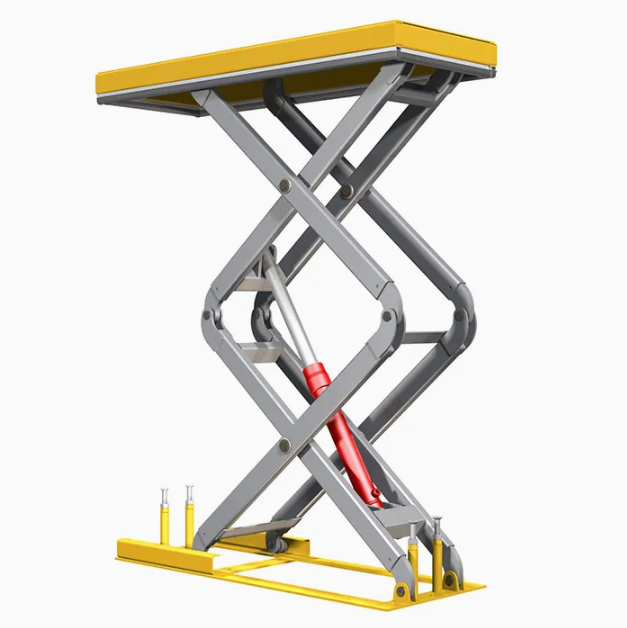 The frame is constructed from high-strength low-alloy steel (equivalent to Q345B grade), welded using certified procedures to maximize load-bearing capacity and fatigue resistance. Critical joints undergo stress analysis during design to eliminate weak points. The work platform is made of 5 mm thick diamond-plate steel, providing excellent slip resistance (coefficient ≥ 0.6) for pallets, carts, or personnel. All structural surfaces are treated with abrasive blasting followed by a two-layer coating system—epoxy zinc-rich primer and polyurethane topcoat—delivering superior corrosion protection suitable for indoor and mildly humid environments. Optional stainless steel platforms (304/316L) are available for hygienic or corrosive settings.
The Importance of Customization
No two factories are the same. Cargo sizes, weights, lifting heights, and space constraints vary widely. That’s why custom stationary scissor lifts outperform standard models in real-world applications.
Customization allows the lift to match:
- Exact load capacity
- Required lifting height
- Platform dimensions
- Pit or surface installation
- Power supply specifications
- Safety standards and controls
A custom solution avoids compromises and future operational headaches.
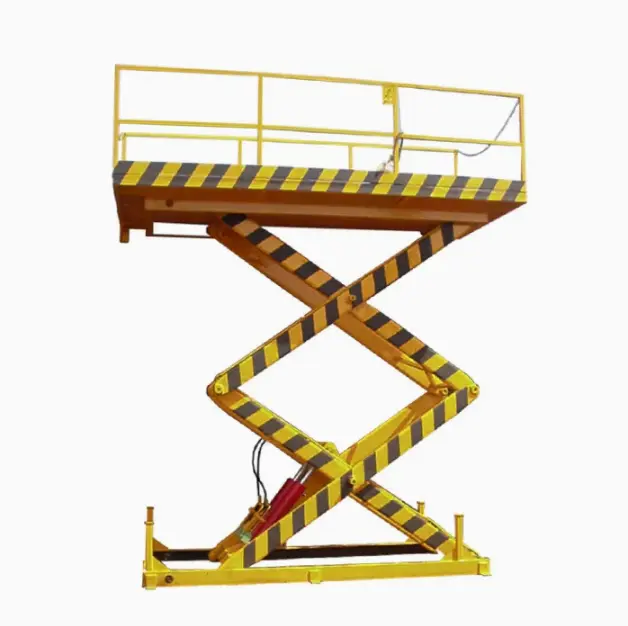 Customization Flexibility
While standard models cover common needs, we offer extensive customization to match unique operational requirements:
- Platform modifications: integrated roller conveyors, chain-driven transfers, side-tipping mechanisms, or built-in weighing scales.
- Environmental adaptations: stainless steel construction (304/316L) for food/pharma applications, explosion-proof motors (ATEX-ready design), or low-temperature lubrication systems for freezer warehouses (down to -30°C).
- Smart control options: PLC-based multi-position memory, barcode-triggered height recall, or remote diagnostics via Ethernet/IP or Modbus interfaces. Custom platform sizes (up to 3m x 2m) and lift heights (up to 6m) are also feasible upon request.
Common Applications in Factory Cargo Lifting
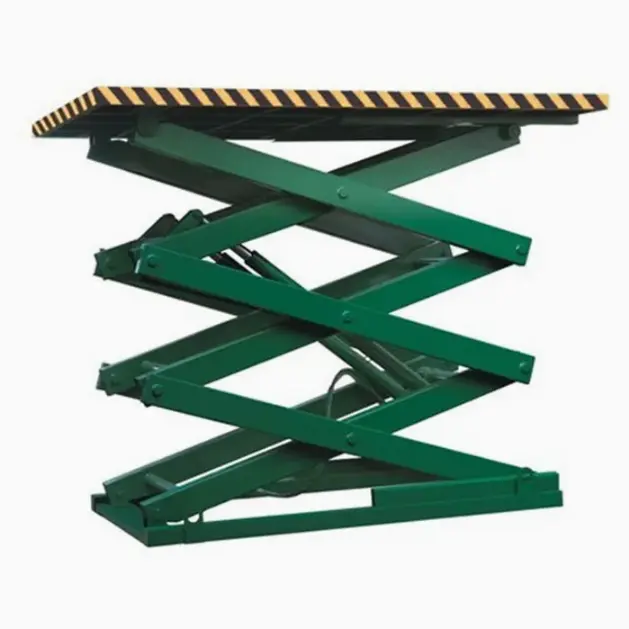 Production Line Material Transfer
Stationary scissor lifts are used to transfer materials between:
- Different production stages
- Conveyor systems
- Assembly stations
They ensure smooth vertical flow without disrupting horizontal processes.
Warehouse and Storage Operations
In warehouses, these lifts move:
- Pallets
- Crates
- Bulk materials
They are often installed near storage racks or mezzanine floors.
Loading and Unloading Zones
At loading docks, stationary scissor lifts bridge height differences between:
- Factory floors and trucks
- Indoor and outdoor platforms
They improve loading speed and reduce forklift dependency.
Heavy Equipment Handling
Custom heavy-duty scissor lifts handle:
- Machinery components
- Molds
- Dies
- Industrial equipment parts
Precision lifting reduces risk during installation and maintenance.
Load Capacity Options
One of the main advantages of stationary scissor lifts is their high load capacity.
Typical ranges include:
- 500 kg
- 1,000 kg
- 2,000 kg
- 3,000 kg
- 5,000 kg or more (custom design)
The structure, hydraulic cylinders, and safety systems are engineered specifically for the rated load.
Lifting Height Range
Stationary scissor lifts can be designed for:
- Low lifting heights (0.5–1.5 meters)
- Medium heights (2–4 meters)
- High vertical travel (custom multi-stage designs)
The required height directly affects scissor arm design and hydraulic configuration.
Platform Size and Design
Platform size is fully customizable to match cargo dimensions.
Options include:
- Standard rectangular platforms
- Extended platforms for long cargo
- Reinforced steel decking
- Anti-slip surface treatment
- Roller or conveyor integration
A well-designed platform improves both safety and efficiency.
Stationary scissor lift price:
stationary scissor lift is a customized product, so the parameters are different and the price of the machine will be different. The price range of the machine is approximately between 1000 USD and 10000 USD.
For example:
Platform size is 1200*2400mm
Load is 4600kg
Lifting height is 3m
Platform thickness is 5mm
oil cylinders: 2* Φ100
Pump station: 4KW
Price: 4500USD based on FOB Qingdao port
Stationary scissor lift warranty:
1.Spare parts with the machine.
2.One-year free warranty, we undertake all charges. Apart from man-made fault.
3.Free spare parts in 3 years, but after one year customer should undertake freight cost. Apart from man-made fault.
4. Life time technical support.
How to get the quote of stationary scissor lift:
If you are interested in this product, please let me know the details as below:
Lifting height:
Platform size:
Load:
And then we will make a detailed plan for you.
Hydraulic System: The Core of the Lift
Stationary scissor lifts rely on hydraulic power, which provides:
- Smooth lifting
- High load capacity
- Reliable operation under continuous use
High-quality systems include:
- Precision hydraulic cylinders
- Stable power units
- Controlled lifting and lowering speed
- Emergency lowering capability
Hydraulics are ideal for industrial cargo lifting because they prioritize force and control over speed.
Safety Features for Factory Environments
Safety is not optional in factories. Custom stationary scissor lifts are equipped with multiple safety mechanisms, such as:
- Overload protection
- Emergency stop buttons
- Safety limit switches
- Hydraulic hose burst valves
- Mechanical safety locks
- Anti-fall protection
These features ensure compliance with industrial safety standards and protect both workers and cargo.
Comprehensive Safety Features
Safety is not an add-on but an integral part of the design. The lift includes:
- Mechanical locking pins that automatically engage at each preset height, offering physical support independent of the hydraulic system.
- Hydraulic burst protection valves on all cylinder lines, which instantly seal the circuit if a hose fails, preventing uncontrolled descent.
- Electronic overload detection: A pressure sensor monitors real-time load; if exceeding 4,600 kg, the control system disables upward movement and triggers audible/visual alarms.
- Dual limit switches (mechanical + electronic) at both upper and lower travel extremes prevent over-extension or hard impacts.
Additionally, the control panel features an emergency stop button with latching function, and all electrical components are housed in an IP54-rated enclosure to protect against dust and splashing water.
Pit Installation vs Surface Installation
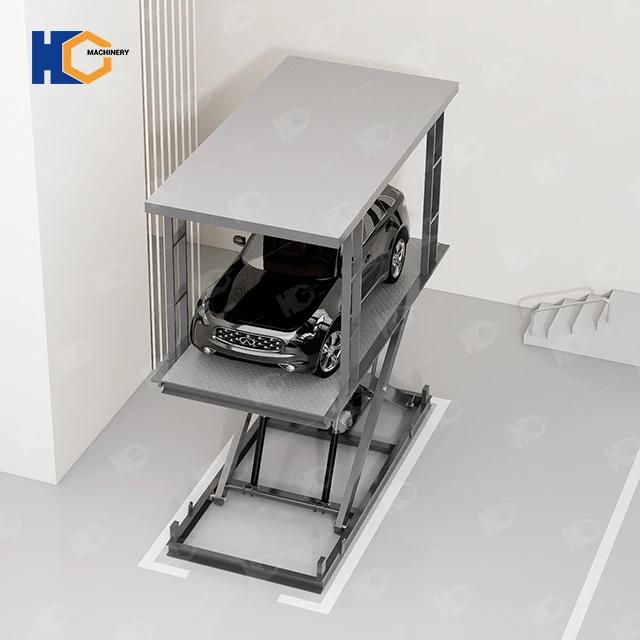
Pit-Mounted Stationary Scissor Lift
- Platform is flush with the floor when lowered
- Ideal for smooth cargo transfer
- Requires civil construction work
Surface-Mounted Stationary Scissor Lift
- Installed directly on the floor
- Faster installation
- Suitable where pits are not feasible
The choice depends on site conditions and operational needs.
Power Supply Options
Most stationary scissor lifts use:
- 380V / 3-phase industrial power
- 220V options for lighter loads
Power configuration can be customized to match local electrical standards.
Durability and Long-Term Performance
Stationary scissor lifts are built for continuous industrial operation.
Durability features include:
- High-strength steel structure
- Precision welding
- Corrosion-resistant coatings
- Industrial-grade components
With proper maintenance, service life often exceeds 10–15 years.
Maintenance Requirements
Maintenance is straightforward and predictable:
- Regular hydraulic oil checks
- Periodic inspection of pins and joints
- Electrical system inspection
- Safety device testing
Compared to complex conveyor systems or automated cranes, maintenance costs are relatively low.
Hydraulic oil change every 500 operating hours (~20 liters), periodic greasing of pivot points, and annual inspection of seals and electrical connections. Wear parts (e.g., seals, filters) are low-cost and readily available. Compared to alternatives like forklifts (high labor/fuel costs) or freight elevators (mandatory annual inspections), this scissor lift reduces total cost of ownership by over 40% over a five-year period. Its simple mechanical design also means fewer failure points and easier troubleshooting by in-house technicians.
Stationary Scissor Lift vs Other Cargo Lifting Solutions
vs Forklifts
- More precise vertical lifting
- Less operator dependency
- Improved safety in fixed locations
vs Cargo Elevators
- Lower cost
- Faster installation
- Simpler structure
vs Ramps
- Saves floor space
- Handles heavy loads efficiently
- Improves ergonomics
Each solution has its place, but stationary scissor lifts excel in fixed vertical lifting tasks.
Cost Factors for Custom Stationary Scissor Lifts
Pricing depends on:
- Load capacity
- Lifting height
- Platform size
- Custom safety features
- Installation type
While custom models cost more than standard units, they deliver better performance and long-term value.
Real-World Applications
In an automotive transmission plant, the lift bridges AGVs and CNC machines at 3-meter height, improving workflow efficiency by 30%.
A frozen food distribution center uses a stainless-steel version to move pallets in -25°C environments, where condensation resistance is critical.
A large-scale mold manufacturer relies on the 5-ton model for safe, millimeter-precise positioning of injection molds during crane-assisted assembly.
Other common uses include truck loading docks, mezzanine access, aircraft maintenance stands, and packaging lines requiring ergonomic height adjustment.
Commitment to Responsible Engineering
While specific regulatory certifications may vary by market, our design philosophy adheres to internationally recognized principles for industrial lifting equipment. Every unit undergoes rigorous factory acceptance testing—including 72-hour continuous cycle tests and 125% overload validation—before shipment. We actively collaborate with clients to provide technical documentation and configuration support tailored to local safety standards or facility requirements. Our engineering team can also assist with risk assessments or integration into larger automated systems.
Global Support & Delivery
Standard lead time is 15 working days, including pre-delivery performance verification. Comprehensive user manuals (in English and other languages) and installation videos are provided. Our after-sales team guarantees a response within 48 hours for technical inquiries, with spare parts available worldwide through regional partners. On-site commissioning and operator training services are also available upon request.
Why Custom Solutions Deliver Better ROI
A custom stationary scissor lift:
- Fits perfectly into your workflow
- Reduces downtime
- Improves safety compliance
- Minimizes manual labor
- Extends equipment lifespan
Over time, the efficiency gains often outweigh the initial investment.
Final Thoughts
A custom stationary scissor lift for factory cargo lifting is more than a piece of equipment. It is an infrastructure upgrade that improves safety, efficiency, and material flow throughout your facility.
By tailoring load capacity, lifting height, platform size, and safety features to your exact needs, factories gain a lifting solution that works quietly, reliably, and consistently—day after day.
In industrial environments, the best lifting system is not the fastest or the flashiest.
It is the one that lifts heavy cargo safely, every single time.
If you are looking to purchase a high-quality, affordable scissor lift, please feel free to contact us for a quote.
 Room 203, Second Floor, Building 8, Phase Ⅱ, Zhizao Town, Jibei Street, Jiyang District, Jinan City, Shandong Province