
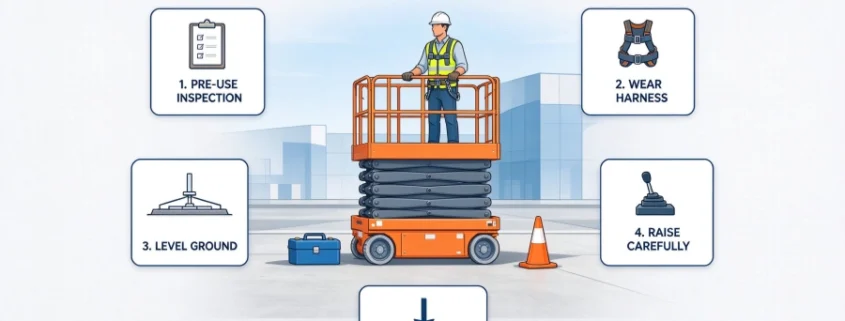
How to Operate a Scissor Lift: Step-by-Step Guide
Operating a scissor lift requires more than knowing which button raises the platform. Operators must understand the machine’s controls, inspect its condition, assess the worksite, calculate the platform load, and recognize hazards that could lead to falls, tip-overs, crushing injuries, or electrical accidents.
For construction contractors, warehouses, factories, industrial maintenance teams, and equipment rental companies, a consistent operating procedure helps improve productivity and reduce avoidable downtime.
A scissor lift is a mobile elevating work platform (MEWP) that raises workers and their tools primarily in a vertical direction using a crossed-arm lifting mechanism. Electric models are commonly used indoors, while suitable rough-terrain models can serve specified outdoor applications.
This guide explains how to operate a scissor lift step by step, from pre-operation inspections to raising, moving, lowering, parking, and responding to emergencies. It also covers the responsibilities of supervisors and fleet managers who need reliable operating practices across multiple machines and job sites.
The essential rule is to follow the operating manual for the exact model. Control layouts, elevated-travel permissions, wind limits, load capacities, emergency-lowering systems, and other restrictions vary between machines. General guidance cannot replace model-specific training or applicable workplace regulations.
1. Understand the Scissor Lift Before Operating It
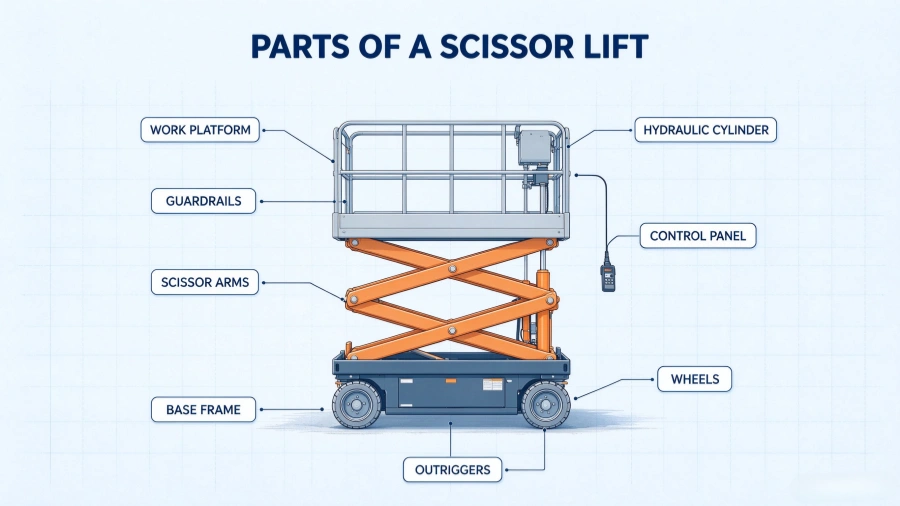
Before starting a scissor lift, the operator should understand its main components and what they do.
| Component | Function | What the operator should know |
|---|---|---|
| Work platform | Supports workers, tools, and permitted materials | Understand its rated capacity, dimensions, and occupancy limits |
| Guardrails and access gate | Help protect occupants from falling | Check that all required protective components are installed and secured |
| Scissor mechanism | Raises and lowers the platform | Keep clear of moving arms and potential pinch points |
| Platform control panel | Provides operating controls from the platform | Learn the model-specific functions, indicators, and emergency stop |
| Ground control panel | Provides controls from ground level | Identify the controls used for authorized ground operation and recovery |
| Drive and steering system | Moves the machine around the workplace | Understand steering response, braking, travel speed, and permitted surfaces |
| Emergency-lowering system | Allows the platform to be lowered under specified emergency conditions | Know its location and the exact recovery procedure |
| Battery or power system | Supplies energy to the machine | Check its condition and follow the manufacturer’s charging requirements |
Some machines include additional features such as pothole protection, tilt alarms, load-sensing systems, and platform-extension decks. These features must not be treated as substitutes for proper inspection or safe operation.
Why model-specific familiarization matters
Two scissor lifts may have similar lifting heights but different control arrangements, driving capabilities, and operating restrictions.
An operator who understands one machine may still need familiarization with another model before using it. The International Powered Access Federation (IPAF) distinguishes general operator training from familiarization with the actual equipment.
For employers, this means training records alone are not enough. Operators should also understand the specific machine assigned to the job. See IPAF’s operator training and familiarization guidance.
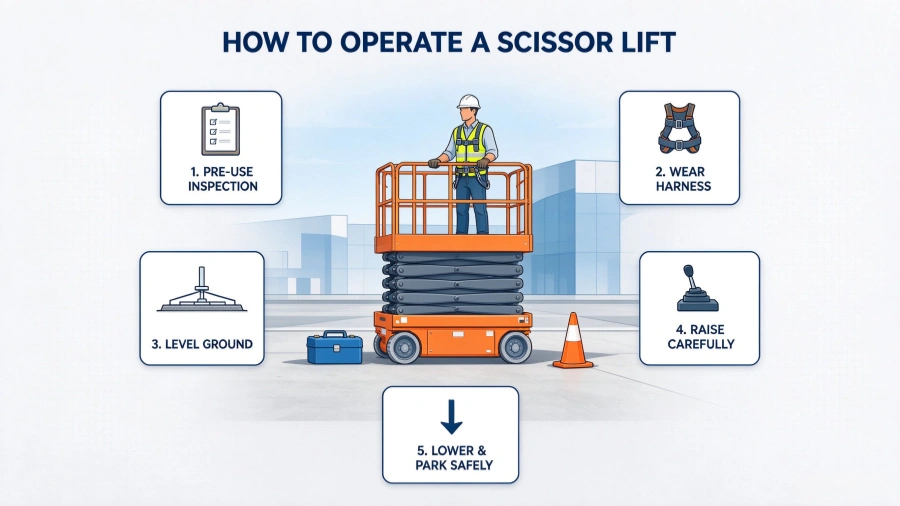
2. Complete Operator Training and Worksite Planning
Before operating a scissor lift, confirm that the worker has the required training, authorization, and familiarity with the equipment.
The work supervisor should also evaluate whether the machine is suitable for the planned task.
Step 1: Confirm operator competence
The operator should know how to:
Use the ground and platform controls.
Raise and lower the platform correctly.
Drive, steer, stop, and reposition the machine within its permitted operating conditions.
Identify inspection failures and stop using defective equipment.
Recognize fall, crushing, electrical, and stability hazards.
Use the emergency-lowering system as specified by the manufacturer.
Follow the workplace rescue and emergency procedures.
Training and authorization requirements depend on the applicable jurisdiction, industry, and site rules. A written guide or online video is not a substitute for required practical instruction and assessment.
Step 2: Assess the work task
Before choosing the machine’s position, establish the required platform height, the work area, and the materials that will be carried.
For example, a warehouse lighting installation may require a platform that can fit between storage aisles. An industrial maintenance job may require closer attention to overhead pipework, machinery, and potential entrapment points.
The supervisor should identify:
Required working height and platform position.
Total weight of workers, tools, and materials.
Doorways, aisles, turning space, and overhead clearances.
Floor or ground conditions.
Nearby vehicles, pedestrians, and other equipment.
Electrical hazards and overhead obstructions.
Environmental conditions, including wind and temperature.
The plan for emergency recovery if the platform cannot be lowered normally.
This assessment helps determine whether the chosen scissor lift can complete the job without creating unnecessary operating risks.
3. Perform a Pre-Operation Scissor Lift Inspection
A pre-use inspection should be completed before each shift or at the frequency required by the manufacturer’s instructions and applicable regulations. IPAF’s pre-use inspection guidance emphasizes checking equipment before use to help ensure it is safe for the operator and other workers.
A walk-around inspection should be followed by the prescribed function tests.
Step 3: Inspect the machine’s exterior
Begin with the platform lowered and the machine in the inspection condition specified by the manufacturer.
Check the following:
Platform and guardrails: Look for damaged rails, missing components, loose fasteners, damaged flooring, defective gates, and other conditions that could affect safe access or fall protection.
Scissor arms and structure: Look for visible cracks, deformation, damaged welds, abnormal wear, or signs of unauthorized repairs. Never place your hands or body between moving scissor arms.
Wheels and tires: Check for cuts, damage, loose wheel components, and other defects relevant to the machine’s design.
Hydraulic system: Look for visible fluid leaks, damaged hoses, or other indications of hydraulic problems.
Electrical system and battery: Check visible wiring, connectors, battery condition, charging connections, and relevant warning indicators.
Controls and safety devices: Inspect emergency-stop controls, control labels, alarms, interlocks, and protective systems specified for the model.
Labels and documentation: Confirm that the rated-capacity information, warning labels, and required operating instructions are present and legible.
Ground-control and emergency-lowering systems: Verify their condition and function according to the prescribed test procedure.
Not every component can be fully assessed through a visual inspection. Any additional inspection, function testing, or maintenance must follow the manufacturer’s requirements.
Step 4: Test the controls and safety functions
After the walk-around inspection, perform the specified function checks in the designated safe area.
Verify the functions applicable to the particular machine, which may include:
Forward and reverse travel.
Steering and braking.
Raising and lowering.
Platform and ground controls.
Emergency-stop operation.
Audible alarms and warning indicators.
Emergency or auxiliary lowering.
Model-specific interlocks and protective devices.
Test each function in accordance with the operator’s manual. Keep people away from moving parts and the potential movement path.
If a control does not respond normally, an alarm behaves unexpectedly, or a safety function fails, do not operate the machine until the problem has been assessed and the equipment has been cleared for use.
Operators should report the defect, follow their workplace isolation or lockout procedure where applicable, and prevent unauthorized use.
4. Position the Scissor Lift on Suitable Ground
Correct positioning is essential because an elevated scissor lift can become unstable if the ground, slope, load, or operating conditions exceed its permitted limits.
Step 5: Choose a suitable operating location
Move the machine to an area that meets the manufacturer’s requirements for surface condition and stability before raising the platform.
Confirm that the location has:
Sufficient load-bearing capacity.
A surface within the machine’s permitted slope limits.
No unsafe holes, drop-offs, loose debris, or unexpected obstructions.
Adequate space for the platform to rise without contacting overhead objects.
Sufficient clearance from electrical hazards.
Protection from vehicle traffic or pedestrian interference where necessary.
Do not assume that a concrete floor is automatically suitable. Elevated machinery can impose significant loads, and floors may have load restrictions, openings, or concealed weaknesses.
Likewise, do not assume that every outdoor scissor lift is suitable for sand, soft ground, or uneven construction surfaces. The model’s terrain capability must be checked against actual site conditions.
Step 6: Establish the work zone
Where necessary, use barriers, signs, traffic controls, and a designated spotter to prevent people or vehicles from entering the machine’s operating area.
Pay particular attention to locations near:
Forklift routes and warehouse aisles.
Loading bays and vehicle entrances.
Fixed machinery and structural beams.
Doorways and low ceilings.
Pedestrian walkways.
Power lines and electrical equipment.
A spotter should be trained in the agreed communication method and positioned where they can observe relevant hazards without entering a dangerous area.
The operator remains responsible for stopping the movement if the path is unclear or a hazard develops.
5. Enter the Platform and Prepare the Load
Step 7: Access the platform safely
Make sure the platform is in its designated access position, normally fully lowered, before entering.
Use the built-in steps or access points and maintain appropriate contact while entering or exiting. Do not climb the scissor mechanism or use improvised access arrangements.
Once inside:
Ensure the access gate is closed and secured as designed.
Confirm that required guardrails are in place.
Keep both feet on the platform floor.
Place tools and materials so that they cannot fall or move unexpectedly.
Confirm that all occupants understand the operating plan and communication method.
Do not stand on guardrails, boxes, ladders, or other objects to gain additional height. Do not lean excessively beyond the guardrails to reach a task.
Step 8: Check the platform load
Calculate the total load before raising the platform.
Suppose a maintenance team has two workers weighing 165 kg combined, tools weighing 40 kg, and materials weighing 55 kg.
The total load is:
The machine must be rated for that total load in the intended configuration, while also satisfying its occupant limits, load-distribution requirements, and any restrictions on an extended platform.
Never overload the platform, and do not attach tools or materials to guardrails unless the manufacturer explicitly provides for the relevant arrangement.
Load capacity is not simply a matter of the total weight. The number of occupants, material distribution, platform extensions, and operating conditions can all affect permitted use.
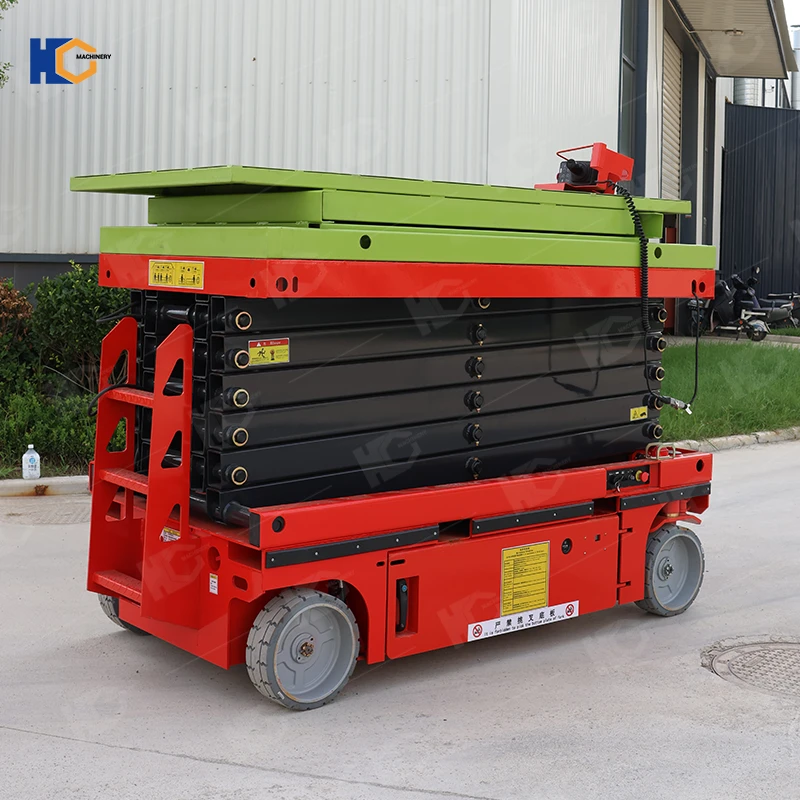
6. Start and Operate the Scissor Lift Controls
Step 9: Select the correct control station
Scissor lifts commonly have a ground control station and a platform control station. The precise startup sequence differs by manufacturer and model.
Before using either station:
Read the machine’s startup instructions.
Identify the main power or key selector, as applicable.
Locate the emergency-stop controls.
Understand how the machine selects ground or platform operation.
Confirm that no one is in a position where movement could cause injury.
Follow the model’s prescribed startup procedure rather than assuming that every scissor lift uses the same control sequence.
Step 10: Operate the platform controls
Once the required checks are complete and the machine is in the correct operating mode, use the designated controls to raise or lower the platform.
Depending on the model, the operator may need to activate an enable switch or trigger while selecting a function. Some machines use joysticks, while others use separate buttons or different control arrangements.
Operators should understand the particular controls before beginning elevated work.
Use smooth, controlled inputs. If movement does not match the expected response, release the control, stop, and investigate according to the manual.
Do not bypass an interlock or warning system to force the machine to operate.
7. Raise the Platform to the Required Working Height
Step 11: Confirm the area above the platform is clear
Before raising the lift, inspect the entire intended movement path.
Look for beams, ceilings, pipes, cables, sprinklers, machinery, and other objects that could collide with the platform or trap occupants.
Check for people or equipment moving nearby. Pay particular attention to crushing hazards between the rising platform and fixed structures.
If an overhead obstruction could interfere with the job, change the position or operating plan rather than attempting to work around an unsafe clearance.
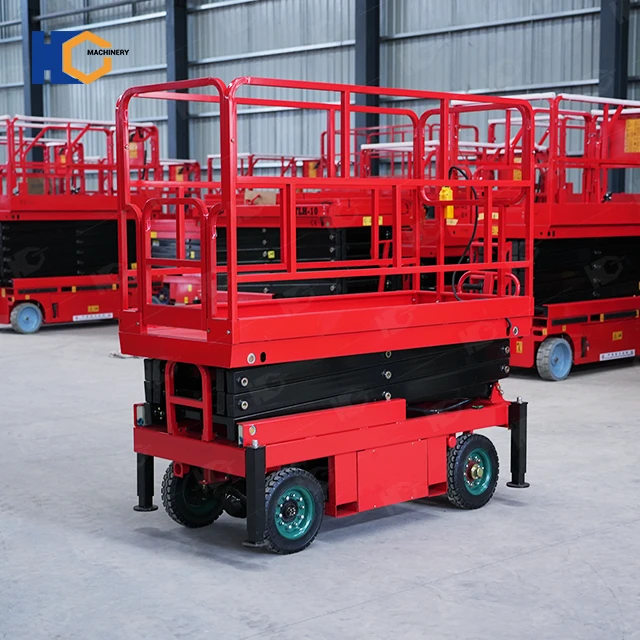
Step 12: Raise the platform in a controlled manner
Once the area is clear and all conditions are suitable:
Confirm that the machine is within its permitted operating limits.
Check that the required occupant and load limits are satisfied.
Use the designated elevation control according to the operator’s manual.
Monitor the platform’s movement and the surrounding area.
Stop the operation if instability, unexpected movement, an alarm, or a developing hazard is observed.
Do not attempt to speed up lifting by altering the machine, defeating a safety device, or using another machine to raise the platform.
Never use a forklift, crane, or other improvised method to lift the scissor platform unless the equipment and procedure are specifically designed and authorized for that purpose.
8. Work Safely While the Platform Is Elevated
Reaching the required height does not remove the need to monitor the work environment.
Step 13: Maintain a safe working position
Once elevated, occupants should:
Keep their feet on the platform floor.
Work within a comfortable reach.
Keep the platform gate secured.
Avoid leaning outside the guardrails.
Keep hands and body parts away from pinch points.
Secure tools and materials as required.
Observe the machine’s load limits and operating instructions.
Use fall-protection equipment when required by the applicable rules, manufacturer’s instructions, and site risk assessment. Guardrails must remain correctly installed and functional. Do not assume that a personal fall-arrest system is universally required or universally sufficient for every scissor lift; the correct arrangement depends on the equipment and applicable requirements.
Step 14: Monitor weather and environmental conditions
Outdoor operation requires particular attention to wind, ground conditions, and the machine’s rated operating limits.
Strong winds can destabilize an elevated platform. Operators must follow the maximum permitted wind speed and other weather restrictions specified for the actual model.
Also monitor changes such as:
Sudden wind gusts.
Rain or water affecting traction.
Softening ground.
Nearby vehicle movements.
Changing overhead hazards.
Excessive temperature or other conditions outside the machine’s permitted range.
If conditions become unsafe, stop the work and follow the manufacturer’s procedures for lowering and securing the machine.
Step 15: Keep communication available
For jobs that require coordination with workers on the ground, use an agreed communication method.
This is particularly important where the operator cannot see the full travel path, where other machinery is operating nearby, or where an emergency could require assistance from ground personnel.
For fleets and large job sites, supervisors should establish clear responsibilities for the operator, ground observer, and emergency rescue personnel before the machine is raised.
9. Drive or Reposition the Scissor Lift
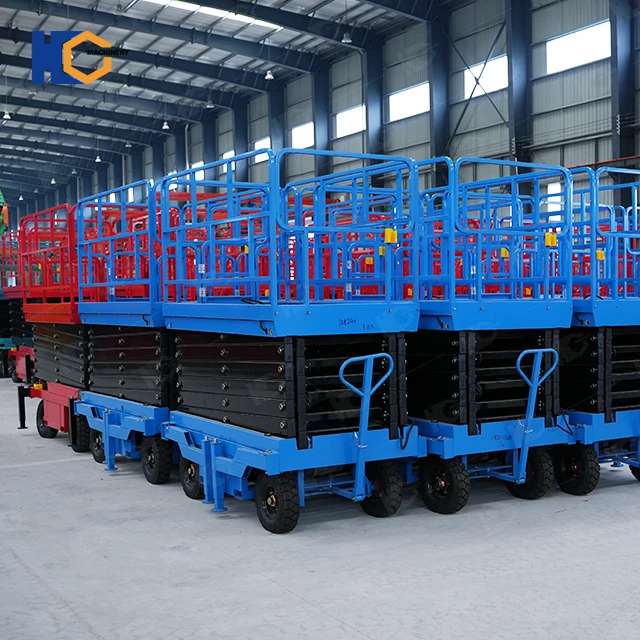
Driving is one of the areas where operators must pay especially close attention to model-specific instructions.
Some scissor lifts permit travel with the platform elevated within defined height, speed, surface, and other restrictions. Other machines or operating conditions prohibit it.
Never assume that an elevated scissor lift can be driven. Follow the exact manufacturer’s instructions, including any requirements for the platform to be lowered before travel.
Step 16: Prepare before moving the machine
Before moving:
Confirm whether travel is permitted in the current platform position.
Check the intended route for holes, slopes, debris, drop-offs, and obstructions.
Verify overhead clearance and the turning path.
Ensure that people are clear of the wheels and movement path.
Check that the travel path is suitable for the machine and its current configuration.
If the machine must be lowered before travel, lower it fully using the approved procedure before moving.
Step 17: Travel at a controlled speed
When travel is permitted, operate slowly enough to maintain control and respond to changing conditions.
Watch for pedestrians, vehicles, blind corners, and objects that could cause the machine to strike a structure or lose stability.
Use a trained spotter when visibility is restricted or the site risk assessment requires one. Stop if the route becomes unsafe or the operator cannot confirm that the path is clear.
Never use the machine’s elevated platform as a means of reaching another location by driving across unsuitable ground.
Step 18: Reposition and re-evaluate
If the work location changes, assess the new position before continuing.
Check the ground, access route, overhead hazards, load, and nearby activities. A location that was safe for one part of the task may not be suitable for the next.
In busy industrial environments, this reassessment can help prevent collisions, trapping incidents, and unnecessary machine downtime.
10. Lower the Platform and Exit Safely
Step 19: Prepare for lowering
Before lowering the platform:
Confirm that the area below is clear of people and objects.
Check the lowering path for obstructions.
Ensure tools and materials are secure.
Alert nearby workers when necessary.
Keep occupants clear of moving mechanisms and pinch points.
Step 20: Lower the platform smoothly
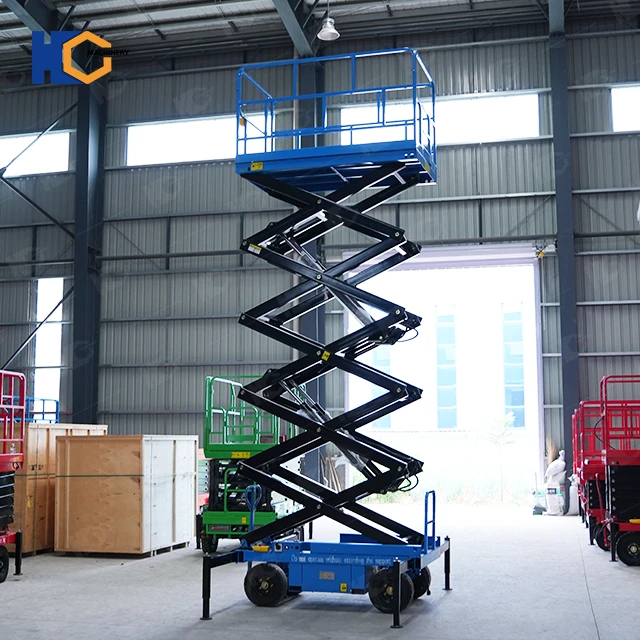
Use the prescribed lowering control to return the platform to its access position.
Monitor the platform throughout the descent. If it stops unexpectedly, an alarm activates, or an obstruction becomes apparent, follow the applicable stop and recovery procedure.
Do not reach into the scissor mechanism or try to clear an obstruction while the platform is moving.
Step 21: Exit only when safe
After the platform has reached its approved access position, follow the manufacturer’s entry and exit procedure.
Secure any tools and materials, leave using the designated access point, and avoid climbing over the guardrails.
If the lift needs to be moved to another task, repeat the route assessment and travel procedure before doing so.
11. Park, Shut Down, and Charge the Scissor Lift
Correct shutdown helps protect the machine and reduces risks when it is left unattended.
Step 22: Park the machine correctly
When the job is complete:
Lower the platform to the designated stowed position.
Move to an authorized parking area on suitable ground.
Apply the parking or securing procedure specified by the manufacturer.
Place the controls and power system in the prescribed shutdown condition.
Remove the key or otherwise prevent unauthorized operation, where applicable.
Leave the equipment in a condition that does not obstruct traffic or emergency access.
Do not leave the machine elevated or unsecured in a location where it could create a hazard.
Step 23: Inspect and report issues after use
Check for new damage, leaks, unusual noises, depleted batteries, or other problems observed during operation.
Report defects according to the company procedure. Any issue that could affect safety should be assessed before the lift is returned to service.
For rental companies and fleet operators, recording operating hours, damage reports, and maintenance needs helps improve traceability and reduce repeated failures.
Step 24: Charge the battery according to the manual
For electric scissor lifts, use the charging equipment and process approved for the battery type.
Check the charging location, ventilation requirements where applicable, connector condition, and any temperature-related restrictions. Follow the manufacturer’s instructions for lead-acid, lithium-ion, or other fitted battery systems.
Do not use an incompatible charger or continue charging equipment with damaged electrical components.
12. What Should You Do If a Scissor Lift Stops Working at Height?
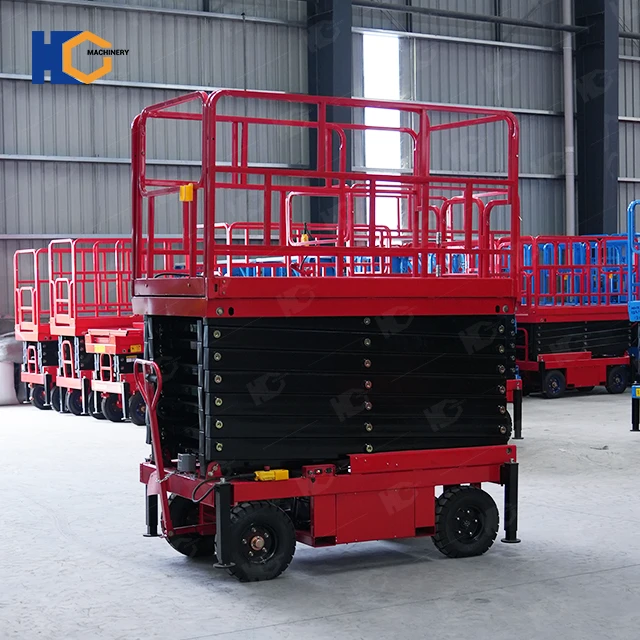
A machine that stops responding while elevated requires a controlled recovery, not an improvised rescue.
Potential causes include a depleted battery, technical failure, overloaded platform, trapped platform, or an operator becoming incapacitated.
Step 25: Stop and assess the situation
If the platform stops unexpectedly:
Stop operating the controls and assess immediate hazards.
Communicate with the ground personnel or supervisor.
Keep occupants in a safe position within the platform, where it is safe to do so.
Identify the emergency procedure for that specific machine.
Activate the documented rescue or recovery plan.
Do not force a failed control, bypass a safety interlock, or attempt to climb down the scissor mechanism.
Step 26: Use the approved emergency-lowering procedure
Scissor lifts may have ground controls and emergency or auxiliary lowering systems. Their design and operating sequence vary.
A trained, designated ground-rescue person should follow the manufacturer’s procedure and the site’s rescue plan. The plan should account for the machine’s position, the occupants’ condition, overhead hazards, and whether lowering could create additional risks.
IPAF recommends that a documented recovery and rescue plan be established, understood, and rehearsed before work at height begins. It also recommends confirming that designated rescue personnel can communicate with the platform occupants and access the relevant ground controls. See IPAF’s Recovery and Rescue Plans guidance.
If normal ground controls or emergency lowering do not work, contact the supervisor and the supplier or qualified service personnel. Emergency recovery should not be improvised by untrained staff.
Step 27: Respond appropriately to electrical contact or entrapment
If the lift contacts an electrical source, occupants should follow the site’s electrical emergency procedure, avoid contacting the source or nearby conductive objects, and alert the relevant emergency personnel. Do not approach the machine until the hazard has been assessed and the electrical source has been made safe by qualified personnel.
If an occupant is trapped against an overhead structure, stop the relevant movement immediately and activate the established rescue procedure. Do not continue moving the platform in a way that could worsen the entrapment.
After any incident or suspected safety-system failure, the equipment must be assessed and cleared before being returned to service.
13. Common Scissor Lift Operating Mistakes to Avoid
For B2B employers, avoiding recurring mistakes is an important part of maintaining productivity and workplace safety.
| Common mistake | Why it matters | Better practice |
|---|---|---|
| Operating without model familiarization | Controls and restrictions vary between machines | Train and authorize operators for the equipment they will use |
| Skipping pre-use checks | Defects may remain undetected | Complete and document inspections at the required frequency |
| Overloading the platform | Can exceed the machine’s permitted operating limits | Calculate the total load and check capacity restrictions |
| Driving while elevated without permission | Can create a stability or collision hazard | Follow the model’s elevated-travel rules |
| Using the lift on unsuitable ground | May compromise stability | Assess surface strength, level, slopes, and obstructions |
| Standing on guardrails or improvised supports | Increases fall risk | Keep feet on the platform and work within safe reach |
| Ignoring wind restrictions | May make elevated operation unsafe | Follow the manufacturer’s operating limits |
| Operating near unprotected traffic | Creates collision and crushing hazards | Establish a controlled work zone |
| Bypassing safety devices | Removes intended protection | Stop work and have defects assessed by qualified personnel |
| Starting work without a rescue plan | Can delay recovery after a malfunction | Designate ground rescue personnel and rehearse procedures |
Safety procedures should be practical enough for operators to follow consistently, while allowing supervisors to verify that inspections and worksite controls have actually been completed.
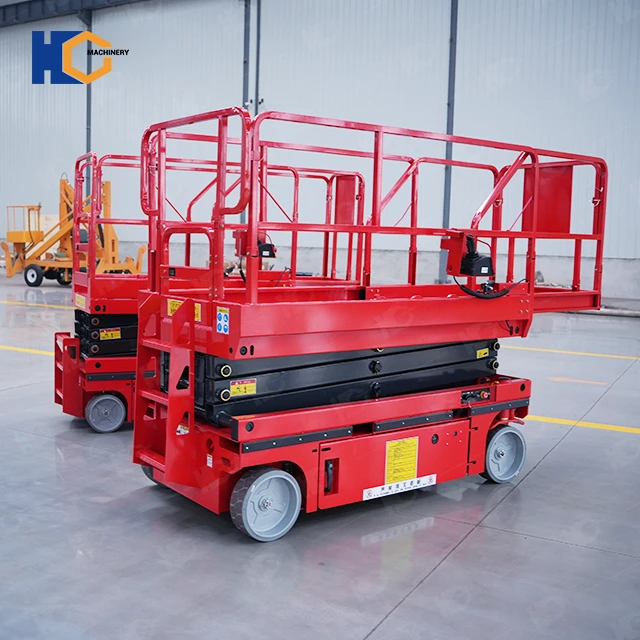
14. How B2B Companies Can Standardize Scissor Lift Operation
For businesses that own or rent multiple machines, safe operation should be part of a documented equipment-management system rather than an informal instruction passed between operators.
For construction contractors
Provide task-specific risk assessments, confirm the machine suits the working height and terrain, control nearby vehicle traffic, and assign clear responsibility for emergency recovery.
For warehouse and factory operators
Pay particular attention to aisle dimensions, overhead obstructions, floor-loading restrictions, forklift traffic, pedestrian routes, and indoor charging arrangements.
For equipment rental companies
Supply the correct operating manual, identify model-specific restrictions, document the machine’s condition, and ensure customers understand the relevant controls and emergency procedures. Rental handover should include appropriate familiarization rather than relying solely on the customer’s previous experience.
For fleet managers
Maintain records of pre-use inspections, defects, maintenance, operating hours, repairs, and operator authorization. Review recurring failures and near misses to identify where training, equipment selection, or worksite planning needs improvement.
For purchasing departments
When evaluating a scissor lift, check more than the price and maximum platform height. Confirm that the machine’s load rating, platform size, travel capability, safety systems, operating environment, manuals, spare parts, and service arrangements meet the intended application.
A lower purchase price does not compensate for equipment that is unsuitable for the work or difficult to maintain.
15. Scissor Lift Operating Checklist for Supervisors
The following checklist can help site managers and equipment owners verify that the essential operating steps have been addressed.
This checklist is intended as a general management aid. It should be adapted to the specific machine, worksite, and applicable safety requirements, rather than replacing the manufacturer’s inspection checklist.
Frequently Asked Questions About Operating a Scissor Lift
How do you operate a scissor lift for the first time?
Begin with the machine’s operating manual, required operator training, and model-specific familiarization. Complete the pre-use inspection, assess the worksite, check platform capacity, identify the controls, and test the required functions using the manufacturer’s procedure before beginning elevated work.
Can you drive a scissor lift while it is raised?
Only when the particular machine’s instructions permit elevated travel and all required conditions are satisfied. Some models permit it within defined restrictions, while other conditions require the platform to be lowered before movement. Never assume elevated travel is allowed.
Do you need a license or certification to operate a scissor lift?
Requirements vary by country, industry, and workplace. Employers may need to provide formal training, assessment, authorization, and equipment familiarization under applicable rules. Check the requirements for the worksite instead of assuming one certificate satisfies every jurisdiction.
How much weight can a scissor lift carry?
The permitted load depends on the specific model and configuration. The rated capacity must cover the combined weight of workers, tools, and materials, while also satisfying occupant, load-distribution, and platform-extension restrictions.
Can a scissor lift be used outdoors?
Some scissor lifts are designed for suitable outdoor applications, including rough-terrain models. Outdoor use depends on the machine’s surface, slope, wind, temperature, and other operating limits. An indoor slab lift should not be assumed suitable for rough or uneven ground.
Should workers wear a harness on a scissor lift?
Follow the applicable regulations, risk assessment, and manufacturer’s instructions. Proper guardrails and a secured access gate are fundamental protective measures. Where personal fall protection is required, use the specified equipment and attachment arrangement. Do not attach a lanyard to an external structure or use a fall-protection arrangement without confirming that it is appropriate for the machine and task.
What should you do if the lift stops while elevated?
Stop, communicate with the ground team, and follow the established emergency recovery plan. A designated and familiarized ground-rescue person should use the machine’s prescribed controls and lowering system as appropriate. If the system fails or the situation is unsafe, obtain qualified assistance rather than attempting an improvised descent.
How often should a scissor lift be inspected?
Pre-use inspections should follow the manufacturer’s instructions and the applicable workplace requirements, commonly before each shift or day of use. Periodic examinations, scheduled maintenance, and additional inspections may also be required depending on the equipment, jurisdiction, and operating history.
Conclusion
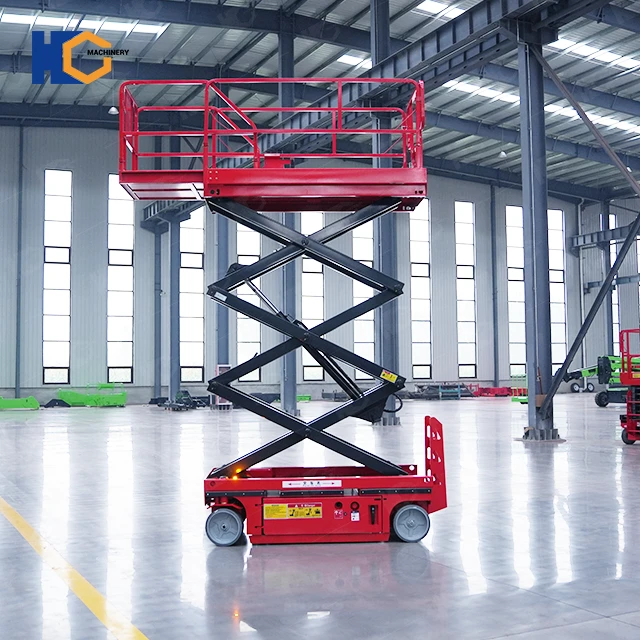
Learning how to operate a scissor lift involves more than raising and lowering the platform. Safe and effective operation begins with trained operators, correct equipment selection, a thorough pre-use inspection, and a clear understanding of the worksite.
Operators must position the machine on suitable ground, check the platform load, use the controls according to the manual, monitor hazards while elevated, and follow the specified procedures for travel, lowering, parking, and emergency recovery.
For construction companies, factories, warehouses, rental businesses, and equipment owners, consistent operating procedures also support better maintenance, reduced downtime, and more reliable fleet management.
At Huichuang Lift, we encourage customers to evaluate lifting equipment according to its intended application, platform capacity, working height, operating environment, and safety requirements. Selecting an appropriate machine and ensuring that operators understand its limitations are essential steps toward productive, responsible equipment use.
To explore scissor lift solutions for your business, visit JNHCLift and review the specifications and operating documentation for the model that matches your application.
Sources and Further Reading
Occupational Safety and Health Administration (OSHA) — Scissor Lifts: Safety, Stabilization, Positioning, and Training. A technical reference for safe scissor lift use in the United States.
International Powered Access Federation (IPAF) — MEWP Pre-Use Inspection Toolbox Talk. Guidance on inspecting equipment before use.
IPAF — Recovery and Rescue Plans. Guidance on preparing for emergencies involving elevated work platforms.
IPAF — Operator Training and Familiarization. Guidance on the distinction between general training and familiarization with specific equipment.
American National Standards Institute (ANSI) / Scaffold & Access Industry Association (SAIA) — ANSI/SAIA A92.24: Training Requirements for MEWPs. A reference covering training and familiarization for mobile elevating work platforms.
Safety disclaimer: This article provides general operational guidance for educational purposes. Always follow the specific machine’s operating manual, applicable local requirements, workplace risk assessment, and documented rescue plan. It is not a substitute for practical training or authorization to operate lifting equipment.

JGS has 15 years of experience working in the lift manufacturing industry, providing customized and OEM lift solutions to lift buyers.
 Room 203, Second Floor, Building 8, Phase Ⅱ, Zhizao Town, Jibei Street, Jiyang District, Jinan City, Shandong Province
 +86 152 5319 3706
 admin@jnhclift.com

Leave a Reply
Want to join the discussion?Feel free to contribute!