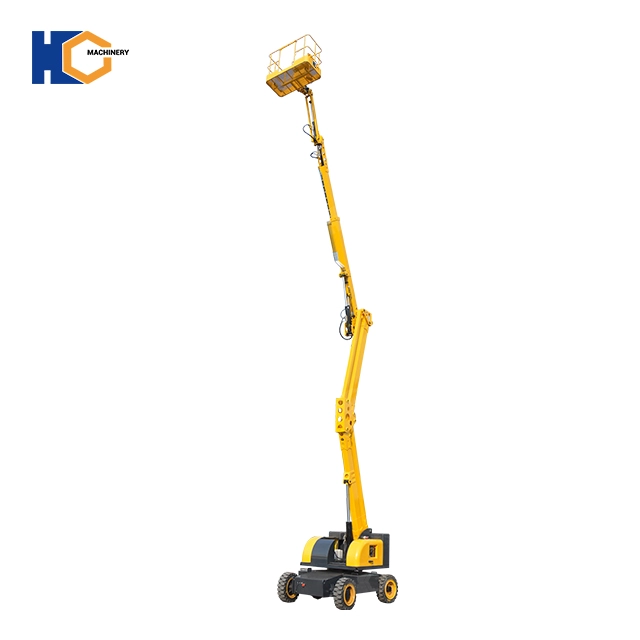
When it comes to aerial work platforms, two of the most common types are articulating boom lifts and telescopic boom lifts. Both are designed to elevate workers to high and hard-to-reach areas, but they each have unique features and advantages that make them suitable for different tasks. Understanding the differences between these two types of boom lifts can help you make an informed decision for your specific needs.
Articulating Boom Lift vs. Telescopic Boom Lift
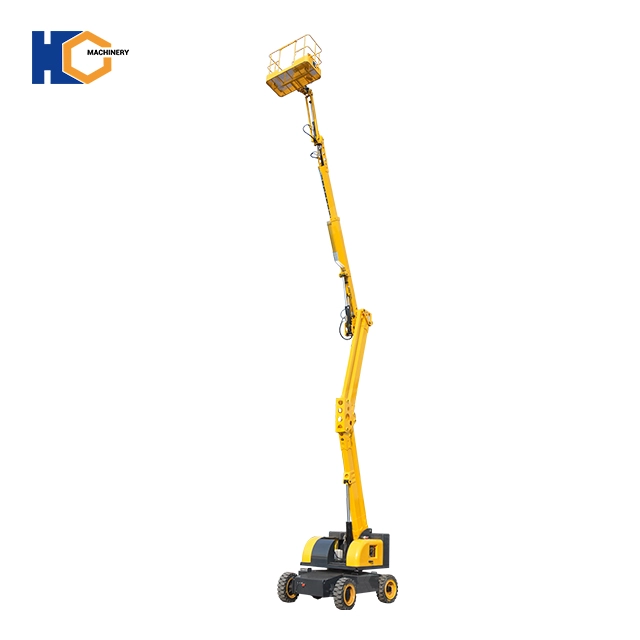
Articulating Boom Lifts
Articulating boom lifts, also known as knuckle boom lifts, have multiple sections that bend and flex. This design allows them to maneuver around obstacles and access areas that are difficult to reach with other types of lifts. Here are some key characteristics and advantages of articulating boom lifts:
Versatility and Flexibility: The articulated arms can move in various directions, making it possible to work around corners and over obstacles. This flexibility is particularly useful in confined spaces and complex job sites.
Access to Hard-to-Reach Areas: Articulating boom lifts are ideal for tasks that require precision and the ability to navigate tight spaces. They can easily access areas above machinery, through narrow openings, and around barriers.
Indoor and Outdoor Use: These lifts are suitable for both indoor and outdoor applications. They are commonly used in construction, maintenance, electrical work, and other industries where access to high and awkward places is necessary.
Compact Design: Many articulating boom lifts have a compact base, allowing them to be used in narrow aisles and tight spaces without sacrificing reach and height capabilities.
Articulating Boom Lifts Specifications and Market Retail Prices
| Model | Max Working Height (ft) | Max Horizontal Reach (ft) | Lift Capacity (lbs) | Platform Size (ft) | Engine Type | Market Price (USD) |
|---|---|---|---|---|---|---|
| JLG 450AJ | 45 | 25 | 500 | 8 x 3 | Diesel/Electric | $70,000 - $80,000 |
| Genie Z-45/25J | 51 | 25 | 500 | 8 x 3 | Diesel/Electric | $75,000 - $85,000 |
| Haulotte HA41RTJ | 133 | 62 | 500 | 8 x 3 | Diesel | $180,000 - $190,000 |
| Snorkel A46JRT | 52 | 24 | 500 | 8 x 3 | Diesel | $60,000 - $70,000 |
| Skyjack SJ46 AJ | 52 | 25 | 500 | 8 x 3 | Diesel | $65,000 - $75,000 |
| JLG 800AJ | 86 | 51 | 500 | 8 x 3 | Diesel | $140,000 - $150,000 |
| Genie Z-80/60 | 86 | 60 | 500 | 8 x 3 | Diesel | $150,000 - $160,000 |
| Haulotte HA80 RTJ | 86 | 55 | 500 | 8 x 3 | Diesel | $135,000 - $145,000 |
| Snorkel A62JRT | 68 | 39 | 500 | 8 x 3 | Diesel | $125,000 - $135,000 |
| Skyjack SJ85 AJ | 91 | 56 | 500 | 8 x 3 | Diesel | $150,000 - $160,000 |
Articulating Boom Lifts Primary Uses
Construction in Confined Spaces
Building Maintenance
Electrical and HVAC Work
Tree Care and Landscaping
Telescopic Boom Lifts
Telescopic boom lifts, also known as stick booms or straight booms, feature a single, extendable arm that can reach significant heights. These lifts are known for their ability to provide maximum vertical and horizontal reach. Here are some key characteristics and advantages of telescopic boom lifts:
Extended Reach: Telescopic boom lifts are designed to reach greater heights and distances than articulating lifts. They are ideal for tasks that require a straight, direct approach to high work areas.
Stability and Strength: The design of telescopic boom lifts provides excellent stability, making them suitable for heavy-duty tasks and outdoor environments where stability is crucial.
Speed and Efficiency: The extendable arm allows for quick and efficient elevation, reducing the time needed to reach the desired height. This makes them ideal for large-scale construction projects, building maintenance, and other high-reaching tasks.
Outdoor Applications: Telescopic boom lifts are particularly well-suited for outdoor use, especially in areas with rough terrain. Many models are equipped with rugged tires and four-wheel drive capabilities to handle uneven surfaces.
Telescopic Boom Lifts Specifications and Market Retail Prices
| Model | Max Working Height (ft) | Max Horizontal Reach (ft) | Lift Capacity (lbs) | Platform Size (ft) | Engine Type | Market Retail Price (USD) |
|---|---|---|---|---|---|---|
| JLG 460SJ | 46 | 39 | 600 | 8 x 3 | Diesel | $85,000 - $95,000 |
| Genie S-65 | 65 | 56 | 500 | 8 x 3 | Diesel | $120,000 - $130,000 |
| Haulotte HT85 RTJ | 85 | 76 | 500 | 8 x 3 | Diesel | $150,000 - $160,000 |
| Snorkel TB66J | 72 | 67 | 500 | 8 x 3 | Diesel | $100,000 - $110,000 |
| Skyjack SJ66 T | 72 | 57 | 500 | 8 x 3 | Diesel | $95,000 - $105,000 |
| JLG 860SJ | 86 | 75 | 750 | 8 x 3 | Diesel | $140,000 - $150,000 |
| Genie S-85 | 85 | 76 | 500 | 8 x 3 | Diesel | $130,000 - $140,000 |
| Haulotte HT132 RTJ | 132 | 69 | 1000 | 8 x 3 | Diesel | $200,000 - $220,000 |
| Snorkel TB126J | 126 | 80 | 500 | 8 x 3 | Diesel | $180,000 - $190,000 |
| Skyjack SJ86 T | 92 | 76 | 500 | 8 x 3 | Diesel | $160,000 - $170,000 |
Telescopic Boom Lifts Primary Uses
Large-Scale Construction
Industrial Maintenance
Telecommunications and Utilities
Outdoor Projects
Choosing the Right Boom Lift
The choice between an articulating boom lift and a telescopic boom lift depends on the specific requirements of your project. Here are some factors to consider:
Work Environment: If your project involves navigating around obstacles and working in confined spaces, an articulating boom lift is likely the better choice. For open areas and tasks that require maximum reach, a telescopic boom lift may be more appropriate.
Height and Reach Requirements: Determine the maximum height and horizontal reach needed for your project. Telescopic boom lifts generally offer greater reach, while articulating lifts provide better maneuverability.
Terrain and Conditions: Consider the terrain and environmental conditions of your work site. Telescopic boom lifts are better suited for rough, outdoor terrains, while articulating lifts can handle both indoor and outdoor environments with various obstacles.
Task Specificity: Evaluate the specific tasks you need to perform. Articulating boom lifts are ideal for tasks that require precision and flexibility, while telescopic boom lifts excel in projects that demand straightforward, extended reach.
In conclusion, both articulating and telescopic boom lifts have their own unique advantages and are designed to meet different operational needs. By understanding the differences and considering the specific requirements of your project, you can choose the right boom lift to ensure efficiency, safety, and success in your aerial tasks.
Comparison Table: Articulating Boom Lift vs. Telescopic Boom Lift
| Feature | Articulating Boom Lift | Telescopic Boom Lift |
|---|---|---|
| Design | Multiple jointed sections that allow for a variety of movement angles | Straight, extendable arm that telescopes outward in a straight line |
| Reach Type | Flexible, multi-directional reach | Maximum vertical and horizontal reach in a straight line |
| Maneuverability | Excellent for confined spaces and obstacles; can move around objects | Best for open spaces with few obstacles; limited lateral movement |
| Ideal Usage Scenarios | Great for tasks in tight spaces, around obstacles (buildings, trees, etc.) | Ideal for jobs requiring high vertical reach in open environments |
| Horizontal Outreach | Shorter horizontal reach compared to telescopic | Longer horizontal reach, better suited for wide spaces |
| Vertical Reach | Lower vertical reach, typically between 30-90 feet | Higher vertical reach, typically between 40-180 feet |
| Applications | Electrical work, tree trimming, maintenance in tight areas | Construction, exterior building work, high-level installations |
| Stability | More stable in uneven terrains due to articulation | Stable for straight reach but requires stable ground for operation |
| Speed of Operation | Slower due to articulation and maneuvering capabilities | Faster operation with direct reach capability |
| Ease of Use | More complex controls due to the need for articulation | Simpler controls, straight forward reach |
| Price | Generally more affordable due to the smaller reach capabilities | More expensive due to extended reach and greater height potential |
| Terrain Capability | Suitable for uneven terrain, tight corners | Best suited for flat, even terrain |
| Setup Time | Requires more setup time due to its flexible operation | Faster to set up due to its simpler, straight reach design |
| Power Source | Available in electric, diesel, and hybrid options | Typically available in diesel and hybrid options |
Summary:
Articulating Boom Lifts are best for applications where maneuverability and the ability to work around obstacles are essential. These lifts are ideal for work in tight or confined spaces with obstacles.
Telescopic Boom Lifts are designed for longer reach and higher vertical work, making them more suitable for open spaces or tasks that require a long horizontal or vertical reach, like construction projects and high-level installations.
Both lifts have their advantages depending on the specific requirements of the job, with articulating boom lifts excelling in maneuverability and telescopic lifts excelling in height and reach.
Articulating Boom Lift vs. Straight Boom Lift: Understanding Differences
Articulating boom lifts (knuckle booms) and straight boom lifts (telescopic booms) are two common types of aerial work platforms. Both are used for accessing high or hard-to-reach areas, but they differ significantly in design, functionality, and applications.
1. Design and Structure
Articulating Boom Lift:
Features multiple hinged sections that allow the boom to "articulate" or bend.
Offers more flexibility to navigate around obstacles.
Ideal for complex work sites with tight or obstructed areas.
Straight Boom Lift:
Comprises a single, telescoping arm that extends in a straight line.
Offers direct vertical or horizontal reach.
Best suited for open spaces where height and outreach are priorities.
2. Reach and Maneuverability
Articulating Boom Lift:
Horizontal Reach: Limited compared to straight booms due to the hinged structure.
Vertical Reach: Moderate, depending on the model.
Maneuverability: Excellent for accessing hard-to-reach areas, working around corners, and reaching over barriers.
Straight Boom Lift:
Horizontal Reach: Offers greater outreach than articulating booms.
Vertical Reach: Can achieve significant heights (up to 185 feet in some models).
Maneuverability: Limited to straight-line access, not ideal for working around obstacles.
3. Applications
Articulating Boom Lift:
Maintenance work in tight spaces, like factories or warehouses.
Outdoor tasks requiring precise positioning, such as tree trimming.
Construction sites with multiple barriers.
Straight Boom Lift:
High-rise building maintenance or construction.
Utility line repair and installation.
Jobs requiring maximum height and horizontal reach without obstacles.
4. Load Capacity
Articulating Boom Lift:
Generally supports lower load capacities due to its complex design.
Suitable for lightweight tools and one or two operators.
Straight Boom Lift:
Can handle higher load capacities.
Ideal for heavier equipment or multiple workers.
5. Terrain Adaptability
Articulating Boom Lift:
Often equipped with 4WD or outriggers for uneven surfaces.
More versatile in rugged terrains.
Straight Boom Lift:
Requires relatively stable ground for safe operation.
May struggle on rough terrains unless equipped with specialized tires or tracks.
6. Cost
Articulating Boom Lift:
Higher cost due to advanced design and flexibility.
Maintenance can also be more expensive because of the additional joints and moving parts.
Straight Boom Lift:
Generally more affordable.
Lower maintenance costs as it has fewer mechanical components.
7. Safety Features
Both types come with safety features such as fall protection, load sensors, and emergency stop mechanisms. However:
Articulating Boom Lift: Additional safety measures are often needed for navigating tight spaces.
Straight Boom Lift: Simpler safety protocols due to its straightforward operation.
Comparison Table
| Feature | Articulating Boom Lift | Straight Boom Lift |
|---|---|---|
| Reach Type | Flexible, bends around obstacles | Straight-line access |
| Max Height | Moderate | High |
| Applications | Tight spaces, complex environments | Open areas, maximum height jobs |
| Load Capacity | Lower | Higher |
| Terrain | Adaptable, rugged | Requires stable ground |
| Cost | Higher initial and maintenance costs | Lower overall costs |
Which One to Choose?
Choose an articulating boom lift if:
You need to navigate around obstacles.
The job site has confined or obstructed spaces.
Precision and maneuverability are key.
Choose a straight boom lift if:
Maximum height and outreach are required.
The job site is open and obstacle-free.
You need to lift heavier loads.
Both lifts are essential tools for different scenarios. Understanding their unique capabilities ensures that the right equipment is selected for each job.
How to select Articulating Boom Lift and Telescopic Boom Lift?
When selecting between an articulating boom lift and a telescopic boom lift, it's important to consider the pros and cons of each to determine which one best fits your specific needs. Here is a detailed comparison of the advantages and disadvantages of both types of lifts.
Articulating Boom Lifts
Pros:
Maneuverability:
Flexibility: The articulated arms can bend and pivot, allowing the lift to reach around obstacles and into tight spaces.
Precision: Can position workers accurately, making it easier to perform detailed tasks.
Versatility:
Suitable for both indoor and outdoor use, making it a versatile choice for various job sites.
Compact base designs enable use in narrow aisles and confined spaces.
Accessibility:
Capable of accessing hard-to-reach areas, such as over machinery or through narrow openings.
Ideal for tasks that require navigating around barriers or working in complex environments.
Safety:
The ability to maneuver around obstacles reduces the need to reposition the entire lift, enhancing safety for workers.
Cons:
Height and Reach Limitations:
Generally offers less vertical and horizontal reach compared to telescopic boom lifts.
Not suitable for projects that require maximum height and distance.
Complex Operation:
The multiple joints and pivot points can make operation more complex, requiring skilled operators.
May require more time to position correctly compared to straight boom lifts.
Stability:
Can be less stable on rough terrain compared to telescopic boom lifts, especially at maximum extension.
Telescopic Boom Lifts
Pros:
Extended Reach:
Height: Provides maximum vertical reach, making it ideal for tasks that require significant elevation.
Distance: Can extend horizontally over long distances, suitable for reaching high and far work areas.
Stability:
The straight boom design offers excellent stability, particularly on rough terrain.
Often equipped with rugged tires and four-wheel drive capabilities for enhanced stability on uneven surfaces.
Speed and Efficiency:
The extendable arm allows for quick and direct elevation, reducing the time needed to reach the desired height.
Simplifies the process of positioning and elevating workers, increasing productivity.
Heavy-Duty Capability:
Built to handle heavy-duty tasks, making them suitable for large-scale construction and industrial projects.
Cons:
Limited Maneuverability:
The straight boom design restricts movement around obstacles, making it less suitable for confined spaces.
Lacks the flexibility to navigate around barriers or reach over machinery.
Size and Weight:
Typically larger and heavier than articulating boom lifts, which can limit their use in tight or indoor spaces.
May require more space for operation and storage.
Indoor Use:
Less versatile for indoor use due to size and reach capabilities.
May be challenging to maneuver in areas with limited space or many obstacles.
Cost:
Generally more expensive to purchase and maintain compared to articulating boom lifts.
Higher operational costs due to larger size and more complex machinery.
Conclusion
Choosing between an articulating boom lift and a telescopic boom lift depends on the specific requirements of your project. Articulating boom lifts offer superior maneuverability and flexibility, making them ideal for tasks in confined spaces and complex environments. Telescopic boom lifts provide greater reach and stability, making them suitable for large-scale construction and industrial projects that require significant height and distance.
By weighing the pros and cons of each type of lift, you can make an informed decision that enhances efficiency, safety, and productivity in your aerial work operations.
JNCH Lift: Articulating Boom Lifts and Telescopic Boom Lifts Manufacturer
JNCH Lift is a prominent manufacturer of both articulating boom lifts and telescopic boom lifts, providing high-quality lifting solutions for various industries. Understanding the unique features and applications of these two types of boom lifts can help customers make informed decisions about their equipment needs. Here is a detailed overview of the primary uses, advantages, and disadvantages of JNCH’s articulating and telescopic boom lifts.
JNCH Lift’s articulating and telescopic boom lifts each offer unique advantages tailored to specific operational needs. Articulating boom lifts provide flexibility, maneuverability, and precise access, making them ideal for confined spaces and detailed tasks. Telescopic boom lifts deliver extended reach, stability, and efficiency, making them suitable for large-scale construction and industrial projects. By understanding the primary uses and benefits of each type of boom lift, customers can select the right equipment to enhance safety, productivity, and efficiency in their aerial work operations.
As a manufacturer of articulating boom lifts and telescopic boom lifts, there are several key advantages that can set your factory apart in the market. These advantages can help you build a strong reputation, attract more customers, and ensure long-term success.
1. Control Over Quality
Advantage:
Direct control over the production process allows you to maintain high quality standards.
Implementing strict quality control measures ensures that every lift meets safety and performance criteria.
Benefit:
Customers can trust the reliability and durability of your products.
High-quality products lead to customer satisfaction and repeat business.
2. Customization Capabilities
Advantage:
Ability to offer customized solutions tailored to specific customer needs.
Flexibility to modify designs, features, and specifications based on client requirements.
Benefit:
Attracts a broader range of customers with unique needs.
Enhances customer satisfaction by providing personalized equipment.
3. Cost Efficiency
Advantage:
Eliminates middlemen and reduces additional costs associated with outsourcing.
Streamlined production processes can lead to cost savings and increased efficiency.
Benefit:
Competitive pricing can attract cost-conscious customers.
Higher profit margins due to lower production costs.
4. Innovation and Development
Advantage:
Direct involvement in research and development allows for continuous innovation.
Ability to stay ahead of market trends and introduce new features and technologies.
Benefit:
Offers cutting-edge products that meet evolving industry standards.
Enhances brand reputation as an industry leader in innovation.
5. Faster Time-to-Market
Advantage:
Direct control over the production schedule enables quicker response to market demands.
Ability to rapidly prototype, test, and launch new models.
Benefit:
Meets customer needs promptly, gaining a competitive edge.
Reduces the time from concept to commercial availability.
6. Enhanced Customer Support
Advantage:
Direct communication with customers allows for better understanding of their needs and issues.
Ability to provide comprehensive after-sales support, including maintenance and repairs.
Benefit:
Builds strong customer relationships and loyalty.
Quick resolution of issues leads to higher customer satisfaction.
7. Brand Recognition and Trust
Advantage:
Manufacturing high-quality products under your brand builds trust and recognition in the market.
Consistent delivery of reliable equipment enhances brand reputation.
Benefit:
Strong brand reputation attracts more customers.
Increases market share and long-term business growth.
8. Environmental and Safety Standards Compliance
Advantage:
Ensuring compliance with environmental and safety standards through controlled manufacturing processes.
Ability to implement eco-friendly practices and sustainable production methods.
Benefit:
Attracts environmentally conscious customers.
Reduces legal risks and enhances corporate responsibility image.
Conclusion
As a manufacturer of articulating boom lifts and telescopic boom lifts, your factory can leverage these advantages to stand out in the competitive market. By maintaining high quality, offering customization, ensuring cost efficiency, fostering innovation, reducing time-to-market, providing excellent customer support, building brand recognition, and complying with environmental and safety standards, your factory can achieve sustained growth and success. These advantages not only enhance your product offerings but also build lasting relationships with customers, ensuring their loyalty and satisfaction.
If you want to get wholesale prices from the source factory, please contact our experts.
390.webp)
892.webp)