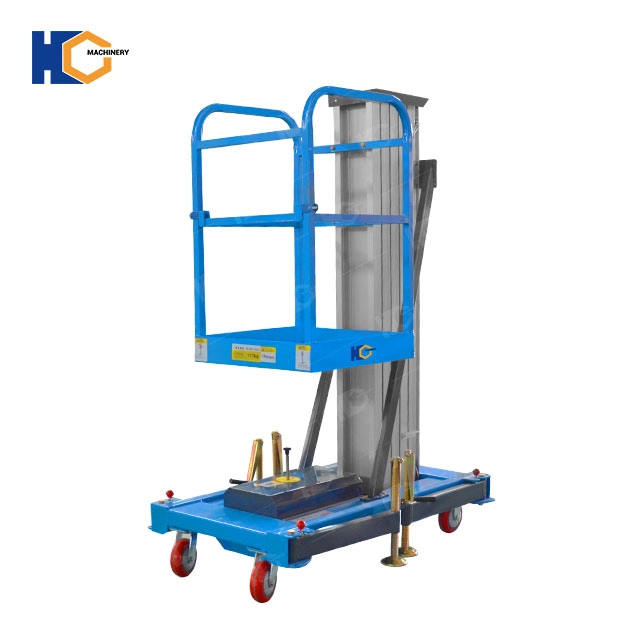
Choosing the right aerial work platform matters more than ever. As workplaces raise their safety standards, companies are shifting away from risky ladders and toward professional lifting equipment. Two of the most widely used options are the single man lift and the scissor lift. Although they both elevate workers to a safe working height, they are built for different environments, different tasks, and different budget levels.
This comprehensive guide delivers a deep comparison between the two, helping you understand their structure, specifications, functions, advantages, cost differences, applications, and which lift is best for your operation.
What Is a Single Man Lift?
A single man lift—also called a personnel lift, vertical mast lift, or man lift—is a compact, lightweight, vertical access machine designed for one operator and light tools. It uses a telescopic aluminum mast that extends straight upward.
Key traits include:
Narrow body (generally 0.74–0.80 m wide)
Very lightweight (200–600 kg)
Quiet electric or battery power
One-person platform
Suitable for tight indoor spaces
Single man lifts are extremely popular in warehouses, retail stores, malls, hospitals, airports, and maintenance facilities where mobility and compact size matter more than platform size.
What Is a Scissor Lift?
A scissor lift is a larger aerial work platform using a stack of crisscrossing metal supports that extend upward in a scissor-like pattern. It offers a much wider platform, higher load capacity, and the ability to lift multiple workers.
Typical features include:
Wide platform (1.0–2.5 m)
Load capacities from 230–450+ kg
Electric or diesel power
Indoor and outdoor models
Stable, heavy-duty platform for two or more people
Scissor lifts are widely used in construction, facility management, industrial maintenance, and outdoor job sites requiring larger tools and multiple workers.
Structural Differences: Mast vs Scissor Mechanism
Single Man Lift Structure
A single man lift uses a telescopic mast system, usually made from lightweight but high-strength aluminum. This allows for:
Smoother vertical movement
Lower machine weight
Smaller chassis footprint
Quiet operation
The mast structure is ideal for straight-up height access where lateral reach is unnecessary.
Scissor Lift Structure
A scissor lift uses steel scissor arms, driven by hydraulic cylinders that push the scissor stack upward. This design allows:
Large working platform
Higher lifting loads
More stability for multiple people
Wider base to support additional weight
The trade-off is that the lift becomes heavier, wider, and less suitable for tight indoor passages.
Typical Specifications Comparison
| Feature | Single Man Lift | Scissor Lift |
|---|---|---|
| Working Height | 4–14 m | 6–18 m |
| Platform Capacity | 120–200 kg | 230–450+ kg |
| Platform Size | Small, 1 person | Large, 2–4 people |
| Machine Width | 0.74–0.80 m | 0.76–1.25 m |
| Machine Weight | 200–600 kg | 900–3500 kg |
| Power Source | Battery / AC electric | Battery (indoor) or diesel (outdoor) |
| Best Use | Indoor maintenance | Construction & heavy-duty jobs |
| Mobility | Very easy | Moderate–heavy |
The numbers show that these lifts serve very different needs.
Performance Differences Explained
1. Lifting Capacity
Single man lift: lower capacity
Scissor lift: handles heavy tools, equipment, and multiple workers
If you need to carry heavy materials like ducting, panels, lights, or tools, the scissor lift wins.
2. Platform Space
Single man lifts offer just enough space for the operator and small tools.
Scissor lifts provide large platforms, often 2–3 times bigger.
3. Indoor vs Outdoor
Single man lifts overwhelmingly dominate indoor jobs.
Scissor lifts cover indoor electric models and outdoor rough-terrain varieties.
4. Maneuverability
Single man lifts are extremely nimble.
Scissor lifts require wider aisles and larger turning radius.
5. Floor Load
Single man lifts can safely operate on delicate floors like:
Shopping mall tiles
Marble flooring
Hospitals
Museums
Raised server floors
Scissor lifts may exceed floor load limits in some facilities.
6. Reach Type
Both lifts are strictly vertical-only.
If sideways reach is needed, a boom lift is the right choice instead.
Applications: Where Each Lift Works Best
Best Applications for Single Man Lifts
These lifts are optimized for tasks requiring mobility and space efficiency:
Warehouse equipment maintenance
Reaching high shelves and racking
Electrical and lighting repair
HVAC filter changes
Retail display installation
Hotel and mall cleaning
Airport signage service
Library or museum high-stack access
Their narrow design allows them to roll through standard doorways and elevators without folding or removing parts.
Best Applications for Scissor Lifts
Scissor lifts excel in heavier, more demanding tasks:
Construction and building installation
Large maintenance projects
Ceiling renovation
Industrial warehouses
Manufacturing plants
Outdoor repair work
High-bay lighting installation
Parking garage construction
Plasterboard, piping, and cable tray installation
Their larger platform supports teams working side by side.
Advantages of Single Man Lift vs Scissor Lift
Benefits of Single Man Lifts
Ultra-compact for confined spaces
Lightweight and easy to move
Minimal floor pressure
Cost-effective investment
Outstanding for routine indoor maintenance
Low noise and zero emissions
Passes through narrow aisles and doorways
Requires very little training
Their convenience makes them a modern replacement for ladders.
Benefits of Scissor Lifts
Higher load capacity
Larger working platform
Can lift multiple workers
More versatile in construction environments
Outdoor-capable models available
Strong stability at height
Greater lifting heights in heavy-duty designs
If productivity and platform size matter, scissor lifts lead comfortably.
Safety Comparison
Both lifts comply with global safety certifications such as CE, ANSI, and ISO.
Single Man Lift Safety Features
Emergency lowering
Anti-tilt sensors
Non-slip platform
Guardrails
Emergency stop
Automatic brakes
Overload detection
Their light weight and compact body reduce tipping risk in controlled indoor environments.
Scissor Lift Safety Features
Robust steel structure
Guardrails and toe boards
Emergency descent
Load sensing systems
Pothole protection
Outriggers (in some models)
Tilt alarms
Stronger chassis
Scissor lifts are safer for higher loads and multi-worker jobs.
Cost Comparison: Which One Is Cheaper?
Generally, single man lifts are significantly cheaper than scissor lifts.
Single Man Lift Price Range (2025)
| Height | Price (USD) |
|---|---|
| 4–6 m | $1,800 – $2,800 |
| 6–8 m | $2,200 – $3,500 |
| 8–10 m | $2,800 – $4,500 |
| 10–12 m | $3,500 – $5,000 |
| 12–14 m | $4,000 – $6,500 |
Scissor Lift Price Range (2025)
| Height | Price (USD) |
|---|---|
| 6–8 m electric | $5,000 – $8,500 |
| 8–10 m electric | $6,500 – $10,500 |
| 10–12 m electric | $7,800 – $12,000 |
| 12–14 m diesel | $12,000 – $20,000 |
| 14–18 m rough-terrain | $20,000 – $60,000 |
Single man lifts win overwhelmingly for buyers with limited budgets or routine maintenance needs.
Operational Cost Differences
Single man lifts have:
Lower electricity usage
Cheaper replacement parts
Fewer hydraulic components
Minimal annual maintenance
Scissor lifts require:
More frequent hydraulic maintenance
Higher battery consumption
More robust inspection cycles
Scissor lift operating costs can be 1.5–3 times higher annually.
Which Lift Is Better? Final Comparison Based on Usage
Choose a Single Man Lift If You Need:
Indoor maintenance
Work in tight aisles
A lightweight and portable lift
A safe alternative to ladders
Low upfront and maintenance costs
Easy movement through doors and elevators
One-person tasks without heavy tools
Single man lifts are unbeatable for everyday facility operations.
Choose a Scissor Lift If You Need:
Multiple workers on the platform
Heavy tools or supplies at height
Large surface installation
Construction or industrial work
Outdoor lifting capability
Higher platform heights
Stronger structural support
Scissor lifts are the workhorses for construction and heavy-duty jobs.
Future Trends: Why Many Companies Use Both
Large facilities increasingly adopt a hybrid aerial fleet:
Single man lifts for quick, repetitive daily tasks
Scissor lifts for heavy-duty periodic projects
This combined approach ensures maximum efficiency and cost control.
Facilities such as airports, logistics centers, and malls often use 3–10 single man lifts for routine tasks while renting or owning 1–2 scissor lifts for bigger maintenance or renovation projects.
Conclusion
The comparison between a single man lift vs scissor lift reveals two machines designed for very different purposes. A single man lift prioritizes mobility, low cost, quiet operation, and tight indoor access. A scissor lift focuses on high load capacity, multi-worker platforms, and both indoor and outdoor capability.
Neither lift is universally “better”—the right choice depends entirely on your tasks, environment, and budget. For facilities performing daily maintenance, a single man lift is the smartest, most cost-effective solution. For industrial and construction work requiring heavy loads and large platforms, the scissor lift remains essential.
If you’d like to explore next steps, categories like vertical mast lifts, push-around lifts, and rough-terrain scissor lifts offer useful extensions of this comparison.
390.webp)
892.webp)