
3 Person Small Lift for Home Price in India
A 3-person home lift is becoming an attractive solution for Indian villas, duplexes, bungalows, and multi-story independent houses. It provides convenient access between floors without requiring the large cabin size normally associated with commercial passenger elevators.
But the price can vary considerably.
In India, published 2026 market estimates range from approximately ₹6 lakh for basic residential lift configurations to ₹25 lakh or more for premium systems, while some compact 3–4-person home lift estimates fall around ₹14–25 lakh. This wide range comes from lift technology, number of floors, cabin size, shaft requirements, doors, interior finishes, installation, and customization.
So, what should an Indian homeowner actually expect to pay for a 3-person small lift for home?
Let’s break it down.
3 Person Small Lift for Home Price in India
For a 3-person residential lift, no single fixed price applies to every Indian home.
A practical 2026 budgeting range is approximately:
- Basic compact home lift: ₹6–12 lakh
- Mid-range 3-person residential lift: ₹12–20 lakh
- Premium/customized home lift: ₹20–30 lakh+
- High-end designer or specialized systems: potentially higher
These are indicative market ranges, not a fixed quotation. Publicly available Indian pricing guides show significant variation. For example, one 2026 guide places 3–4-person domestic lifts at approximately ₹14–25 lakh, while another lists basic 3-person capacity systems in a lower ₹6–9 lakh range.
The important question is therefore not simply:
“How much does a 3-person lift cost?”
It is:
“What configuration do I need for my house, and what is included in the quoted price?”
That distinction can save a buyer several lakh rupees when comparing suppliers.
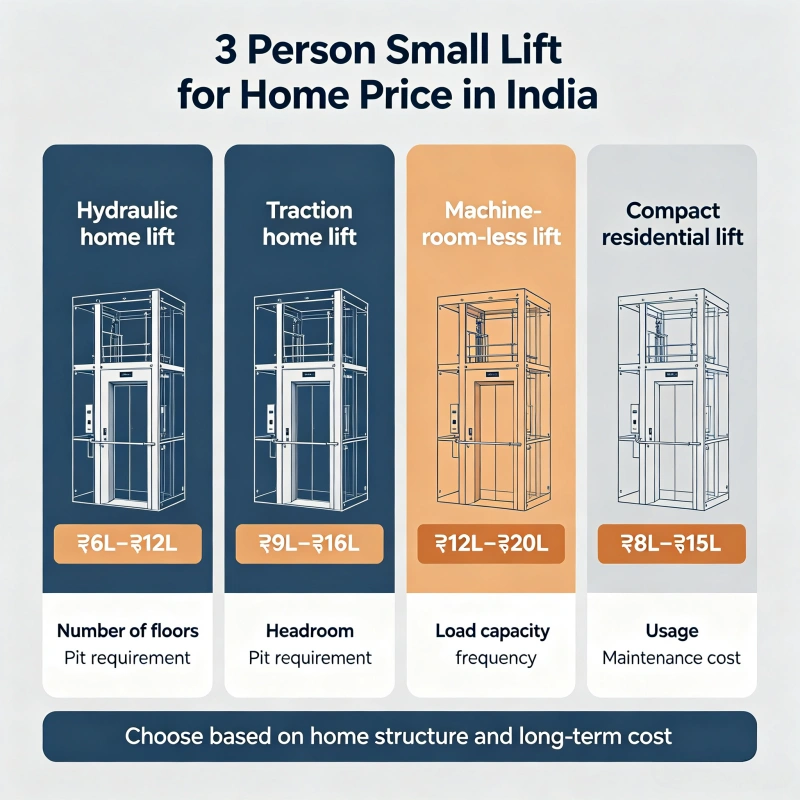
Quick Price Guide for a 3-Person Home Lift in India
| Configuration | Indicative Budget | Typical Application |
|---|---|---|
| Basic compact lift | ₹6–12 lakh | Small house, simple finish |
| Standard 3-person lift | ₹12–20 lakh | Duplex/villa |
| Premium 3-person lift | ₹20–30 lakh+ | Luxury home, glass/design cabin |
| Imported/customized system | ₹20 lakh+ | Premium architectural projects |
Check a quotation carefully to see whether it includes installation, doors, the control system, safety equipment, the shaft, civil work, transportation, GST, and commissioning.
Some Indian 2026 guides specifically note that civil work and installation may be quoted separately, while GST may also be added to the equipment price.
Why Are 3-Person Home Lift Prices So Different?
Two elevators can both be advertised as “3-person home lifts” but have very different prices.
The main cost factors are below.
1. Lift Technology
The drive system strongly influences price.
Common residential options include:
- Hydraulic home lift
- Traction home lift
- Gearless/MRL lift
- Screw-driven lift
- Compact battery-powered lift
- Pneumatic/vacuum lift
Hydraulic systems can offer a relatively economical solution for low-rise homes, while premium traction, gearless, vacuum, or designer systems can cost substantially more.
For example, published 2026 Indian estimates put hydraulic home lifts broadly around ₹8–20 lakh, while traction/gearless systems can reach ₹10–25 lakh or more, depending on configuration.
2. Number of Floors
A 3-person lift serving two floors is not the same project as one serving four or five levels.
More floors mean:
- Greater travel height
- More guide rails
- More landing doors
- More wiring
- More installation work
- Different drive requirements
- More structural work
For example, one current Indian pricing guide estimates approximately ₹11.5–23 lakh for a 3-floor home lift depending on configuration, while other sources show substantially lower entry-level pricing for basic systems.
That is why you should always include the number of stops when requesting a quotation.
3. Cabin and Platform Size
A 3-person lift does not need to be as large as a commercial passenger elevator.
For a compact home, the buyer may prioritize:
- Small footprint
- Easy installation
- Low structural modification
- Adequate wheelchair access where required
- Comfortable passenger movement
A larger cabin increases material requirements and may require a larger shaft.
If space is limited, a customized compact cabin can sometimes be a better solution than purchasing a standard commercial elevator.
4. Shaft and Civil Work
This is one of the most frequently overlooked costs.
Depending on the lift design and house structure, the project may require:
- Lift shaft
- Steel structure
- Aluminum/glass enclosure
- Pit
- Machine space
- Electrical work
- Floor openings
- Reinforcement
- Landing modifications
A lift that appears inexpensive on a product page can become much more expensive after site preparation.
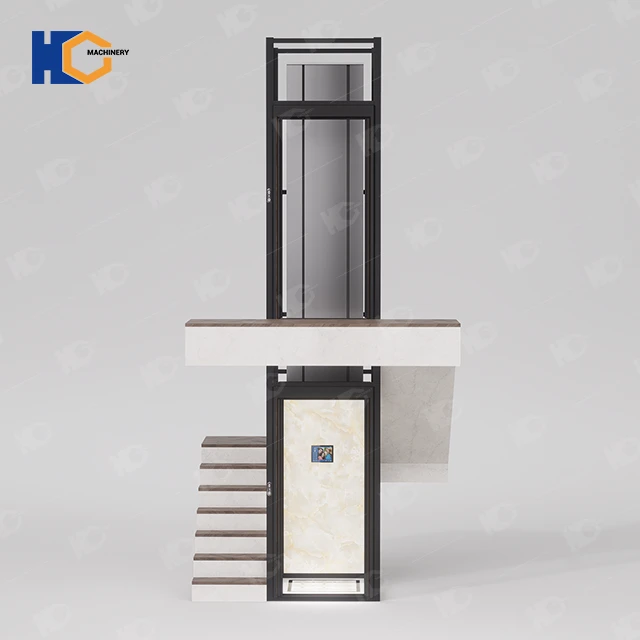
Some compact home lift designs are specifically developed to reduce the need for deep pits, large shafts, or machine rooms, which can make them attractive for existing Indian houses.
What Is the Best 3-Person Lift for a Small Indian Home?
For a small Indian home, the most important consideration is not maximum capacity.
It is space efficiency.
A suitable 3-person home lift should ideally provide:
- Compact installation footprint
- Reliable low-rise operation
- Appropriate load capacity
- Easy entry and exit
- Suitable safety systems
- Low maintenance requirements
- Optional battery/backup power
- Flexible shaft or enclosure options
This is particularly relevant for Indian urban homes where the available plot area is limited, and the lift often has to be installed after the house has already been designed.
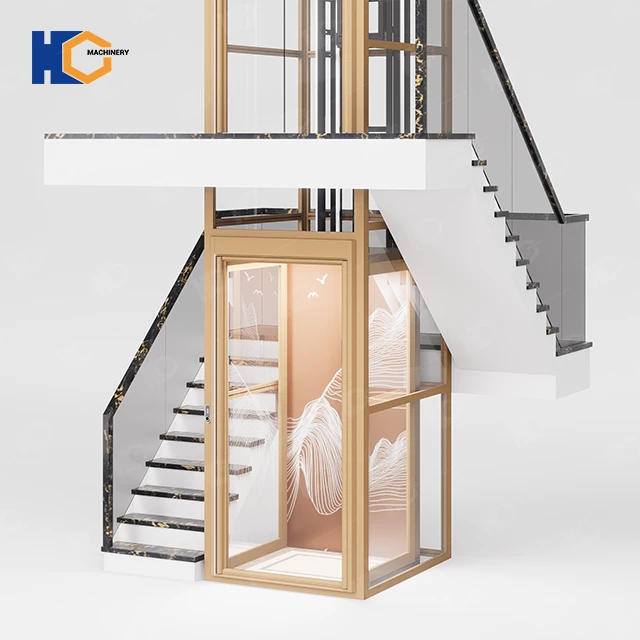
A compact lift may be installed beside a staircase, inside a small shaft, in a courtyard, or against an exterior wall, depending on the building design.
How Much Space Does a 3-Person Home Lift Need?
No universal dimension exists because the required space depends on the lift type and cabin design.
However, buyers should distinguish between:
Cabin/platform size
and
total installation footprint.
For example, a compact cabin might be designed for three people, but the complete lift still needs space for guide rails, doors, drive equipment, safety structures, and landing access.
When contacting a manufacturer, provide:
- Available width
- Available depth
- Floor-to-floor height
- Number of floors
- Desired cabin size
- Door opening direction
- Indoor or outdoor installation
- Whether a shaft already exists
A home lift manufacturer can then recommend a practical configuration instead of simply selling the largest standard model.
3 Person Home Lift: How Much Weight?
“3 person” should not be treated as an exact weight specification.
Express passenger capacity in kilograms, not just by the number of people.
For example, a residential lift may be configured around a 250–400 kg load capacity depending on its design.
If the lift needs to accommodate:
- Three adults
- A wheelchair user
- A caregiver
- Heavy luggage
- Household goods
the required capacity may be higher than a simple three-person calculation suggests.
Therefore, when requesting a quotation, ask for both:
Passenger capacity + rated load capacity.
3 Person Small Lift for Home: Indian Customer Case Analysis
The following cases are representative Indian buyer scenarios, created from common residential purchasing requirements. They are not independently verified, named customer testimonials.
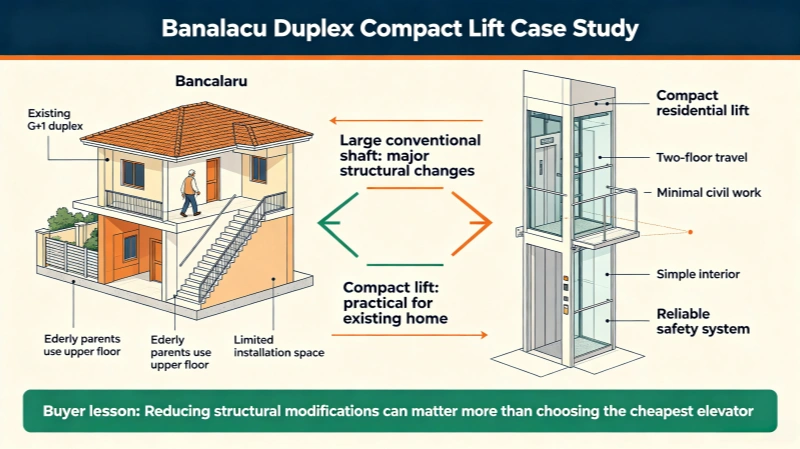
Case 1: Bengaluru Duplex — Compact Space Priority
Project: G+1 duplex house
Location: Bengaluru
Requirement: 3-person residential lift
Main concern: Limited installation space
The homeowner wanted a lift because elderly parents were using the upper floor regularly. The house was already built, so a large conventional elevator shaft would have required significant structural modifications.
The purchasing priorities were:
- Compact footprint
- Minimal civil work
- Two-floor travel
- Simple interior
- Reliable safety system
For this type of project, a compact residential lift can be more practical than a conventional commercial elevator.
Buyer lesson:
For an existing Indian house, reducing structural modifications can matter more than choosing the cheapest elevator.
Case 2: Hyderabad Villa — Family Use
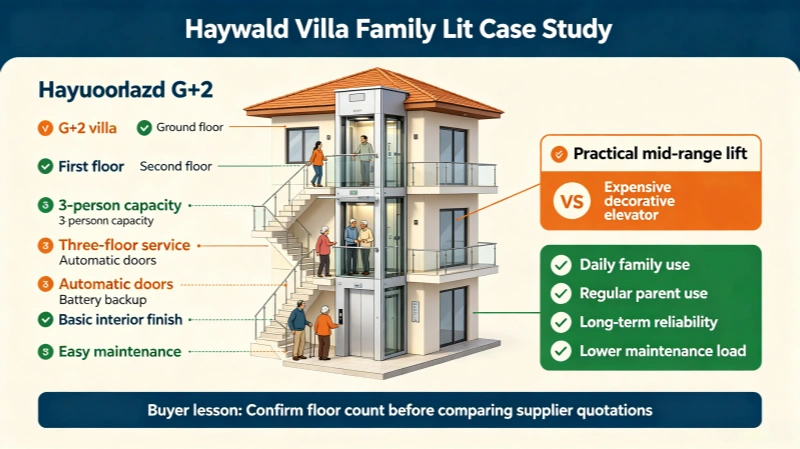
Project: G+2 villa
Location: Hyderabad
Requirement: 3-person lift for daily family use
Main concern: Price vs. long-term reliability
The family wanted a lift connecting the ground, first, and second floors. Their parents would use it regularly, but the lift also needed to be convenient for the rest of the family.
Instead of selecting a luxury glass elevator, the buyer focused on:
- 3-person capacity
- Three-floor service
- Automatic or convenient doors
- Battery backup
- Basic interior finish
- Easy maintenance
The lesson from this type of project is that a practical mid-range lift can offer better value than spending heavily on decorative features.
Current Indian market guides show that moving from two to three floors can materially increase the budget, so confirm the floor count before comparing supplier quotations.
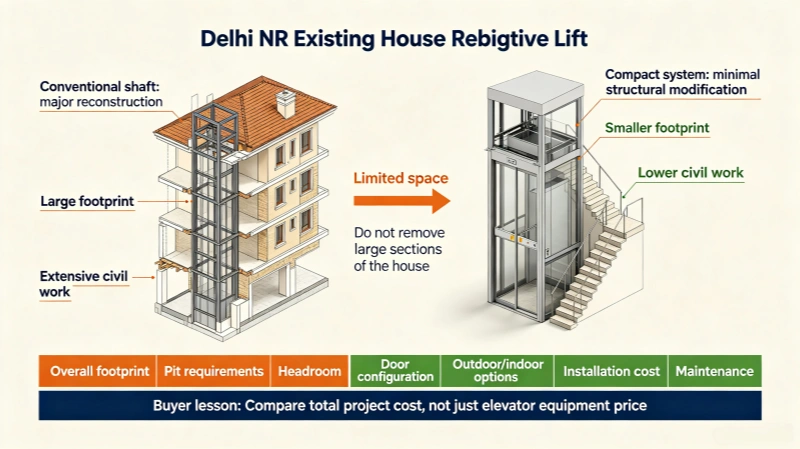
Case 3: Delhi NCR — Existing House Retrofit
Project: Existing multi-story residence
Location: Delhi NCR
Requirement: Small 3-person home lift
Main concern: Installation without major reconstruction
The homeowner had limited space and did not want to remove a large section of the house to construct a conventional lift shaft.
The preferred solution was a compact system with a smaller footprint and minimal structural modification.
The project evaluation focused on:
- Overall footprint
- Pit requirements
- Headroom
- Door configuration
- Outdoor/indoor options
- Installation cost
- Maintenance
This retrofit shows why buyers should compare total project cost, not just elevator equipment price.
A lower equipment price can become expensive if extensive civil work is required.
Case 4: Mumbai — Small Plot, Multi-Level Home
Project: Multi-story urban residence
Location: Mumbai
Requirement: Compact 3-person home elevator
Main concern: Maximum use of limited floor space
In a dense urban environment, every square metre matters.
The homeowner therefore preferred a smaller lift footprint instead of a large luxury cabin.
The buying decision was based on:
Space → Capacity → Reliability → Price → Appearance
rather than:
Price → Everything else.
This is a useful purchasing principle for many Indian homeowners.
The cheapest lift is not necessarily the cheapest complete solution if it requires significant reconstruction.
What Should Be Included in a 3-Person Home Lift Quotation?
When comparing suppliers in India or importing from an overseas manufacturer, ask for a detailed quotation.
It should identify whether the price includes:
Lift Equipment
- Cabin/platform
- Drive system
- Controller
- Guide rails
- Landing doors
- Safety devices
Installation
- Mechanical installation
- Electrical connection
- Commissioning
- Testing
Building Work
Check whether the quotation includes or excludes:
- Pit construction
- Shaft
- Structural steel
- Floor opening
- Reinforcement
- Electrical supply
Other Costs
Also confirm:
- Transportation
- GST
- Customs duties if imported
- Local installation
- Annual maintenance
- Warranty
- Spare parts
This matters because some advertised Indian home lift prices exclude civil work, installation, or taxes.
Imported vs. Indian-Made 3-Person Home Lift
Indian homeowners may encounter three broad sourcing options:
Indian Manufacturer
Advantages:
- Local service
- Easier spare-parts access
- Local installation
- Familiarity with Indian buildings
- Easier communication
International Brand
Advantages:
- Established technology
- Premium finishes
- Advanced controls
- Strong brand recognition
Potential disadvantages:
- Higher price
- Imported components
- Higher service costs in some regions
Direct Factory Import
Buying directly from an overseas manufacturer can provide a competitive equipment price, particularly for distributors, contractors, and projects involving multiple units.
However, the buyer must calculate the landed cost, including:
- FOB/CIF price
- Shipping
- Insurance
- Customs
- GST
- Local transportation
- Installation
- Commissioning
- After-sales service
Never compare the factory equipment price directly with a fully installed local quotation without adjusting for these additional costs.
How to Reduce the Cost of a 3-Person Home Lift in India
You don’t necessarily need luxury specifications to get a reliable home lift.
Choose a Compact Cabin
Avoid paying for unnecessary cabin space.
Limit Decorative Upgrades
Premium glass, wood, stainless-steel finishes, special lighting, and designer control panels can increase the cost.
Select the Correct Capacity
Do not automatically purchase a 6-person elevator if three-person capacity meets the family’s needs.
Plan During Construction
Installing the lift during the house design stage can reduce later structural modifications.
Compare Complete Project Cost
Ask suppliers for:
Equipment + installation + civil work + taxes + transportation
rather than comparing only the advertised lift price.
Is a 3-Person Small Lift Worth It for an Indian Home?
For many Indian homeowners, yes.
A compact three-person lift can provide several practical benefits:
- Easier movement for elderly family members
- Better accessibility between floors
- Convenient transportation of groceries and luggage
- More comfortable movement in multi-storey houses
- Better long-term usability of the property
- Potentially better suitability for aging in place
The value is especially clear in homes where bedrooms, kitchens, living areas, and terraces span multiple floors.
However, choose the lift based on the actual house.
A large luxury elevator is unnecessary if a compact three-person system provides everything the family needs.
3 Person Small Lift for Home Price in India: Buying Checklist
Before placing an order, confirm these 12 points:
- How many floors does the lift serve?
- What is the rated load capacity?
- What are the cabin dimensions?
- What is the complete shaft/installation footprint?
- Does it require a pit?
- Does it require a machine room?
- What is the lifting height?
- What type of drive system is used?
- Is battery backup included?
- Is installation included in the price?
- Are GST and civil works included?
- Who will provide after-sales service in India?
These questions can make two apparently similar quotations much easier to compare.
Frequently Asked Questions
How much does a 3-person small lift cost in India?
A 3-person small home lift can range from ₹6 lakh to ₹25 lakh+, depending on technology, floors, cabin size, installation, and customization. Mid-range and premium 3–4-person systems are often quoted around ₹14–25 lakh in current published market guides.
What is the cheapest 3-person home lift in India?
Basic hydraulic or compact residential systems can be among the lower-cost options. Some 2026 market guides place basic systems in the ₹6–12 lakh range, although the final price depends heavily on installation and civil work.
How much does a 3-person lift cost for a 3-floor house?
A G+2 home generally costs more than a G+1 because of additional travel height and landing requirements. Published 2026 estimates for 3-floor home lifts vary widely, ranging from about ₹6.5–9.5 lakh for basic systems to much higher prices for premium systems.
Does a 3-person lift need a lift shaft?
Not always. The requirement depends on the technology and design. Some compact residential lifts can use a customized shaft or enclosure, while other systems require more conventional structural arrangements.
Can a 3-person home lift be installed in an existing house?
Yes. Compact residential lifts are often considered for retrofit applications. However, you must check available floor space, headroom, pit requirements, structural strength, and electrical supply before selecting a model.
Is a 3-person lift suitable for elderly people?
Yes. One of the main reasons homeowners choose compact residential elevators is easier movement between floors for elderly family members or people who have difficulty using stairs.
What is more important: lift price or cabin size?
Neither should be considered alone. The best configuration balances capacity, cabin size, available space, number of floors, safety, installation requirements, and total cost.
Does the quoted price include installation?
Not always. Some suppliers include installation while others quote the lift equipment separately. Always ask for a written breakdown before comparing prices.
What information should I send to a manufacturer for a quotation?
For an accurate quotation, provide:
- Number of floors
- Floor-to-floor height
- Available shaft space
- Desired cabin size
- Number of passengers
- Required load capacity
- Indoor/outdoor installation
- Existing shaft or new shaft
- Door configuration
A floor plan or site photograph can also help the manufacturer recommend the right configuration.
How much does a 2-person home elevator cost?
A 2-person home elevator is generally one of the more compact and affordable residential elevator options. In India, current 2026 market prices vary widely by technology and installation requirements, with some compact models starting around ₹6–10 lakh, while premium systems can cost considerably more. One current market guide lists 2-person lifts at approximately ₹6.5–10 lakh including installation, while other premium residential systems start above ₹11 lakh.
The final price depends on the lift type, number of floors, cabin dimensions, shaft requirements, doors, safety equipment, installation and customization.
How much does a 3-person home elevator cost?
A 3-person home elevator usually costs more than a 2-person model because it requires a larger cabin and generally has a higher load capacity. A 2026 Indian market guide places 3-person residential lifts at approximately ₹9–13.5 lakh including installation for standard configurations.
However, premium traction, hydraulic, glass or customized home elevators can cost substantially more. Buyers should compare complete project quotations, not capacity alone.
Is a 3-person elevator much more expensive than a 2-person elevator?
Usually, no. The price difference between a 2-person and 3-person elevator is often smaller than buyers expect.
For standard residential configurations, the larger cabin, stronger drive system and higher load capacity may increase the equipment cost, but other factors can have a much greater impact, including:
- Number of floors and stops
- Hydraulic, traction, screw or vacuum technology
- Shaft and pit requirements
- Automatic or manual doors
- Cabin materials and finishes
- Installation and civil work
- Safety and emergency systems
For example, one 2026 market guide estimates ₹6.5–10 lakh for a 2-person lift versus ₹9–13.5 lakh for a 3-person lift, although actual quotations vary by manufacturer and project.
Which is cheaper: a 2-person or 3-person home elevator?
A 2-person elevator is normally cheaper because it uses a smaller cabin and a lower-capacity lifting system.
It can also reduce the space required for the elevator installation. For homeowners with limited floor area, this can be an important advantage.
However, the cheapest elevator is not always the best choice. If three people, an elderly person with an attendant, or a wheelchair user will regularly use the lift, choosing a 2-person model simply to reduce the initial price may result in an inconvenient cabin size.
Is a 2-person home elevator enough for two adults?
Yes. A 2-person home elevator is designed for transporting two passengers within its rated load capacity.
It is often suitable for:
- Couples
- Small apartments or villas
- Elderly homeowners
- Duplex houses
- Homes with limited installation space
- Occasional passenger transportation
However, buyers should check the actual rated load in kilograms, rather than relying only on the term “2-person.” Passenger capacity is a simplified description; the manufacturer’s rated load and cabin dimensions are more important when comparing models.
Is a 3-person elevator better for a family home?
For many family homes, a 3-person elevator provides greater flexibility.
It offers additional cabin space for multiple users and may be more convenient when carrying shopping bags, luggage, household items or assisting an elderly passenger.
A 3-person model is particularly worth considering when:
- More than two people may use the elevator frequently
- An attendant may accompany an elderly passenger
- The home has three or more occupants using the lift daily
- Additional cabin space is important
- Future accessibility needs are being considered
Does a 3-person elevator require more space than a 2-person elevator?
Usually, yes. A 3-person elevator generally needs a larger cabin, which can increase the required shaft or installation footprint.
However, actual dimensions vary significantly by elevator technology and manufacturer. Some compact residential elevators are specifically engineered to provide greater capacity while maintaining a relatively small footprint.
For a small home, ask the manufacturer for both:
Cabin size + overall shaft/installation dimensions
Do not compare cabin dimensions alone.
Which elevator is better for an elderly person: 2-person or 3-person?
If the elderly passenger normally travels alone, a 2-person elevator may be sufficient.
If a family member or caregiver needs to accompany the passenger, a 3-person model is usually more practical. The extra space can make boarding, positioning and exiting easier.
For users with wheelchairs or mobility equipment, don’t evaluate capacity by passenger count alone. Buyers should check:
- Door opening width
- Cabin width and depth
- Wheelchair turning requirements
- Rated load
- Floor-to-floor travel
- Emergency operation
- Automatic rescue or battery backup
Is a 3-person home elevator worth the extra cost?
For many family homes, yes. The additional investment can provide more usable cabin space and better long-term flexibility.
The decision becomes especially attractive when the elevator will be used frequently or when accessibility may become more important in the future.
However, if space is extremely limited and the lift is primarily intended for one or two people, a compact 2-person model may offer better value.
What is the price difference between a 2-person and 3-person home elevator?
There is no universal fixed price difference because elevator prices are project-specific.
As a general 2026 India market reference, one published guide gives approximately:
| Elevator Capacity | Indicative Price |
|---|---|
| 2 Person | ₹6.5–10 lakh |
| 3 Person | ₹9–13.5 lakh |
| 4 Person | ₹10–16 lakh |
These figures are indicative rather than fixed quotations. Other market sources show substantially wider ranges because technology, brand, customization, civil work and installation can change the final project price.
Does the number of floors affect the price more than elevator capacity?
In many projects, yes. Increasing the number of floors can significantly affect the total cost because it increases travel height, landing requirements, installation work and sometimes the technical specifications of the elevator.
For example, current Indian market guides show noticeable price increases between G+1, G+2 and G+3 home elevator installations.
Therefore, when requesting a quotation, provide both:
Passenger capacity + number of floors/stops
For example: “3-person home elevator, G+2, 3 stops.”
Should I choose a 2-person or 3-person home elevator?
Choose a 2-person elevator if your priority is compact size, lower initial cost and transportation for one or two passengers.
Choose a 3-person elevator if you want more cabin space, better family usability or the ability for an elderly passenger to travel with an attendant.
As a simple rule:
Small space + 1–2 regular users → 2-person lift
Family home + more space + attendant/accessibility needs → 3-person lift
Before ordering, compare the rated load, cabin dimensions, shaft dimensions, number of stops, installation cost, warranty and after-sales service—not just the advertised elevator price.
Final Conclusion
The price of a 3-person small lift for a home in India can vary from a relatively affordable compact residential solution to a premium customized elevator costing ₹20 lakh or more.
The reason is simple: “3-person lift” describes capacity, not the complete product specification.
Technology, number of floors, cabin size, shaft design, doors, safety systems, interior finish, installation, civil work, transportation, and taxes can all affect the final project cost.
For a small Indian home, the best solution is usually not the largest or most expensive lift. It is a compact system that provides sufficient capacity, reliable operation, appropriate safety features, and the smallest practical installation footprint.
For homeowners comparing suppliers, the best approach is to request a complete project quotation, not just an equipment price.

Jnhclift (Huichuang Lift), based in Jinan, China, is a professional manufacturer of scissor lifts, home elevators, and lift platforms. With our own dedicated factory, we deliver high-quality, reliable lifting solutions tailored to meet diverse industrial and residential needs.
 Room 203, Second Floor, Building 8, Phase Ⅱ, Zhizao Town, Jibei Street, Jiyang District, Jinan City, Shandong Province
 +8615628811021
 admin@jnhclift.com