
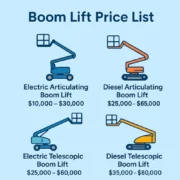
How much does a boom lift cost?
Boom lifts are among the most versatile aerial work platforms used in construction, maintenance, warehousing, industrial plants, telecommunications, utilities, shipyards, airports, and large infrastructure projects. Their ability to provide safe access to elevated and hard-to-reach work areas makes them essential equipment across many industries.
One of the most common questions buyers ask is: “How much does a boom lift cost?”
The answer depends on several factors, including lift type, working height, platform capacity, power source, manufacturer, customization requirements, and whether the equipment is new or used. Entry-level boom lifts may cost less than $20,000, while large telescopic boom lifts can exceed $250,000.
This comprehensive guide explains boom lift pricing, specifications, operating costs, competitor comparisons, and how to select the best boom lift for your project or rental fleet.
What Is a Boom Lift?
A boom lift is a type of aerial work platform (AWP) designed to lift workers, tools, and materials vertically and horizontally to elevated work areas.
Unlike scissor lifts that move primarily straight upward, boom lifts use articulated or telescopic arms to reach over obstacles and access difficult locations.
Common applications include:
- Building construction
- Exterior painting
- Steel structure installation
- Window cleaning
- Electrical maintenance
- Airport maintenance
- Telecommunications tower servicing
- Industrial facility maintenance
- Warehouse operations
- Bridge inspection
Boom lifts significantly improve safety and productivity compared to ladders and scaffolding.

Average Boom Lift Cost in 2026
The following table provides general pricing for different categories of boom lifts.
| Boom Lift Type | Working Height | New Price Range |
|---|---|---|
| Towable Boom Lift | 10–18 m | $15,000–$40,000 |
| Electric Articulating Boom Lift | 12–20 m | $30,000–$90,000 |
| Diesel Articulating Boom Lift | 16–28 m | $60,000–$150,000 |
| Electric Telescopic Boom Lift | 20–28 m | $80,000–$180,000 |
| Diesel Telescopic Boom Lift | 20–45 m | $90,000–$250,000+ |
| Ultra High-Reach Boom Lift | 45–58 m | $250,000–$600,000+ |
Prices vary according to manufacturer, configuration, and market conditions.
Factors That Affect Boom Lift Pricing
Working Height
Height is one of the biggest factors influencing boom lift costs.
Typical price ranges:
| Platform Height | Estimated Cost |
| 10–15 m | $15,000–$50,000 |
| 16–20 m | $40,000–$90,000 |
| 20–30 m | $80,000–$180,000 |
| 30–45 m | $150,000–$300,000 |
| 45 m+ | $300,000–$600,000+ |
As height increases, manufacturers must use stronger structures, larger hydraulic systems, and more sophisticated stability controls.
Boom Type
There are two primary boom lift designs.
Articulating Boom Lift
Features:
- Multiple hinged joints
- Better maneuverability
- Can reach over obstacles
Applications:
- Indoor maintenance
- Complex construction sites
- Industrial plants
Typical price:
$30,000–$180,000
Telescopic Boom Lift
Features:
- Straight extending boom
- Greater horizontal outreach
- Faster positioning
Applications:
- Large construction projects
- Bridges
- Stadiums
- Infrastructure work
Typical price:
$60,000–$250,000+
Power Source
Electric Boom Lift
Advantages:
- Zero emissions
- Quiet operation
- Suitable for indoor environments
Price range:
$30,000–$150,000
Diesel Boom Lift
Advantages:
- Higher power output
- Rough terrain capability
- Longer operating cycles
Price range:
$60,000–$250,000+
Hybrid Boom Lift
Advantages:
- Lower fuel consumption
- Reduced emissions
- Flexible indoor/outdoor use
Price range:
$80,000–$200,000+
Platform Capacity
Higher capacities require stronger structural components.
Common capacities include:
- 200 kg
- 230 kg
- 250 kg
- 300 kg
- 450 kg
Larger capacities generally increase equipment costs by 10% to 30%.

Towable Boom Lift Cost
Towable boom lifts are ideal for contractors requiring mobility and lower ownership costs.
Specifications:
| Item | Typical Value |
| Working Height | 10–18 m |
| Capacity | 200–250 kg |
| Weight | 1,500–3,500 kg |
Price range:
- Economy models: $15,000–$25,000
- Premium models: $25,000–$40,000
Advantages:
- Lower purchase cost
- Easy transportation
- Reduced maintenance
Disadvantages:
- Limited height
- Smaller platform capacity
Electric Boom Lift Cost
Electric boom lifts are increasingly popular due to environmental regulations and indoor applications.
Typical pricing:
| Height | Price Range |
| 12 m | $30,000–$50,000 |
| 16 m | $45,000–$80,000 |
| 20 m | $70,000–$120,000 |
Industries using electric boom lifts include:
- Warehousing
- Manufacturing
- Airports
- Shopping centers
- Hospitals
Electric lifts generally have lower operating costs than diesel models.
Diesel Boom Lift Cost
Diesel boom lifts dominate outdoor construction and infrastructure projects.
Typical pricing:
| Height | Price Range |
| 20 m | $70,000–$120,000 |
| 26 m | $90,000–$160,000 |
| 34 m | $140,000–$250,000 |
| 45 m | $250,000–$450,000 |
Advantages:
- Powerful engine performance
- Rough terrain capability
- Long operating hours
Disadvantages:
- Higher fuel consumption
- More maintenance
- Increased emissions

New vs Used Boom Lift Pricing
Many buyers must decide between purchasing new equipment and used equipment.
New Boom Lift
Advantages:
- Manufacturer warranty
- Latest technology
- Better safety systems
- Longer service life
Typical cost:
$20,000–$600,000+
Used Boom Lift
Advantages:
- Lower investment
- Faster ROI
Typical cost:
$10,000–$250,000
Before purchasing used equipment, inspect:
- Hydraulic cylinders
- Boom sections
- Tires
- Platform controls
- Structural welds
- Safety systems
- Battery condition
A well-maintained used boom lift can save 30%–60% compared with a new unit.
Boom Lift Rental Cost
Many companies choose rental instead of ownership.
Average rental rates:
| Rental Period | Cost |
| Daily | $250–$1,500 |
| Weekly | $800–$5,000 |
| Monthly | $2,500–$15,000 |
Rental is often ideal for short-term projects.
Ownership becomes more economical for businesses with regular equipment utilization.
Competitor Comparison: Boom Lift vs Scissor Lift
Many buyers compare boom lifts and scissor lifts before purchasing.
| Feature | Boom Lift | Scissor Lift |
| Vertical Reach | Excellent | Excellent |
| Horizontal Reach | Excellent | Limited |
| Maneuverability | Excellent | Moderate |
| Purchase Cost | Higher | Lower |
| Indoor Use | Good | Excellent |
| Outdoor Use | Excellent | Good |
| Complex Work Areas | Excellent | Limited |
Scissor lifts generally cost:
$8,000–$80,000
Boom lifts generally cost:
$15,000–$600,000+
If work requires outreach over obstacles, boom lifts are usually the better choice.
Competitor Comparison: Articulating vs Telescopic Boom Lift
Articulating Boom Lift
Advantages:
- Flexible movement
- Better obstacle avoidance
- Compact working envelope
Disadvantages:
- Lower outreach
- More complex maintenance
Telescopic Boom Lift
Advantages:
- Maximum outreach
- Faster positioning
- Higher productivity
Disadvantages:
- Less maneuverability around obstacles
Comparison table:
| Feature | Articulating | Telescopic |
| Reach Around Obstacles | Excellent | Moderate |
| Horizontal Outreach | Good | Excellent |
| Maintenance Complexity | Higher | Lower |
| Productivity | Good | Excellent |
| Industrial Maintenance | Excellent | Good |
| Construction Projects | Good | Excellent |
Competitor Comparison: Boom Lift vs Scaffolding
Traditional scaffolding still exists in many industries, but boom lifts offer significant advantages.
Scaffolding
Advantages:
- Low equipment cost
- Suitable for long-duration stationary work
Disadvantages:
- Time-consuming setup
- Higher labor requirements
- Reduced flexibility
Boom Lift
Advantages:
- Fast deployment
- Increased productivity
- Better mobility
- Enhanced safety
Disadvantages:
- Higher initial investment
For large projects, boom lifts often reduce overall labor costs enough to offset the higher purchase price.
Major Factors Influencing ROI
When calculating return on investment, consider:
Equipment Utilization
The more frequently a boom lift is used, the faster the investment is recovered.
Maintenance Costs
Annual maintenance typically ranges from:
$1,000–$15,000
Depending on:
- Usage frequency
- Lift size
- Operating environment
Fuel and Electricity
Electric models:
- Lower operating expenses
- Lower maintenance costs
Diesel models:
- Higher fuel expenses
- Greater outdoor productivity
Resale Value
Premium manufacturers typically maintain higher resale values.
Well-maintained boom lifts often retain:
- 50%–70% of value after five years

How to Choose the Right Boom Lift
Before purchasing, ask the following questions:
What Height Do You Need?
Avoid paying for unnecessary height.
Choose the smallest model capable of completing the job safely.
Indoor or Outdoor Use?
Indoor:
- Electric boom lift
Outdoor:
- Diesel rough terrain boom lift
Mixed environments:
- Hybrid models
What Obstacles Exist?
For congested environments:
- Articulating boom lifts
For open job sites:
- Telescopic boom lifts
What Is Your Budget?
Recommended options:
| Budget | Suggested Equipment |
| Under $30,000 | Towable Boom Lift |
| $30,000–$80,000 | Electric Articulating Lift |
| $80,000–$150,000 | Diesel Articulating Lift |
| $150,000–$300,000 | Large Telescopic Lift |
| $300,000+ | Ultra High-Reach Boom Lift |
Future Trends in Boom Lift Technology
The aerial work platform industry continues evolving rapidly.
Key developments include:
- Lithium battery systems
- Autonomous positioning technology
- Smart telematics
- Remote diagnostics
- Predictive maintenance
- Advanced anti-collision systems
- Hybrid powertrains
- Lightweight high-strength steel structures
These innovations improve safety, productivity, and operating efficiency while reducing ownership costs.
Conclusion
The cost of a boom lift varies widely depending on type, height, capacity, and power source. Entry-level towable boom lifts may start around $15,000, while large diesel telescopic models can exceed $250,000. Ultra-high-reach boom lifts used in major infrastructure projects can cost more than $600,000.
When evaluating boom lift prices, buyers should look beyond the purchase price and consider operating expenses, maintenance requirements, productivity gains, resale value, and project needs. Comparing boom lifts with scissor lifts, scaffolding, and alternative access solutions can help identify the most cost-effective option.
For contractors, rental companies, industrial facilities, and construction firms, selecting the right boom lift can significantly improve safety, efficiency, and long-term profitability. By understanding the factors that influence boom lift costs and comparing competing equipment types, buyers can make informed investment decisions that deliver strong returns for years to come.

Jnhclift (Huichuang Lift), based in Jinan, China, is a professional manufacturer of scissor lifts, home elevators, and lift platforms. With our own dedicated factory, we deliver high-quality, reliable lifting solutions tailored to meet diverse industrial and residential needs.
 Room 203, Second Floor, Building 8, Phase Ⅱ, Zhizao Town, Jibei Street, Jiyang District, Jinan City, Shandong Province
 +8615628811021
 admin@jnhclift.com