
Wheelchair Lifts for Homes: A Complete Guide to Residential Accessibility
Stairs, raised entrances, split-level floors, and elevated decks can make everyday movement difficult for people who use wheelchairs or mobility scooters. A wheelchair lift for home use provides a practical way to overcome these barriers without requiring the user to leave their wheelchair or transfer to a stair lift.
Modern residential wheelchair lifts are available in different configurations for indoor and outdoor installation. Some models are designed to raise a wheelchair from ground level to a front porch, while others connect different floors or provide access to elevated patios, garages, and residential entrances.
But which type of wheelchair lift is right for your home? How much space does it require? Is an outdoor model suitable for winter conditions? And how much should you budget for the equipment and installation?
This guide explains the main types of home wheelchair lifts, their specifications, costs, safety features, installation requirements, and maintenance considerations. It also introduces practical selection criteria to help homeowners, contractors, and accessibility equipment distributors choose a suitable solution.
1. What Is a Wheelchair Lift for a Home?
A residential wheelchair lift is a powered accessibility device designed to transport a person using a wheelchair, power chair, or mobility scooter between different elevations.
Unlike a traditional stair lift, which carries a seated passenger along a staircase, a wheelchair lift uses a platform large enough to accommodate the wheelchair itself.
A typical vertical wheelchair platform lift consists of:
- A lifting platform with a non-slip surface
- A supporting frame or guide rail structure
- A hydraulic or mechanical drive system
- Upper and lower landing access points
- Operating controls
- Safety devices and emergency controls
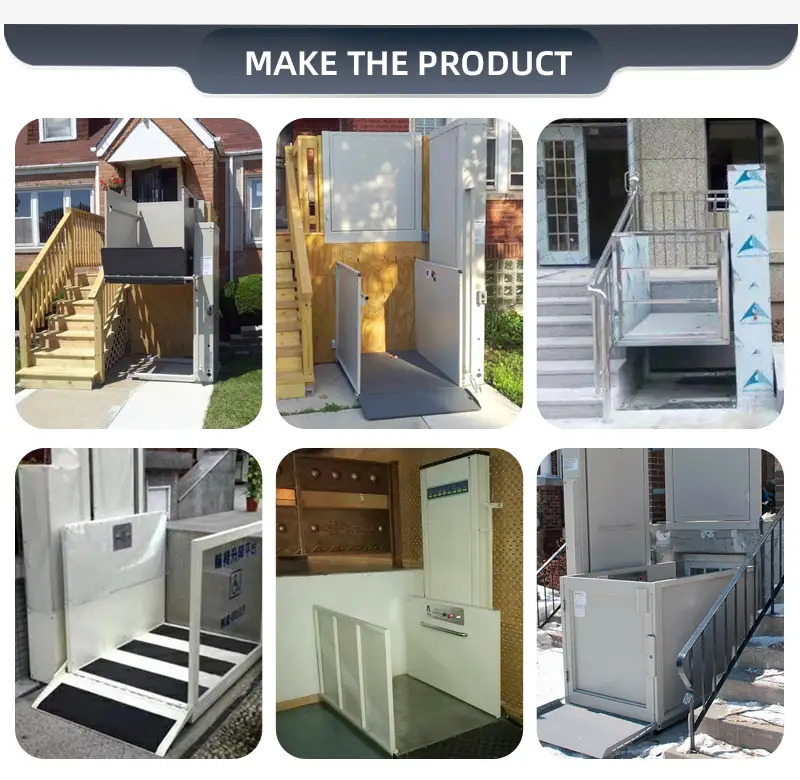
Depending on the design, a home wheelchair lift can be installed beside a front porch, outside a garage, inside a split-level home, or next to an elevated deck.
Common Applications of Home Wheelchair Lifts
| Home Area | Accessibility Problem | Recommended Solution |
|---|---|---|
| Front entrance | Several steps between the driveway and entrance | Outdoor vertical platform lift |
| Raised porch | Elevated entrance without enough ramp space | Residential porch lift |
| Backyard deck | Difference in height between the garden and deck | Outdoor wheelchair lift |
| Garage | Raised garage floor or entrance | Vertical platform lift |
| Split-level home | Short vertical distance between living areas | Indoor platform lift |
| Multi-story home | Regular movement between residential floors | Home elevator or suitable multi-floor lift system |
The most suitable solution depends on the height difference, available installation space, wheelchair dimensions, and how frequently the lift will be used.
2. Types of Wheelchair Lifts for Homes
Not every home has the same accessibility problem. A homeowner who needs to overcome three porch steps may not need the same equipment as someone who needs wheelchair access between two floors.
Understanding the different types of residential wheelchair lifts helps prevent unnecessary construction and purchasing costs.
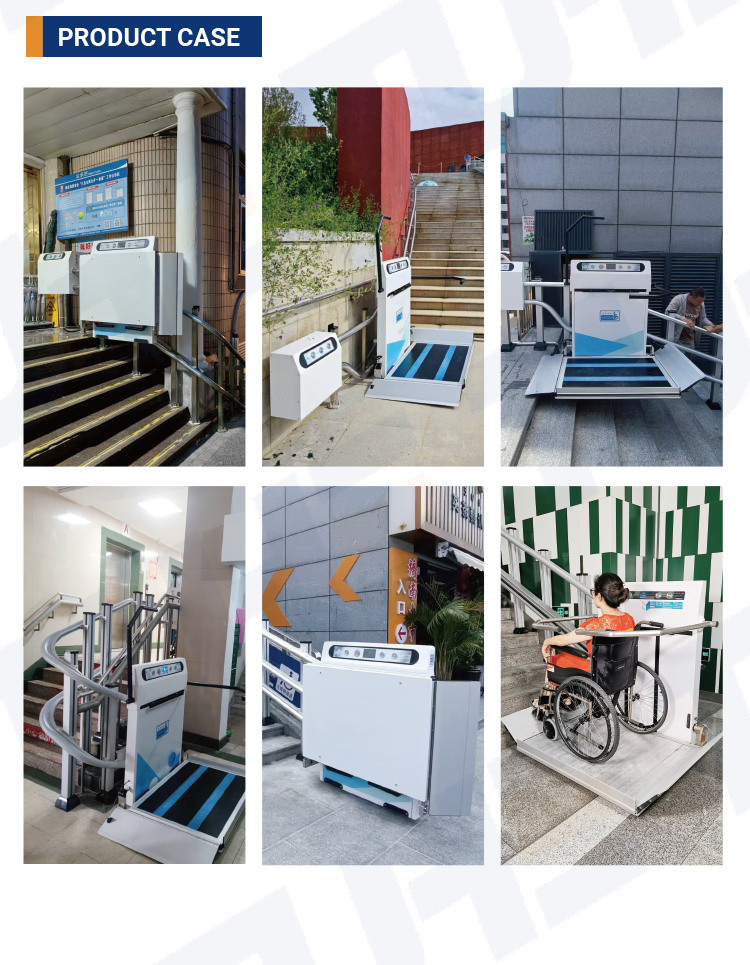
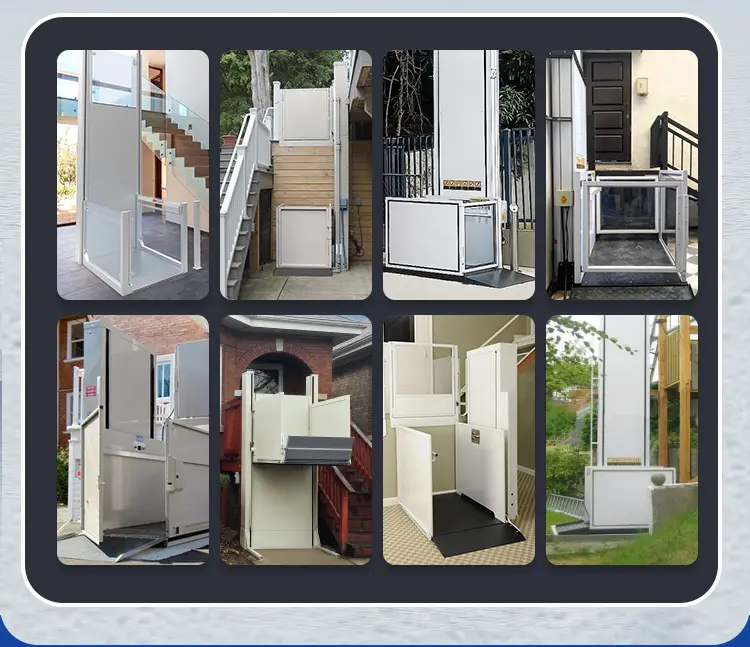
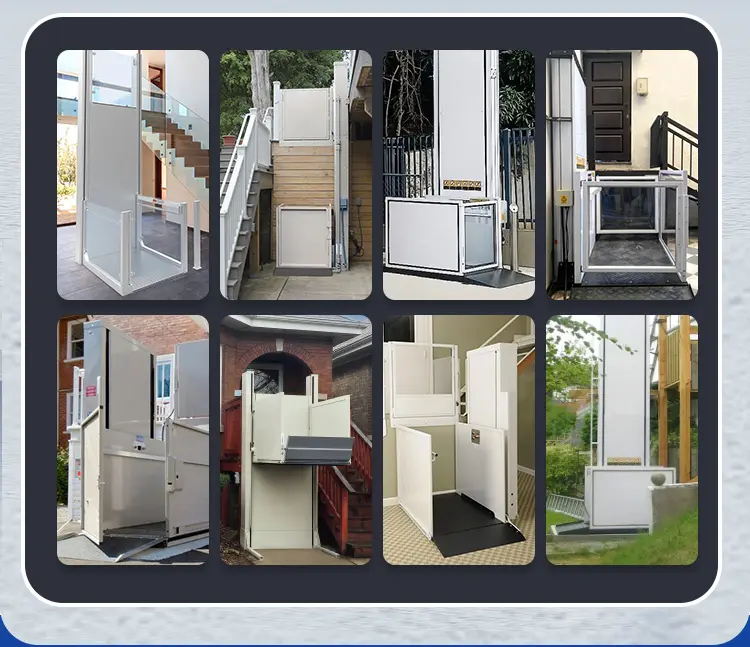
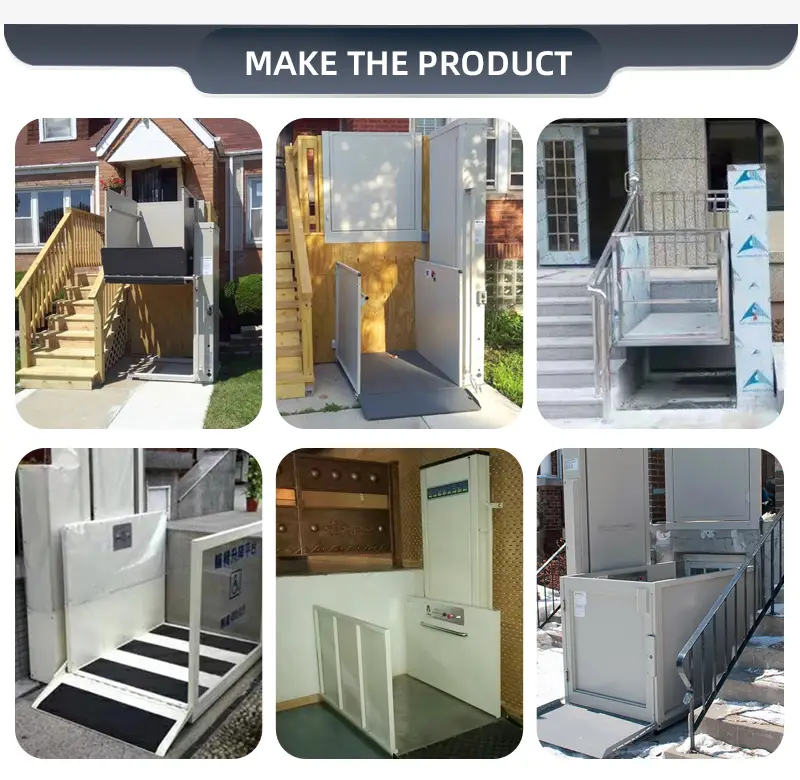
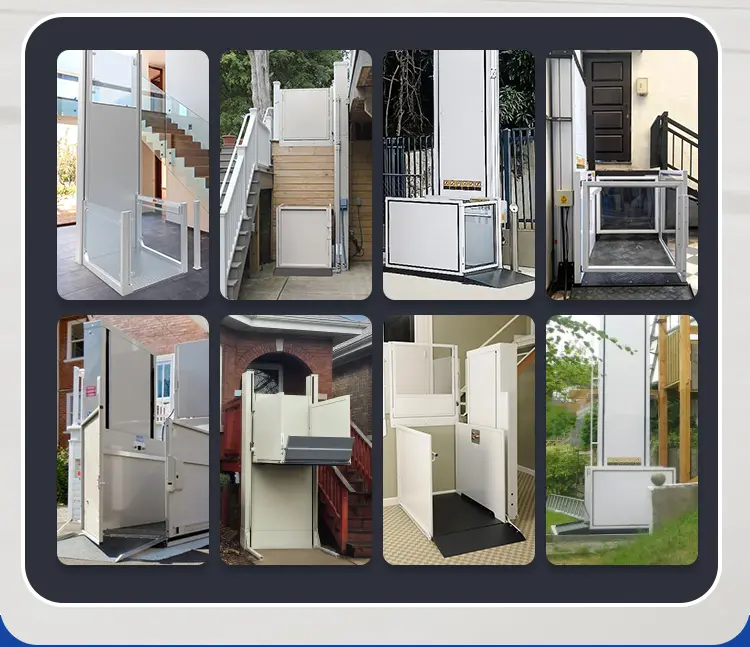
2.1 Outdoor Vertical Platform Wheelchair Lift
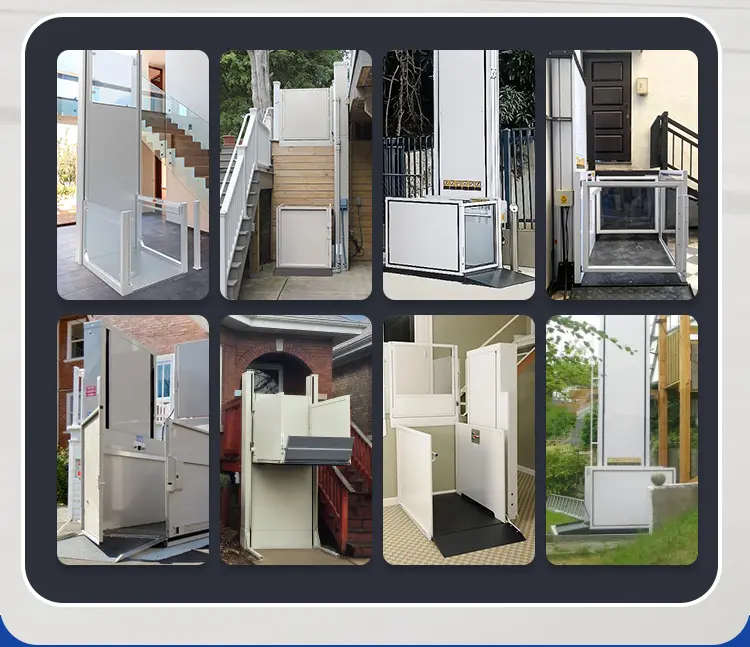
An outdoor vertical platform lift, also called a porch lift, moves a wheelchair vertically between ground level and an elevated landing.
<image-placeholder>
Typical applications include:
- Front porches
- Raised entrances
- Outdoor decks
- Garage access
- Garden platforms
- Exterior residential stairs
Its main advantage is that it can provide direct vertical access without requiring a long wheelchair ramp.
For example, a homeowner with a 1.2-meter-high front porch may find that a wheelchair ramp requires considerable ground space. A vertical platform lift can provide a more compact alternative when the site is suitable.
Important specifications to consider include:
- Rated load capacity
- Platform dimensions
- Maximum travel height
- Outdoor corrosion protection
- Weather-resistant electrical components
- Emergency lowering
- Landing gate configuration
Huichuang Lift offers customized outdoor residential wheelchair lifts with lifting heights from 1 to 6 meters and a rated capacity of 250 kg for a published model configuration.
See our 1–6m Outdoor Residential Wheelchair Lift with Cabin for product details.
2.2 Indoor Vertical Platform Wheelchair Lift
An indoor wheelchair platform lift is designed for homes where a wheelchair user needs to move between different floor levels or overcome an internal elevation change.
Typical applications include:
- Raised living rooms
- Sunken living rooms
- Split-level houses
- Interior entrance steps
- Small residential floor transitions
Compared with a conventional passenger elevator, an indoor vertical platform lift can offer a more compact solution for certain short-rise applications.
However, the installation area must still provide enough clearance for the platform, entrance, landing access, and safe wheelchair maneuvering.
Before selecting a model, consider:
- Whether the lift will be installed beside a wall or within an enclosed area
- Whether a dedicated shaft or enclosure is required
- The available platform entrance direction
- Whether the wheelchair user needs a caregiver to travel with them
- The building’s structural and electrical conditions
For a home with several full floors, a residential elevator may be more suitable than a short-rise platform lift.
2.3 Inclined Platform Wheelchair Lift
An inclined platform lift travels along a rail system installed beside an existing staircase.
Unlike a stair lift with a seat, it has a platform designed to carry a wheelchair.
It may be suitable when:
- The staircase cannot be replaced
- There is insufficient space for a vertical lift
- The homeowner wants to preserve the existing stair structure
- The staircase has a straight or curved layout that can accommodate a suitable rail system
The platform can often fold when not in use to reduce its impact on the available staircase width.
However, buyers should check the staircase width, landing space, turning points, rail configuration, and whether the remaining stairway provides adequate access for other household members.
2.4 Multi-Floor Home Wheelchair Lift
For a multi-story residence, a homeowner may need a system that connects more than two levels.
In this situation, the choice may be between a suitable multi-stop platform lift and a wheelchair-accessible home elevator.
A traditional residential elevator may be a better option when:
- The user needs frequent access to several floors
- A fully enclosed passenger cabin is preferred
- The lift will serve multiple household members
- The building design supports an elevator installation
Explore our 2, 3, 4, 5 and 6-floor wheelchair lift solutions for multi-level residential projects.
3. How Much Do Wheelchair Lifts for Homes Cost?
The price of a home wheelchair lift depends on the product type, lifting height, platform dimensions, load capacity, installation conditions, and optional safety features.
It is important to distinguish between equipment-only prices and complete installed project costs.
Residential Wheelchair Lift Price Comparison
| Product Type | Indicative Equipment Price (USD) | Main Application |
|---|---|---|
| Basic residential vertical platform lift | $2,400–$6,500 | Short-rise home access |
| Customized outdoor wheelchair lift | $3,000–$10,000+ | Porches, decks, and raised entrances |
| Enclosed vertical platform lift | $5,000–$15,000+ | Outdoor or indoor residential access |
| Inclined wheelchair platform lift | $5,000–$15,000+ | Existing staircases |
| Wheelchair-accessible home elevator | $15,000–$40,000+ | Multi-floor residential transportation |
These are preliminary equipment-budget references, not fixed market averages. Product configurations, destination markets, shipping, taxes, and installation can change the final cost.
Huichuang Lift Factory Price Reference
Huichuang Lift publishes a price range of approximately $2,400–$6,500 for selected residential vertical wheelchair lift configurations.
One published product configuration includes:
| Specification | Product Details |
|---|---|
| Rated load | 250 kg |
| Lifting height | 1–6 meters |
| Platform size | 1430 × 1000 mm |
| Drive system | Hydraulic |
| Lifting speed | 6–8 m/min |
| Power supply | 220V / 50Hz, customizable options |
| Control | Push-button and remote control options |
| Customization | Platform dimensions and other configurations |
These specifications describe a listed product configuration. The final design must be confirmed according to the actual project and destination requirements.
Equipment Price vs. Installation Price
A factory-direct price is not the same as a complete installation quotation.
For U.S. homeowners, published estimates vary significantly. Angi reports an average wheelchair platform lift cost of approximately $8,800 in 2026, with many projects ranging from $3,600 to $15,900. Lifeway Mobility reports professionally installed wheelchair platform lift projects commonly costing $12,000–$35,000 or more.
These estimates use different product and service scopes. A factory equipment quotation should not be compared directly with a local contractor’s complete installation price.
Additional project expenses may include:
- Concrete foundation
- Electrical work
- Structural modifications
- Shipping and delivery
- Installation labor
- Permits and inspection
- Weather protection
- Local maintenance services
For a more detailed breakdown, read our platform lift cost guide.
4. How to Choose the Right Wheelchair Lift for Your Home
The best wheelchair lift is not necessarily the model with the highest capacity or the lowest price.
It is the model that matches the user’s mobility equipment, the home’s structure, the required travel distance, and the intended operating conditions.
4.1 Measure the Vertical Travel Height
The first measurement is the vertical distance between the lower and upper landings.
Do not measure the length of the staircase or the horizontal distance between the two levels. The manufacturer needs the actual vertical rise.
For example:
| Installation Situation | Approximate Vertical Rise | Possible Solution |
|---|---|---|
| Small entrance step | 300–600 mm | Short-rise platform lift or ramp |
| Raised front porch | 600–1,500 mm | Outdoor vertical platform lift |
| Elevated deck | 1,500–2,500 mm | Customized vertical platform lift |
| Split-level interior | 1,000–2,000 mm | Indoor platform lift |
| Multiple residential floors | Project-specific | Home elevator or multi-stop system |
These are illustrative planning categories, not fixed product limits.
A professional site assessment should confirm the available space, landing conditions, support structure, and applicable installation requirements.
4.2 Choose the Correct Platform Size
Platform dimensions are one of the most overlooked factors when buying a wheelchair lift.
A lift may have sufficient rated load capacity but still be unsuitable if the wheelchair cannot enter, turn, or exit comfortably.
Measure:
- Overall wheelchair width
- Overall wheelchair length
- Footrest projection
- Turning clearance
- Required caregiver space
- Door or gate opening width
A standard wheelchair and a large powered wheelchair may have very different space requirements.
For example, Huichuang Lift’s published residential vertical platform lift has a platform size of 1430 × 1000 mm. Custom platform dimensions are available for suitable projects.
However, do not select platform dimensions based on the wheelchair alone. The complete entrance and exit arrangement must also be considered.
4.3 Check the Rated Load Capacity
The rated capacity must accommodate the wheelchair user and all equipment or people permitted to travel on the lift.
Common capacity categories include:
| Rated Load | Typical Application |
|---|---|
| 250 kg | Standard residential wheelchair lift configurations |
| 350 kg | Higher-capacity residential applications |
| 400 kg | Selected customized accessibility systems |
A higher rated capacity may require stronger supporting structures and different hydraulic components.
If a caregiver needs to accompany the wheelchair user, confirm that the platform dimensions and rated load are sufficient for both.
Never exceed the manufacturer’s stated load limit.
4.4 Select Indoor or Outdoor Installation
Indoor and outdoor lifts have different environmental requirements.
| Consideration | Indoor Wheelchair Lift | Outdoor Wheelchair Lift |
|---|---|---|
| Environmental exposure | Relatively protected | Exposed to weather |
| Surface treatment | Standard suitable finish | Corrosion-resistant finish may be required |
| Electrical protection | Suitable indoor enclosure | Weather-resistant electrical enclosure |
| Drainage | Usually less demanding | Important around the foundation |
| Temperature | Indoor operating conditions | Must match local climate |
| Maintenance | Indoor cleaning and inspection | Additional weather-related checks |
For outdoor installations, buyers in colder regions should pay particular attention to low-temperature operation, moisture protection, corrosion resistance, and ice or snow accumulation.
Specify a lift for the actual local climate rather than simply describing it as weatherproof.
4.5 Consider the Entrance and Exit Direction
The platform entrance arrangement affects how easily a wheelchair user can enter and leave the lift.
Common configurations include:
- Same-side entry and exit
- 90-degree entry and exit
- 180-degree straight-through entry and exit
For example, a home with a narrow porch may require a 90-degree arrangement to connect the driveway and entrance.
A straight-through arrangement may be more convenient when the lower and upper landing spaces are aligned.
The manufacturer should confirm the available configuration against the site drawing before production.
5. Wheelchair Lift vs. Ramp vs. Stair Lift vs. Home Elevator
Homeowners often compare wheelchair lifts with ramps, stair lifts, and home elevators.
Each solution addresses a different accessibility problem.
| Accessibility Solution | Carries the Wheelchair? | Best Application | Main Limitation |
|---|---|---|---|
| Wheelchair ramp | Yes | Low-height entrances with sufficient space | Requires a longer access route |
| Stair lift | No | Users who can transfer to a seat | Wheelchair must be moved separately |
| Vertical platform lift | Yes | Raised porches and short vertical travel | Limited travel height compared with elevators |
| Inclined platform lift | Yes | Existing staircases | Requires suitable staircase and rail layout |
| Home elevator | Yes, if properly configured | Multiple floors | Higher investment and more construction planning |
When Is a Wheelchair Lift Better Than a Ramp?
A ramp is often a practical solution for a small elevation change when sufficient space is available.
However, a higher entrance may require a much longer ramp.
For example, using a 1:12 slope as a preliminary planning illustration, a 900 mm rise would require approximately 10.8 meters of sloped ramp run, excluding landings and additional maneuvering space.
This is why a vertical platform lift can be a more space-efficient solution for some homes.
The actual ramp slope, landings, clear width, handrails, and other requirements must be determined according to the applicable accessibility standards and project conditions.
When Is a Wheelchair Lift Better Than a Stair Lift?
A stair lift carries a seated passenger along a staircase. The user generally needs to transfer from the wheelchair to the stair lift seat.
A wheelchair platform lift carries the wheelchair itself.
Therefore, a platform lift is usually more appropriate when the user cannot safely or comfortably transfer between mobility devices.
When Should You Choose a Home Elevator?
Consider a home elevator when the user needs to travel between several full floors.
It may offer:
- An enclosed cabin
- More comfortable multi-floor transportation
- Greater flexibility for regular household use
- A design that integrates with the home’s interior
However, a home elevator generally requires a higher investment and more detailed building planning.
For a short entrance rise, a vertical platform lift may be a simpler solution.
Learn more about our home elevator solutions.
6. Essential Safety Features for Residential Wheelchair Lifts
Safety is the most important consideration when selecting a home wheelchair lift.
A residential lift must be designed to prevent unintended movement, protect users during travel, and provide a safe way to respond to equipment or power failures.
Important safety features include:
Emergency Stop Button
An accessible emergency stop button allows the lift to be stopped immediately when an unusual situation occurs.
It should be positioned where the user or caregiver can reach it easily.
Safety Sensors
Sensors can detect obstacles in designated areas and stop movement when an obstruction is detected.
Their location and function depend on the equipment design.
Overload Protection
Overload protection prevents the lift from operating when the load exceeds its rated capacity.
This helps protect the lifting mechanism and supporting structure.
Door and Gate Interlocks
Landing gates and doors should be designed so that the lift cannot operate under unsafe access conditions.
The exact interlock arrangement depends on the lift configuration and applicable regulations.
Emergency Lowering
If a power failure occurs, the user needs a defined emergency procedure.
Depending on the model, this may involve battery-assisted lowering or a manual emergency lowering valve.
Non-Slip Platform
A non-slip surface helps reduce the risk of wheelchair movement during entry, exit, and travel.
The platform should also have appropriate barriers and edge protection according to its design.
What Should You Check Before Accepting the Equipment?
| Inspection Item | What to Verify |
|---|---|
| Load capacity | Rated capacity is clearly identified |
| Platform | Surface is stable and non-slip |
| Emergency stop | Operates correctly |
| Safety sensors | Respond to the specified test conditions |
| Landing gates | Close and lock correctly |
| Interlocks | Prevent unsafe operation |
| Emergency lowering | Procedure is demonstrated |
| Controls | Accessible and understandable |
| Operating manual | Provided in the required language |
For U.S. projects, ask the supplier and local installer to identify the applicable requirements, including ASME A18.1 where relevant, as well as local building and electrical requirements. ADA requirements should be assessed according to the building and installation context; a residential product description alone does not establish compliance for every project.
7. How Is a Home Wheelchair Lift Installed?
Installation requirements depend on the selected model, lifting height, structural arrangement, and whether the lift is installed indoors or outdoors.
A typical installation project involves the following steps.
Step 1: Site Assessment
Measure the vertical rise, available floor area, platform landing locations, and entrance clearance.
Check whether the proposed location provides enough room for the wheelchair to enter and exit safely.
Step 2: Confirm the Foundation
The lift must be supported by a suitable foundation or building structure.
Some vertical platform lift models can be fixed directly to a properly prepared concrete floor without a conventional elevator pit.
For example, Huichuang’s published residential VPL specification identifies direct floor mounting and a concrete thickness requirement of at least 200 mm.
This is a model-specific installation reference, not a universal requirement. The actual foundation must be verified against the selected lift’s engineering drawings and site conditions.
Step 3: Confirm the Electrical Supply
Check the local power supply before ordering.
A published Huichuang residential model uses single-phase 220V/50Hz, with customization options available.
For U.S. installations, the electrical configuration must be confirmed for the actual local supply and equipment. Do not assume that a 220V/50Hz factory specification can be connected directly to every U.S. residential electrical system.
Step 4: Manufacture and Deliver the Lift
After the specifications and drawings are approved, the manufacturer prepares the equipment.
International orders also require export packaging, shipping arrangements, customs clearance, and local delivery planning.
Step 5: Installation and Commissioning
The installation team assembles the equipment, connects the electrical and control systems, and verifies the operation of the safety devices.
Step 6: Final Testing and User Training
Before handover, the installer should demonstrate:
- Normal operation
- Emergency stop
- Emergency lowering
- Door and gate operation
- Load limits
- Routine inspection procedures
- Maintenance requirements
The homeowner should receive the operating manual and relevant technical documentation.
8. How to Maintain a Residential Wheelchair Lift
Regular maintenance helps maintain safe operation and reduce unexpected downtime.
The maintenance schedule should always follow the manufacturer’s instructions and local inspection requirements.
| Maintenance Frequency | Recommended Check |
|---|---|
| Before use | Check the platform and landing area for obstructions |
| Regularly | Clean the platform and accessible surfaces |
| Monthly or as specified | Inspect visible safety devices and controls |
| Periodically | Check hydraulic hoses, connections, and electrical components |
| According to the service schedule | Professional inspection and servicing |
For outdoor wheelchair lifts, additional attention should be paid to:
- Leaves and debris around the platform
- Water accumulation
- Corrosion and surface damage
- Ice and snow
- Weather seals and electrical enclosures
- Unusual operating noises
Do not attempt to repair hydraulic or electrical components without appropriate technical knowledge.
If the lift makes unusual noises, moves irregularly, or has a malfunctioning safety device, stop using it and contact a qualified technician.
9. Why Choose Huichuang Lift for Home Wheelchair Lifts?
Huichuang Lift, operated by Jinan Huichuang Machinery Manufacturing Co., Ltd., manufactures wheelchair lifts, hydraulic lifting equipment, home elevators, and customized platform lifting systems.
Our residential wheelchair lift solutions are designed for different accessibility requirements, including outdoor entrances, raised porches, decks, and indoor residential applications.
Our Product Advantages
Customized Platform Dimensions
Platform dimensions can be adjusted according to wheelchair size, available installation space, and entrance arrangements.
Flexible Lifting Height
Selected residential vertical platform lift models support lifting heights from 1 to 6 meters, with customized solutions available for suitable projects.
Hydraulic Drive System
Hydraulic drive configurations provide controlled vertical movement and can be selected according to the required load and lifting height.
Indoor and Outdoor Options
Suitable configurations are available for residential installations in different environments, subject to the required environmental protection and site conditions.
Multiple Entry and Exit Arrangements
Same-side, 90-degree, and 180-degree access configurations can be considered according to the building layout.
OEM and Factory-Direct Cooperation
We support customized manufacturing and OEM cooperation for distributors, contractors, and accessibility equipment suppliers.
Product Specification Example
| Parameter | Published Product Specification |
|---|---|
| Product | Outdoor residential wheelchair lift |
| Rated load | 250 kg |
| Lifting height | 1–6 m |
| Platform size | 1430 × 1000 mm |
| Drive system | Hydraulic |
| Speed | 6–8 m/min |
| Power | 220V/50Hz, customizable options |
| Control | Push-button / remote options |
| Customization | Available |
These are reference specifications for one published model. Other configurations may have different technical parameters.
Learn more about our vertical platform wheelchair lifts for homes.
Manufacturing and After-Sales Support
For international customers, we provide:
- Customized product specifications
- Technical drawings and product documentation
- Installation manuals
- Wiring diagrams
- Remote installation guidance
- Replacement parts support
- Technical assistance
- OEM and distributor cooperation
Explore our wheelchair lift manufacturing factory and company profile to learn more about our manufacturing capabilities.

10. Home Wheelchair Lift Buying Checklist: What Should You Prepare?
Before contacting a manufacturer, prepare the following information.
This will help the supplier recommend a suitable model and provide a more accurate quotation.
| Information | What to Provide |
|---|---|
| Installation location | Indoor or outdoor |
| Application | Front porch, deck, garage, or indoor floor |
| Vertical travel height | Exact height difference between landings |
| Wheelchair dimensions | Overall width and length |
| Rated load | User, wheelchair, and additional permitted load |
| Platform dimensions | Required usable platform area |
| Entrance arrangement | Same-side, 90-degree, or 180-degree |
| Available installation space | Length, width, and height |
| Foundation | Existing concrete or proposed supporting structure |
| Power supply | Local voltage and frequency |
| Destination | Country and city |
| Quantity | One unit or multiple units |
A Practical Example
Suppose a homeowner needs a wheelchair lift for a raised outdoor porch.
The project information might look like this:
| Requirement | Example |
|---|---|
| Application | Front porch access |
| Installation | Outdoor |
| Vertical rise | 1.5 meters |
| Rated load | 250 kg |
| Platform size | 1430 × 1000 mm |
| Drive system | Hydraulic |
| Entry and exit | 90-degree |
| Power supply | To be confirmed locally |
| Quantity | 1 unit |
With these details, the manufacturer can evaluate whether a standard configuration is suitable or whether customization is required.
Tip: Send photographs of the entrance, staircase, landing, and available installation area. A simple site drawing with measurements can also help avoid unnecessary changes after production.
11. Frequently Asked Questions About Wheelchair Lifts for Homes
What is the best wheelchair lift for a home?
The best wheelchair lift depends on the home’s layout and the user’s mobility needs. An outdoor vertical platform lift is often suitable for raised porches and decks, while an indoor platform lift may work better for split-level interiors. Multi-story homes may require a wheelchair-accessible home elevator.
How much does a home wheelchair lift cost?
The cost varies according to the model, travel height, platform size, and installation requirements. Huichuang Lift publishes selected residential vertical platform lift configurations at approximately $2,400–$6,500 for equipment. Complete installed prices in the United States can be considerably higher.
Can a wheelchair lift be installed outside a house?
Yes. Many residential wheelchair lifts are designed for outdoor use. The selected model should have suitable corrosion protection, weather-resistant electrical components, and an installation arrangement appropriate for the local climate.
How much space is needed for a home wheelchair lift?
The required space depends on the platform dimensions, supporting structure, entrance arrangement, and available landing area. The standard platform size of one Huichuang model is 1430 × 1000 mm, but the complete installation footprint will be larger.
Can a wheelchair lift carry a caregiver?
Some models can accommodate a wheelchair user and caregiver, but this depends on the platform size and rated load capacity. Confirm the combined weight and required space before ordering.
Is a vertical platform lift better than a wheelchair ramp?
A vertical platform lift can be more space-efficient when the entrance is relatively high or the available ground area is limited. A ramp may be more economical for a small rise when enough space is available. The best option depends on the site’s layout and applicable accessibility requirements.
Can a home wheelchair lift work during a power outage?
Some models provide battery backup or manual emergency lowering. Buyers should confirm the exact emergency operation method for the selected configuration and ensure that household members know how to use it.
Does a wheelchair lift require an elevator shaft?
Many vertical platform lifts are designed without a conventional elevator shaft or full elevator hoistway. However, they still require suitable structural support, safe landing access, and any enclosure or guarding required by the applicable design and regulations.
How long does a residential wheelchair lift last?
Service life depends on the design, operating frequency, environment, maintenance, and availability of replacement parts. Follow the manufacturer’s maintenance schedule and arrange professional servicing as required.
Can I customize the platform size and lifting height?
Yes. Many manufacturers support customization of platform dimensions, lifting height, entrance direction, finishes, and control systems. Customization should be finalized through approved technical drawings before production.
Is a wheelchair lift suitable for a multi-story home?
A vertical platform lift can serve selected multi-level applications, depending on its design and permitted travel height. For regular transportation between several full floors, a residential elevator may be more appropriate.
12. Get a Customized Wheelchair Lift for Your Home
Choosing the right wheelchair lift is about more than finding a product that can move vertically. The lift must fit the wheelchair, accommodate the user safely, match the home’s structure, and operate reliably in its installation environment.
For a raised porch, an outdoor vertical platform lift may provide a compact alternative to a long wheelchair ramp. For an indoor split-level home, a compact platform lift may solve a difficult floor transition. For a multi-story residence, a wheelchair-accessible home elevator may be a better long-term solution.
Huichuang Lift provides residential wheelchair lifts, outdoor vertical platform lifts, customized hydraulic lifting systems, and OEM manufacturing services for international customers.
Contact our team to discuss your home wheelchair lift project.
To receive a suitable recommendation and quotation, please provide:
- Required lifting height
- Wheelchair dimensions
- Rated load capacity
- Available installation space
- Indoor or outdoor application
- Entrance and exit arrangement
- Destination country
Our team can help evaluate your requirements and recommend a suitable residential wheelchair lift configuration.
Contact Huichuang Lift: https://www.jnhclift.com/contact-us/

JGS has 15 years of experience working in the lift manufacturing industry, providing customized and OEM lift solutions to lift buyers.
 Room 203, Second Floor, Building 8, Phase Ⅱ, Zhizao Town, Jibei Street, Jiyang District, Jinan City, Shandong Province
 +86 152 5319 3706
 admin@jnhclift.com