
What Is a Scissor Lift? A Complete Guide to Types, Uses, and Applications
When working at height, having the right access equipment can make a significant difference in workplace safety, productivity, and operating efficiency. Whether it is installing electrical systems in a warehouse, maintaining factory equipment, or completing construction work, workers need a stable and reliable way to reach elevated areas.
This is where a scissor lift becomes an important piece of equipment.
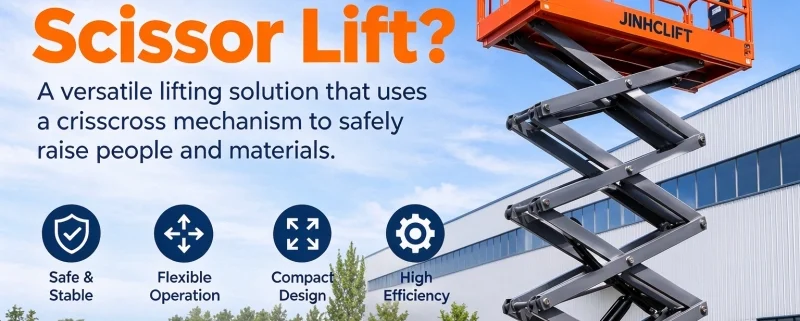
A scissor lift is a mechanical elevating platform that raises workers, tools, and approved materials vertically using a folding support mechanism made of connected steel arms. The arms extend and retract in a crisscross pattern, allowing the platform to move up and down while maintaining a relatively consistent horizontal position.
Unlike boom lifts, which can provide horizontal outreach, scissor lifts are primarily designed for vertical access. Their spacious platforms, practical load capacities, and straightforward lifting structures make them suitable for many construction, warehouse, manufacturing, and maintenance applications.
However, not all scissor lifts are designed for the same purpose. Different models offer different lifting heights, platform capacities, mobility systems, power sources, and operating conditions.
In this guide, we will explain what a scissor lift is, how it works, the different types available, where it is used, and what buyers should consider when choosing the right model.
1. What Is a Scissor Lift?
A scissor lift, also known as a scissor platform lift or scissor elevating work platform, is a lifting machine designed to provide controlled vertical access to elevated working areas.
Its defining feature is a series of interconnected metal arms arranged in an X-shaped configuration. These arms expand when the platform rises and fold together when it lowers, creating the characteristic scissor-like movement.
Most mobile scissor lifts consist of five main structural systems:
- Work Platform: The upper deck where operators stand and carry permitted tools or materials.
- Scissor Arms: Interconnected steel supports responsible for raising and lowering the platform.
- Hydraulic System: Supplies the force required to extend the lifting mechanism in hydraulic models.
- Base Frame and Chassis: Supports the machine and provides stability, with wheels or tracks on mobile models.
- Control System: Allows operators to control lifting, lowering, movement, and emergency functions.
Depending on the design, a scissor lift may be manually moved, towed, self-propelled, crawler-mounted, or permanently installed.
The equipment is commonly used for overhead maintenance, electrical installation, warehouse operations, construction, industrial servicing, and other tasks that require a stable elevated working surface.
For buyers comparing different configurations, the Huichuang lift Scissor Lift Product Range provides an overview of available lifting solutions.
2. How Does a Scissor Lift Work?
The working principle of a scissor lift is based on the expansion and contraction of connected support arms.
In a typical hydraulic scissor lift, an electric motor or another power source drives a hydraulic pump. The pump delivers pressurized hydraulic oil to one or more cylinders, causing the cylinders to extend and push the scissor arms outward.
As the arms open, the platform moves vertically upward.
When the operator activates the lowering control, the hydraulic system regulates the return of oil, allowing the cylinders and scissor arms to retract. The platform then descends in a controlled manner.
The basic lifting process includes:
- The power source activates the hydraulic pump.
- Hydraulic pressure is generated and delivered to the cylinders.
- The cylinders extend and push the connected scissor arms.
- The arms expand, raising the platform vertically.
- Control valves regulate the movement and lowering process.
Some lifting systems use alternative mechanical or electric actuator arrangements. The exact configuration depends on the machine design.
It is important to understand that the hydraulic system provides lifting force, while the scissor structure supports the platform and transfers the load through the lifting mechanism.
For a more detailed technical explanation of hydraulic cylinders, pumps, valves, and the complete lifting process, read our guide: How Does a Scissor Lift Work?
3. What Are the Different Types of Scissor Lifts?
Scissor lifts are available in several configurations. The main differences involve how the equipment moves, where it operates, and what type of lifting task it performs.
Understanding these differences is essential when selecting equipment for a specific project.
3.1 Mobile Scissor Lift
A mobile scissor lift is designed to be moved between working locations. Depending on the model, it may use wheels and manual positioning or an integrated mobility system.
These machines are suitable for maintenance, installation, and other tasks where operators need to access different elevated positions within a facility or job site.
Typical applications include:
- Warehouse maintenance
- Commercial building repairs
- Factory equipment servicing
- Electrical installation
- Indoor construction
A mobile model is particularly useful when the working location changes frequently but the machine does not necessarily need to drive itself while elevated.
Explore the Mobile Scissor Lift range for equipment designed around flexible positioning requirements.
3.2 Self-Propelled Electric Scissor Lift
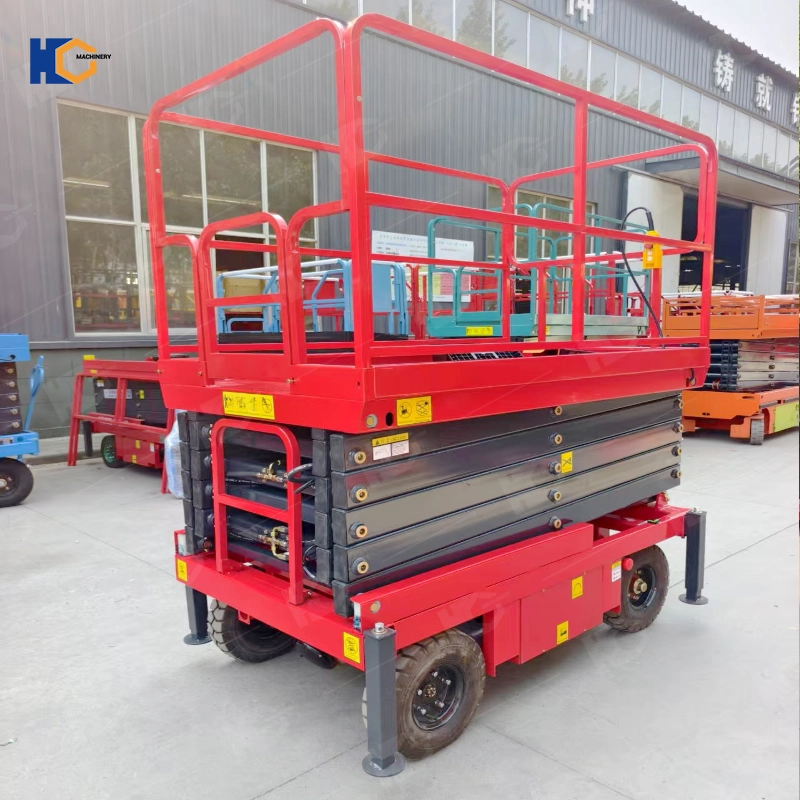
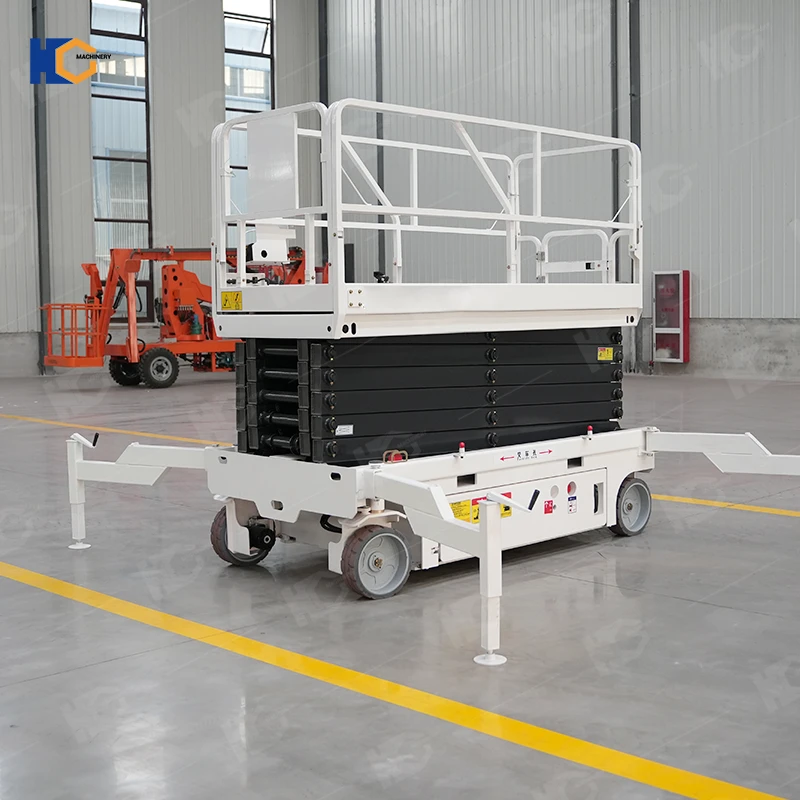
A self-propelled electric scissor lift combines vertical lifting with powered horizontal movement.
Instead of relying on workers to push or tow the machine, operators can control its travel through the onboard driving system.
Depending on the specific model, certain machines can also travel while the platform is elevated, subject to manufacturer restrictions and applicable safety requirements.
Common characteristics include:
- Battery-powered operation
- Electric drive motors
- Compact chassis designs
- Relatively quiet operation
- No exhaust emissions at the point of use
Electric scissor lifts are widely used in warehouses, factories, shopping centers, airports, and commercial buildings where indoor operation is important.
For projects requiring frequent repositioning, a Self-Propelled Electric Scissor Lift can help reduce manual handling and improve work efficiency.
3.3 Towable Mobile Scissor Lift
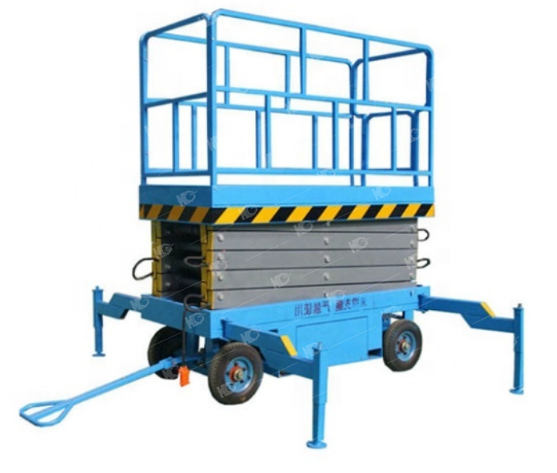
A towable scissor lift is designed to be transported between job sites using a suitable towing vehicle.
Unlike self-propelled models, its main transportation advantage is the ability to move the equipment over longer distances without relying on its own powered driving system.
Typical applications include:
- Building maintenance
- Outdoor facility repairs
- Construction projects
- Temporary installation work
- Maintenance contractors working across multiple locations
Before choosing a towable lift, buyers should consider towing compatibility, overall dimensions, transport weight, setup requirements, and the conditions of the intended working surface.
See the Towable Mobile Scissor Lift for a closer look at this configuration.
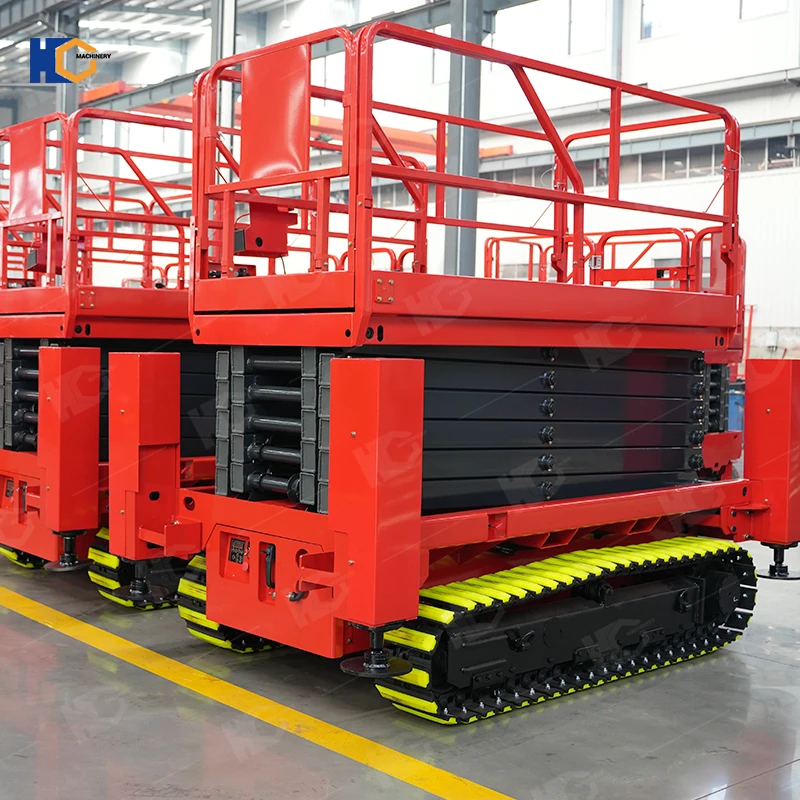
3.4 Crawler Scissor Lift
A crawler scissor lift uses tracked undercarriage systems instead of conventional wheels.
The tracks distribute the machine’s weight across a larger contact area and can provide better traction on certain uneven or soft surfaces.
Depending on the model, crawler scissor lifts may be equipped with additional stabilization systems, hydraulic controls, and specialized chassis structures.
They are commonly considered for:
- Outdoor construction sites
- Uneven ground conditions
- Landscaping and infrastructure projects
- Industrial maintenance
- Sites where conventional wheeled equipment has limited traction
However, tracked equipment is not automatically suitable for every rough-terrain application. Maximum slope, ground pressure, machine weight, and stabilization requirements must be checked against the manufacturer’s specifications.
Learn more about the Crawler Scissor Lift for demanding ground conditions.
3.5 Fixed Scissor Lift Platform
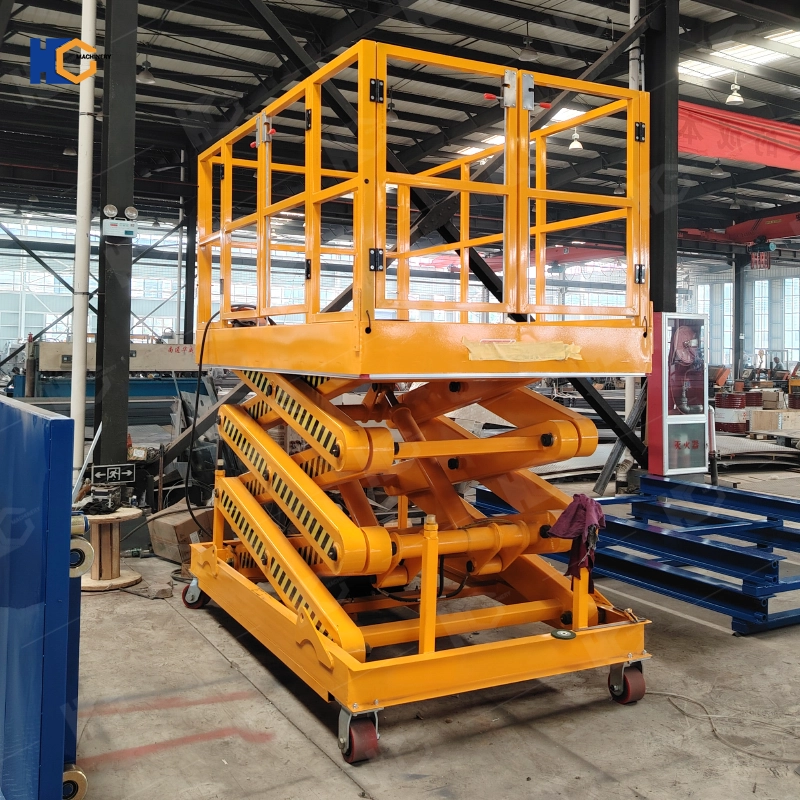
A fixed scissor lift is generally installed at a designated location rather than moved around a job site.
Unlike mobile personnel access platforms, fixed hydraulic scissor lift tables are commonly designed to raise goods, pallets, production materials, or equipment between different working levels.
Typical applications include:
- Factory production lines
- Warehouse loading areas
- Material transfer stations
- Assembly workshops
- Loading and unloading operations
These systems can be customized according to platform dimensions, lifting height, rated capacity, installation space, and operating requirements.
One important distinction is that a fixed industrial scissor lift table should not automatically be treated as a personnel lifting platform. Its intended use must be confirmed from the equipment design and rated specifications.
3.6 Scissor Parking Lift
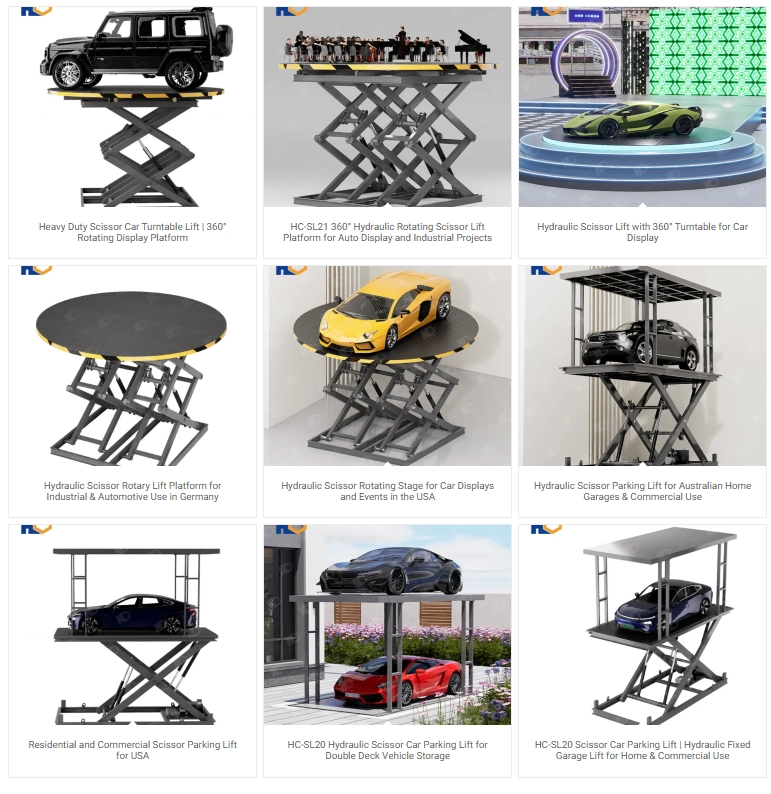
A scissor parking lift uses a scissor-type hydraulic lifting mechanism to raise and lower vehicles.
Its primary purpose is to increase parking capacity by allowing one vehicle to be stored above another, depending on the parking system configuration.
Typical applications include:
- Residential garages
- Commercial parking facilities
- Hotels
- Car dealerships
- Vehicle storage facilities
Unlike aerial work platforms, parking lifts are designed around vehicle dimensions, vehicle weight, platform configuration, and parking space requirements.
For more information about this specialized application, visit the Scissor Parking Lift product page.
4. What Are Scissor Lifts Used For?
Scissor lifts are used in industries where workers need controlled vertical access and a stable platform for carrying tools and performing tasks.
Their applications vary according to working height, platform capacity, mobility, and the operating environment.
4.1 Construction and Building Maintenance
Construction contractors use scissor lifts for tasks that require workers to reach elevated areas while carrying tools and installation materials.
Common applications include:
- Ceiling installation
- Electrical wiring
- HVAC installation
- Steel structure assembly
- Interior finishing
- Painting and decoration
- Fire protection system installation
For many indoor construction projects, electric scissor lifts are suitable when floor conditions and access dimensions meet the equipment requirements.
4.2 Warehousing and Logistics
Warehouses often have high storage racks, lighting systems, ventilation equipment, and overhead installations that require regular inspection and maintenance.
Scissor lifts can help workers access these areas without repeatedly setting up ladders or temporary scaffolding.
Typical applications include:
- High-level rack maintenance
- Lighting replacement
- Inventory system installation
- Conveyor servicing
- Fire sprinkler inspection
- Warehouse cleaning
When selecting equipment for warehouse use, buyers should pay particular attention to overall machine width, turning radius, lowered height, floor loading, and aisle clearance.
4.3 Manufacturing and Industrial Facilities
Factories rely on various types of lifting equipment to maintain production efficiency.
Scissor lifts can provide access to overhead machinery, ventilation systems, electrical installations, and other industrial infrastructure.
Common tasks include:
- Production line maintenance
- Machine servicing
- Pipeline inspection
- Industrial lighting repairs
- Equipment installation
- Factory cleaning
For material transfer between production levels, a fixed hydraulic scissor lift table may be more appropriate than a mobile personnel lifting platform.
4.4 Shopping Centers and Commercial Buildings
Shopping malls, hotels, and commercial buildings require regular maintenance of high ceilings, decorative lighting, signage, ventilation systems, and security equipment.
Electric scissor lifts are often considered for these environments because of their low operating noise and lack of exhaust emissions at the point of use.
The selected machine must also fit through entrances, elevators, corridors, and maintenance access routes.
4.5 Airports and Large Facilities
Airports and other large facilities require maintenance across extensive indoor and outdoor areas.
Scissor lifts may be used for terminal lighting, ceiling inspections, HVAC servicing, and certain equipment installation tasks.
The required working height, access restrictions, ground conditions, and operational safety procedures should be evaluated before equipment selection.
5. What Are the Advantages of a Scissor Lift?
Scissor lifts offer several practical advantages for work that requires vertical access.
5.1 A Spacious Working Platform
One of the main advantages of a scissor lift is its relatively large platform compared with many compact vertical mast lifts.
This allows operators to work with approved tools and materials while maintaining a defined working area.
Platform dimensions and occupancy limits vary by model, so the rated capacity and manufacturer’s instructions must always be followed.
5.2 High Vertical Lifting Capability
Scissor lifts are designed to raise platforms vertically through their expanding support structures.
They are particularly useful when the work area is directly above the machine’s operating position.
5.3 Practical Load Capacity
Depending on the model, a scissor lift can support one or more trained operators along with approved tools and materials.
The actual rated capacity depends on structural design, lifting height, platform configuration, and operating conditions.
Buyers should calculate the combined weight of personnel, tools, and materials rather than selecting equipment based only on the number of workers.
5.4 Improved Working Efficiency
A scissor lift can reduce the time required to access elevated work areas compared with repeatedly repositioning ladders or assembling temporary access equipment.
Self-propelled models can further improve productivity by allowing operators to reposition the machine more conveniently, within the limits specified by the manufacturer.
5.5 Multiple Configurations for Different Environments
The availability of electric, towable, crawler, and fixed configurations makes scissor lift technology suitable for a wide range of applications.
The key is selecting a machine that matches the actual work requirements instead of assuming one configuration can perform every task.
6. What Are the Limitations of a Scissor Lift?
Although scissor lifts are versatile, they are not the best solution for every elevated work requirement.
Understanding their limitations helps prevent unsuitable equipment purchases.
6.1 Limited Horizontal Outreach
A conventional scissor lift primarily moves vertically.
It generally cannot reach over obstacles or extend its platform horizontally in the same way as a boom lift.
When workers need to access areas behind structural obstacles or above equipment, a boom lift may be a more appropriate option.
6.2 Ground Conditions Matter
The stability of a scissor lift depends on the condition of the operating surface, machine configuration, load distribution, and permitted operating limits.
Soft ground, slopes, holes, debris, and uneven surfaces can create serious hazards.
Outdoor projects may require specialized rough-terrain or crawler equipment, but the selected machine must still operate within its approved ground and slope limits.
6.3 Access Space Can Be a Restriction
Although some electric scissor lifts are designed for narrow indoor spaces, larger models may not fit through standard doorways or narrow warehouse aisles.
Buyers should measure the entire access route, including door openings, turning areas, ramps, and overhead clearances.
6.4 Working Height and Load Capacity Are Limited by Design
Every scissor lift has a specified maximum platform height, working height, and load capacity.
Increasing one specification may affect machine weight, dimensions, structural requirements, and stability.
Equipment should never be operated beyond its rated limits to compensate for an incorrect selection.
7. Scissor Lift vs. Boom Lift vs. Mast Lift: What Is the Difference?
Scissor lifts, boom lifts, and mast lifts are all used for elevated access, but their designs serve different purposes.
The most important distinction is how they reach the working area and how much space they provide for operators and equipment.
| Comparison | Scissor Lift | Boom Lift | Mast Lift |
|---|---|---|---|
| Main movement | Vertical | Vertical and horizontal outreach | Primarily vertical |
| Working platform | Generally spacious | Depends on model | Usually compact |
| Horizontal reach | Limited | Yes | Limited |
| Typical capacity | Varies by model; often relatively high | Varies by model | Often lower |
| Main applications | Construction and maintenance | Obstacle access and elevated outreach | Compact indoor access |
| Common environments | Indoor and outdoor, depending on model | Indoor and outdoor, depending on model | Mainly indoor |
When Should You Choose a Scissor Lift?
Choose a scissor lift when the work area is directly above the machine and operators need a relatively spacious platform for tools and approved materials.
When Should You Choose a Boom Lift?
A boom lift is more suitable when workers need horizontal outreach to reach over obstacles, around structures, or into difficult-to-access areas.
When Should You Choose a Mast Lift?
A mast lift is worth considering when the working area is narrow and a compact machine with a smaller platform is sufficient.
For a more detailed comparison, see our guides to Cherry Picker vs. Scissor Lift and Mast Lift vs. Scissor Lift.
8. How to Choose the Right Scissor Lift
Selecting the right scissor lift requires more than comparing lifting heights or purchase prices.
The equipment should match the working environment, load requirements, available space, and expected operating frequency.
Here are seven important factors to consider.
8.1 Determine the Required Working Height
First, identify the highest point workers need to reach.
It is important to distinguish between platform height and working height.
Platform height refers to the height of the platform above the ground. Working height is generally an estimated operator reach above the platform.
Manufacturers may use different conventions when presenting specifications, so buyers should confirm how each measurement is defined.
8.2 Calculate the Required Load Capacity
Consider the total weight of:
- Operators
- Hand tools
- Installation equipment
- Permitted materials
- Other approved loads
Do not assume that a platform designed for two people can automatically support any combination of workers and equipment.
Always follow the rated capacity and occupancy limits.
8.3 Identify the Working Environment
Determine whether the machine will operate indoors, outdoors, or in both environments.
Indoor applications may require:
- Compact overall dimensions
- Non-marking tires
- Low operating noise
- Electric power
- Suitable floor loading
Outdoor applications may require:
- Greater ground clearance
- Appropriate tires or tracks
- Suitable traction
- Weather-resistant components
- Additional stabilization features
8.4 Select the Right Mobility System
Consider how frequently the equipment needs to move.
A manually positioned mobile scissor lift may be sufficient for occasional work in one area.
A self-propelled model may be more efficient for frequent repositioning.
A towable lift can be useful for contractors transporting equipment between different locations.
Crawler models may be considered for certain uneven-ground applications.
8.5 Check Machine Dimensions
Before ordering, confirm:
- Overall length and width
- Lowered machine height
- Platform dimensions
- Machine weight
- Turning radius
- Doorway and aisle clearance
- Transport dimensions
This is especially important for warehouses and facilities with restricted access.
8.6 Evaluate Power and Maintenance Requirements
Electric models generally suit indoor environments where quiet operation and the absence of exhaust emissions are important.
Other power configurations may be appropriate for outdoor or specialized industrial applications.
Buyers should also evaluate battery type, charging requirements, hydraulic component accessibility, spare parts availability, and routine maintenance needs.
8.7 Check Safety Features and Local Requirements
Depending on the model, safety features may include:
- Emergency stop controls
- Emergency lowering systems
- Guardrails and access gates
- Tilt alarms
- Overload protection
- Pothole protection
- Descent alarms
- Safety interlocks
The actual equipment configuration and required certifications should be verified against the destination market’s regulations and the manufacturer’s documentation.
9. Scissor Lift Safety: What Should Operators Know?
A scissor lift provides an elevated working platform, but safe operation depends on proper equipment selection, training, inspection, and worksite management.
Before operating a machine, workers should understand the manufacturer’s instructions and the specific limitations of the model.
Important safety considerations include:
Pre-Operation Inspection
Check the platform, guardrails, tires or tracks, hydraulic components, control systems, alarms, emergency stop, and other safety devices according to the operator’s manual.
Ground and Stability Assessment
Ensure the machine is positioned on a suitable surface and operated within its permitted slope and ground-condition limits.
Load Management
Never exceed the rated platform capacity. Include workers, tools, and materials when calculating the total load.
Fall Prevention
Keep the guardrail system installed and secured. Stand on the platform floor rather than on guardrails or other objects.
Electrical Hazards
Identify overhead power lines and other energized equipment before positioning the lift.
Movement Restrictions
Follow the manufacturer’s instructions regarding travel at elevation. Do not assume that every scissor lift can move while fully raised.
Operator Training
Only trained and authorized personnel should operate the equipment.
In the United States, OSHA provides specific guidance on scissor lift hazards, fall prevention, stabilization, positioning, inspection, and operator training.
For more detailed operating instructions, read our How to Operate a Scissor Lift: Step-by-Step Guide.
10. How Much Does a Scissor Lift Cost?
The purchase price of a scissor lift varies according to its design, lifting height, platform capacity, power system, mobility configuration, and optional features.
A compact mobile scissor lift generally has a different cost structure from a self-propelled electric model or a specialized crawler machine.
Other factors that can influence the final quotation include:
- Platform size and extension
- Battery configuration
- Hydraulic system specifications
- Drive motors and controllers
- Safety devices
- Customization requirements
- Certifications and documentation
- Order quantity
- Packaging and international shipping
For international buyers, it is also important to distinguish between EXW, FOB, and CIF quotations, as these terms represent different cost and delivery responsibilities.
Comparing equipment based only on the initial purchase price can lead to an incomplete assessment. Buyers should also consider maintenance, replacement parts, energy consumption, warranty coverage, and expected service life.
For more detailed purchasing information, read How Much Does a Scissor Lift Cost?.
11. Why Buy Scissor Lifts from a Manufacturer?
For distributors, rental companies, contractors, and industrial buyers, selecting a reliable manufacturer is just as important as selecting the right equipment.
A capable manufacturer should be able to provide more than a standard product catalogue.
Important considerations include:
Product Range
A manufacturer with multiple configurations can help buyers compare equipment according to different applications and working conditions.
Technical Customization
Some projects require specific platform dimensions, lifting heights, load capacities, voltage configurations, or control systems.
Manufacturing and Quality Control
Buyers should evaluate production facilities, component sourcing, inspection procedures, testing records, and product documentation.
Export Experience
International orders require suitable packaging, shipping coordination, export documentation, and an understanding of destination-market requirements.
After-Sales Support
Technical assistance, operating manuals, spare parts, and maintenance guidance can help reduce equipment downtime.
Jinan Huichuang Machinery Manufacturing Co., Ltd. (Huichuang lift) is a lifting equipment manufacturer based in Jinan, Shandong, China.
The company offers mobile, towable, self-propelled, crawler, and other scissor lift configurations, alongside customized lifting equipment solutions.
With its own manufacturing facilities, engineering capabilities, and OEM/ODM services, Huichuang lift works with international distributors, contractors, project developers, and equipment buyers.
You can learn more about the company’s production capabilities on the Huichuang lift Factory page.
12. Frequently Asked Questions About Scissor Lifts
What is the main purpose of a scissor lift?
The main purpose of a scissor lift is to provide controlled vertical access to elevated working areas. It allows trained workers to perform maintenance, construction, installation, and inspection tasks from a raised platform.
How high can a scissor lift go?
The maximum lifting height depends on the machine design and model. Different scissor lifts are manufactured for different working heights, ranging from compact low-level machines to larger high-reach platforms.
Always distinguish between platform height and working height when comparing specifications.
How many people can fit on a scissor lift?
The permitted number of occupants depends on the manufacturer’s rated capacity, platform configuration, and operating restrictions. Buyers should never determine occupancy based only on available platform space.
Are scissor lifts suitable for outdoor use?
Yes, certain scissor lifts are designed for outdoor applications. However, the machine must be suitable for the ground conditions, slope, weather, wind limits, and other environmental requirements of the job site.
What is the difference between an electric and a hydraulic scissor lift?
Electric scissor lifts commonly use battery-powered systems for mobility and lifting. Hydraulic scissor lifts use pressurized hydraulic fluid to generate lifting force.
These terms describe different aspects of equipment design and are not always mutually exclusive. Many electric scissor lifts also use hydraulic cylinders for vertical lifting.
Is a scissor lift better than a ladder?
For tasks requiring longer working periods, multiple tools, or a stable elevated work surface, a suitable scissor lift may be more efficient than a ladder.
However, the equipment must be selected according to the actual task, access conditions, and safety requirements.
Can a scissor lift move while elevated?
Some self-propelled models allow controlled travel at elevation under specified conditions. Other models require the platform to be fully lowered before movement.
Always follow the instructions for the exact machine model.
What is the difference between a scissor lift and a scissor lift table?
A personnel scissor lift is designed to raise authorized operators on an elevated work platform.
A scissor lift table is generally designed to raise goods, pallets, or materials. Its intended use depends on the manufacturer’s design and rated specifications.
These products may share a similar lifting mechanism but are not automatically interchangeable.
Conclusion: Is a Scissor Lift the Right Equipment for Your Project?
A scissor lift is a practical vertical lifting solution for construction, warehousing, manufacturing, facility maintenance, and many other industrial applications.
Its main advantages include a spacious working platform, controlled vertical movement, practical load capacity, and a variety of configurations for different operating environments.
However, choosing the right model requires a clear understanding of the required working height, load capacity, ground conditions, available space, mobility, and power requirements.
For contractors, distributors, rental companies, and industrial buyers, working with an experienced manufacturer can also make it easier to evaluate specifications and develop equipment configurations that match specific project requirements.
Looking for a suitable scissor lift for your next project?
Huichuang lift provides a range of scissor lift solutions and customized manufacturing services for international customers.
Share your required working height, platform capacity, operating environment, and purchase quantity with our team. Our engineers can help evaluate your requirements and recommend a suitable configuration.
Contact Huichuang lift for a Scissor Lift Quotation.

Huichuang Lift, based in Jinan, China, is a professional manufacturer of scissor lifts, home elevators, and lift platforms. With our own dedicated factory, we deliver high-quality, reliable lifting solutions tailored to meet diverse industrial and residential needs.
 Room 203, Second Floor, Building 8, Phase Ⅱ, Zhizao Town, Jibei Street, Jiyang District, Jinan City, Shandong Province
 +86 152 5319 3706
 admin@jnhclift.com
Leave a Reply
Want to join the discussion?Feel free to contribute!