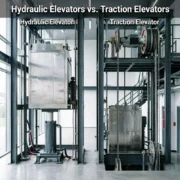
Hydraulic Elevators vs. Traction Elevators
Among the various elevator technologies available today, Hydraulic Elevators and Traction Elevators are the two most widely used solutions worldwide. Both systems have proven reliability and excellent performance, but they are designed to solve different challenges and serve different applications.
Many buyers ask the same questions:
- What is the difference between hydraulic and traction elevators?
- Which elevator is safer?
- Which one costs less?
- Which system requires less maintenance?
- Which elevator is better for homes?
- Which elevator is better for hotels and commercial buildings?
The answer depends on your building structure, budget, travel height, usage frequency, and long-term operational goals.
This comprehensive guide provides a detailed comparison of hydraulic elevators and traction elevators, including their working principles, advantages, disadvantages, applications, cost considerations, maintenance requirements, and recommendations to help you make the best choice.
Understanding Elevator Technologies
Before comparing the two systems, it is important to understand how each elevator works.
What Is a Hydraulic Elevator?
A hydraulic elevator uses hydraulic fluid pressure to move the elevator car.
The system consists of:
- Hydraulic cylinder
- Piston
- Hydraulic power unit
- Oil reservoir
- Control system
- Elevator cabin
When the pump forces hydraulic oil into the cylinder, pressure pushes the piston upward, lifting the elevator car.
When descending, the system releases oil back into the reservoir, allowing gravity to lower the elevator smoothly.
Hydraulic elevators are commonly used in:
- Private homes
- Villas
- Low-rise buildings
- Warehouses
- Hospitals
- Small hotels
What Is a Traction Elevator?
A traction elevator operates using steel ropes or belts attached to a counterweight.
Major components include:
- Electric motor
- Traction machine
- Steel ropes or belts
- Counterweight
- Elevator cabin
- Guide rails
- Controller
The motor rotates a drive sheave, which moves the ropes and lifts or lowers the elevator car.
Modern traction elevators often use gearless motors and advanced variable-frequency drive technology for enhanced efficiency and comfort.
Traction elevators are commonly installed in:
- Residential towers
- Hotels
- Office buildings
- Shopping centers
- High-rise developments
- Commercial facilities
Both of these models are standard small-scale home elevators manufactured at our factory. Their shared characteristics include low cost, powerful functionality, convenient and responsive operation, and excellent safety performance.

Hydraulic Elevator vs. Traction Elevator: Working Principle Comparison
| Feature | Hydraulic Elevator | Traction Elevator |
|---|---|---|
| Drive Method | Hydraulic Pressure | Electric Motor & Counterweight |
| Lifting Mechanism | Piston & Cylinder | Rope & Pulley System |
| Power Usage | Higher | Lower |
| Counterweight | No | Yes |
| Machine Room | Usually Required | Optional |
| Travel Height | Low to Medium | Medium to High |
| Speed | Moderate | Fast |
The most fundamental difference lies in how the lifting force is generated.
Hydraulic systems push the cabin upward using fluid pressure, while traction systems pull the cabin using motor-driven ropes and a counterweight.
Advantages of Hydraulic Elevators
Lower Initial Investment
One of the biggest advantages of hydraulic elevators is affordability.
Hydraulic systems typically cost:
- 15%–35% less than comparable traction elevators
- Lower installation costs
- Simpler construction requirements
This makes them attractive for homeowners and small property developers.
Excellent Load Capacity
Hydraulic elevators generate a strong lifting force.
Advantages include:
- High carrying capacity
- Stable lifting performance
- Reliable operation under heavy loads
This makes hydraulic elevators ideal for:
- Cargo elevators
- Wheelchair elevators
- Hospital elevators
- Home lifts
Smooth and Stable Ride
Hydraulic technology naturally absorbs vibration.
Benefits include:
- Smooth starts
- Comfortable stops
- Reduced cabin shaking
Passengers often appreciate the soft riding experience.
Easier Installation
Hydraulic elevators generally require:
- Less structural modification
- Simpler shaft requirements
- Faster installation
This is particularly beneficial for retrofit projects.
Ideal for Existing Buildings
Hydraulic elevators are commonly selected when adding elevators to:
- Existing homes
- Older hotels
- Renovated villas
- Historical buildings
Their flexible installation requirements simplify modernization projects.
Disadvantages of Hydraulic Elevators
Lower Energy Efficiency
Hydraulic elevators consume more electricity because the motor works against gravity during ascent.
Unlike traction elevators:
- No counterweight assists movement
- Pump operates under higher loads
Energy costs increase over time.
Limited Travel Height
Hydraulic elevators are best suited for:
- 2 to 6 floors
- Travel heights below 20 meters
Beyond this range, efficiency decreases significantly.
Slower Speed
Typical hydraulic elevator speed:
- 0.3–1.0 m/s
This is adequate for homes and small buildings but may feel slow in larger facilities.
Hydraulic Oil Maintenance
Hydraulic systems require:
- Oil inspections
- Seal replacement
- Hydraulic fluid maintenance
Failure to maintain the system can affect performance.
Environmental Concerns
Older hydraulic systems may experience:
- Oil leakage
- Fluid disposal issues
Modern systems have significantly improved environmental performance, but concerns remain.

Advantages of Traction Elevators
Superior Energy Efficiency
Traction elevators use a counterweight that balances much of the cabin load.
This significantly reduces motor workload.
Benefits include:
- Lower electricity consumption
- Reduced operating costs
- Better sustainability
Energy savings become substantial over the elevator’s lifespan.
Faster Travel Speed
Traction elevators can achieve:
- 1.0–10 m/s or higher
This makes them ideal for:
- Hotels
- Office buildings
- Apartment towers
- High-rise structures
Passengers experience shorter waiting times.
Unlimited Travel Height Potential
Traction elevators excel in tall buildings.
Applications include:
- High-rise residential towers
- Commercial skyscrapers
- Large hotels
- Mixed-use developments
Hydraulic elevators cannot compete in this category.
Smaller Footprint
Machine-room-less (MRL) traction elevators eliminate the need for a dedicated machine room.
Benefits include:
- Space savings
- Increased usable building area
- Greater architectural flexibility
Advanced Technology Integration
Modern traction systems support:
- Smart controls
- Destination dispatch
- IoT monitoring
- Predictive maintenance
- Energy regeneration
These features improve operational efficiency.
Disadvantages of Traction Elevators
Higher Initial Cost
Traction elevators typically require:
- More advanced equipment
- More complex installation
- Higher engineering costs
Initial investment is generally higher than hydraulic systems.
More Complex Installation
Installation involves:
- Counterweights
- Rope systems
- Precision alignment
- Advanced electrical systems
Construction time may be longer.
Increased Technical Complexity
Maintenance technicians require specialized expertise.
Repairs can involve:
- Motors
- Controllers
- Drive systems
- Ropes
- Encoders
This can increase service costs.
Potential Noise Issues
Older traction elevators sometimes generate:
- Motor noise
- Rope noise
- Mechanical vibration
Modern gearless systems have greatly reduced these issues.

Cost Comparison
Initial Purchase Cost
| Elevator Type | Average Cost |
| Hydraulic Home Elevator | $20,000–$60,000 |
| Hydraulic Commercial Elevator | $30,000–$100,000 |
| Traction Home Elevator | $30,000–$80,000 |
| Traction Commercial Elevator | $50,000–$200,000+ |
Hydraulic elevators generally offer lower upfront costs.
Operating Costs
| Factor | Hydraulic | Traction |
| Electricity Usage | Higher | Lower |
| Maintenance Cost | Moderate | Moderate |
| Lifespan Cost | Higher | Lower |
| Efficiency | Lower | Higher |
Traction elevators often provide better long-term economics.
Ride Quality Comparison
Hydraulic Elevators
Strengths:
- Smooth acceleration
- Comfortable operation
- Stable ride
Weaknesses:
- Slower speed
- Longer travel times
Traction Elevators
Strengths:
- Faster operation
- Efficient performance
- Advanced control systems
Weaknesses:
- Ride quality depends heavily on system quality
Premium traction elevators often deliver outstanding comfort.
Safety Comparison
Both technologies are extremely safe when properly maintained.
Hydraulic Elevator Safety Features
- Emergency lowering
- Pressure relief valves
- Safety locks
- Overload protection
- Emergency alarms
Traction Elevator Safety Features
- Overspeed governors
- Safety brakes
- Rope monitoring systems
- Emergency power systems
- Intelligent diagnostics
Both systems meet international safety standards when certified.
Application Scenarios
Best Applications for Hydraulic Elevators
Hydraulic elevators excel in:
Private Homes
Benefits:
- Affordable
- Compact
- Comfortable
Villas
Advantages:
- Luxury appearance
- Easy installation
- Quiet operation
Small Hotels
Suitable for:
- 2-5 floors
- Moderate traffic
Hospitals
Advantages:
- Stable ride quality
- Heavy load capability
Wheelchair Accessibility Projects
Hydraulic systems provide smooth transportation for mobility-impaired users.

Best Applications for Traction Elevators
Traction elevators excel in:
High-Rise Residential Buildings
Advantages:
- Fast speed
- High efficiency
- Excellent scalability
Hotels
Benefits:
- High passenger flow handling
- Reduced waiting times
Office Buildings
Supports:
- Frequent operation
- Peak traffic periods
Shopping Centers
Ideal for:
- Continuous passenger traffic
- Multiple floors
Commercial Complexes
Provides maximum operational efficiency.

Which Pain Points Does Each Elevator Solve?
Hydraulic Elevator Pain Points Solved
- Limited budget
- Retrofit installations
- Low-rise buildings
- Heavy lifting requirements
- Small construction projects
Traction Elevator Pain Points Solved
- High passenger volume
- Tall building transportation
- Energy consumption concerns
- Fast travel requirements
- Long-term operational savings
How Should Users Choose?
Choose a Hydraulic Elevator If:
Your building has:
- 2–5 floors
- Limited budget
- Lower daily traffic
- Existing structure constraints
You prioritize:
- Lower installation costs
- Simpler construction
- Heavy load capacity
Choose a Traction Elevator If:
Your building has:
- More than 5 floors
- High traffic volume
- Long-term ownership plans
You prioritize:
- Energy efficiency
- Faster speed
- Lower operating costs
- Advanced technology
Elevator Selection Decision Matrix
| Requirement | Hydraulic Elevator | Traction Elevator |
| Lowest Initial Cost | ★★★★★ | ★★★ |
| Energy Efficiency | ★★★ | ★★★★★ |
| High-Speed Travel | ★★ | ★★★★★ |
| Low-Rise Building | ★★★★★ | ★★★★ |
| High-Rise Building | ★★ | ★★★★★ |
| Heavy Loads | ★★★★★ | ★★★★ |
| Home Installation | ★★★★★ | ★★★★ |
| Hotel Application | ★★★ | ★★★★★ |
| Retrofit Projects | ★★★★★ | ★★★ |
| Long-Term Savings | ★★★ | ★★★★★ |
Future Trends in Elevator Technology
The elevator industry continues evolving toward:
- Machine-room-less systems
- Regenerative drives
- Smart monitoring
- AI predictive maintenance
- Energy-saving technologies
- Touchless controls
Interestingly, both hydraulic and traction systems are benefiting from these innovations.
Modern hydraulic elevators are becoming more efficient, while traction elevators continue to improve ride comfort and reduce installation complexity.
Conclusion
The debate between hydraulic elevators and traction elevators is not about determining which technology is universally better—it is about identifying which solution best matches your building’s requirements.
Hydraulic elevators remain the preferred choice for homes, villas, wheelchair lifts, hospitals, and low-rise buildings because they offer lower installation costs, strong lifting capacity, easier retrofitting, and excellent ride comfort. They effectively solve challenges related to budget limitations, structural constraints, and heavy-load applications.
Traction elevators, on the other hand, dominate high-rise residential buildings, hotels, office towers, and commercial developments because they provide superior energy efficiency, faster speeds, greater travel heights, and lower long-term operating costs. They are designed to solve the challenges of high passenger traffic, energy consumption, and vertical transportation in taller structures.
For homeowners and small building owners, a hydraulic elevator often delivers the best value. For developers, hotel operators, and commercial property managers seeking long-term efficiency and scalability, a traction elevator is usually the smarter investment.
By carefully evaluating building height, passenger traffic, budget, maintenance expectations, and future growth plans, users can confidently select the elevator technology that provides the optimal balance of safety, performance, comfort, and return on investment.
Jnhclift (Huichuang Lift), based in Jinan, China, is a professional manufacturer of scissor lifts, home elevators, and lift platforms. With our own dedicated factory, we deliver high-quality, reliable lifting solutions tailored to meet diverse industrial and residential needs.
 Room 203, Second Floor, Building 8, Phase Ⅱ, Zhizao Town, Jibei Street, Jiyang District, Jinan City, Shandong Province
 +8615628811021
 admin@jnhclift.com