Scissor Lift vs Cherry Picker: Complete Comparison
Scissor Lift vs Cherry Picker: Complete Comparison of Specifications, Applications, Advantages, and Prices
When working at height, choosing the right aerial work platform directly affects productivity, safety, and operating costs. Two of the most popular types of equipment used in construction, maintenance, warehouses, factories, and outdoor projects are scissor lifts and cherry pickers (also called boom lifts).
Although both machines are designed to lift workers and equipment safely above the ground, they have completely different structures, working principles, movement capabilities, and ideal applications. A scissor lift is mainly designed for vertical lifting with a stable working platform, while a cherry picker provides flexible height access and horizontal outreach through an extendable boom.
Understanding the differences between a scissor lift vs cherry picker helps contractors, rental companies, and businesses select the right machine based on working height, load capacity, workspace conditions, and budget.
What Is a Scissor Lift?
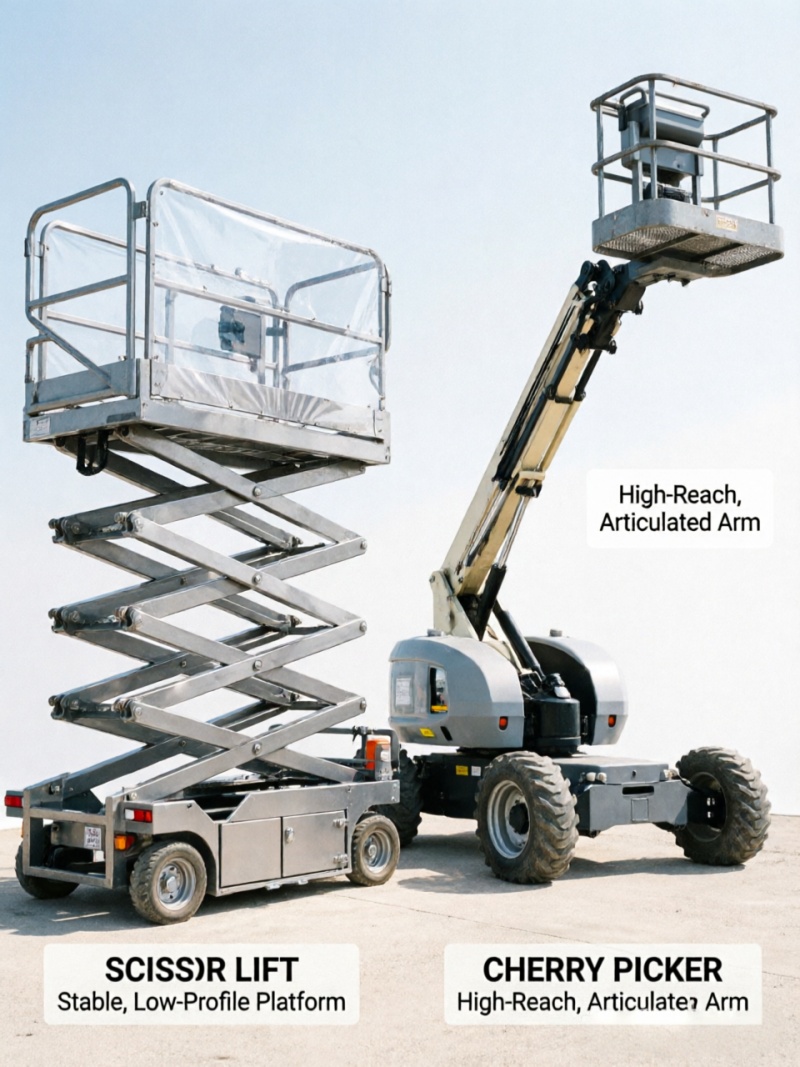
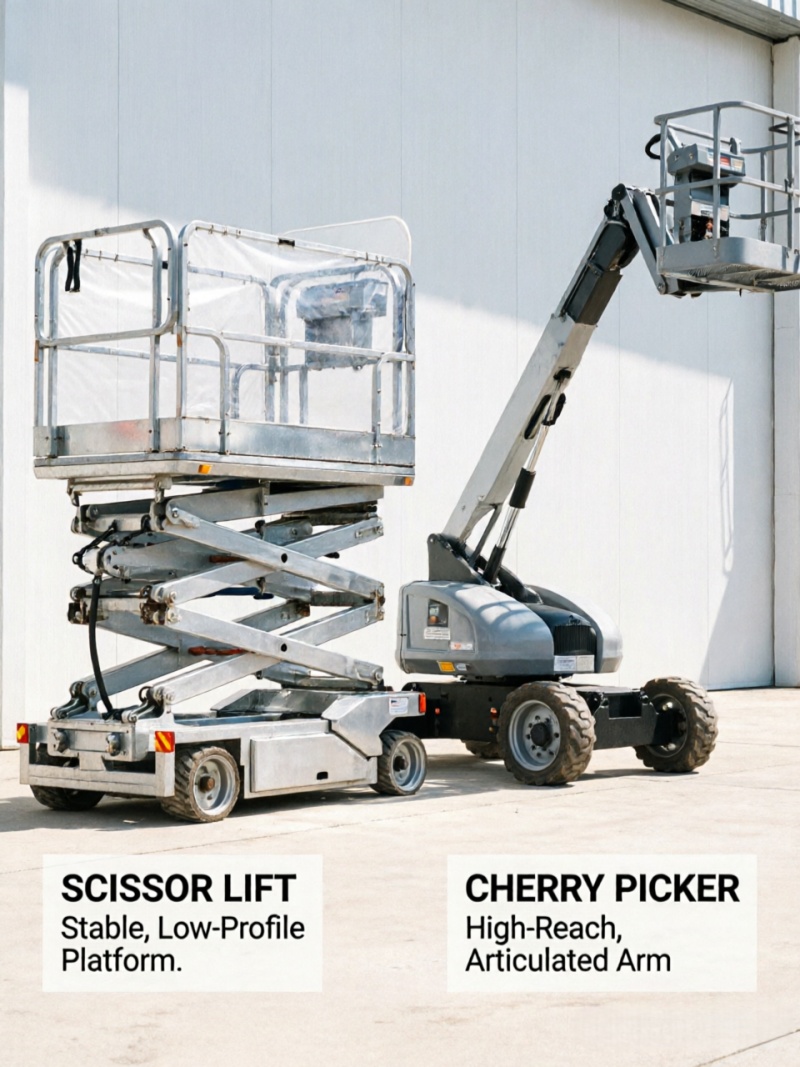
A scissor lift is a type of mobile aerial work platform that uses crossed folding supports, similar to a pair of scissors, to raise a platform vertically. The lifting mechanism consists of connected steel arms powered by hydraulic cylinders or electric actuators.
When the hydraulic system extends, the crossed arms open, pushing the platform upward. When lowered, the arms fold together, reducing the machine’s overall height for transportation and storage.
Scissor lifts are designed mainly for straight vertical access, making them ideal when workers need a large, stable platform for tasks directly above the machine.
Common scissor lift types include:
- Electric scissor lifts
- Diesel rough terrain scissor lifts
- Hydraulic scissor lifts
- Self-propelled scissor lifts
- Towable scissor lifts
- Mini scissor lifts
- Warehouse scissor lifts
What Is a Cherry Picker?
A cherry picker is an aerial lift that uses a hydraulic boom arm to move workers vertically and horizontally. The name comes from its historical use in fruit harvesting, where workers were lifted into trees to pick cherries.
Today, cherry pickers are widely used in construction, electrical maintenance, telecommunications, street lighting, and industrial repair.
Unlike scissor lifts, which only move upward, cherry pickers can reach over obstacles, around structures, and into difficult-access areas.
Main cherry picker types include:
- Articulating boom lifts
- Telescopic boom lifts
- Towable boom lifts
- Self-propelled boom lifts
- Electric boom lifts
- Diesel boom lifts
Scissor Lift vs Cherry Picker: Working Principle Comparison
The biggest difference between these two machines is the lifting mechanism.
How Does a Scissor Lift Work?
A scissor lift uses multiple connected metal arms arranged in an X pattern.
The hydraulic cylinder pushes the arms outward, causing them to extend upward. The platform remains level during lifting, providing a stable working area.
Advantages of this design:
- High platform stability
- Large working space
- Higher load capacity
- Suitable for multiple workers
- Easy operation
Because the platform only moves vertically, scissor lifts require the machine to be positioned directly below the working area.
How Does a Cherry Picker Work?
A cherry picker uses a boom system consisting of one or more articulated or telescopic sections.
The boom can:
- Extend upward
- Rotate horizontally
- Reach over obstacles
- Position workers at different angles
This makes cherry pickers much more flexible in complex environments.
For example, a worker can stand on the ground and use a boom lift to reach the edge of a rooftop, tree branches, electrical poles, or building facades without frequently moving the machine.
Scissor Lift vs Cherry Picker Specifications Comparison
Different projects require different machine specifications. Below is a typical comparison.
| Specification | Scissor Lift | Cherry Picker |
|---|---|---|
| Working Height | 6m-22m (20ft-72ft) | 8m-60m+ (26ft-200ft+) |
| Platform Type | Large rectangular platform | Small basket/platform |
| Movement | Mainly vertical | Vertical + horizontal |
| Load Capacity | 200kg-1,000kg+ | 100kg-450kg |
| Workers | 2-6 people | Usually 1-2 people |
| Platform Size | Large | Compact |
| Outdoor Ability | Good with rough terrain models | Excellent |
| Indoor Use | Excellent | Limited for some models |
| Stability | Very high | High but requires more safety control |
| Obstacle Access | Limited | Excellent |
| Cost | Lower | Higher |
Advantages of Scissor Lifts
1. Larger Working Platform
One of the biggest advantages of a scissor lift is its spacious platform.
A typical electric scissor lift platform can hold:
- Two or more workers
- Tools
- Materials
- Equipment
This makes it suitable for jobs such as:
- Ceiling installation
- Lighting installation
- HVAC maintenance
- Warehouse repair
- Interior construction
Workers can move around freely without repeatedly lowering the machine.
2. Higher Load Capacity
Compared with cherry pickers, scissor lifts usually support heavier loads.
Common capacities:
- Small electric models: 230 kg-300 kg
- Medium models: 500 kg-700 kg
- Heavy-duty models: 1,000kg+
This allows workers to carry construction materials, panels, pipes, and tools.
3. Better Stability
The four-wheel platform design and wide base provide excellent stability.
For flat surfaces such as:
- Factories
- Shopping malls
- Warehouses
- Airports
Scissor lifts are often safer and more efficient than boom lifts.
4. Lower Operating Cost
Electric scissor lifts have:
- Low energy consumption
- Minimal maintenance
- No fuel cost
- Low-noise operation
They are especially popular for indoor projects.
Advantages of Cherry Pickers
1. Superior Reach Capability
The biggest advantage of cherry pickers is flexibility.
A boom lift can reach areas that a scissor lift cannot.
Examples:
- Working above machinery
- Repairing bridges
- Maintaining power lines
- Cleaning tall buildings
- Trimming trees
The boom can extend sideways, allowing operators to avoid obstacles.
2. Higher Working Height Options
Cherry pickers offer some of the highest access heights among mobile platforms.
Typical ranges:
- Small towable boom lifts: 8m-15m
- Medium boom lifts: 16m-30m
- Large telescopic boom lifts: 40m-60m+
For high-rise construction and industrial maintenance, boom lifts are often the only practical option.
3. Better Outdoor Performance
Diesel boom lifts are designed for demanding outdoor environments.
Features include:
- Four-wheel drive
- Large tires
- Rough terrain capability
- Strong climbing ability
They can operate on:
- Construction sites
- Uneven ground
- Roadsides
- Oil fields
- Industrial yards
4. More Flexible Positioning
A cherry picker can position workers precisely.
The operator can move:
- Up
- Down
- Left
- Right
- Around obstacles
This reduces machine repositioning time and improves productivity.
Application Comparison: Which One Is Better?
The best choice depends on the working environment.
Scissor Lift Applications
Scissor lifts are commonly used in:
Warehouses
For:
- Shelf installation
- Lighting maintenance
- Inventory management
Electric scissor lifts are preferred because they are quiet and emission-free.
Construction Interiors
Used for:
- Drywall installation
- Painting
- Electrical wiring
- Ceiling work
The large platform improves efficiency.
Factory Maintenance
Factories use scissor lifts for:
- Machine repair
- Pipeline inspection
- Equipment installation
Cherry Picker Applications
Cherry pickers are preferred for:
Building Exterior Maintenance
Examples:
- Glass cleaning
- Exterior painting
- Sign installation
The boom allows workers to reach building sides without scaffolding.
Power Line Maintenance
Utility companies use boom lifts because they can reach high poles and wires safely.
Tree Care
Arborists use cherry pickers because they can reach branches from different angles.
Telecommunications
For:
- Antenna installation
- Tower maintenance
- Cable repair
Scissor Lift vs Cherry Picker Price Comparison
The purchase price varies depending on brand, working height, capacity, and configuration.
Scissor Lift Price
Typical global market prices:
| Type | Price Range |
|---|---|
| Small electric scissor lift | $3,000-$8,000 |
| 8m-10m electric scissor lift | $8,000-$15,000 |
| 12m-14m self-propelled scissor lift | $15,000-$30,000 |
| Rough terrain diesel scissor lift | $25,000-$60,000 |
Chinese factory prices are usually lower:
- Small models: $3,000-$6,000
- Medium models: $8,000-$18,000
- Custom models: $20,000+
Cherry Picker Price
Cherry pickers are usually more expensive due to their complex boom systems.
Typical prices:
| Type | Price Range |
|---|---|
| Towable boom lift | $8,000-$20,000 |
| Small electric boom lift | $20,000-$40,000 |
| Articulating boom lift | $40,000-$100,000 |
| Large telescopic boom lift | $80,000-$200,000+ |
Chinese manufacturers usually offer:
- Towable boom lifts: $7,000-$15,000
- Electric boom lifts: $15,000-$40,000
- Diesel boom lifts: $30,000-$80,000
Maintenance Cost Comparison
Scissor Lift Maintenance
Maintenance requirements:
- Hydraulic oil inspection
- Battery maintenance
- Tire inspection
- Electrical system checks
Electric models are especially economical.
Cherry Picker Maintenance
Boom lifts require more maintenance:
- Hydraulic boom inspection
- Rotation system maintenance
- Engine servicing
- Safety sensor calibration
Because the structure is more complex, maintenance costs are usually higher.
Safety Comparison
Both machines require proper operation training.
Scissor Lift Safety Advantages
Benefits:
- Stable platform
- Guardrails around working area
- Lower risk of movement
However:
- Must operate on stable ground
- Cannot reach over obstacles
Cherry Picker Safety Advantages
Benefits:
- Allows access without climbing
- Flexible positioning
Important precautions:
- Use safety harnesses
- Check ground conditions
- Avoid excessive wind
- Follow boom operating limits
Which One Should You Buy: Scissor Lift or Cherry Picker?
Choose a scissor lift if:
- You need a large platform
- Work is mainly vertical
- You work indoors
- You need higher load capacity
- You want lower operating costs
Choose a cherry picker if:
- You need horizontal outreach
- You work around obstacles
- You need extreme height access
- Projects are mainly outdoors
- Flexibility is more important than platform size
Final Conclusion: Scissor Lift vs Cherry Picker
Both scissor lifts and cherry pickers are valuable aerial work platforms, but they are designed for different challenges.
A scissor lift is the better choice for stable, efficient vertical lifting applications where workers need space, capacity, and affordability. It is widely used in warehouses, factories, and indoor construction projects.
A cherry picker is the better solution when access is complicated, height requirements are greater, or workers need to reach over obstacles. It provides unmatched flexibility for outdoor construction, utilities, and maintenance work.
Before purchasing, companies should evaluate working height, load requirements, operating environment, budget, and future applications. Selecting the right aerial lift can significantly improve safety, productivity, and long-term investment value.

Jnhclift (Huichuang Lift), based in Jinan, China, is a professional manufacturer of scissor lifts, home elevators, and lift platforms. With our own dedicated factory, we deliver high-quality, reliable lifting solutions tailored to meet diverse industrial and residential needs.
 Room 203, Second Floor, Building 8, Phase Ⅱ, Zhizao Town, Jibei Street, Jiyang District, Jinan City, Shandong Province
 +86 152 5319 3706
 admin@jnhclift.com