How much does a scissor lift cost? In 2026, the price of a new electric scissor lift in the US market can range from approximately $14,000 to $58,000, depending on its platform-height class, capacity, brand, and configuration. Larger rough-terrain models can cost $49,000 to over $130,000. Used electric scissor lifts may be available for under $10,000, while rental costs are commonly calculated by the day, week, or month.
For international buyers, purchasing directly from a manufacturer in China can offer another price option. However, a factory quotation is not the same as a delivered price because freight, import charges, insurance, and local service costs may be additional.
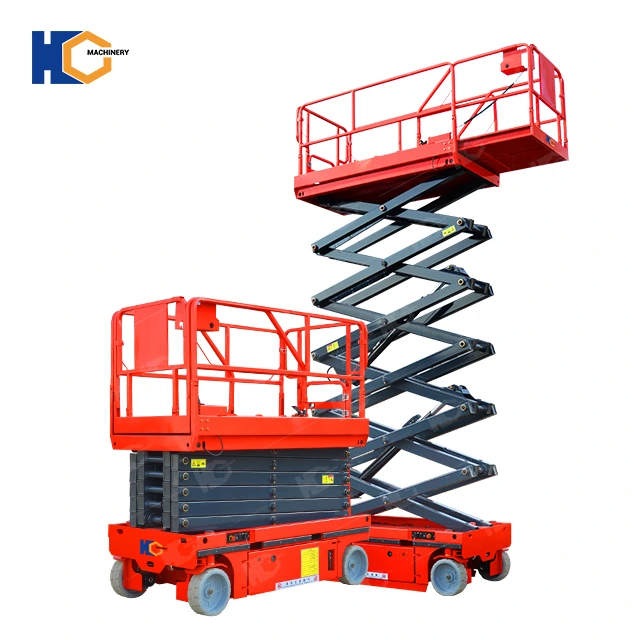
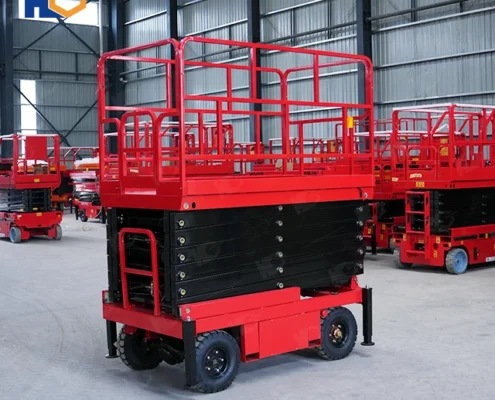
At Huichuang Lift, we manufacture mobile and self-propelled electric scissor lifts for distributors, contractors, rental companies, warehouses, and industrial users. This guide compares 2026 market prices, explains what affects equipment costs, and shows how to calculate the actual investment before purchasing.
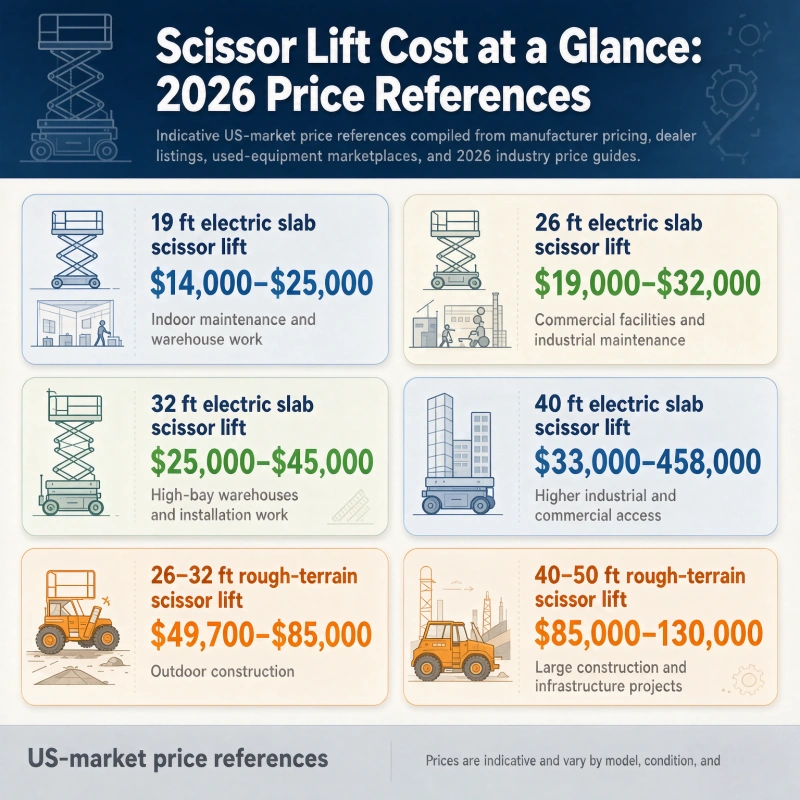
1. Scissor Lift Cost at a Glance: 2026 Price References
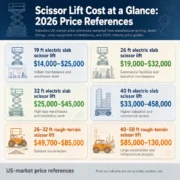
The following table summarizes indicative US-market price references compiled from manufacturer pricing, dealer listings, used-equipment marketplaces, and 2026 industry price guides.
| Scissor Lift Type | New Purchase Price Reference (USD) | Main Application |
|---|
| 19 ft electric slab scissor lift | $14,000–$25,000 | Indoor maintenance and warehouse work |
| 26 ft electric slab scissor lift | $19,000–$32,000 | Commercial facilities and industrial maintenance |
| 32 ft electric slab scissor lift | $25,000–$45,000 | High-bay warehouses and installation work |
| 40 ft electric slab scissor lift | $33,000–$58,000 | Higher industrial and commercial access |
| 26–32 ft rough-terrain scissor lift | $49,700–$85,000 | Outdoor construction |
| 40–50 ft rough-terrain scissor lift | $85,000–$130,000 | Large construction and infrastructure projects |
These are planning ranges, not guaranteed quotations. The figures combine different types of public price evidence, including MSRP listings, dealer asking prices, and industry estimates. Taxes, delivery, optional equipment, and local regulatory costs are not necessarily included.
For example, the JCB Machine Store lists starting prices of approximately $14,240 for its S1932E 19 ft electric scissor lift, $19,007 for the S2632E, $24,991 for the S3246E, and $33,284 for the S4046E. A separate 2026 industry price guide gives higher estimated ranges for several height classes.
The difference demonstrates why buyers should compare the actual model and quotation terms rather than rely on a single average market price.

2. How Much Does a New Scissor Lift Cost by Height?
Lifting height is one of the biggest cost factors, but the relationship is not simply that every extra meter adds the same amount to the purchase price.
Higher machines often require longer scissor structures, different hydraulic cylinders, stronger chassis components, and additional stability considerations.
19 ft Electric Scissor Lift
Indicative new price: $14,000–$25,000
A 19 ft electric model is a common choice for indoor maintenance and lower-level warehouse operations.
Typical applications include:
- Replacing ceiling lights
- Inspecting warehouse inventory
- Installing electrical cables
- Maintaining HVAC equipment
- Working in retail and commercial buildings
Compact dimensions are particularly important for this category. A machine that fits through a standard commercial doorway and can turn in narrow aisles may be more valuable than one with slightly higher capacity.
26 ft Electric Scissor Lift
Indicative new price: $19,000–$32,000
A 26 ft electric scissor lift is widely used for indoor commercial and industrial maintenance.
In November 2026, published dealer listings included Skyjack SJ3226E units at approximately $19,400–$19,850 and a JLG ES2632 listed at approximately $23,500.
This category is often considered for:
- Warehouse lighting and sprinkler work
- Commercial ceiling installation
- Electrical conduit installation
- Factory maintenance
- Interior construction projects
Compare the platform dimensions, rated load, and machine width carefully. Two models in the same height class may have very different access requirements.
32 ft Electric Scissor Lift
Indicative new price: $25,000–$45,000
A 32 ft class electric scissor lift provides additional vertical access for higher industrial spaces, large warehouses, and commercial installation projects.
Buyers should pay particular attention to the overall machine weight and floor loading requirements. Larger machines may not be suitable for every warehouse floor, elevator, or access route.
40 ft Electric Scissor Lift
Indicative new price: $33,000–$58,000
A 40 ft electric scissor lift is designed for applications that require greater vertical reach.
Its purchase cost is generally higher because of the larger structure, heavier chassis, and more demanding design and stability requirements.
Before purchasing, confirm the platform height, working height, overall dimensions, weight, and permitted operating conditions. A machine’s height classification alone does not tell you whether it will fit the project.
Rough-Terrain Scissor Lifts
Indicative new price: $49,700–$130,000+, depending on height and configuration
Rough-terrain scissor lifts generally cost more than standard electric slab models.
They may include:
- Four-wheel drive
- Larger off-road tires
- Higher ground clearance
- Stronger chassis structures
- Diesel or specialized electric power systems
- Terrain-oriented stability and traction features
A published 2026 dealer listing for a Skyjack SJ6826RT was approximately $49,700, while a separate market guide estimated $58,000–$85,000 for 26–32 ft rough-terrain diesel models.
For large infrastructure and heavy construction projects, higher-reach rough-terrain machines can exceed $100,000.
Important: A standard indoor electric slab lift should not be selected for uneven ground simply because its lifting height is suitable. Check the intended surface, permitted slope, chassis design, and operating limitations.
3. How Much Does a Scissor Lift Cost by Type?
The lifting mechanism and power system can significantly change the cost of equipment.
Electric Scissor Lift
Electric scissor lifts are commonly selected for indoor work because they produce no exhaust emissions at the point of use and generally operate more quietly than diesel-powered equipment.
Their cost depends on platform height, capacity, battery configuration, travel system, and optional features.
Explore our electric and other scissor lift product options to compare available machine types.
Self-Propelled Electric Scissor Lift
Self-propelled models have an integrated powered travel system, allowing operators to reposition the machine without manually pushing or towing it.
The additional drive components and control system affect the manufacturing cost.
Huichuang’s published product listing for selected self-propelled electric scissor lift configurations shows a reference price range of US$3,300–11,000. This is a product-page listing reference, not a fixed price for every model or a guaranteed delivered quotation.
The actual price depends on the selected lifting height, capacity, platform configuration, battery, drive system, and commercial terms.
View our self-propelled electric scissor lift models for more details.
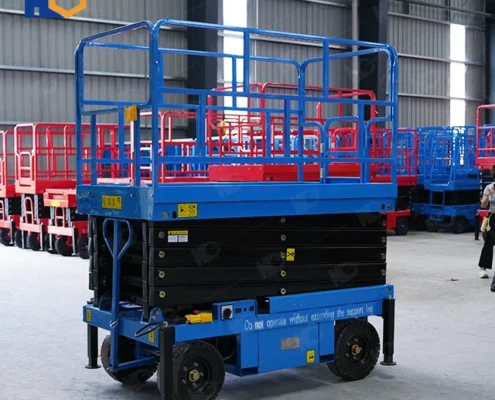
Mobile Scissor Lift
A mobile scissor lift may be manually repositioned or moved using an appropriate towing or handling arrangement, depending on its design.
Simpler mobile units generally have fewer powered mobility components than self-propelled machines. They can therefore be a more economical option for occasional maintenance tasks.
Explore our mobile scissor lift range if you do not need an integrated self-propelled travel system.
Fixed Scissor Lift Platform
A stationary scissor lift is a different purchasing category. It is commonly installed at a fixed location for lifting goods, production materials, or vehicles.
Its price depends heavily on rated capacity, lifting stroke, platform size, pit or installation requirements, and hydraulic power unit configuration.
A fixed industrial lift table should not be compared directly with a mobile personnel-lifting platform based only on lifting capacity.
You can review our fixed scissor lift platform solutions.
Factory Price vs Market Price
Many buyers are surprised by the large gap between factory prices and retail market prices.
Why Are Market Prices Higher?
Distributors add costs for:
- Inventory storage
- Shipping
- Local certification
- Technical support
- Warranty service
- Dealer profits
Typical markups range from 20% to 100%.
Example
A 10m electric scissor lift may cost:
- Factory Price: $8,500
- Distributor Price: $12,000
- Retail Price: $16,000
Direct factory purchasing can generate substantial savings.
Factors Affecting Scissor Lift Cost
Lift Height
The higher the platform, the higher the cost.
Additional height requires:
- More steel
- Larger hydraulic cylinders
- Enhanced stability systems
Load Capacity
Higher capacity increases:
- Structural requirements
- Hydraulic system size
- Manufacturing costs
Power Source
Power options include:
- Manual
- Electric
- Battery
- Hydraulic
- Diesel
Diesel-powered models generally cost more.
Brand Reputation
Premium brands command higher prices due to reliability and resale value.
Certifications
International certifications increase manufacturing costs:
However, certified equipment improves safety and market acceptance.
Customization
Custom options can increase costs by 10% to 40%.
Examples include:
- Extended platforms
- Larger capacities
- Explosion-proof systems
- Non-marking tires
- Lithium batteries
- Special paint colors
Cost of Owning a Scissor Lift
Purchase price is only part of the total ownership cost.
Annual Maintenance
Typical maintenance expenses:
| Lift Type | Annual Cost |
| Small Electric | $300-$800 |
| Self-Propelled | $500-$1,500 |
| Rough Terrain | $1,000-$3,000 |
Battery Replacement
Lead-acid batteries:
- Lifespan: 3-5 years
- Replacement cost: $800-$3,000
Lithium batteries:
- Lifespan: 8-10 years
- Replacement cost: $2,000-$8,000
Insurance
Commercial equipment insurance:
Operator Training
Training costs:
Renting vs Buying a Scissor Lift
Some businesses choose rental instead of ownership.
Rental Rates
| Lift Type | Daily | Weekly | Monthly |
| Electric Scissor Lift | $100-$250 | $400-$800 | $1,000-$2,500 |
| Rough Terrain Lift | $250-$500 | $1,000-$2,500 | $3,000-$7,000 |
When Renting Makes Sense
- Short-term projects
- Seasonal demand
- Limited budgets
When Buying Makes Sense
- Frequent usage
- Long-term projects
- Equipment rental businesses
If a lift will be used more than six months per year, purchasing often yields better financial returns.
4. How Much Does a Scissor Lift Cost From a Chinese Factory?
For international buyers, factory-direct purchasing is another option worth evaluating.
A Chinese manufacturer may supply standard electric scissor lifts, customized platform configurations, and OEM-branded equipment. However, the price depends on the exact machine specification and the agreed Incoterm.
Huichuang’s published product listing shows selected self-propelled electric scissor lift configurations in the US$3,300–11,000 range.
When comparing factory quotations, ask the supplier to identify:
| Quotation Item | What to Confirm |
|---|
| Model | Exact product model and configuration |
| Lifting height | Platform height and working height separately |
| Rated capacity | Permitted load for the main platform and extension deck |
| Platform dimensions | Length, width, and extension arrangement |
| Battery | Voltage, capacity, type, and charger |
| Drive system | Motor and controller configuration |
| Safety equipment | Included standard and optional safety components |
| Warranty | Coverage period and responsibilities |
| Trade term | EXW, FOB, or CIF |
| Lead time | Production and inspection schedule |
Factory Price vs. Dealer Price
A dealer price may include services that are not included in an overseas factory quotation.
| Cost Item | Factory-Direct Purchase | Local Dealer Purchase |
|---|
| Equipment price | Based on factory configuration | Includes distributor pricing structure |
| International freight | Usually arranged separately | Often incorporated into local supply |
| Customs handling | Buyer or appointed agent, depending on terms | Usually handled before local delivery |
| Local inventory | Not necessarily available | May be available from stock |
| Local maintenance | Must be confirmed | May be provided by the dealer |
| Spare parts | Can be sourced from the factory | Depends on local inventory |
| Customization | Often more flexible | Depends on dealer and manufacturer |
Do not assume that buying directly from a factory automatically saves a fixed percentage. The real financial difference depends on configuration, shipping volume, logistics, import charges, local service, and warranty arrangements.
Understanding EXW, FOB, and CIF Prices
International quotations should specify their Incoterms.
- EXW: The seller makes the goods available at the agreed premises. The buyer generally arranges collection and the subsequent transport.
- FOB: Under an agreed FOB shipment, the seller delivers the goods on board the vessel at the named port. The contract and applicable Incoterms determine the transfer of risk and responsibilities.
- CIF: The seller pays the agreed cost, insurance, and freight to the named destination port, although risk transfers at the shipment stage under the applicable rules.
A $7,000 FOB quotation is not equivalent to a $7,000 delivered quotation.
For a detailed discussion of self-propelled machine configurations and pricing, see our self-propelled scissor lift cost guide.
5. How Much Does a Used Scissor Lift Cost?
Used scissor lifts can reduce the initial investment, particularly for companies that need equipment for occasional work.
However, two machines of the same model and platform-height class may have very different values because of their age, operating hours, battery condition, maintenance history, and inspection status.
The following examples are based on used-equipment marketplace asking prices reported in November 2026.
| Used Model | Height Class | Median Asking Price | Middle 50% Price Range |
|---|
| Genie GS-1930 | 19 ft | $5,000 | $4,900–$5,500 |
| Skyjack SJ3219 | 19 ft | $5,400 | $4,600–$6,600 |
| Genie GS-2632 | 26 ft | $7,400 | $6,100–$8,100 |
| Genie GS-3246 | 32 ft | $9,000 | $7,300–$9,200 |
| Skyjack SJ-6832RT | 32 ft rough terrain | $19,600 | $15,500–$24,100 |
These are dealer asking-price statistics from a marketplace, not confirmed final transaction prices. Availability changes over time, and inspection status can substantially affect the price.
What Should You Inspect Before Buying a Used Scissor Lift?
A used machine with a low asking price can become expensive if major components need replacement shortly after delivery.
Before purchasing, check:
1. Battery condition
Ask for battery age, charging history, test results, and any replacement records. Battery condition can influence both operating time and the future maintenance budget.
2. Operating hours
Compare the hour meter with service records, machine age, and visible component wear. Operating hours are useful information, but they do not tell the full maintenance history.
3. Hydraulic system
Inspect cylinders, hoses, fittings, and visible leakage. Unusual lifting or lowering behavior should be investigated before purchasing.
4. Scissor arms and pivot points
Look for deformation, cracks, damage, excessive clearance, or unusual wear.
5. Safety functions
Confirm the emergency stop, emergency lowering arrangement, brakes, guardrails, alarms, and other model-specific safety devices.
6. Inspection and service records
Request previous inspection reports, maintenance documentation, and a functional test before final payment.
For planning transportation and floor-load requirements, our guide on how much a scissor lift weighs explains typical weight differences between equipment categories.
6. How Much Does It Cost to Rent a Scissor Lift?
Renting can be more economical than purchasing when the equipment is needed for a short project, seasonal work, or occasional maintenance.
According to the detailed pricing section of DOZR’s March 2026 rental guide, the reported average scissor lift rental cost was approximately:
- $223 per day
- $495 per week
- $984 per month
The guide reports that its analysis used thousands of actual marketplace rental transactions. These are North American market benchmarks, not guaranteed rental rates for every location or machine.
A compact 19 ft electric model commonly starts around $100–$150 per day and $450–$700 per month in the same guide.
What Additional Rental Costs Should You Expect?
The advertised daily or monthly rate may not include all rental charges.
Ask whether the quotation includes:
- Delivery to the jobsite
- Equipment pickup
- Loading and unloading
- Damage waiver or insurance
- Taxes and environmental fees
- Battery charging or fuel
- Overtime or operating-hour restrictions
- Cleaning and damage charges
For a project lasting several weeks, compare the weekly and monthly rates rather than multiplying the daily price.
Renting vs. Buying: A Simple Cost Comparison
Consider an illustrative electric scissor lift with a purchase price of $20,000 and a comparable rental rate of $984 per month.
The simple purchase-to-rent calculation is:
$20,000 ÷ $984 ≈ 20.3 months
This means the purchase price equals approximately 20 months of base rental charges.
However, this is not a complete break-even calculation. Ownership also involves maintenance, batteries, insurance, inspections, financing, storage, and depreciation. Renting may involve delivery, pickup, damage protection, and availability charges.
Buying is worth evaluating when:
- The machine is used regularly throughout the year.
- The business needs a consistent model for repeated tasks.
- Rental equipment is frequently unavailable.
- The company has maintenance and storage capability.
- Fleet utilization is high enough to justify ownership.
Renting is often more practical when:
- The project lasts only a few days or weeks.
- Working heights change from project to project.
- Equipment is needed only occasionally.
- The business wants to avoid maintenance and storage responsibilities.
7. What Factors Affect Scissor Lift Prices?
Understanding the cost drivers makes it easier to compare quotations from different manufacturers.
1. Platform Height and Working Height
A taller machine generally needs more structural material and a different lifting configuration.
One important point is that platform height is not the same as working height.
- Platform height measures the height of the platform above ground.
- Working height is the estimated reach of an operator standing on the platform.
A commonly used approximation adds around 2 m or 6 ft to platform height, but manufacturers may use different conventions.
Always confirm both measurements on the technical datasheet.
2. Rated Load Capacity
A machine designed for two workers and their tools may need a different platform, scissor structure, and hydraulic configuration from a smaller one-person model.
The rated load should include the combined permitted weight of workers, tools, materials, and approved accessories.
Total Platform Load = Workers + Tools + Materials + Approved Accessories
Do not select a machine based only on the number of people it can carry.
3. Platform Size and Extension Deck
A larger platform can improve working efficiency by giving operators more space for tools and materials.
However, it may increase the machine’s overall dimensions and weight.
The extension deck may also have a separate capacity limit. Confirm the permitted load on the main platform and extension section before comparing models.
4. Power System and Battery Type
Battery and drive configurations affect the initial price and long-term operating expenses.
For example:
| Battery Option | General Cost Consideration |
|---|
| Lead-acid battery | Usually lower initial purchase cost |
| Lithium battery | Usually higher initial cost, with different charging and maintenance characteristics |
The right comparison should include charger compatibility, operating cycles, charging time, expected service life, replacement availability, and local support.
5. Electric vs. Diesel Power
Electric slab lifts are generally designed for suitable indoor and paved-surface applications.
Diesel-powered rough-terrain models use a different chassis and power system and are designed for demanding outdoor environments.
Their purchase prices should not be compared without considering the different functions and performance requirements.
6. Brand and Component Selection
Price differences can also reflect:
- Hydraulic pump and cylinder brands
- Motor and controller configuration
- Battery and charger specifications
- Structural design and material selection
- Safety devices
- Parts availability
- Warranty and dealer support
A lower equipment price is not necessarily better value if critical components are difficult to maintain or replace.
7. Certification and Destination-Market Requirements
Different countries may impose different requirements on mobile elevating work platforms.
The buyer should check the applicable product standards, conformity documents, inspection requirements, manuals, warning labels, and local operating rules before importing.
Do not assume a general company certificate automatically covers every model or destination market.
8. Customization and OEM Branding
Customization may involve:
- Platform dimensions
- Rated platform capacity
- Lifting height
- Tire configuration
- Battery and charging system
- Accessories
- Machine color
- Company logo and identification labels
Structural changes can affect engineering, testing, production time, and price. Buyers should finalize the technical specification before confirming the order.
For customized product requirements, see our custom self-propelled electric scissor lift factory.
8. What Is the Total Cost of Owning a Scissor Lift?
The initial purchase price is only one part of the investment.
A complete ownership budget should include:
| Cost Category | What to Include |
|---|
| Purchase price | Machine and selected options |
| Transportation | Inland freight, international freight, loading and unloading |
| Import-related costs | Customs clearance, applicable duties, taxes and port fees |
| Inspection | Required inspections and third-party checks |
| Training | Operator familiarization and formal training where required |
| Batteries | Charging, maintenance, and future replacement |
| Maintenance | Hydraulic, electrical, structural and mechanical servicing |
| Spare parts | Tires, switches, motors, cylinders, controls and wear components |
| Insurance | Applicable equipment and liability coverage |
| Storage | Indoor or covered storage where required |
| Financing | Interest and applicable financing charges |
| Depreciation | Change in resale value over the ownership period |
Total Cost of Ownership Formula
A useful budgeting framework is:
Total Cost of Ownership (TCO) = Purchase Price + Transportation + Import Costs + Inspection + Training + Maintenance + Battery and Parts + Storage + Financing − Resale Value
The ownership period and expected annual working hours should be defined before comparing machines.
For example, a machine that operates daily in a warehouse may justify a higher-quality battery and more readily available spare parts. A lift used only occasionally may not need the same configuration.
The best purchasing decision is based on the cost per productive operating hour, not just the lowest quotation.
9. How to Choose a Scissor Lift That Fits Your Budget
Choosing the right category before comparing quotations helps avoid unnecessary spending.
| Application | Recommended Equipment Type | Main Cost Priority |
|---|
| Indoor warehouse maintenance | Electric self-propelled scissor lift | Chassis dimensions, capacity, battery |
| Shopping mall maintenance | Compact electric scissor lift | Quiet operation, non-marking tires |
| Factory installation | Electric self-propelled model | Platform capacity and size |
| Outdoor construction | Rough-terrain scissor lift | Traction, ground clearance and stability |
| Occasional maintenance | Rental or mobile scissor lift | Usage period and relocation |
| Fixed goods lifting | Stationary scissor lift | Rated platform capacity, platform size and installation |
| Work around obstacles | Boom lift | Horizontal outreach and working envelope |
A scissor lift raises the platform primarily vertically. If the job requires reaching over obstacles or around structures, a boom lift may be more suitable, even if its purchase or rental cost is higher.
Compare our boom lift product range and boom lift cost guide when your project requires horizontal outreach.
10. How to Get an Accurate Scissor Lift Price Quotation
A supplier cannot prepare a reliable quotation using only the phrase “I need a 10 m scissor lift.”
Two machines with the same lifting height may have different capacities, platform dimensions, batteries, drive motors, machine weights, and optional features.
Send the following information when requesting a quotation:
| Information | Example |
|---|
| Equipment type | Electric self-propelled scissor lift |
| Required platform height | Confirm exact requirement |
| Required working height | 10 m |
| Rated platform capacity | 230 kg or 320 kg |
| Platform dimensions | Standard or customized |
| Power system | Battery electric |
| Working environment | Indoor warehouse |
| Floor condition | Smooth concrete |
| Tire requirement | Non-marking solid tires |
| Accessories | Extension deck, alarm, work lights |
| Quantity | 1 unit or fleet order |
| Destination | Country and delivery address or port |
| Trade term | EXW, FOB, or CIF |
| Certification | Applicable destination-market documents |
Ask the supplier to provide a written quotation that matches the agreed specification. The quotation should identify the model, price, included accessories, warranty, production schedule, inspection arrangements, and delivery conditions.
11. Why Source Scissor Lifts Directly from Huichuang Lift?
Huichuang Lift is the brand of Jinan Huichuang Machinery Manufacturing Co., Ltd., a lifting equipment manufacturer based in Jinan, Shandong, China.
Our company operates a manufacturing facility of approximately 20,000 m², multiple production workshops, and dedicated product showrooms, supported by a team of around 200 experienced employees.
Our main product lines include hydraulic aerial work lifts and home elevators. The broader product portfolio covers mobile scissor lifts, self-propelled electric scissor lifts, fixed lifting platforms, boom lifts, mast lifts, cargo lifts, and other equipment.
For international buyers, we can discuss:
- Standard model selection
- Customized platform configurations
- OEM branding requirements
- Technical specifications and drawings
- Product inspection arrangements
- Spare parts and maintenance information
- Export packaging and shipping terms
Our lift factory page provides more information about our production facilities, manufacturing capabilities, and product solutions.
You can also learn about our company background and manufacturing experience.
12. Frequently Asked Questions About Scissor Lift Costs
How much does a new scissor lift cost in 2026?
Based on US market manufacturer listings and published price guides, a new compact 19 ft electric model may cost approximately $14,000–$25,000. Larger 26–40 ft electric models can range from around $19,000 to $58,000, while rough-terrain machines can cost considerably more.
These are indicative market references, not fixed prices.
How much does a used scissor lift cost?
Used electric scissor lifts can be listed for under $10,000, especially older compact models. Larger machines and units in better condition generally cost more. Battery condition, operating hours, inspection history, and maintenance records should be checked before purchase.
How much does a scissor lift cost per day to rent?
DOZR’s detailed March 2026 pricing section reports a national average of approximately $223 per day. Compact electric models may be available at lower daily rates, while large rough-terrain units can cost several hundred dollars per day.
Delivery, pickup, taxes, and additional rental fees may increase the total bill.
Is it cheaper to rent or buy a scissor lift?
Renting is often more economical for short projects or irregular use. Buying may become attractive when the equipment is used regularly and consistently throughout the year.
The decision should include maintenance, storage, insurance, financing, inspections, and resale value rather than comparing only the rental bill with the purchase price.
Are electric scissor lifts cheaper than diesel models?
Electric slab scissor lifts are often less expensive than comparable large rough-terrain diesel machines. However, the comparison should account for lifting height, capacity, chassis design, and intended terrain. They are designed for different operating environments.
Why do scissor lifts with the same height have different prices?
They may have different platform sizes, rated platform capacities, machine weights, batteries, drive motors, safety packages, and optional equipment. The manufacturer’s design and after-sales support also influence the final quotation.
Does buying directly from a Chinese factory reduce the cost?
Factory-direct purchasing may reduce certain intermediary costs and provide more customization options. However, international shipping, customs clearance, import duties, local compliance, inspection, and after-sales support should be included when evaluating the total cost.
What is the difference between platform height and working height?
Platform height measures the vertical distance from the ground to the platform. Working height estimates the reach of a worker standing on the platform. Many manufacturers use an approximate difference of 2 m, but the actual specification should be confirmed for each model.
What costs are not included in the scissor lift purchase price?
Depending on the quotation, additional costs may include transport, freight, insurance, import charges, port handling, training, inspection, accessories, spare parts, and local service.
What information should I provide to get a scissor lift quotation?
Provide the required working and platform heights, rated platform capacity, platform dimensions, application, ground conditions, quantity, destination country, and any required customization. These details help the manufacturer identify a suitable configuration.
Conclusion: How Much Should You Budget for a Scissor Lift?
The cost of a scissor lift depends on more than its lifting height. Equipment type, platform capacity, battery, chassis design, condition, brand, and after-sales support all influence the final investment.
For US buyers, published 2026 market references show new 19 ft electric machines around $14,000–$25,000, larger electric models reaching $58,000 or more, and rough-terrain machines exceeding $100,000 in some configurations. Used machines and rental equipment offer different entry costs, but their condition and additional charges must be evaluated carefully.
For international distributors, contractors, and equipment buyers, sourcing from a manufacturer in China can be another option. The key is to compare identical specifications and calculate the full landed cost rather than focusing only on the factory price.
Huichuang Lift supplies mobile and self-propelled electric scissor lifts and other lifting equipment for international customers. Our team can help you compare model specifications, platform capacities, and available configurations.
Looking for a scissor lift quotation?
Send us your required height, capacity, application, quantity, and destination country.
Contact Huichuang Lift for Scissor Lift Prices and Product Specifications.
Jnhclift (Huichuang Lift), based in Jinan, China, is a professional manufacturer of scissor lifts, home elevators, and lift platforms. With our own dedicated factory, we deliver high-quality, reliable lifting solutions tailored to meet diverse industrial and residential needs.






 Room 203, Second Floor, Building 8, Phase Ⅱ, Zhizao Town, Jibei Street, Jiyang District, Jinan City, Shandong Province
 +86 152 5319 3706
 admin@jnhclift.com