15T Mobile Dock Leveler Lift – Portable Loading Solution
- Brand: HUICHUANG(JNHC lift)
- Customization: YES
- Manual: YES
- Payment Methods: TT
- Delivery time: 15 working days
Price: $1,000 and $5,000
 +8615628811021
 admin@jnhclift.com
Eliminate Fixed Docks. Load Anywhere. Safely.
Our 15-ton mobile dock leveler is engineered for industrial environments where flexibility, durability, and safety are non-negotiable. Whether you’re loading into trucks, shipping containers, or temporary sites without permanent docks, this manual lift provides seamless, reliable forklift access—anytime, anywhere.
Why Choose Our 15T Mobile Dock Leveler?
Our 15-ton mobile dock leveler delivers unmatched performance through six core advantages—engineered for real-world industrial demands:
- 15-Ton Rated Capacity: Built to safely support fully loaded forklifts and heavy palletized cargo without deformation or fatigue.
- Dual-Texture Anti-Slip Deck: Combines diamond plate and expanded metal grating for maximum traction—even in rain, snow, oil, or mud—dramatically reducing slip risks.
- Manual Hydraulic Adjustment: Requires no electricity or external power source, making it ideal for remote yards, outdoor sites, or emergency operations.
- Integrated Mobility: Features built-in swivel casters, fixed wheels, and forklift entry pockets for effortless relocation across warehouses, loading zones, or job sites.
- Safety Locking Chain & Guardrails: Prevents accidental disengagement from truck beds and protects operators with high-visibility edge markings and sturdy side barriers.
- Powder-Coated Manganese Steel Construction: Offers superior resistance to rust, corrosion, UV exposure, and impact—ensuring years of reliable service in harsh environments.
This rugged, self-contained solution replaces the need for permanent docks while exceeding safety and durability expectations in dynamic logistics settings.

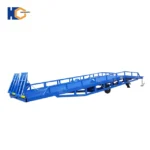
Full view of the 15-ton mobile dock leveler, with integrated wheels and support legs for easy relocation, suitable for various trucks and containers.

Adjustable screw-type outrigger, manually operated for quick leveling on uneven ground, ensuring stable support and preventing tipping.
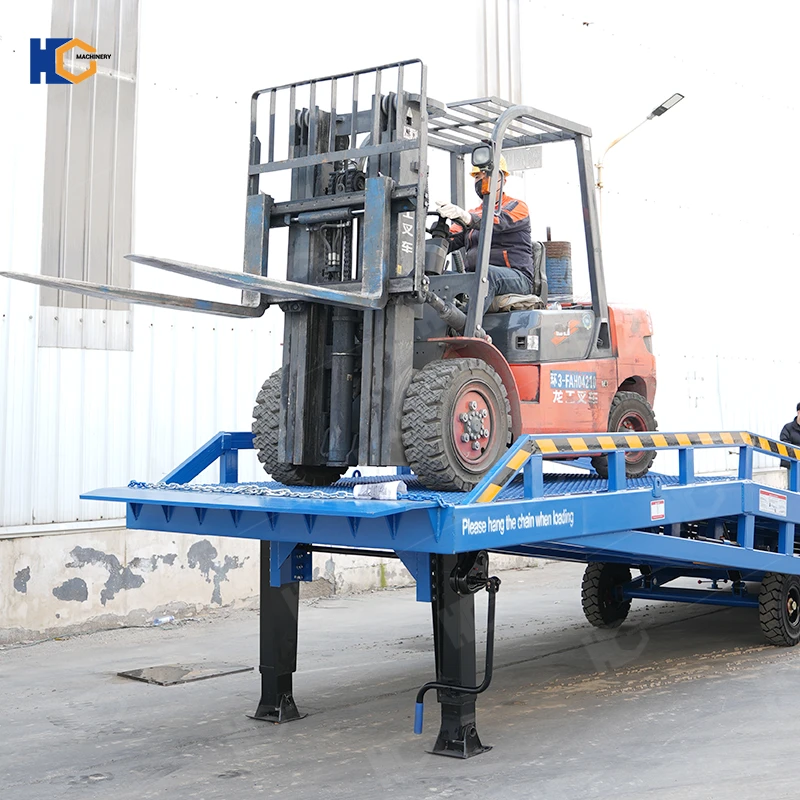
Forklift safely operating on the dock leveler, with anti-slip grating, safety guardrails, and locking chain for stable and secure loading.

Anti-slip diamond plate deck with hinged lip, providing high traction and seamless connection to truck beds for smooth forklift access.
Technical Specifications
| Parameter | Specification |
|---|---|
| Model | MDL-15T |
| Load Capacity | 15,000 kg (33,069 lbs) |
| Deck Material | Reinforced manganese steel |
| Deck Surface | Dual-texture: diamond plate (front) + expanded metal grating (rear) |
| Operating Mechanism | Manual hydraulic pump (no external power required) |
| Height Adjustment Range | 850–1,450 mm (33.5–57.1 in) |
| Outriggers | Screw-type stabilizers for secure leveling on uneven ground |
| Mobility | Swivel casters (2) + fixed wheels (2) + forklift entry pockets |
| Safety Features | Anti-fall hydraulic valves, high-visibility warning stripes, guardrails, truck anchoring chain |
| Finish | Industrial-grade powder coating (UV & corrosion resistant) |
| Weight | Approx. 1,850 kg (4,078 lbs) |
| Compliance | Meets ISO 17987 and ANSI MH30.1 safety standards |
Ideal Applications
- Temporary Warehousing: Deploy instantly at pop-up distribution centers
- Construction Sites: Load materials directly into flatbeds or containers
- Agricultural Operations: Handle harvest equipment and bulk produce
- Disaster Relief: Rapid deployment for emergency supply logistics
- Cross-Docking Yards: Bridge height gaps between trailers and ground level
No Power? No Problem. Since it operates entirely manually, this dock leveler works flawlessly in remote areas, outdoor yards, or during power outages—ensuring your operations never stall.
Compliance & Safety Certifications
Our 15T Mobile Dock Leveler is engineered to meet or exceed global safety standards:
- ✅ ISO 17987: International standard for dock leveler safety requirements
- ✅ ANSI MH30.1: American National Standard for material handling equipment
- ✅ CE Marked (for EU markets) – compliant with Machinery Directive 2006/42/EC
- ✅ Load Tested to 125% Capacity (18.75 tons) – certified by third-party lab
- ✅ Hydraulic Anti-Fall Valves – prevent uncontrolled descent under load
Documentation available upon request for procurement and safety audits.
Trusted by Industry Professionals
“We deployed three units at our seasonal fruit distribution center in California. Zero downtime in six months—even during monsoon season. The anti-slip deck kept our forklifts moving safely when competitors’ ramps failed.”
— Logistics Manager, Agri-Export Co., USA
No customer reference yet?
“Trusted by logistics, construction, and cold-chain teams across North America, Europe, and Southeast Asia for reliable, portable loading solutions.”
Support, Warranty & Customization
We stand behind every unit with comprehensive service:
- Warranty:
- 2-year warranty on structural frame
- 1-year coverage on the hydraulic system and pump
- Global Shipping:
Delivered via flatbed truck or 20ft/40ft container—door-to-door options available - Technical Support:
Free consultation with loading solutions engineers + multilingual operation manual (PDF/print) - Custom Options:
- Load capacities: 10T, 15T, or 20T
- Deck lengths: 3m, 3.5m, or 4m
- Colors: Standard safety yellow or custom RAL finishes
How to Choose the Right Mobile Dock Leveler
Not sure if 15T is right for you? Consider these guidelines:
- < 8-ton operations (e.g., light pallets, small warehouses): A 10T model offers cost savings without compromising safety.
- 8–12-ton regular loads (e.g., full pallet racks, machinery): The 15T leveler provides an ideal safety margin—recommended for most industrial users.
- > 12-ton or heavy equipment (e.g., industrial forklifts, steel coils): Opt for our 20T heavy-duty version with reinforced cross-members.
Pro Tip: Always choose a dock leveler rated at least 25% above your maximum expected load to account for dynamic forces during forklift entry/exit.
Competitive Comparison: Why Our 15T Mobile Dock Leveler Stands Out
| Feature | Our 15T Leveler | Typical Competitor (Generic Brand) |
|---|---|---|
| Deck Surface | Dual-texture: diamond plate + expanded metal grating | Single-surface (often smooth steel) |
| Anti-Slip Performance | Excellent in wet, oily, or snowy conditions | Slips are reported in rain or frost |
| Frame Material | Reinforced manganese steel (high tensile strength) | Mild steel (prone to bending over time) |
| Mobility | Integrated casters + forklift pockets | Wheels only—no forklift access |
| Safety Locking | Heavy-duty chain + guardrails | Optional or missing |
| Hydraulic System | Manual pump with anti-fall valves | Basic jack—no descent control |
| Corrosion Resistance | Industrial powder coat + sealed welds | Painted finish—rusts within 1–2 years |
| Certifications | ISO 17987, ANSI MH30.1, CE | Often uncertified or self-declared |
While cheaper alternatives may save $500 upfront, they often lead to downtime, safety incidents, or premature replacement. Our 15T mobile dock leveler delivers lower total cost of ownership through durability, safety, and zero-power operation.
Safety First: Engineered for Zero Compromise
We prioritize operator and cargo safety through multiple redundant systems:
- Anti-Fall Hydraulic Valves: Prevent sudden drops during descent
- Locking Chain: Secures the unit to the truck chassis to avoid slippage
- High-Visibility Stripes: Alert personnel to deck edges in low-light conditions
- Stabilizing Outriggers: Eliminate wobble on soft or uneven surfaces
15 T Mobile Dock Leveler Lift vs Alternative Loading Solutions
The 15T Mobile Dock Leveler Lift is designed to bridge the height gap between loading docks, warehouses, and trucks, enabling forklifts to move cargo safely and efficiently. Compared with traditional loading methods, it significantly improves loading speed, reduces labor costs, and enhances workplace safety.
| Feature | 15 T Mobile Dock Leveler Lift | Fixed Dock Leveler | Container Loading Ramp | Manual Loading Platform |
|---|---|---|---|---|
| Load Capacity | Up to 15 Tons | 6-15 Tons | 6-12 Tons | 1-3 Tons |
| Mobility | Excellent | None | Good | Limited |
| Installation Required | No | Yes | No | No |
| Suitable Locations | Multiple Sites | Single Dock Only | Outdoor Areas | Small Warehouses |
| Forklift Access | Excellent | Excellent | Good | Limited |
| Initial Investment | Medium | High | Medium | Low |
| Maintenance Cost | Low | Medium | Low | Low |
| Loading Efficiency | Very High | Very High | High | Low |
| Flexibility | Excellent | Poor | Good | Moderate |
15T Mobile Dock Leveler Lift vs Fixed Dock Leveler
A fixed dock leveler is permanently installed at a loading bay and works well for facilities with dedicated loading docks. However, it lacks flexibility and requires civil construction.
Advantages of 15T Mobile Dock Leveler:
- No foundation or pit construction required
- Can be moved to different loading areas
- Lower installation cost
- Ideal for temporary warehouses and rental operations
- Suitable for facilities without loading docks
Advantages of Fixed Dock Leveler:
- Permanent solution
- Higher loading frequency capability
- Better for high-volume distribution centers
15T Mobile Dock Leveler Lift vs Container Loading Ramp
Container loading ramps are commonly used for loading containers directly from ground level.
Advantages of 15T Mobile Dock Leveler:
- Higher lifting precision
- Adjustable platform height
- Better compatibility with various truck heights
- Improved stability under heavy forklift traffic
Advantages of Container Ramp:
- Lower purchase cost
- Simpler structure
- Suitable for standard container operations
15T Mobile Dock Leveler Lift vs Manual Loading Methods
Many warehouses still rely on manual loading platforms or labor-intensive handling processes.
Advantages of 15T Mobile Dock Leveler:
- Up to 5 times higher loading efficiency
- Significantly reduces labor costs
- Improves worker safety
- Allows direct forklift access into trucks and containers
- Reduces product damage during loading
Why Choose a 15T Mobile Dock Leveler Lift?
Compared with competing loading solutions, the 15T Mobile Dock Leveler Lift offers the best combination of:
- High 15-ton load capacity
- Portable design
- Forklift-friendly operation
- Fast deployment
- Lower infrastructure investment
- Versatile use across multiple loading locations
For logistics centers, manufacturing plants, warehouses, ports, and distribution facilities, a 15T Mobile Dock Leveler Lift provides a more flexible and cost-effective loading solution than fixed dock systems while delivering significantly greater efficiency than traditional loading methods.
Ready to Optimize Your Loading Process?
Stop relying on fixed infrastructure or risky makeshift ramps. The 15T Mobile Dock Leveler Lift delivers professional-grade loading performance wherever you need it—without installation, permits, or electrical wiring.
In Stock | Global Shipping | OEM/ODM Support Available
Contact us today for a custom quote or technical consultation.
Frequently Asked Questions (FAQ)
Q: Can this dock leveler be used on uneven ground?
A: Yes. The unit features screw-type outriggers that provide stable, adjustable support on slopes, gravel, dirt, or other uneven surfaces—ensuring a level and secure platform every time.
Q: How long does it take to adjust the height?
A: Less than 2 minutes. The manual hydraulic pump allows quick, tool-free height matching to any truck or container bed without electricity or external power.
Q: Is assembly required upon delivery?
A: No. Your 15T mobile dock leveler arrives fully assembled and ready for immediate use—just unstrap and deploy.
Q: What maintenance is required?
A: Minimal. We recommend checking hydraulic fluid annually and inspecting welds and deck surfaces quarterly. Lubricate pivot points every 6 months for smooth operation.
Q: Can it be left outdoors year-round?
A: Absolutely. The manganese steel frame and industrial powder coating resist rust, UV damage, and corrosion—even in snow, salt air, or high humidity.
Last Products
Small Glass Home Elevator: A Complete Guide to Design, Benefits, and Buying Tips
- Model: Small Glass Home Elevator
- Brand: HUICHUANG(JNHC lift)
- Customization: YES
- Manual: YES
- Price: $18,000–$35,000
- Payment Methods: TT
- Delivery time: 15 working days
+8615628811021
admin@jnhclift.com
If you’ve ever dreamed of having a sleek, modern elevator in your home — one that adds both function and beauty — then a small glass home elevator might be exactly what you’re looking for. It’s stylish, space-saving, and perfect for modern interiors. In this guide, we’ll dive into what makes glass elevators so popular, explore their pros and cons, and offer practical advice on how to choose the right one for your home.
What Is a Small Glass Home Elevator?
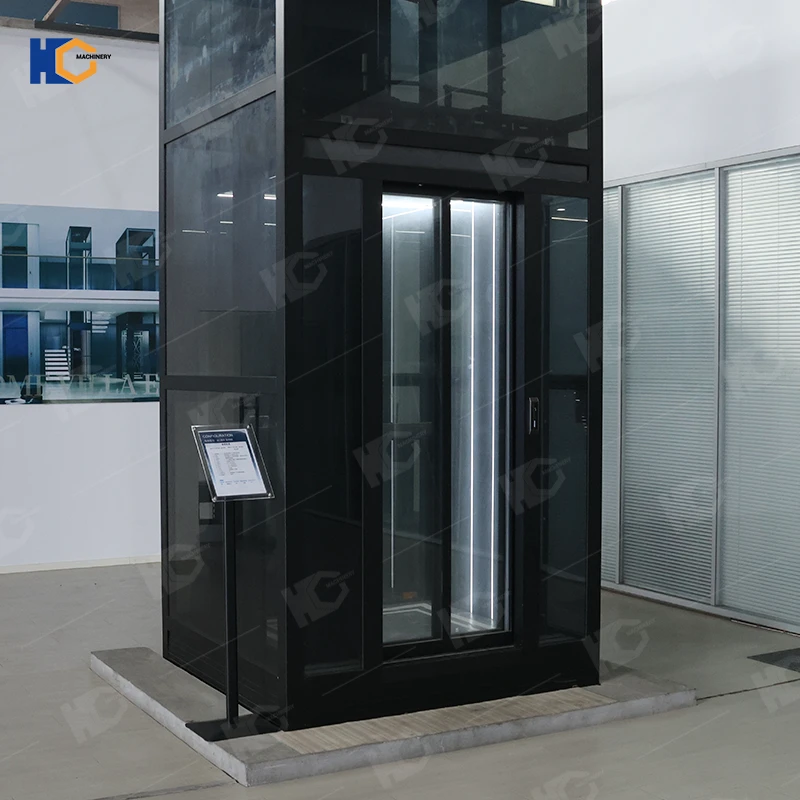
A glass home elevator is a residential lift made primarily from transparent glass panels combined with aluminum or stainless steel framing. Unlike traditional enclosed elevators, it allows for panoramic views as it moves between floors — turning a simple mobility device into a design statement.
Small glass elevators typically feature a compact footprint (0.8–1.2 m²), making them ideal for homes with limited space or where retrofitting is required. They can be either traction-type, hydraulic, or pneumatic vacuum elevators, each with different installation and maintenance requirements.

Key Advantages of Glass Home Elevators
1. Aesthetic Appeal
Glass elevators immediately elevate your interior style. Whether placed near a staircase, in a living room, or against an exterior wall, their transparency makes them look elegant and futuristic. They complement modern architecture and even increase property value.
2. Space-Saving Design
Small glass home elevators can fit into tight spaces without requiring a large shaft or pit. Many models are self-supporting, meaning no additional structural wall is needed — perfect for retrofits or renovations.
3. Natural Light and Openness
Because of their transparent walls, glass elevators make small areas feel larger and brighter. This can be a big plus in urban homes or apartments where light is limited.
4. Accessibility and Comfort
For elderly family members or anyone with mobility issues, a home elevator provides safe and effortless movement between floors. The smooth operation and clear visibility make it more comfortable and less claustrophobic than traditional lifts.
5. Energy Efficiency
Modern glass elevators, especially vacuum and traction types, are surprisingly energy-efficient. Many models consume less than 0.5–1.0 kWh per trip, making them eco-friendly and cost-effective for long-term use.

Disadvantages of a Glass Home Elevator
1. Higher Initial Cost
A small glass home elevator typically costs between $18,000–$35,000, depending on brand, size, and materials. The glass panels and aluminum framing add to the overall expense compared to standard steel or enclosed designs.
2. Privacy Concerns
The transparency that makes it beautiful can also be a drawback in private spaces. However, you can choose tinted or frosted glass for more discretion.
3. More Maintenance for Glass Panels
Glass surfaces require regular cleaning to keep them spotless and clear. Fingerprints and dust are more visible than on solid materials.
4. Limited Load Capacity
Because they’re designed for residential use, most small glass elevators have a weight capacity between 250–400 kg (550–880 lbs) — enough for two to three people but not ideal for heavy cargo.
5. Temperature Sensitivity
When installed near large windows or outdoors, glass elevators can be affected by sunlight and temperature changes. Insulated glass or UV protection can help minimize this issue.
Popular Types of Small Glass Elevators
| Type | Mechanism | Noise Level | Energy Use | Ideal For |
|---|---|---|---|---|
| Traction Glass Elevator | Steel cables + counterweight | Low | Medium | Multi-story homes |
| Hydraulic Glass Elevator | Fluid-powered piston | Medium | High | Homes with strong foundations |
| Vacuum Glass Elevator | Air pressure system | Very Low | Very Low | Compact spaces and retrofits |

How to Choose the Right Glass Home Elevator
- Measure Your Space:
Evaluate available floor space, ceiling height, and pit depth. A typical glass elevator needs around 1 meter² of floor area and 2.5 meters of headroom. - Consider the Number of Floors:
For 2–3 story homes, traction or vacuum types are the best choices. Hydraulic options work well for larger vertical distances but require a machine room. - Set a Budget:
Include installation, customization, and after-sales service costs. A transparent quote should list elevator price, glass type, drive system, and warranty. - Pick the Right Style:
Choose from cylindrical panoramic elevators for a futuristic look or square glass shafts for a minimalist, modern home. - Check Safety Standards:
Make sure the elevator complies with CE, EN81, or ASME A17.1 certifications. Look for features like emergency stop buttons, door sensors, and backup power. - Ask About Maintenance and Warranty:
Reputable manufacturers offer at least a 2-year warranty and professional after-sales service. - Choose the Glass Type:
Go for laminated or tempered glass for durability and safety. Frosted or tinted glass can enhance privacy without compromising style.
Tips for Inspecting Product Quality (Before Purchase)
- Check glass thickness (≥10 mm) for safety and soundproofing.
- Inspect welding and frame joints — they should be smooth and rust-free.
- Test the door mechanism for quiet, stable operation.
- Ensure the control panel responds smoothly and intuitively.
- Verify certifications (CE, ISO9001, or SGS).
- Ask for a real factory video or sample site visit.
- Confirm weight capacity and speed match your project.
- Check the warranty terms and service availability in your country.
- Review customer testimonials or installation cases.
- Inspect lighting and ventilation features inside the cabin.

Who Should Install a Small Glass Home Elevator?
Small glass elevators are perfect for:
- Modern villas or duplexes
- Apartments with elderly residents
- Homes with open-space design
- Designers or homeowners who value aesthetics as much as function
They’re also a popular choice for show homes, office lofts, and Airbnb properties, where design and comfort matter equally.
Final Thoughts
A small glass home elevator isn’t just a mobility device — it’s an architectural centerpiece. While the initial investment may be higher than traditional models, the combination of style, safety, and space efficiency makes it well worth the cost for many homeowners.
If you’re looking for a way to make your home more accessible without sacrificing beauty, a glass elevator could be the perfect blend of luxury and practicality. Choose a trusted manufacturer, inspect the materials carefully, and enjoy a seamless ride — with a view.
FAQ About Small Glass Home Elevators
1. What is a small glass home elevator made of?
Most glass home elevators are built with tempered or laminated glass panels and a stainless steel or aluminum frame. These materials are durable, safe, and give the elevator a sleek, transparent look.
2. How much does a small glass home elevator cost?
Prices typically range from $18,000 to $35,000, depending on the brand, number of floors, and customization. Installation and after-sales service can add $2,000–$5,000 more.
3. How much space do I need to install a glass home elevator?
You’ll need about 1 square meter (10–12 sq ft) of floor space and a ceiling height of 2.5 meters (8.2 ft). Some self-supporting designs don’t require a pit or shaft, making them easy to install in tight spaces.
4. Can a glass elevator be installed in an existing home?
Yes. Many models are designed for retrofit installation, especially vacuum or traction types. They don’t require a deep pit or major structural changes.
5. How safe is a glass home elevator?
Extremely safe. High-quality elevators use tempered safety glass, automatic door sensors, emergency stop buttons, and backup battery systems. All should comply with international safety standards like CE or EN81.
6. How many people can fit inside a small glass elevator?
Most small residential glass elevators can carry 2–3 people (250–400 kg / 550–880 lbs) comfortably. If you need higher capacity, ask your supplier about custom models.
7. What’s the maintenance requirement for a glass elevator?
Routine maintenance is simple:
- Clean the glass panels weekly with a non-abrasive cleaner.
- Have a technician inspect the mechanical system every 6–12 months.
- Lubricate moving parts regularly to ensure quiet operation.
8. Are glass elevators noisy?
Not at all. Modern traction and vacuum models operate at under 50 dB, about as quiet as a normal conversation. Hydraulic systems are slightly louder but still suitable for home use.
9. Can I customize the design of my glass home elevator?
Absolutely. You can choose clear, tinted, or frosted glass, various frame colors, lighting styles, and even decorative ceiling panels. Some homeowners also request panoramic 360° designs.
10. What are the main disadvantages of a glass home elevator?
The main drawbacks are higher cost, regular cleaning, and less privacy compared to enclosed lifts. However, tinted or frosted glass can solve the privacy issue.
11. What’s the lifespan of a glass home elevator?
With regular maintenance, a glass home elevator can last 20–25 years. The glass panels themselves rarely need replacement unless damaged.
12. Does installing a glass home elevator increase home value?
Yes — often by 5–10%. It’s a luxury feature that attracts buyers, improves accessibility, and enhances the home’s architectural appeal.
Last Products
Small Glass Home Elevator: A Complete Guide to Design, Benefits, and Buying Tips
- Model: Small Glass Home Elevator
- Brand: HUICHUANG(JNHC lift)
- Customization: YES
- Manual: YES
- Price: $18,000–$35,000
- Payment Methods: TT
- Delivery time: 15 working days
+8615628811021
admin@jnhclift.com
If you’ve ever dreamed of having a sleek, modern elevator in your home — one that adds both function and beauty — then a small glass home elevator might be exactly what you’re looking for. It’s stylish, space-saving, and perfect for modern interiors. In this guide, we’ll dive into what makes glass elevators so popular, explore their pros and cons, and offer practical advice on how to choose the right one for your home.
What Is a Small Glass Home Elevator?
A glass home elevator is a residential lift made primarily from transparent glass panels combined with aluminum or stainless steel framing. Unlike traditional enclosed elevators, it allows for panoramic views as it moves between floors — turning a simple mobility device into a design statement.
Small glass elevators typically feature a compact footprint (0.8–1.2 m²), making them ideal for homes with limited space or where retrofitting is required. They can be either traction-type, hydraulic, or pneumatic vacuum elevators, each with different installation and maintenance requirements.
Key Advantages of Glass Home Elevators
1. Aesthetic Appeal
Glass elevators immediately elevate your interior style. Whether placed near a staircase, in a living room, or against an exterior wall, their transparency makes them look elegant and futuristic. They complement modern architecture and even increase property value.
2. Space-Saving Design
Small glass home elevators can fit into tight spaces without requiring a large shaft or pit. Many models are self-supporting, meaning no additional structural wall is needed — perfect for retrofits or renovations.
3. Natural Light and Openness
Because of their transparent walls, glass elevators make small areas feel larger and brighter. This can be a big plus in urban homes or apartments where light is limited.
4. Accessibility and Comfort
For elderly family members or anyone with mobility issues, a home elevator provides safe and effortless movement between floors. The smooth operation and clear visibility make it more comfortable and less claustrophobic than traditional lifts.
5. Energy Efficiency
Modern glass elevators, especially vacuum and traction types, are surprisingly energy-efficient. Many models consume less than 0.5–1.0 kWh per trip, making them eco-friendly and cost-effective for long-term use.
Disadvantages of a Glass Home Elevator
1. Higher Initial Cost
A small glass home elevator typically costs between $18,000–$35,000, depending on brand, size, and materials. The glass panels and aluminum framing add to the overall expense compared to standard steel or enclosed designs.
2. Privacy Concerns
The transparency that makes it beautiful can also be a drawback in private spaces. However, you can choose tinted or frosted glass for more discretion.
3. More Maintenance for Glass Panels
Glass surfaces require regular cleaning to keep them spotless and clear. Fingerprints and dust are more visible than on solid materials.
4. Limited Load Capacity
Because they’re designed for residential use, most small glass elevators have a weight capacity between 250–400 kg (550–880 lbs) — enough for two to three people but not ideal for heavy cargo.
5. Temperature Sensitivity
When installed near large windows or outdoors, glass elevators can be affected by sunlight and temperature changes. Insulated glass or UV protection can help minimize this issue.
Popular Types of Small Glass Elevators
| Type | Mechanism | Noise Level | Energy Use | Ideal For |
|---|---|---|---|---|
| Traction Glass Elevator | Steel cables + counterweight | Low | Medium | Multi-story homes |
| Hydraulic Glass Elevator | Fluid-powered piston | Medium | High | Homes with strong foundations |
| Vacuum Glass Elevator | Air pressure system | Very Low | Very Low | Compact spaces and retrofits |
How to Choose the Right Glass Home Elevator
- Measure Your Space:
Evaluate available floor space, ceiling height, and pit depth. A typical glass elevator needs around 1 meter² of floor area and 2.5 meters of headroom. - Consider the Number of Floors:
For 2–3 story homes, traction or vacuum types are the best choices. Hydraulic options work well for larger vertical distances but require a machine room. - Set a Budget:
Include installation, customization, and after-sales service costs. A transparent quote should list elevator price, glass type, drive system, and warranty. - Pick the Right Style:
Choose from cylindrical panoramic elevators for a futuristic look or square glass shafts for a minimalist, modern home. - Check Safety Standards:
Make sure the elevator complies with CE, EN81, or ASME A17.1 certifications. Look for features like emergency stop buttons, door sensors, and backup power. - Ask About Maintenance and Warranty:
Reputable manufacturers offer at least a 2-year warranty and professional after-sales service. - Choose the Glass Type:
Go for laminated or tempered glass for durability and safety. Frosted or tinted glass can enhance privacy without compromising style.
Tips for Inspecting Product Quality (Before Purchase)
- Check glass thickness (≥10 mm) for safety and soundproofing.
- Inspect welding and frame joints — they should be smooth and rust-free.
- Test the door mechanism for quiet, stable operation.
- Ensure the control panel responds smoothly and intuitively.
- Verify certifications (CE, ISO9001, or SGS).
- Ask for a real factory video or sample site visit.
- Confirm weight capacity and speed match your project.
- Check the warranty terms and service availability in your country.
- Review customer testimonials or installation cases.
- Inspect lighting and ventilation features inside the cabin.
Who Should Install a Small Glass Home Elevator?
Small glass elevators are perfect for:
- Modern villas or duplexes
- Apartments with elderly residents
- Homes with open-space design
- Designers or homeowners who value aesthetics as much as function
They’re also a popular choice for show homes, office lofts, and Airbnb properties, where design and comfort matter equally.
Final Thoughts
A small glass home elevator isn’t just a mobility device — it’s an architectural centerpiece. While the initial investment may be higher than traditional models, the combination of style, safety, and space efficiency makes it well worth the cost for many homeowners.
If you’re looking for a way to make your home more accessible without sacrificing beauty, a glass elevator could be the perfect blend of luxury and practicality. Choose a trusted manufacturer, inspect the materials carefully, and enjoy a seamless ride — with a view.
FAQ About Small Glass Home Elevators
1. What is a small glass home elevator made of?
Most glass home elevators are built with tempered or laminated glass panels and a stainless steel or aluminum frame. These materials are durable, safe, and give the elevator a sleek, transparent look.
2. How much does a small glass home elevator cost?
Prices typically range from $18,000 to $35,000, depending on the brand, number of floors, and customization. Installation and after-sales service can add $2,000–$5,000 more.
3. How much space do I need to install a glass home elevator?
You’ll need about 1 square meter (10–12 sq ft) of floor space and a ceiling height of 2.5 meters (8.2 ft). Some self-supporting designs don’t require a pit or shaft, making them easy to install in tight spaces.
4. Can a glass elevator be installed in an existing home?
Yes. Many models are designed for retrofit installation, especially vacuum or traction types. They don’t require a deep pit or major structural changes.
5. How safe is a glass home elevator?
Extremely safe. High-quality elevators use tempered safety glass, automatic door sensors, emergency stop buttons, and backup battery systems. All should comply with international safety standards like CE or EN81.
6. How many people can fit inside a small glass elevator?
Most small residential glass elevators can carry 2–3 people (250–400 kg / 550–880 lbs) comfortably. If you need higher capacity, ask your supplier about custom models.
7. What’s the maintenance requirement for a glass elevator?
Routine maintenance is simple:
- Clean the glass panels weekly with a non-abrasive cleaner.
- Have a technician inspect the mechanical system every 6–12 months.
- Lubricate moving parts regularly to ensure quiet operation.
8. Are glass elevators noisy?
Not at all. Modern traction and vacuum models operate at under 50 dB, about as quiet as a normal conversation. Hydraulic systems are slightly louder but still suitable for home use.
9. Can I customize the design of my glass home elevator?
Absolutely. You can choose clear, tinted, or frosted glass, various frame colors, lighting styles, and even decorative ceiling panels. Some homeowners also request panoramic 360° designs.
10. What are the main disadvantages of a glass home elevator?
The main drawbacks are higher cost, regular cleaning, and less privacy compared to enclosed lifts. However, tinted or frosted glass can solve the privacy issue.
11. What’s the lifespan of a glass home elevator?
With regular maintenance, a glass home elevator can last 20–25 years. The glass panels themselves rarely need replacement unless damaged.
12. Does installing a glass home elevator increase home value?
Yes — often by 5–10%. It’s a luxury feature that attracts buyers, improves accessibility, and enhances the home’s architectural appeal.
 Room 203, Second Floor, Building 8, Phase Ⅱ, Zhizao Town, Jibei Street, Jiyang District, Jinan City, Shandong Province