
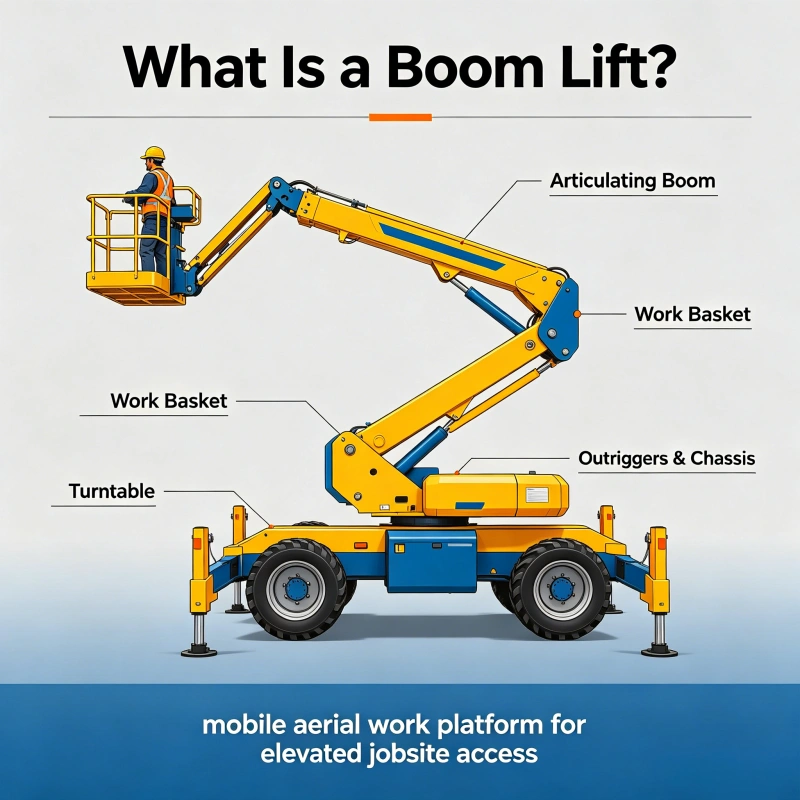
What Is a Boom Lift?
If you are searching for “what is a boom lift,” you are probably looking for more than a dictionary definition. You may also want to know how a boom lift works, what it is used for, how high it can reach, which type is suitable for your project, and whether you should choose a boom lift or a scissor lift.
A boom lift is a mobile elevating work platform designed to position personnel and equipment at elevated work areas. Unlike a scissor lift, which mainly moves a platform vertically, a boom lift can provide both vertical elevation and horizontal outreach. Depending on its design, the boom can also move the platform up and over obstacles.
This flexibility makes boom lifts useful in construction, building maintenance, industrial facilities, telecommunications, landscaping, electrical work, and other applications where workers need to reach elevated or difficult-to-access locations.
The following guide explains what a boom lift is, how it works, the different types, real-world specifications, safety requirements, and how to choose the right machine.
What Is a Boom Lift?
A boom lift, also called a boom-type aerial work platform, is a machine that uses a movable boom to raise a work platform or basket.
The U.S. Occupational Safety and Health Administration (OSHA) defines an aerial device as a vehicle-mounted device, including telescoping or articulating equipment, used to position personnel. OSHA specifically distinguishes articulating boom platforms, which have two or more hinged boom sections, from extensible boom platforms, which use a telescopic or extendable boom.
The most important characteristic of a boom lift is therefore not simply its height.
It is its working envelope.
A boom lift can potentially position a worker:
- Upward
- Outward
- Over an obstacle
- Around a structure
- Below certain elevated structures, depending on configuration
This is why a boom lift can solve access problems that a conventional ladder or vertically lifting platform cannot.
A useful way to understand it is:
A scissor lift mainly takes you up; a boom lift gives you greater freedom to go up, out and around.
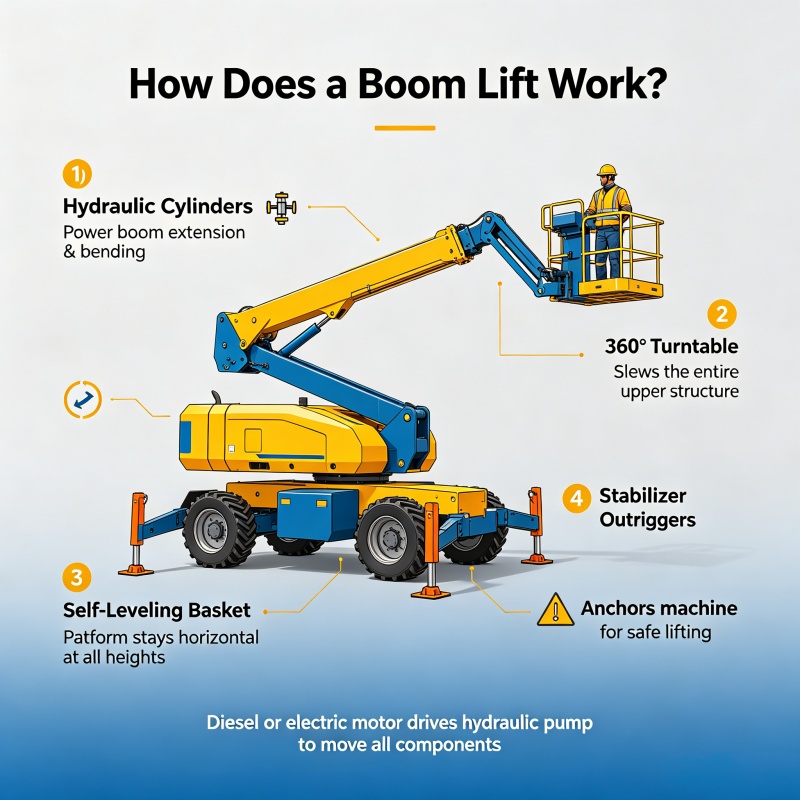
How Does a Boom Lift Work?
Although different models use different mechanical designs, most boom lifts combine a chassis, boom assembly, hydraulic or electric systems, controls, and a work platform.
The basic operating process is relatively straightforward.
1. The Power System Provides Energy
Boom lifts can use different power sources, including:
- Battery-electric systems
- Diesel engines
- Hybrid systems
- Other manufacturer-specific configurations
Electric boom lifts are often selected for indoor or low-noise environments, while diesel-powered machines are commonly used for demanding outdoor construction.
2. Hydraulic Systems Move the Boom
Hydraulic cylinders convert hydraulic pressure into mechanical movement.
Depending on the machine, hydraulic functions can control:
- Boom elevation
- Boom extension
- Boom articulation
- Platform positioning
- Steering or other machine functions
3. The Boom Positions the Platform
The boom is the defining component.
An articulating boom uses hinged sections, while a telescopic boom extends outward in sections.
The operator uses platform controls to position the basket within the machine’s operating envelope.
4. The Platform Carries Personnel and Tools
The platform normally includes:
- Guardrails
- Entry gate
- Operator controls
- Emergency controls
- Platform leveling system
The rated capacity determines how many people and how much equipment it can carry.
The operator must never exceed the manufacturer’s specified load limit.
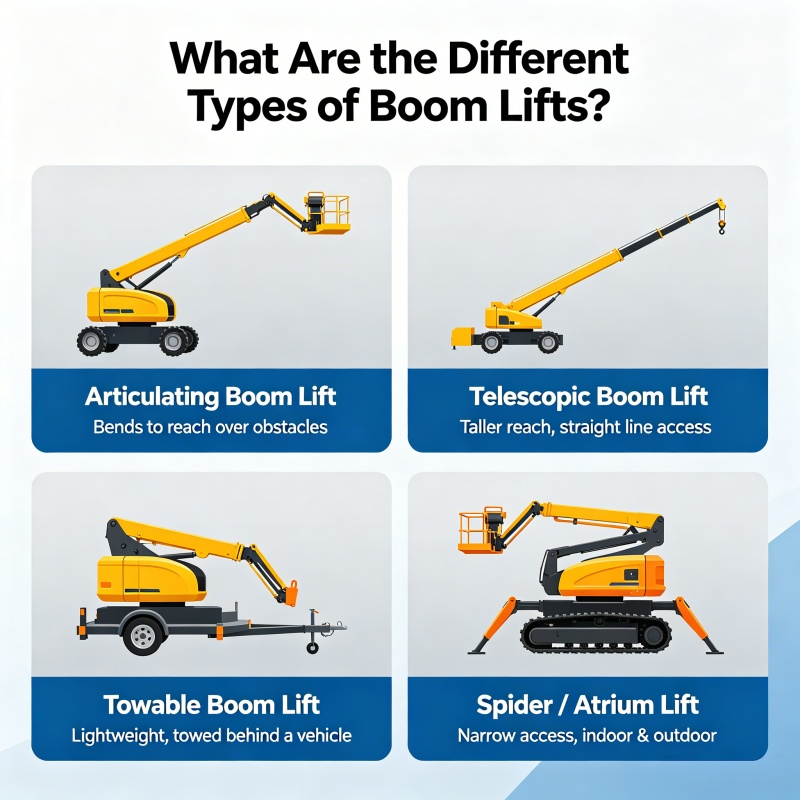
What Are the Different Types of Boom Lifts?
No single boom lift configuration suits every job. The major types are designed around different access requirements.
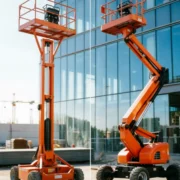
Articulating Boom Lift
An articulating boom lift uses two or more hinged boom sections.
The joints allow the platform to move around obstacles and provide an up-and-over working capability.
This makes articulating boom lifts particularly useful for:
- Building maintenance
- Construction
- Tree trimming
- Industrial maintenance
- Electrical work
- Sign installation
- Exterior building work
For example, if a worker needs to reach a location behind a roof edge or structural obstruction, simply moving vertically may not be enough. An articulating boom can raise the platform and then position it over the obstacle.
A current real-world example is the Genie Z-80/60. Its published 2026 specifications show a maximum working height of 84 ft (25.77 m), horizontal reach of 60 ft (18.29 m), up-and-over clearance of 29 ft (8.83 m), and platform capacity of 500 lb (227 kg).
That example demonstrates why working height alone is not enough when evaluating a boom lift.
Telescopic Boom Lift
A telescopic boom lift, also known as a straight boom lift, uses extendable boom sections.
Its major advantage is long, relatively straight reach.
Telescopic boom lifts are commonly considered for:
- Steel construction
- Large commercial buildings
- Infrastructure projects
- Industrial facilities
- Outdoor construction
- Long-reach maintenance
For example, the Genie S-60 DC/S-60 FE specification lists a maximum working height of 67 ft 2 in (20.60 m) and maximum horizontal reach of 40 ft 6 in (12.30 m), with a maximum platform capacity of 660 lb (300 kg) in the cited configuration.
The practical lesson is important:
A 60-ft-class boom lift is not defined by height alone.
Its outreach, capacity, platform configuration, and operating envelope determine whether it can actually reach your work area.
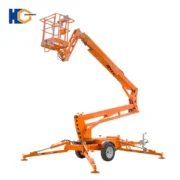
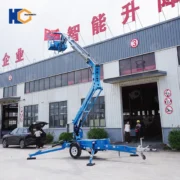
Towable Boom Lift
A towable boom lift is designed to be transported by towing it behind a suitable vehicle.
This configuration can be attractive to:
- Small contractors
- Building maintenance companies
- Rental companies
- Landscaping businesses
- Sign installers
- Property maintenance teams
The main advantage is transportation flexibility.
Instead of transporting a large self-propelled boom lift on specialized equipment, a suitable towable model can be moved between job sites using an appropriate towing vehicle, subject to local requirements.
For businesses that work at many smaller job sites, a towable boom lift can be a particularly practical solution.
Self-Propelled Boom Lift
A self-propelled boom lift integrates its driving system into the machine.
The operator can drive the equipment around the job site and reposition the machine as work progresses.
This is particularly useful on:
- Construction sites
- Large industrial sites
- Commercial projects
- Infrastructure projects
- Large maintenance facilities
The choice between towable and self-propelled equipment should depend on transportation requirements, jobsite size, movement frequency, terrain, and required working height.
Is a Boom Lift an Aerial Lift?
Yes.
A boom lift is a type of aerial lift/aerial work platform, although not every aerial lift is a boom lift.
The broader category can include equipment such as:
- Boom lifts
- Articulating boom platforms
- Extensible boom platforms
- Vertical lifts
- Other personnel-elevating platforms
OSHA’s aerial-lift guidance specifically addresses extensible and articulating boom platforms and identifies them as aerial devices used to position personnel.
This distinction matters when researching equipment because manufacturers may use different terminology such as:
Boom Lift → Aerial Lift → MEWP → Aerial Work Platform
The exact terminology can vary by market and standard.
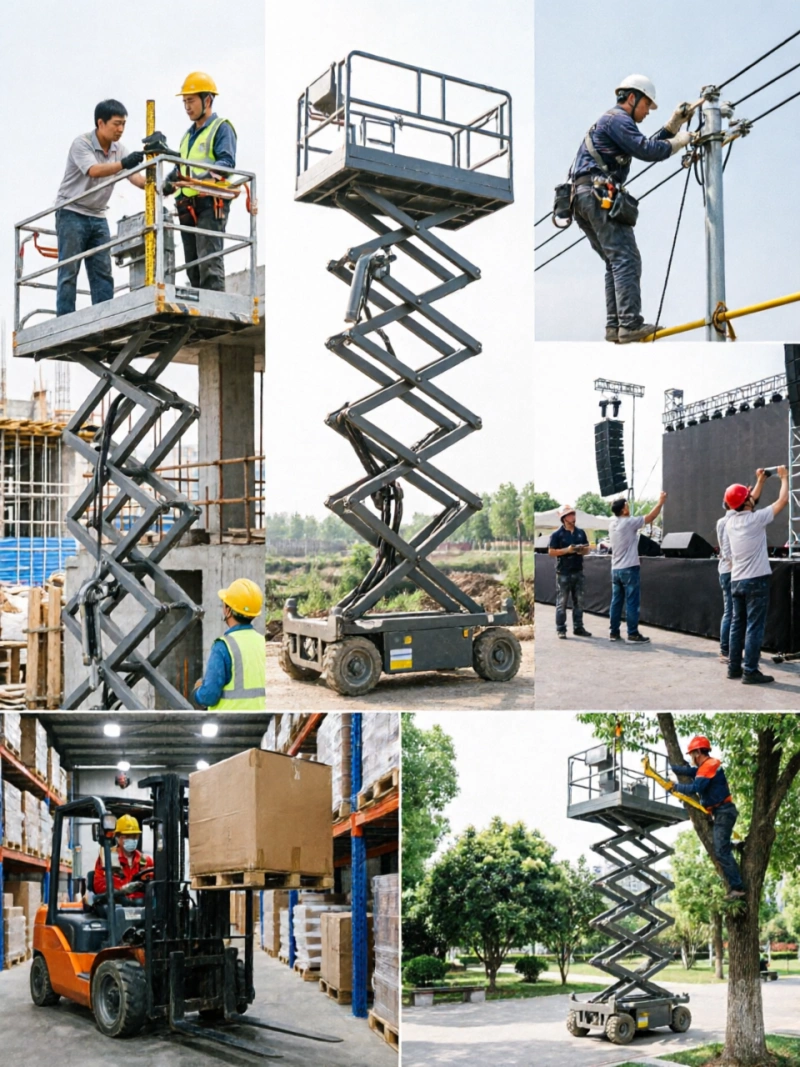
What Is a Boom Lift Used For?
The answer to “what is a boom lift used for?” is essentially:
Whenever workers need controlled access to an elevated or difficult-to-reach work area.
Construction
Boom lifts are widely used for:
- Structural construction
- Steel installation
- Exterior finishing
- Painting
- Roofing-related work
- Glass installation
- Building maintenance
Building Maintenance
A boom lift can provide access to:
- Windows
- Exterior walls
- Lighting
- Signs
- HVAC equipment
- Roof structures
Tree Care
Articulating boom lifts can position workers around branches and elevated tree structures, making them useful for selected tree-care applications.
Telecommunications
Boom lifts may be used for:
- Equipment installation
- Cable-related work
- Infrastructure maintenance
- Elevated communication equipment
Industrial Maintenance
Factories often contain elevated:
- Pipes
- Ducts
- Lighting
- Machinery
- Structural components
A boom lift can position workers closer to these components without requiring permanent scaffolding.
Warehouses and Commercial Facilities
Suitable electric boom lifts can be used for:
- Lighting maintenance
- Sign installation
- Inspection
- High-level repairs
The CDC notes that aerial lifts are used for tasks including changing lightbulbs, storing boxes and moving materials, while emphasizing that their elevated and mobile characteristics create specific safety risks.
Why Use a Boom Lift Instead of a Ladder?
A boom lift is not simply a taller ladder.
A ladder generally provides access along a fixed path. A boom lift is designed to position workers at a specific location within its permitted operating envelope.
Compared with a ladder, a boom lift can provide:
- A working platform
- Guardrails
- Controlled positioning
- Horizontal outreach
- Greater working height
- Improved access around obstacles
- Jobsite mobility
For long-duration professional work, especially where horizontal positioning matters, a boom lift can provide capabilities a ladder cannot.
However, always select equipment based on the specific job and applicable regulations. A boom lift is not automatically the best answer for every elevated task.
Boom Lift vs Scissor Lift: What’s the Difference?
This is one of the most important comparisons for buyers.
| Feature | Boom Lift | Scissor Lift |
|---|---|---|
| Vertical elevation | Yes | Yes |
| Horizontal outreach | Yes | Limited |
| Up-and-over access | Yes, depending on model | Generally no |
| Platform size | Usually smaller | Usually larger |
| Obstacle access | Excellent | Limited |
| Direct overhead work | Good | Excellent |
| Positioning flexibility | High | Moderate |
| Typical strength | Reach and positioning | Vertical access and platform space |
The simplest selection rule is:
If the work is directly above the machine, a scissor lift may be appropriate. If the work is high and offset from the machine, a boom lift may be the better solution.
For example, replacing lighting directly above a warehouse aisle may favor a scissor lift.
Working on a building façade from a position away from the wall may favor an articulating boom lift.
This distinction is more useful than simply comparing maximum heights.
What Are the Main Parts of a Boom Lift?
Understanding boom lift components helps buyers evaluate equipment specifications.
Chassis
The chassis supports the machine and may contain:
- Wheels
- Axles
- Drive system
- Steering system
- Braking system
Boom
The boom is the primary lifting structure.
It may be:
- Articulating
- Telescopic
- Multi-section
Hydraulic Cylinders
These convert hydraulic pressure into mechanical movement.
Platform
The platform carries the permitted occupants and tools.
Turntable
On many boom lifts, the upper structure can rotate relative to the chassis, allowing the platform to reach different working positions.
Controls
Controls are generally provided at the platform and, depending on the machine and applicable requirements, at ground level.
OSHA’s rules for covered extensible and articulating boom platforms require both upper and lower controls, with the lower controls capable of overriding the upper controls.
Safety Systems
Depending on model and market, these can include:
- Emergency stop
- Load monitoring
- Interlocks
- Platform leveling
- Tilt monitoring
- Emergency lowering
- Alarms
- Other manufacturer-specific systems
How High Can a Boom Lift Reach?
There is no single answer because boom lifts are available in many configurations.
A compact electric model may provide a working height around 30–40 ft, while larger articulated or telescopic machines can reach substantially higher.
These published specifications demonstrate the wide range of boom-lift configurations available.
But buyers should avoid choosing a machine based only on maximum working height.
Platform Height vs Working Height
These two specifications are frequently confused.
Platform height describes the maximum platform height.
Working height is usually higher and accounts for the operator’s practical working reach.
For example, the Genie S-60 DC/FE lists:
- Maximum platform height: 61 ft 2 in / 18.60 m
- Maximum working height: 67 ft 2 in / 20.60 m
That is a six-foot difference in the manufacturer’s published imperial figures.
So, when comparing two suppliers, make sure both use the same definition.
Why Horizontal Reach Matters More Than Many Buyers Expect
Imagine a building is 30 ft high, but the machine cannot safely position itself directly below the work area.
A 40-ft vertical lift may still be unable to complete the job.
This is where horizontal outreach becomes critical.
For example, the Genie Z-80/60 has a published maximum horizontal reach of 60 ft (18.29 m) in addition to its 84-ft working height.
Therefore, when requesting a boom lift quotation, provide both:
Required working height + required horizontal outreach
rather than saying only:
“I need a 60-ft boom lift.”
What Powers a Boom Lift?
Electric Boom Lift
Electric models can be useful for:
- Indoor applications
- Warehouses
- Commercial buildings
- Low-noise environments
- Areas where direct exhaust emissions are undesirable
For example, Genie describes its Z-30/20 N as a narrow electric articulating boom lift designed for sensitive work environments, with a 36-ft working height and 21-ft 5-in horizontal reach.
Diesel Boom Lift
Diesel machines are commonly used for:
- Outdoor construction
- Large jobsites
- Demanding applications
- Rough-terrain work
Hybrid Boom Lift
Hybrid systems can combine electric operation with an engine or generator depending on configuration.
The best power source depends on the application, not simply which technology is newest.
Are Boom Lifts Safe?
Boom lifts are professional machines and can be safely operated when properly selected, maintained, inspected, and operated by trained personnel.
However, elevated work has serious hazards.
CDC/NIOSH reports that between 2011 and 2014, 1,380 workers were injured while operating aerial lifts or scissor lifts, and 87 workers died in such incidents; 48 of those deaths resulted from slips, trips, and falls from one level to another.
NIOSH also reports that in 2022, slips, trips and falls killed more than 400 U.S. workers in construction, illustrating the broader importance of fall prevention.
These figures explain why boom-lift selection and operator training should never be treated as secondary considerations.
Common Boom Lift Hazards
Important hazards include:
Falls
Workers can fall from elevated platforms if they do not follow fall-protection requirements.
Tip-Over
Improper setup, unstable ground, excessive slope, or improper loading can contribute to instability.
Electrical Contact
Boom lifts operating near overhead power lines can create serious electrical hazards.
Collision
The platform or boom can contact:
- Buildings
- Machinery
- Vehicles
- Structural components
- Overhead objects
Overloading
Exceeding the manufacturer’s rated capacity can compromise safe operation.
Weather
Wind, rain, lightning, or other environmental conditions can affect safe operation.
OSHA identifies falls, falling objects, tip-overs, ejections, structural failures, electric shock, entanglement, and contact with overhead objects among aerial-lift hazards.
How to Operate a Boom Lift Safely
OSHA requires trained persons to operate applicable aerial lifts and requires lift controls to be tested before use. It also prohibits exceeding manufacturer-specified boom and basket load limits.
Before operating a boom lift, users should evaluate:
- Ground conditions
- Overhead hazards
- Power lines
- Weather
- Machine condition
- Platform capacity
- Boom position
- Traffic
- Nearby structures
Operators should also follow the manufacturer’s instructions and applicable local regulations.
For U.S. projects, buyers should check the requirements for their industry and jurisdiction rather than assuming one safety rule covers every situation.
How Do You Choose the Right Boom Lift?
Select the right boom lift based on the full work envelope, not just maximum height.
Consider these nine factors.
1. Working Height
How high does the worker actually need to work?
2. Horizontal Outreach
How far from the machine must the platform reach?
3. Up-and-Over Requirement
Does the platform need to pass over an obstacle?
If yes, an articulating boom may be particularly useful.
4. Platform Capacity
Calculate the required capacity based on:
Workers + tools + permitted equipment
Never exceed the manufacturer’s rated capacity.
5. Indoor or Outdoor Use
This affects power source, emissions, tires, dimensions, and maneuverability.
6. Ground Conditions
Determine whether the machine will work on:
- Concrete
- Asphalt
- Gravel
- Dirt
- Rough terrain
7. Transportation
If equipment frequently moves between small job sites, consider whether a towable boom lift makes more sense than a self-propelled machine.
8. Machine Dimensions
Check:
- Width
- Length
- Stowed height
- Turning radius
- Ground clearance
9. Local Standards and Certification
Before importing or purchasing equipment, confirm applicable requirements in the destination country.
How Much Does a Boom Lift Cost?
There is no reliable universal boom-lift price.
The cost depends on:
- Working height
- Horizontal outreach
- Boom type
- Platform capacity
- Power source
- Self-propelled or towable configuration
- Terrain capability
- Safety systems
- Customization
- Shipping
- Local taxes
- Installation or commissioning requirements
A compact electric articulating boom lift and a large diesel telescopic boom lift should not be compared based on purchase price alone.
For B2B buyers, the better calculation is:
Purchase price + transportation + maintenance + spare parts + operating cost + expected utilization
This is especially important for rental companies and contractors.
When Should You Choose a Towable Boom Lift?
A towable boom lift can make sense when:
- You work at multiple locations
- Transportation flexibility is important
- Your projects do not require a large self-propelled machine
- You need substantial working height
- Storage space is limited
- You want equipment suitable for maintenance and light construction applications
For a contractor working on different buildings every week, the ability to tow the machine between appropriate sites can be a significant operational advantage.
Can You Buy a Boom Lift Directly From a Manufacturer?
Yes.
For contractors, distributors, rental companies, and international buyers, purchasing directly from a boom lift manufacturer can provide access to:
- Factory pricing
- OEM customization
- ODM development
- Technical specifications
- Spare parts
- Export packaging
- Product documentation
- After-sales support
A manufacturer may be able to customize aspects such as:
- Working height
- Platform capacity
- Platform size
- Power system
- Voltage
- Tires
- Controls
- Branding
- Safety configuration
However, safety-critical modifications should never be treated as ordinary cosmetic customization. Any change should be reviewed and approved by the manufacturer and comply with applicable requirements.
What Information Should You Send to a Boom Lift Manufacturer?
Instead of asking:
“Please send me your boom lift price.”
provide:
Required working height: 50 ft
Required horizontal reach: XX ft
Platform capacity: XX kg
Boom type: Articulating / telescopic
Power: Electric / diesel
Application: Construction / maintenance / rental
Ground: Indoor / outdoor / rough terrain
Transportation: Towable / self-propelled
Destination: Country and applicable market
Quantity: 1 unit / fleet order / OEM
Providing this information allows the manufacturer to recommend a more appropriate configuration and prepare a more meaningful quotation.
Boom Lift FAQ
What is a boom lift?
A boom lift is a mobile elevating work platform that uses an articulating or telescopic boom to position workers at elevated locations.
What is a boom lift mainly used for?
Boom lifts are used for construction, maintenance, industrial work, telecommunications, tree care, electrical work, signage, and other elevated-access applications.
What is the difference between an articulating and telescopic boom lift?
An articulating boom uses hinged sections for up-and-over access, while a telescopic boom extends outward to provide long, relatively straight reach.
How high can a boom lift go?
It depends on the model. Current manufacturer examples range from approximately 36 ft working height for compact models to 84 ft for the Genie Z-80/60, with larger equipment available in other configurations.
Is a boom lift better than a scissor lift?
Neither is universally better. A boom lift is generally better when you need horizontal reach or access over obstacles, while a scissor lift is better for direct vertical work that needs a larger platform.
Can a boom lift be used indoors?
Yes, provided the specific model is designed and approved for the intended environment. Electric boom lifts are often suitable for applications where low noise and no direct exhaust emissions are important.
What is a towable boom lift?
A towable boom lift is designed to be transported by towing it behind a suitable vehicle. It can be useful for contractors and maintenance businesses working across multiple sites.
How much weight can a boom lift carry?
Capacity varies by model and operating configuration. For example, the cited Genie Z-80/60 has a 500-lb (227-kg) platform capacity, while the S-60 DC/FE lists 660 lb (300 kg) in the cited configuration.
Is operator training required?
Yes. OSHA’s applicable rules require trained persons to operate covered aerial lifts, while employers must provide appropriate training and ensure workers understand operating and workplace hazards.
What should I consider before buying a boom lift?
Start with working height, horizontal outreach, platform capacity, boom type, indoor/outdoor environment, terrain, power source, transportation, dimensions, safety requirements, and local compliance.
Final Thoughts
So, what is a boom lift?
A boom lift is much more than a machine that raises people into the air. Its real value is the ability to position workers where conventional vertical access cannot easily reach.
Articulating boom lifts provide flexibility around obstacles. Telescopic boom lifts provide long reach. Towable boom lifts offer transportation flexibility, while self-propelled models are designed for efficient movement around larger jobsites.
Real manufacturer specifications show why buyers should look beyond a single “maximum height” number. A current Genie Z-45/25J DC, for example, provides a 51-ft 9-in working height and 25-ft 1-in horizontal reach, while the Z-80/60 reaches 84 ft in working height and 60 ft horizontally.
The key purchasing principle is therefore:
Working height + horizontal outreach + capacity + boom configuration + working environment = the right boom lift.
For a manufacturer such as Huichuang Lift, this also creates a natural path from educational content to commercial products: users who first search “what is a boom lift” can then explore articulating boom lifts, telescopic boom lifts, towable boom lifts, self-propelled boom lifts, 50-ft models, OEM options, and customized aerial access solutions.
Most importantly, buyers should select equipment based on the actual work envelope and applicable safety requirements—not simply choose the machine with the biggest number on the specification sheet. Height gets attention; useful reach gets the job done.
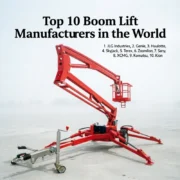
If you want to learn about global boom lift manufacturers, you can learn about the 10 most well-known brands.

Jnhclift (Huichuang Lift), based in Jinan, China, is a professional manufacturer of scissor lifts, home elevators, and lift platforms. With our own dedicated factory, we deliver high-quality, reliable lifting solutions tailored to meet diverse industrial and residential needs.

 Room 203, Second Floor, Building 8, Phase Ⅱ, Zhizao Town, Jibei Street, Jiyang District, Jinan City, Shandong Province
 +86 152 5319 3706
 admin@jnhclift.com

Leave a Reply
Want to join the discussion?Feel free to contribute!