
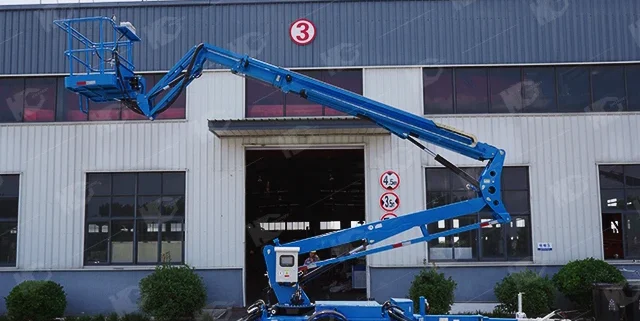
Towable Trailer Boom Lift Technology: Core Components and Systems of High-End Cherry Pickers
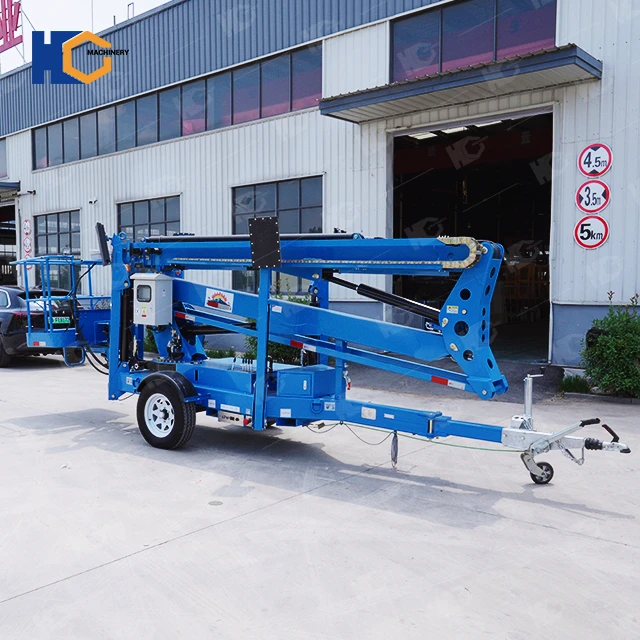
A high-end towable trailer boom lift is much more than a hydraulic lifting arm mounted on a mobile trailer. It is an integrated aerial work platform combining a road-towable chassis, stabilizing outriggers, articulated boom structure, hydraulic power system, precision control technology, and multiple safety protection systems.
The performance of a cherry picker depends on how well these systems work together. A powerful hydraulic pump cannot compensate for an unstable support structure. A long boom cannot guarantee useful working reach without the correct articulation geometry. Similarly, a premium control system is only valuable when its sensors, hydraulic valves, and safety interlocks function reliably.
For construction contractors, equipment rental companies, municipal maintenance teams, and international distributors, understanding these technologies is essential when evaluating equipment quality and long-term operating costs.
In this technical guide, we examine the core components of a towable trailer boom lift, explain how its major systems work together, and identify the engineering details that distinguish a professional-grade cherry picker from a basic trailer-mounted lifting platform.
We also use the Huichuang Lift HCZB series as a practical manufacturing example, including its hydraulic components, CAN bus control system, trailer chassis, stabilizers, and published performance specifications.
Explore the Huichuang Lift HCZB towable boom lift with 360-degree rotation to see its product configuration and available technical features.
1. How Does a Towable Trailer Boom Lift Work?
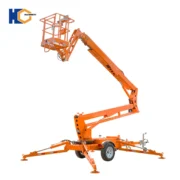
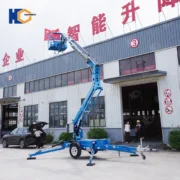
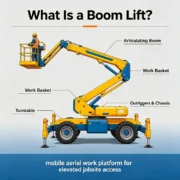
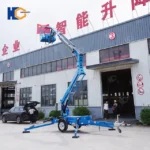
A towable boom lift, also known as a trailer-mounted boom lift, tow-behind cherry picker, or towable articulating boom lift, is a mobile elevating work platform mounted on a trailer chassis.
It is transported between job sites using a suitable towing vehicle. Once positioned at the work location, the trailer is disconnected from the towing vehicle, the stabilizing outriggers are deployed, and the machine is leveled before the boom is operated.
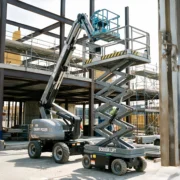
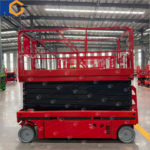
Unlike a conventional scissor lift, which primarily raises workers vertically, an articulating boom lift uses a combination of hinged and sometimes telescopic boom sections to position the platform at different heights and horizontal distances.
This allows operators to reach areas above and around obstacles such as:
- Building facades and roof edges
- Tree branches and landscaping structures
- Industrial pipes and equipment
- Streetlights and overhead signs
- Canopies and external building features
- Advertising boards and lighting installations
The Basic Operating Process
A towable cherry picker generally works through five operating stages:
| Operating stage | Main system involved | Main purpose |
|---|---|---|
| Transportation | Hitch, trailer chassis, axle, brakes, and lights | Move the lift between work locations |
| Stabilization | Hydraulic outriggers and leveling sensors | Establish a stable working base |
| Boom deployment | Hydraulic cylinders and articulated arms | Raise and position the platform |
| Precision positioning | Proportional valves and control system | Control boom movement and basket orientation |
| Shutdown and transport | Emergency systems, boom locks, and trailer brakes | Secure the equipment for storage or towing |
The important engineering principle is that each stage depends on the previous one. The boom should not become operational until the required support and safety conditions have been satisfied.
2. The Main Components of a High-End Towable Cherry Picker
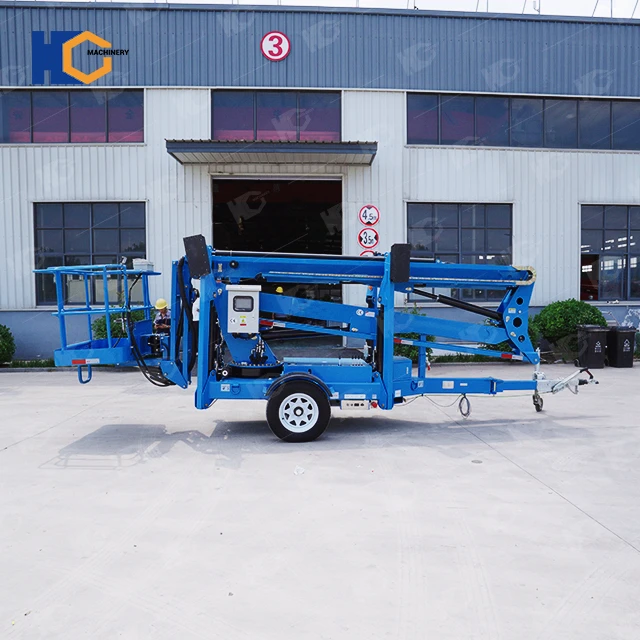
A professional towable boom lift normally contains several major mechanical, hydraulic, electrical, and structural assemblies.
The following table summarizes their functions.
| Core component | Main function | Important quality indicators |
|---|---|---|
| Trailer chassis | Supports and transports the equipment | Structural strength, axle rating, suspension, corrosion protection |
| Towing assembly | Connects the lift to the towing vehicle | Coupler compatibility, safety chains, braking system |
| Hydraulic outriggers | Stabilize and level the machine | Support footprint, cylinder quality, interlocks |
| Articulated boom | Provides vertical and horizontal reach | Structural design, joints, pins, weld quality |
| Slewing mechanism | Rotates the boom assembly | Rotation accuracy, bearing quality, braking |
| Hydraulic power unit | Produces the force required for lifting | Pump performance, filtration, valves, leak protection |
| Work platform | Carries workers and tools | Rated load, anti-slip floor, guardrails, platform leveling |
| Control system | Coordinates machine movements | Proportional controls, sensors, diagnostics |
| Safety system | Prevents or limits unsafe operation | Tilt, overload, emergency stop, emergency lowering |
| Power system | Supplies energy to the lifting functions | AC, DC, diesel, gasoline, or dual-power configuration |
A manufacturer should be able to explain not only what each component does, but also how the complete system behaves when the machine is towing, stabilizing, lifting, or responding to an emergency.
3. Trailer Chassis and Towing System: The Foundation of Equipment Mobility
The trailer chassis is the foundation of a towable boom lift. It supports the boom assembly, hydraulic equipment, power source, stabilizers, and other components during transportation and operation.
Although the chassis is not responsible for lifting workers directly, its structural integrity and roadworthiness are essential to equipment reliability.
Main Components of the Trailer System
1. Main chassis frame
The chassis distributes the weight of the boom, turntable, hydraulic system, and other assemblies. Its dimensions and structural design influence the equipment’s overall weight, stability, and transportation characteristics.
The frame should be manufactured with appropriate structural materials and inspected for weld quality, alignment, and deformation.
2. Towing coupler and drawbar
The coupler connects the trailer to the towing vehicle.
Buyers should confirm:
- Coupler type and ball or eye compatibility
- Rated towing capacity
- Drawbar dimensions and strength
- Correct towing height
- Safety-chain attachment points
A coupler that physically fits a vehicle is not necessarily rated for the trailer’s actual towing requirements.
3. Axle and suspension
The axle supports the trailer’s road load and transfers forces from the wheels to the chassis.
Some premium configurations use torsion axle suspension to absorb road vibration. This can reduce the transmission of shocks to the trailer structure and mounted equipment during transportation.
4. Tires and wheels
Tires should match the trailer’s rated weight, expected towing speed, and operating environment.
Buyers should check tire load ratings, size, pressure recommendations, sidewall condition, and spare-wheel availability.
5. Trailer braking system
Depending on the design and destination-country requirements, a towable boom lift may use mechanical, surge, or electric braking arrangements.
Huichuang Lift’s published HCZB product information describes a multi-mode braking configuration involving impact braking, manual braking, and an electrical braking connection.
The actual braking arrangement should be confirmed against the ordered model and local road regulations.
6. Lighting and electrical connections
The trailer may require road lights, indicators, brake lights, reflectors, and electrical connections to the towing vehicle.
These components should be checked before every road journey.
Why Does Towing Quality Affect Equipment Life?
A towable lift may travel regularly between customer locations, rental depots, warehouses, and construction sites.
Poorly secured boom sections can move during transportation, while repeated vibration may accelerate wear around joints, hydraulic fittings, wiring connections, and structural mounting points.
A good transport design should therefore include:
- Proper boom and platform transport locks
- Suitable suspension
- Secure hydraulic and electrical routing
- Reliable trailer brakes
- Appropriate towing accessories
Huichuang Lift specifies a German AL-KO towing arrangement and torsion axle suspension on its published HCZB product page. These are worth checking against the actual component list when comparing configurations.
For a closer look at the complete Huichuang 50ft towable articulating boom lift, review the published model dimensions and transportation features.
4. Hydraulic Outriggers and Stabilization System: Controlling the Working Base
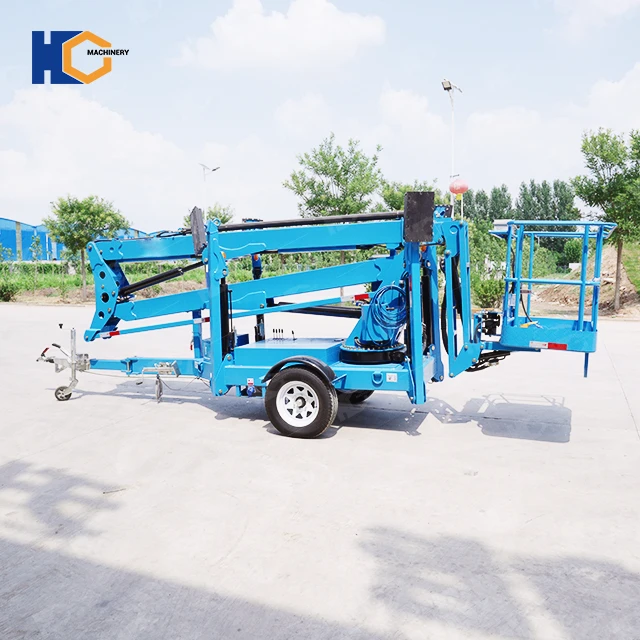
The outrigger system is one of the most important safety-related assemblies on a towable cherry picker.
When the boom is extended, forces are transferred through the boom structure and turntable to the trailer chassis. The outriggers expand the support footprint and transfer the resulting loads to the ground.
Without a properly designed and correctly deployed stabilizing system, a trailer-mounted boom lift cannot be operated safely.
Main Components of the Outrigger System
A hydraulic outrigger assembly normally includes:
- Outrigger arms or support legs
- Hydraulic cylinders
- Foot pads
- Hydraulic hoses and fittings
- Directional valves
- Load-holding valves
- Leveling indicators or sensors
- Safety interlocks
How Hydraulic Outriggers Work
The hydraulic power unit supplies pressurized fluid to the outrigger cylinders through the relevant control valves.
As the cylinders extend, the support legs move outward and their foot pads contact the ground.
The operator then levels the machine according to the manufacturer’s instructions.
On an interlocked design, the boom controls remain disabled until the required outrigger deployment conditions are satisfied.
Huichuang Lift’s HCZB product information specifies an interlocking hydraulic outrigger system designed to prevent boom operation before the supports are deployed and grounded.
Automatic Leveling and Tilt Monitoring
A high-end stabilizer system may combine automatic or assisted leveling with an electronic tilt sensor.
The tilt sensor monitors the chassis inclination. When the machine exceeds its permitted operating limit, the control system can trigger an alarm or restrict hazardous movements.
These systems perform different functions:
| System | Main responsibility |
|---|---|
| Outrigger cylinder | Extends and positions the support leg |
| Foot pad | Transfers force to the ground |
| Leveling system | Helps establish the required chassis position |
| Tilt sensor | Monitors chassis inclination |
| Outrigger interlock | Prevents boom operation when deployment conditions are not met |
An important purchasing point is that automatic leveling does not mean the machine can operate on any surface.
The ground must be capable of supporting the loads transmitted through the outrigger feet. Concrete slabs, asphalt, compacted soil, and landscaped ground can have very different load-bearing characteristics.
Practical Engineering Check: Ground Pressure
The maximum reaction at an outrigger should be evaluated against the ground’s allowable bearing pressure.
A basic preliminary relationship is:
Required support pad area = Maximum outrigger reaction ÷ Allowable ground bearing pressure
Both values must be expressed in compatible units.
The calculation should use the manufacturer’s outrigger reaction data and an appropriate assessment of the actual ground conditions. Do not assume that the machine’s total weight divided by four represents the maximum load on each outrigger.
For uneven or soft ground, properly selected support pads or mats may be required.
5. Articulated Boom Structure: How the Cherry Picker Reaches Over Obstacles
The boom structure determines the machine’s working height, horizontal reach, and ability to position workers around obstacles.
This is the main reason a towable articulating boom lift is different from a vertical scissor lift.
A scissor lift provides primarily vertical movement. An articulating boom can combine lifting, folding, extending, and rotating movements to reach areas that are not directly above the chassis.
Main Structural Sections
1. Lower boom section
The lower boom connects the turntable or central support structure to the upper boom assembly.
Its position and lifting movement provide the initial height and angle of the platform.
2. Upper boom section
The upper boom carries the platform farther away from the main boom pivot.
Depending on the design, it may include a telescopic section to increase horizontal outreach.
3. Articulating joints or knuckles
These joints allow the boom to bend and change its working geometry.
They are particularly useful when the platform needs to pass over a wall, canopy, roof edge, or other obstacle.
4. Telescopic boom
A telescopic section extends or retracts to adjust the reach.
It is usually driven by a hydraulic cylinder or another model-specific extension mechanism.
5. Jib boom
Some high-end models include a smaller articulated section near the platform.
A jib provides additional positioning flexibility and can help the operator approach work areas at more suitable angles.
6. Pins, bushings, and joint connections
These components carry loads and allow controlled rotation at each boom joint.
Excessive wear or poor alignment can result in looseness, vibration, abnormal noise, and inaccurate positioning.
Why Boom Geometry Matters More Than Maximum Height Alone
A machine advertised with a 20-meter working height may not be the best option for every 20-meter job.
Buyers also need to evaluate:
- Horizontal outreach
- Up-and-over height
- Platform position at maximum outreach
- Rated platform capacity throughout the working envelope
- Outrigger footprint
- Rotation restrictions
The working envelope or load chart is essential. Maximum platform height and maximum horizontal outreach may not be available simultaneously.
For complex facade maintenance or overhead installation, the ability to position the platform correctly can be more important than simply selecting the tallest model.
For a comparison with a mobile, self-propelled articulating design, see Huichuang Lift’s mobile articulated boom lift range.
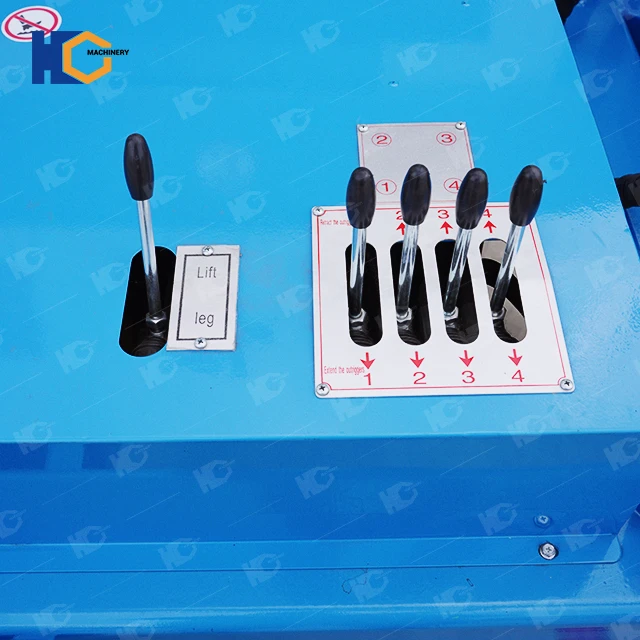
The control system is the brain of a modern towable trailer boom lift. It processes operator input, monitors machine status, coordinates all hydraulic and electrical functions, and provides feedback and diagnostics. The sophistication of the control system is one of the biggest differentiators between budget and professional-grade equipment.
6. Turntable and Slewing System: Controlling Boom Rotation
The turntable connects the boom assembly to the trailer chassis and allows the upper structure to rotate around its vertical axis.
Its major components may include:
- Slewing bearing or rotation support
- Rotating platform
- Drive mechanism
- Hydraulic motor or cylinder arrangement
- Hydraulic and electrical connections
- Rotation limit or monitoring system
Why 360-Degree Rotation Matters
A rotating boom allows the machine to cover different working directions without repeatedly moving the trailer.
For maintenance contractors, this can reduce repositioning time and simplify access around a building.
However, buyers should distinguish between:
- Continuous 360-degree rotation
- Limited-angle rotation
- Rotation with an operating stop or travel restriction
Huichuang Lift lists optional 360-degree continuous chassis rotation on the HCZB series, together with a 160-degree basket swing.
These are two different movements. Chassis rotation changes the direction of the boom assembly, while basket rotation changes the operator’s orientation at the end of the boom.
Basket Rotation and Positioning
An independent basket rotation mechanism helps the operator face the work surface without requiring the entire boom assembly to change direction.
For example, during exterior window maintenance, an operator may need to adjust the basket angle to align with the building facade.
A 160-degree basket swing option can provide additional positioning flexibility, subject to the selected model’s operating limits.
7. Hydraulic Power System: The Core of Lifting Performance
The hydraulic system converts mechanical or electrical power into controlled lifting force.
In a towable cherry picker, it may operate the boom lifting cylinders, extension mechanism, rotation functions, outrigger cylinders, and platform leveling system.
The quality of the hydraulic system affects lifting smoothness, movement speed, positioning accuracy, temperature management, and reliability.
Main Hydraulic Components
| Component | Function |
|---|---|
| Hydraulic power source | Drives the hydraulic pump |
| Hydraulic pump | Converts mechanical energy into fluid flow |
| Hydraulic oil reservoir | Stores hydraulic fluid |
| Hydraulic filter | Removes contaminants from the oil |
| Proportional valve | Regulates hydraulic flow according to control input |
| Directional valve | Selects the movement circuit |
| Pressure relief valve | Limits system pressure |
| Hydraulic cylinder | Converts fluid pressure into linear force |
| Counterbalance or load-holding valve | Helps control and hold loads safely |
| Hydraulic hoses and fittings | Transfer pressurized fluid |
How the System Works
When the operator activates a boom movement, the controller sends a signal to the relevant valve.
The valve directs hydraulic fluid toward the selected cylinder. The cylinder then extends or retracts to move the corresponding boom section.
When the operator releases the control, the hydraulic circuit should stop the movement in a controlled manner.
Load-holding and counterbalance arrangements are important because the boom carries a suspended load. These components help prevent uncontrolled movement if pressure changes or a hose or power component fails, depending on the circuit design.
Why Proportional Valves Matter
A basic on/off valve provides relatively simple movement control.
A proportional valve allows the hydraulic flow rate to change in response to the control signal, enabling smoother movement and finer positioning.
This matters when:
- Approaching a building facade
- Working near overhead pipes
- Positioning the basket beside a tree canopy
- Moving close to signage or lighting fixtures
- Coordinating several boom movements
Huichuang Lift’s published HCZB series specification identifies an American Hydra-Force proportional valve arrangement for controlling lifting, lowering, extension, and rotation movements.
For buyers, the important question is not simply which valve brand is installed. It is whether the complete hydraulic circuit provides predictable movement, adequate pressure protection, and accessible maintenance points.
Hydraulic Filtration and Oil Temperature
Hydraulic oil contamination can accelerate wear in pumps, valves, seals, and cylinders.
A high-quality system should include appropriate filtration and clear maintenance requirements.
The HCZB product page also lists a hydraulic oil filtration alarm system designed to monitor oil condition and temperature-related maintenance needs.
When evaluating a supplier, request:
- Hydraulic circuit drawings
- Recommended oil specification
- Filter replacement intervals
- Operating temperature limits
- Hose and fitting specifications
- Inspection and leak-test records
8. Electrical Control System and CAN Bus Technology
Modern towable boom lifts combine hydraulic power with electrical and electronic control systems.
The electrical system coordinates platform controls, ground controls, sensors, alarms, safety interlocks, and selected operating functions.
Main Control Components
A typical advanced arrangement may include:
- Ground control panel
- Platform control panel
- Main controller or PLC
- CAN bus communication network
- Joystick or proportional control input
- Display screen
- Emergency stop switches
- Tilt sensor
- Outrigger position sensors
- Overload detection
- Platform leveling sensor
- Power and diagnostic circuits
What Is CAN Bus Technology?
CAN stands for Controller Area Network.
It is a communication architecture that allows electronic control modules and connected devices to exchange information through a shared communication network.
In a towable boom lift, CAN bus can support communication between the main controller, sensors, control stations, and display system.
Potential benefits include:
- Centralized system monitoring
- Fault-code reporting
- Diagnostic information
- Reduced need for separate signal wiring
- Easier identification of certain electrical faults
Huichuang Lift’s HCZB product listing describes a CAN bus control system with self-diagnosis and a multilingual fault-message display.
For an international rental fleet, accessible diagnostic information can reduce the time required to identify a fault and arrange service.
Ground Controls and Platform Controls
A professional cherry picker should provide appropriate control access at both the ground and platform levels.
The platform controls allow the operator to position the machine during normal operation.
Ground controls allow authorized personnel to operate selected functions and assist with emergency lowering or recovery.
The system’s control hierarchy should be clearly defined in the user manual. Buyers should verify which controls override others and how emergency recovery works.
Why a Foot Switch or Dead-Man Control Matters
A foot switch or dead-man control requires the operator to maintain intentional activation before certain platform functions can operate.
This helps reduce accidental movement caused by unintended control input.
Huichuang’s HCZB specifications identify a platform master control switch designed to require operator activation before the platform controls become active.
9. Work Platform and Automatic Leveling System
The platform or basket is the operator’s working area. Its design directly affects comfort, access, visibility, and safety.
A high-quality platform should provide:
- Suitable rated load
- Anti-slip flooring
- Guardrails
- Secure entry gate
- Clear control layout
- Suitable tool storage
- Properly designed access and egress
- Approved attachment points where specified
Platform Capacity
The rated platform capacity includes the combined load of workers, tools, and materials.
For example, consider an illustrative work assignment:
| Load item | Weight |
|---|---|
| Operator A | 85 kg |
| Operator B | 75 kg |
| Tools | 20 kg |
| Small materials | 15 kg |
| Total | 195 kg |
If the machine has a 200 kg rated platform capacity, this load leaves very little capacity margin.
The number of permitted occupants must also be checked. A platform’s rated load does not automatically authorize any particular number of workers.
Automatic Platform Leveling
As the boom changes angle or extends, the basket must remain within its specified operating orientation.
A self-leveling mechanism coordinates platform position with the movement of the boom assembly.
Depending on the design, this may use a hydraulic leveling cylinder, linkage system, or electronic sensing and control arrangement.
Huichuang Lift lists an automatic self-leveling platform and optional 160-degree basket swing for its HCZB range.
A buyer should confirm how the leveling function operates, whether manual trim is available, and what inspection is required if the basket does not remain correctly aligned.
10. Multiple Power Systems: AC, Battery, Gasoline, Diesel, and Dual Power
Towable cherry pickers can use different power configurations according to working conditions and available energy sources.
The power source determines how the hydraulic pump is driven and affects noise, emissions, operating duration, and maintenance requirements.
AC Electric Power
AC-powered configurations can be suitable for locations with an available electrical supply.
Typical applications include:
- Indoor maintenance
- Industrial facilities
- Noise-sensitive areas
- Long-duration work with a suitable power connection
Buyers should confirm the required voltage, frequency, current, cable arrangement, and whether the equipment can operate while connected to an external power source.
DC Battery Power
Battery-powered configurations provide quiet operation without direct exhaust emissions.
They can be useful for residential maintenance, indoor work, and locations where engine exhaust is undesirable.
Battery capacity, charging time, operating cycle, and replacement availability should be confirmed before ordering.
Gasoline Power
Gasoline-powered hydraulic systems are useful when convenient fuel availability and independent operation are priorities.
The engine drives the hydraulic pump, providing the flow required for boom and stabilizer movements.
Routine maintenance includes engine oil, filters, fuel system components, and cooling arrangements.
Diesel Power
Diesel power may be considered for outdoor projects requiring longer running periods or where diesel fuel is more readily available.
However, noise, emissions, ventilation, and engine maintenance should be taken into account.
Bi-Energy or Dual-Power Configuration
Some models combine an engine-driven hydraulic system with battery-electric operation.
This can provide flexibility across outdoor and indoor applications, depending on the actual design.
Huichuang Lift lists AC, diesel, gasoline, customized DC battery, and dual-power options for its HCZB series.
| Power configuration | Main advantage | Main purchasing consideration |
|---|---|---|
| AC electric | Quiet operation and no local exhaust emissions during electric operation | Power supply and cable management |
| DC battery | Mobile, quiet operation | Battery capacity and charging |
| Gasoline | Flexible outdoor operation | Fuel, engine maintenance, and emissions |
| Diesel | Long operating periods for outdoor applications | Fuel consumption, noise, and servicing |
| Dual power | Flexibility across different working environments | Higher system complexity and correct mode selection |
11. Safety Systems: How High-End Cherry Pickers Protect Operators
The safety system is not a single device. It is a network of mechanical, hydraulic, electrical, and electronic protections.
A high-quality towable boom lift should address risks during towing, setup, lifting, positioning, and emergency recovery.
Essential Safety Components
| Safety component | Main purpose |
|---|---|
| Outrigger interlock | Prevents boom operation before required support conditions are met |
| Tilt sensor | Detects excessive chassis inclination |
| Overload protection | Restricts operation beyond the rated platform load |
| Emergency stop | Provides a rapid means to stop machine functions |
| Emergency lowering | Allows controlled descent during a power or system failure |
| Hydraulic load-holding valves | Help control suspended loads |
| Platform self-leveling | Maintains the specified basket orientation |
| Anti-pinch design | Helps reduce trapping hazards around moving structures |
| Transport locks | Secure the boom and basket during road transport |
| Trailer braking system | Helps control the trailer during transportation |
Huichuang Lift’s published HCZB specifications list emergency stops at ground and platform controls, emergency lowering, overload protection, tilt monitoring, interlocking outriggers, hydraulic balance valves, and transport locks.
These functions should be verified on the actual machine during factory acceptance testing.
Emergency Lowering Is Especially Important
Imagine an operator working at height when the main power source fails.
The machine should have a manufacturer-defined emergency recovery procedure that allows authorized personnel to lower the platform safely.
Depending on the model, this may involve:
- A manual emergency lowering valve
- An auxiliary power system
- A manual hydraulic pump
- A ground-level recovery control
Huichuang lists an optional emergency manual pump for selected HCZB configurations.
The presence of an emergency device is not enough. The supplier must provide clear recovery instructions, and the operator or ground personnel must be trained to use the specific system.
Standards and Compliance
For North American buyers, ANSI/SAIA A92.2-2021 is an important reference for vehicle-mounted elevating and rotating aerial devices. Its scope includes articulating and extensible boom devices mounted on vehicles, trailers, or all-terrain vehicles.
In the United States, OSHA’s aerial lift requirements and safe-use guidance also apply to relevant equipment and workplace activities.
OSHA identifies falls, electrocution, and collapse or tip-over as major aerial lift hazards. Its guidance emphasizes training, inspection, proper use of controls, and following the manufacturer’s instructions.
For export projects, confirm the exact applicable standard and conformity documentation for the destination country and the specific machine configuration.
Useful technical references:
A CE declaration or other certificate should be checked against the actual model and its applicable requirements. It should not be treated as an automatic substitute for local approval, inspection, or operator training.
12. How to Evaluate a High-End Towable Boom Lift: HCZB Series Technical Example
A practical way to evaluate a manufacturer’s engineering is to look at actual model specifications instead of relying only on terms such as “heavy-duty,” “premium,” or “international quality.”
Huichuang Lift’s published HCZB-10 to HCZB-20 product range provides a useful example.
HCZB Series Main Specifications
| Model | Platform height | Working height | Rated capacity | Working radius | Listed machine weight |
|---|---|---|---|---|---|
| HCZB-10-200 | 10 m | 12 m | 200 kg | 5.5 m | 1.7 t |
| HCZB-12-200 | 12 m | 14 m | 200 kg | 6.5 m | 2.0 t |
| HCZB-14-200 | 14 m | 16 m | 200 kg | 8.5 m | 2.4 t |
| HCZB-16-200 | 16 m | 18 m | 200 kg | 10.5 m | 2.6 t |
| HCZB-18-200 | 18 m | 20 m | 200 kg | 11 m | 4.3 t |
| HCZB-20-200 | 19.8 m | 22 m | 200 kg | 11 m | 4.5 t |
Other published product details include:
- Platform dimensions: approximately 900 × 700 mm
- AC, DC, gasoline, and diesel power options, depending on configuration
- Optional 360-degree continuous chassis rotation
- 160-degree basket swing
- Automatic platform leveling
- Hydraulic outrigger interlock
These are manufacturer-listed reference specifications. The final technical drawing, load chart, approved options, and transport data should be checked for the exact model and order.
What Can Buyers Learn from These Specifications?
1. Higher platform height usually requires a different structural configuration.
The listed HCZB-10 weighs approximately 1.7 tonnes, while the HCZB-20 weighs approximately 4.5 tonnes.
This difference matters for transport, towing vehicle selection, setup space, and ground loading.
2. Horizontal reach increases independently of platform height.
The published working radius increases from 5.5 m on the HCZB-10 to 11 m on the HCZB-20 range.
However, the maximum platform height and maximum working radius should not be assumed to occur simultaneously. Buyers must request the applicable working envelope or load chart.
3. Rated load remains a separate design limit.
All six listed HCZB configurations specify a 200 kg rated platform load.
Choosing a higher platform height does not automatically increase capacity.
4. Larger models require more careful transport planning.
A machine weighing 4.5 tonnes cannot be treated like a compact light-duty trailer.
The buyer must confirm the total transport mass, trailer and axle ratings, tongue load, towing vehicle capacity, braking arrangement, and legal requirements in the destination country.
Explore the HCZB 10–20 m towable boom lift range for model-specific configurations.
13. Real-World Selection Example: Choosing a 50ft-Class Towable Cherry Picker
Consider a contractor maintaining exterior building structures with work areas located above landscaping, walls, and other ground-level obstacles.
The contractor needs a machine with:
- A working height in the 16–18 m range
- Horizontal outreach to reach around obstacles
- A platform load suitable for the operator and tools
- A towable chassis for movement between sites
- Hydraulic outriggers and reliable leveling
- Precise basket positioning
The HCZB-14-200 is one model worth evaluating.
Its published specifications include:
| Specification | HCZB-14-200 |
|---|---|
| Platform height | 14 m |
| Working height | 16 m |
| Working radius | 8.5 m |
| Rated platform capacity | 200 kg |
| Platform size | 900 × 700 mm |
| Machine weight | 2.4 tonnes |
These figures provide a starting point, not final confirmation of suitability.
Before purchasing, the contractor should overlay the manufacturer’s working envelope onto the actual building layout and confirm that the required position is reachable within the rated load and permitted outrigger configuration.
For example, if the work area is above a wall, the machine needs enough up-and-over clearance as well as horizontal reach. If the ground is soft, the outrigger support arrangement needs to be assessed before the equipment is positioned.
This is an illustrative engineering selection example, not a claim about a specific completed customer project.
14. Manufacturing Quality: What Should You Inspect Before Buying?
A high-end cherry picker should be evaluated through its production quality and documented testing, not just its list of imported components.
For distributors, rental companies, and contractors purchasing from overseas manufacturers, pre-shipment inspection can reduce the risk of receiving equipment that differs from the approved configuration.
1. Structural Inspection
Check:
- Boom section dimensions and alignment
- Weld appearance and inspection records
- Pin and bushing fit
- Turntable mounting
- Outrigger structure
- Trailer frame alignment
- Corrosion protection
- Boom and platform transport locks
2. Hydraulic Inspection
Check:
- Pump operation
- Hydraulic pressure and flow
- Hose routing and fitting security
- Cylinder movement
- Hydraulic leaks
- Load-holding function
- Emergency lowering
- Oil filtration and maintenance access
3. Electrical and Control Inspection
Check:
- Control station operation
- CAN bus communication
- Diagnostic display
- Wiring protection
- Emergency stop functions
- Tilt sensor response
- Outrigger interlocks
- Platform leveling
- Power supply and charging arrangement
4. Functional and Safety Testing
Request records for the applicable tests, including:
- Boom extension and retraction
- Boom lifting and lowering
- Rotation and basket movement
- Platform leveling
- Outrigger deployment
- Emergency stop
- Emergency lowering
- Load and stability testing under the prescribed procedure
- Trailer lights and brake checks
Any load or stability test must be performed using the manufacturer’s approved procedure and applicable standards. Buyers should not improvise tests that exceed the machine’s rated capacity.
5. Protection Against Corrosion
Towable equipment is often exposed to outdoor rain, dust, road spray, humidity, and temperature changes.
Huichuang Lift specifies electrophoretic coating treatment for the HCZB series.
This type of coating can help provide more uniform corrosion protection than relying only on an exterior paint finish. Buyers should still inspect surface preparation, coating coverage, drainage areas, electrical enclosure protection, and any exposed fasteners.
15. How to Reduce Operating Costs and Extend Cherry Picker Service Life
The purchase price is only part of the cost of owning a towable boom lift.
For equipment rental companies and contractors, maintenance, transportation, downtime, and spare-parts access can have a significant effect on total cost of ownership.
Keep the Hydraulic System Clean
Hydraulic oil contamination can accelerate the wear of pumps, valves, seals, and cylinders.
Follow the manufacturer’s recommended oil and filter replacement intervals. Investigate unusual temperature increases, slow boom movement, or unexpected pressure changes instead of simply continuing operation.
Inspect Outriggers Regularly
Check support arms, cylinders, pads, hydraulic fittings, locking arrangements, and interlock sensors.
Any damage or incomplete deployment should be addressed before the machine is used.
Secure the Boom Before Transport
Before towing, lower the boom into its designated travel position, secure the platform and boom with the specified locks, and follow the manufacturer’s transport procedure.
Never tow a machine with an unsecured boom or loose platform components.
Maintain the Trailer Brakes and Tires
Check brake operation, coupler condition, tire pressure, wheel fasteners, safety chains, lights, and electrical connectors.
Trailer-related problems can affect both road safety and the condition of the lifting equipment.
Keep Electronic Diagnostics Available
Record fault codes and maintenance events. A clear service history helps technicians distinguish repeated problems from isolated issues.
For businesses operating several machines, a maintenance record for each unit can help identify recurring failures and plan spare-parts purchases.
16. Why Consider Huichuang Lift as Your Towable Boom Lift Manufacturer?
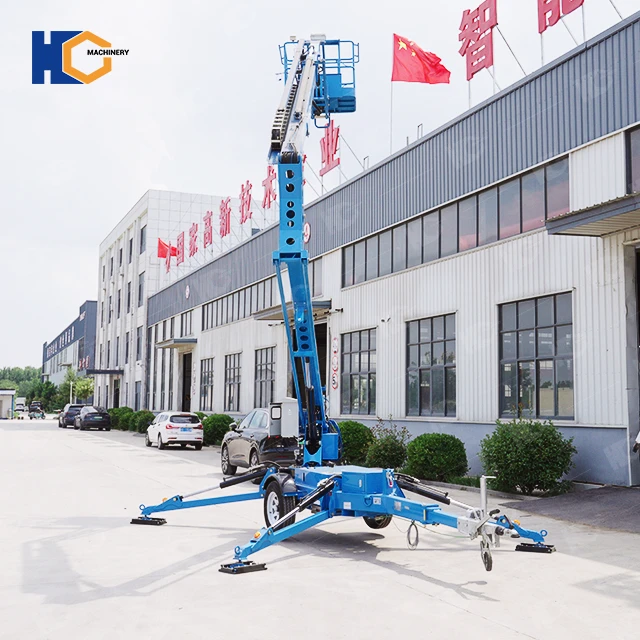
Huichuang Lift is the short name of Jinan Huichuang Machinery Manufacturing Co., Ltd., based in Jinan, Shandong, China.
According to its published company information, Huichuang Lift operates multiple production workshops and product showrooms with approximately 200 experienced staff. Its main product lines include hydraulic aerial work lifts and home elevators.
Its aerial work platform portfolio includes towable boom lifts, mobile articulated boom lifts, crawler boom lifts, and other lifting equipment.
Integrated HCZB Component Configuration
The HCZB series brings together several systems that are important for a professional towable cherry picker:
- Articulated boom structure
- Hydraulic outrigger interlocks
- Proportional hydraulic controls
- CAN bus control and diagnostics
- Automatic platform leveling
- Tilt monitoring and overload protection
- Emergency lowering arrangements
- Towing and transport safety components
The exact components and available options should be confirmed against the selected model and its final bill of materials.
Multiple Height and Power Configurations
The published HCZB range covers platform heights from approximately 10 m to 19.8 m, with working heights listed up to 22 m.
Power options include AC, gasoline, diesel, customized DC battery, and selected dual-power arrangements.
This gives contractors and distributors flexibility when matching the equipment to different working environments.
OEM and Customization Support
Huichuang Lift supports project-based discussions covering:
- Platform and basket configuration
- Working height and outreach requirements
- Power configuration
- Control system options
- Brand logo and machine color
- Selected accessories
- Export packing and documentation
For fleet operators and equipment distributors, discussing these details before production helps align the equipment with the intended market.
Learn more about the company’s manufacturing background on the Huichuang Lift About Us page.
Related Boom Lift Solutions
Different work environments may require different lifting technologies.
For example:
- A self-propelled articulated boom lift may suit sites that require powered machine movement between work positions. See the diesel self-propelled articulating boom lift.
- A crawler boom lift may be more suitable where tracked movement and a different ground-contact arrangement are required. Explore the compact crawler boom lift.
- A scissor lift may be more appropriate when the task requires vertical access and a larger platform rather than horizontal outreach. Compare the mobile scissor lift range.
For a broader equipment cost comparison, read How Much Does a Boom Lift Cost?.
If you are sourcing a towable cherry picker for a construction project, rental fleet, or municipal maintenance application, contact Huichuang Lift with the required working height, horizontal outreach, platform capacity, power source, and destination country.
17. Frequently Asked Questions About Towable Trailer Boom Lift Technology
What are the main components of a towable boom lift?
The main components include a trailer chassis, towing coupler, axle and braking system, hydraulic outriggers, articulated boom, turntable, hydraulic power unit, work platform, electrical control system, and safety devices.
What is the difference between a towable boom lift and a self-propelled boom lift?
A towable boom lift is transported between locations using an external towing vehicle. A self-propelled boom lift has its own powered drive chassis and can normally reposition itself around the worksite.
Some towable models offer optional powered or friction-wheel movement for short-distance positioning, but this does not automatically mean the machine can drive while its platform is elevated.
How do hydraulic outriggers work on a cherry picker?
Hydraulic outriggers extend from the trailer chassis and transfer machine loads to the ground through support feet or pads.
An interlocking system can prevent boom operation until the required support conditions have been met. Leveling sensors may monitor chassis inclination during setup and operation.
Why are proportional hydraulic valves important?
Proportional valves regulate hydraulic flow according to the operator’s control input. They allow smoother and more precise boom movement than simple on/off controls.
This is particularly useful when positioning the basket near buildings, trees, equipment, or other obstacles.
What is a CAN bus control system on a boom lift?
CAN bus is a communication network that allows electronic controllers and connected sensors to exchange information.
On a towable boom lift, it can support machine monitoring, diagnostics, safety interlocks, and fault reporting.
Can a towable boom lift rotate 360 degrees?
Some models offer 360-degree continuous chassis or turntable rotation, while others use limited-angle rotation.
Check the manufacturer’s exact configuration. A 360-degree turntable rotation is different from basket rotation, which changes the orientation of the work platform.
What power sources are available for towable cherry pickers?
Common options include AC electric, DC battery, gasoline, diesel, and selected dual-power configurations.
The correct choice depends on operating hours, noise restrictions, emissions requirements, available electrical supply, and maintenance preferences.
What is the typical platform capacity of a towable boom lift?
Many trailer-mounted boom lifts in this equipment category have rated platform capacities around 200–227 kg (440–500 lb), although the available ratings vary by model.
Always check the maximum rated platform load and the manufacturer’s occupant limitations.
What does working height mean?
Working height is an estimated operator reach above the platform. Platform height is the actual height of the platform floor above ground.
The measurement convention should be confirmed because manufacturers may use different definitions in product marketing and technical documents.
Which safety standard applies to trailer-mounted boom lifts in the United States?
ANSI/SAIA A92.2-2021 covers relevant vehicle-mounted elevating and rotating aerial devices, including specified equipment mounted on trailers. OSHA workplace requirements and other applicable regulations must also be considered.
Confirm the correct classification and compliance requirements for the actual machine and its intended use.
How can I verify the quality of a towable boom lift before shipment?
Request a complete technical specification, component list, hydraulic and electrical drawings, applicable conformity documents, inspection reports, and warranty terms.
Arrange a factory acceptance inspection covering the boom, outriggers, hydraulic circuit, controls, emergency functions, towing equipment, and prescribed load or stability tests.
Final Thoughts: High-End Cherry Picker Technology Is About How Systems Work Together
A reliable towable trailer boom lift is the result of coordinated engineering across several major systems.
The trailer chassis provides transportation and structural support. The hydraulic outriggers stabilize the machine. The articulated boom creates the required working envelope. The hydraulic system powers controlled movement, while the electrical control network coordinates operation and safety protection.
For buyers, the most important question is not simply whether a machine uses an imported hydraulic valve or an advanced controller. It is whether the complete equipment system has been designed, manufactured, tested, and maintained as a reliable unit.
Huichuang Lift’s HCZB series provides a range of towable articulated boom lift configurations with published platform heights from 10 m to 19.8 m, working heights up to 22 m, and a standard listed platform capacity of 200 kg.
If you are evaluating a high-end cherry picker for construction, tree maintenance, municipal work, or equipment rental, compare its working envelope, towing requirements, stabilizer design, hydraulic controls, and safety documentation before making a purchasing decision.
Contact Huichuang Lift with your required working height, outreach, rated load, power configuration, and destination country. The engineering and sales team can help review the HCZB configuration and prepare a factory quotation.

Bella has over 10 years of experience in the scissor lift, home elevator, and lifting platform industry, providing high-quality, customized lifting solutions to meet her clients’ unique needs. Her deep technical knowledge and customer-centric approach ensure that every project, from compact home elevators to industrial scissor lifts and custom lifting platforms, is completed accurately, reliably, and to stringent quality standards.
 Room 203, Second Floor, Building 8, Phase Ⅱ, Zhizao Town, Jibei Street, Jiyang District, Jinan City, Shandong Province
 +86 152 5319 3706
 admin@jnhclift.com
Leave a Reply
Want to join the discussion?Feel free to contribute!