
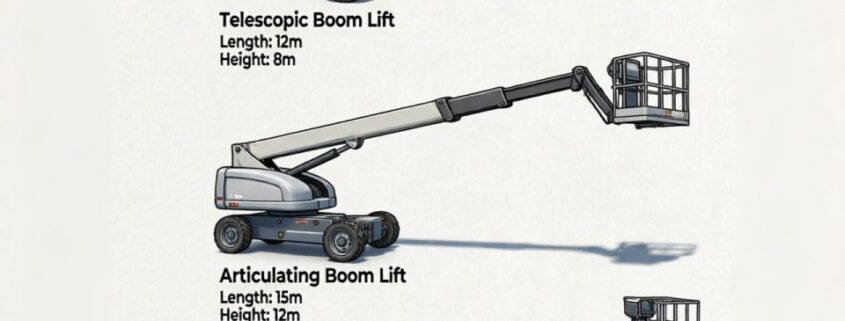
Boom Lift Sizes: Complete Guide
Boom lifts are among the most versatile aerial work platforms used in construction, maintenance, warehousing, telecommunications, utilities, and industrial projects. Unlike scissor lifts, which move vertically, boom lifts provide both vertical and horizontal reach, allowing operators to access difficult-to-reach locations safely and efficiently.
One of the most common questions buyers and renters ask is: What boom lift sizes are available?
The answer depends on the type of boom lift, working height requirements, outreach needs, terrain conditions, and power source. Modern boom lifts range from compact indoor models with working heights of 20 feet to heavy-duty machines capable of reaching over 180 feet.
This guide explains boom lift sizes by category, compares different boom lift types, and helps businesses choose the right machine for their projects.
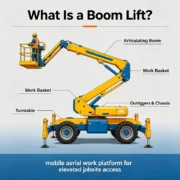
What Is a Boom Lift?
A boom lift is an aerial work platform equipped with a hydraulic arm (boom) that elevates workers, tools, and materials to high locations. The boom can extend outward and upward, providing access to areas that ladders, scaffolding, and scissor lifts cannot easily reach.
Boom lifts are widely used for:
- Building construction
- Exterior maintenance
- Window cleaning
- Bridge inspection
- Telecommunications installation
- Tree trimming
- Industrial maintenance
- Airport operations
- Warehouse management
- Utility line repairs
The primary specification used to classify boom lifts is working height.
Understanding Boom Lift Size Measurements
Before comparing boom lift sizes, it is important to understand key measurements.
Working Height
Working height refers to the maximum height an operator can safely reach while standing in the platform.
Typical range:
- 20 ft (6 m)
- 30 ft (9 m)
- 40 ft (12 m)
- 60 ft (18 m)
- 80 ft (24 m)
- 120 ft (36 m)
- 180 ft (55 m)
Platform Height
Platform height is the actual height of the work basket.
Example:
- Platform height: 38 ft
- Working height: 44 ft
Manufacturers usually add approximately 6 ft to the working height calculation.
Horizontal Outreach
Horizontal outreach measures how far the boom can extend sideways.
This specification is crucial when working over obstacles such as:
- Machinery
- Roof edges
- Trees
- Utility poles
- Industrial equipment
Lift Capacity
Boom lift platforms typically support:
- 440 lbs (200 kg)
- 500 lbs (227 kg)
- 660 lbs (300 kg)
- 1,000 lbs (454 kg)
Larger models often accommodate multiple workers and tools.
Types of Boom Lifts and Their Sizes
Boom lifts can be divided into several major categories.
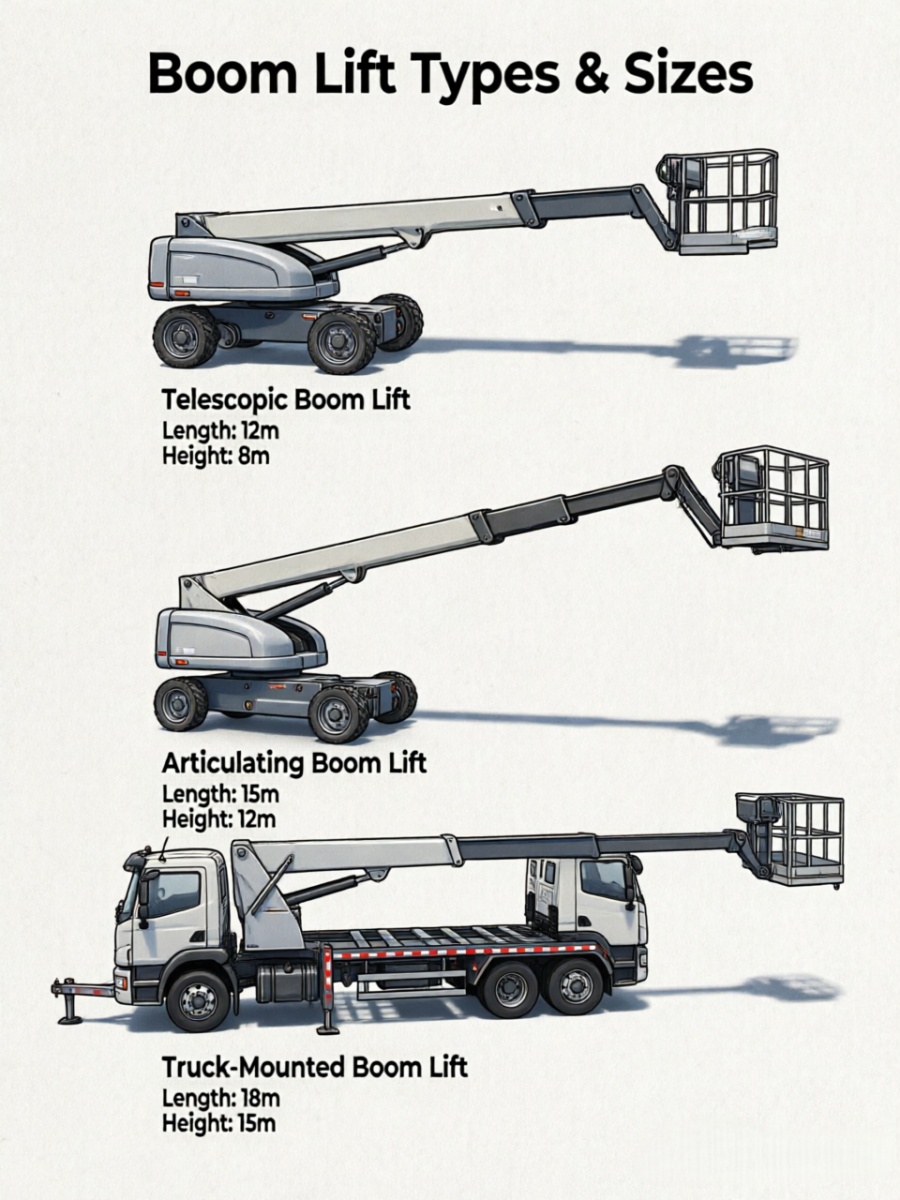
1. Telescopic Boom Lift
Telescopic boom lifts, often called straight boom lifts, feature a boom that extends in a straight line.
These machines offer maximum horizontal outreach and are ideal for jobs requiring long-distance access.
Typical Sizes
| Working Height | Platform Height | Horizontal Reach |
|---|---|---|
| 40 ft | 34 ft | 25 ft |
| 60 ft | 54 ft | 45 ft |
| 80 ft | 74 ft | 60 ft |
| 120 ft | 114 ft | 80 ft |
| 180 ft | 174 ft | 100+ ft |
Advantages
- Longest outreach
- Fast elevation speed
- Ideal for large construction projects
- Suitable for bridge and infrastructure work
Applications
- Steel structure installation
- Stadium construction
- Airport maintenance
- High-rise buildings
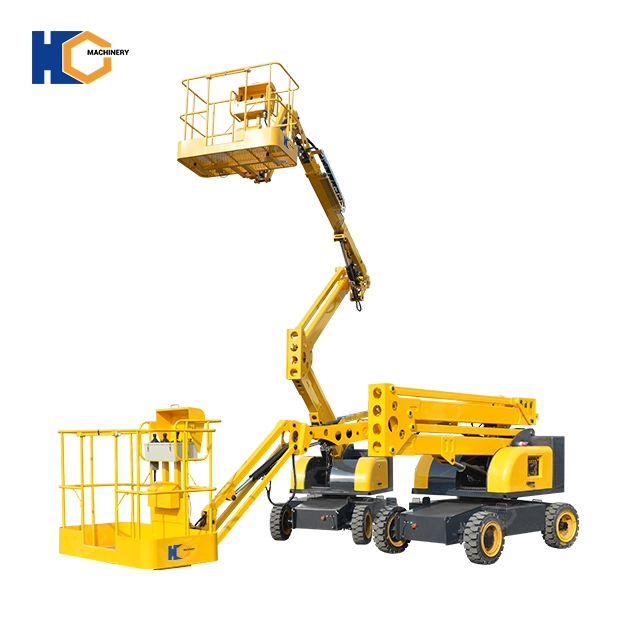
2. Articulating Boom Lift
Articulating boom lifts feature multiple hinged sections that allow the boom to bend around obstacles.
These machines are often called knuckle boom lifts.
Typical Sizes
| Working Height | Platform Height |
| 30 ft | 24 ft |
| 45 ft | 39 ft |
| 60 ft | 54 ft |
| 80 ft | 74 ft |
| 150 ft | 144 ft |
Advantages
- Excellent maneuverability
- Can reach over obstacles
- Suitable for confined spaces
- Increased positioning flexibility
Applications
- Industrial plants
- Warehouses
- Shopping centers
- Refineries
- Aircraft maintenance
Telescopic vs Articulating Boom Lift
| Feature | Telescopic Boom Lift | Articulating Boom Lift |
| Reach Distance | Excellent | Good |
| Obstacle Navigation | Limited | Excellent |
| Setup Speed | Faster | Moderate |
| Flexibility | Lower | Higher |
| Large Construction Sites | Best | Good |
| Indoor Maintenance | Moderate | Excellent |
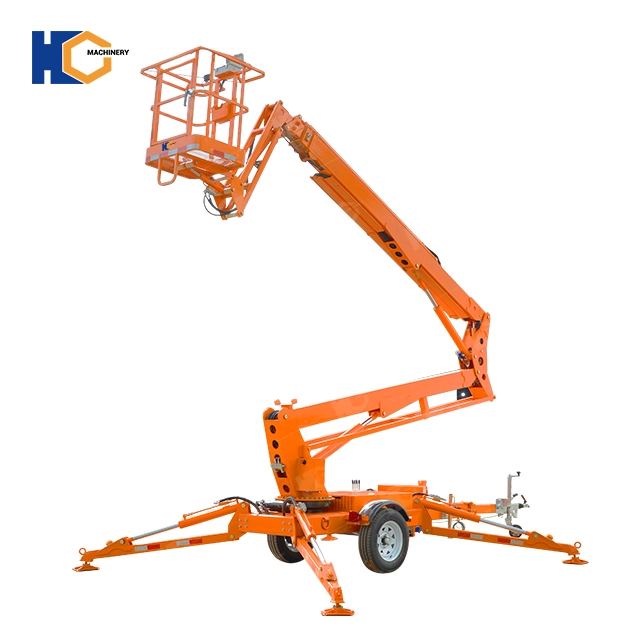
3. Towable Boom Lift
Towable boom lifts are lightweight units that can be transported using a pickup truck, SUV, or trailer hitch.
These are among the most economical boom lifts available.
Typical Sizes
| Working Height | Platform Height |
| 30 ft | 24 ft |
| 35 ft | 29 ft |
| 45 ft | 39 ft |
| 55 ft | 49 ft |
Advantages
- Lower acquisition cost
- Easy transportation
- Minimal maintenance
- Lightweight design
Applications
- Tree care
- Sign installation
- Property maintenance
- Residential projects
Towable boom lifts are especially popular among rental companies and contractors with multiple job sites.
4. Self-Propelled Electric Boom Lift
Electric boom lifts use battery-powered drive systems and produce zero emissions.
These machines are designed primarily for indoor operations.
Typical Sizes
| Working Height | Platform Height |
| 30 ft | 24 ft |
| 40 ft | 34 ft |
| 50 ft | 44 ft |
| 60 ft | 54 ft |
Advantages
- Zero emissions
- Low noise operation
- Lower operating costs
- Environmentally friendly
Applications
- Warehouses
- Manufacturing facilities
- Airports
- Shopping malls
- Data centers
As sustainability requirements increase, electric boom lifts continue gaining market share globally.
5. Diesel Self-Propelled Boom Lift
Diesel boom lifts are designed for outdoor operations and rough terrain.
They offer higher power and longer operating cycles than battery-powered models.
Typical Sizes
| Working Height | Platform Height |
| 40 ft | 34 ft |
| 60 ft | 54 ft |
| 80 ft | 74 ft |
| 100 ft | 94 ft |
| 150 ft | 144 ft |
| 180 ft | 174 ft |
Advantages
- Powerful engines
- Longer runtime
- Rough terrain capability
- Higher lifting capacities
Applications
- Construction sites
- Mining operations
- Infrastructure projects
- Oil and gas facilities
6. Rough Terrain Boom Lift
Rough terrain boom lifts are equipped with:
- Four-wheel drive
- Large off-road tires
- Oscillating axles
- Enhanced ground clearance
Common Sizes
| Working Height | Platform Height |
| 45 ft | 39 ft |
| 65 ft | 59 ft |
| 85 ft | 79 ft |
| 135 ft | 129 ft |
Best Uses
- Uneven ground
- Muddy construction sites
- Remote projects
- Wind farms
These lifts maintain stability where standard boom lifts may struggle.
7. Compact Boom Lift
Compact boom lifts are specifically engineered for narrow spaces.
Typical Sizes
| Working Height | Platform Height |
| 20 ft | 14 ft |
| 26 ft | 20 ft |
| 30 ft | 24 ft |
| 35 ft | 29 ft |
Advantages
- Small turning radius
- Lightweight design
- Easy transportation
- Indoor accessibility
Applications
- Retail stores
- Warehouses
- Office buildings
- Hotels
8. Truck-Mounted Boom Lift
Truck-mounted boom lifts combine aerial access equipment with a road-legal vehicle.
Typical Sizes
| Working Height | Platform Height |
| 40 ft | 34 ft |
| 60 ft | 54 ft |
| 80 ft | 74 ft |
| 120 ft | 114 ft |
Advantages
- Rapid deployment
- Excellent mobility
- No trailer required
- Reduced transportation costs
Applications
- Utility companies
- Telecommunications
- Street lighting
- Municipal maintenance
Most Popular Boom Lift Sizes
30-40 ft Boom Lifts
Ideal for:
- Warehouses
- Residential projects
- Indoor maintenance
45-60 ft Boom Lifts
Ideal for:
- Commercial buildings
- Sign installation
- Roofing projects
65-85 ft Boom Lifts
Ideal for:
- Construction
- Infrastructure projects
- Industrial facilities
100 ft+ Boom Lifts
Ideal for:
- High-rise construction
- Bridge inspection
- Wind energy projects
Factors Affecting Boom Lift Size Selection
Working Height Requirements
Always choose a machine with a slightly greater reach than the actual work area.
Ground Conditions
For rough terrain:
- Diesel models
- Four-wheel drive
- Larger tires
For indoor flooring:
- Electric models
- Non-marking tires
Horizontal Reach Needs
Projects involving obstacles require greater outreach or the use of articulating booms.
Transportation Requirements
Towable and truck-mounted lifts offer easier mobility between locations.
Budget Considerations
Generally:
- Towable boom lifts = lowest cost
- Electric boom lifts = lower operating costs
- Diesel rough terrain lifts = higher purchase price
- Ultra-high boom lifts = premium investment
Boom Lift vs Scissor Lift Size Comparison
| Feature | Boom Lift | Scissor Lift |
| Vertical Reach | Excellent | Excellent |
| Horizontal Reach | Excellent | None |
| Maneuverability | High | Moderate |
| Obstacle Access | Excellent | Poor |
| Platform Capacity | Moderate | High |
| Outdoor Use | Excellent | Good |
When jobs require reaching over obstacles, boom lifts are the preferred solution.
Future Trends in Boom Lift Sizes
The boom lift industry continues evolving through:
- Lithium battery technology
- Hybrid power systems
- Lightweight materials
- Smart telematics
- Autonomous positioning systems
Manufacturers are introducing larger electric boom lifts capable of reaching heights previously achievable only with diesel-powered equipment.
As sustainability regulations become stricter, battery-powered models in the 60–80 ft range are expected to become increasingly common.

Conclusion
Boom lifts are available in a wide range of sizes, from compact 20-foot indoor machines to giant 180-foot construction platforms. The best boom lift size depends on working height, outreach requirements, terrain conditions, transportation needs, and project type.
The major categories include telescopic boom lifts, articulating boom lifts, towable boom lifts, electric boom lifts, diesel boom lifts, rough terrain boom lifts, compact boom lifts, and truck-mounted boom lifts. Each offers unique advantages for specific applications.
By understanding boom lift sizes and the capabilities of each type, contractors, rental companies, and facility managers can select the safest and most cost-effective aerial work platform for their operations.

Jnhclift (Huichuang Lift), based in Jinan, China, is a professional manufacturer of scissor lifts, home elevators, and lift platforms. With our own dedicated factory, we deliver high-quality, reliable lifting solutions tailored to meet diverse industrial and residential needs.
-180x180.webp "Towable trailer boom lift (3)")

 Room 203, Second Floor, Building 8, Phase Ⅱ, Zhizao Town, Jibei Street, Jiyang District, Jinan City, Shandong Province
 +8615628811021
 admin@jnhclift.com