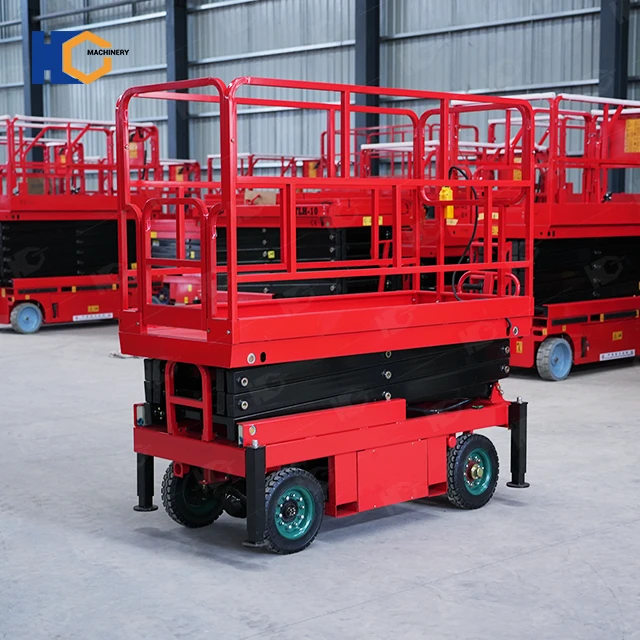
Mobile Hydraulic Scissor Lift Platform
- Model: Mobile hydraulic scissor lift
- Work height: 4-16m
- Brand: HUICHUANG(JNHC lift)
- Customization: YES
- Manual: YES
- Price: $1,300 – $5,500
- Payment Methods: TT
 +8615628811021
 admin@jnhclift.com
Choosing a mobile hydraulic scissor lift platform is not simply a matter of selecting the highest lifting height or the largest load capacity. The right machine must match the working environment, required access height, platform dimensions, power supply, mobility requirements and safety conditions of the job site.
For construction contractors, warehouse operators, equipment rental companies and industrial maintenance teams, a mobile scissor lift provides a practical way to raise personnel, tools and permitted materials to elevated work areas. Its hydraulic lifting system and crossed steel arms create a vertically moving platform, while its mobile chassis allows the machine to be repositioned between work areas.
However, not every mobile scissor lift is designed for the same task. A manually pushed platform, a battery-powered self-propelled lift, a towable unit and a crawler-type scissor lift have different operating characteristics.
At Huichuang Lift, we manufacture customized hydraulic lifting equipment for industrial, commercial and maintenance applications. This guide explains how mobile hydraulic scissor lift platforms work, which configurations are available, how to compare technical specifications and what information buyers should prepare before requesting a factory quotation.
Explore our mobile scissor lift product range to see the equipment category and available solutions.
1. What Is a Mobile Hydraulic Scissor Lift Platform?
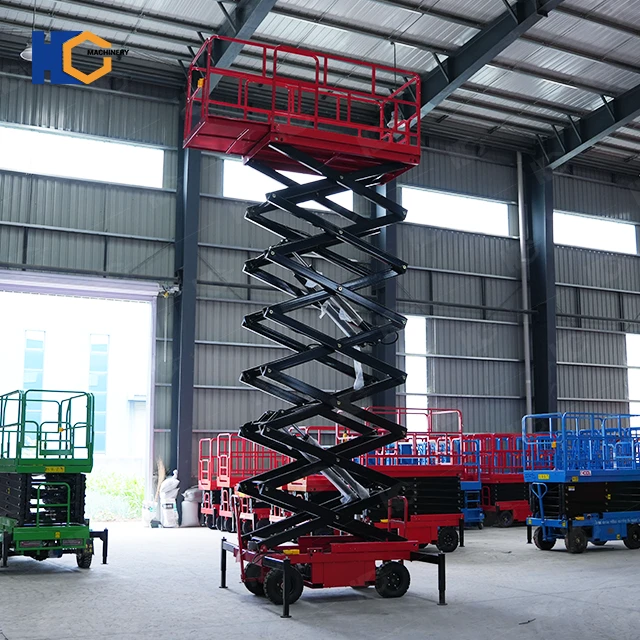
A mobile hydraulic scissor lift platform is a mobile elevating work platform (MEWP) that uses a hydraulic system and a scissor-shaped supporting mechanism to raise and lower a work platform vertically.
The machine is generally composed of:
- A steel chassis and mobile wheel assembly.
- Crossed scissor arms and pivot connections.
- One or more hydraulic lifting cylinders.
- A hydraulic power unit.
- A work platform with guardrails and an access gate.
- Electrical and operating controls.
- Safety and emergency protection devices.
When the hydraulic system supplies pressure to the lifting cylinder, the cylinder moves the scissor mechanism and raises the platform. When the system is commanded to lower, hydraulic oil returns through the designed control circuit, allowing the platform to descend at a controlled speed.
Unlike a boom lift, a conventional scissor lift primarily provides vertical access. It is suitable for jobs where the operator can position the machine beneath or close to the work area without requiring significant horizontal outreach.
Mobile Aerial Work Platform vs. Mobile Scissor Lift Table
This distinction is important because the same keyword is sometimes used for two different equipment categories.
| Item | Mobile Scissor Aerial Work Platform | Mobile Scissor Lift Table |
|---|---|---|
| Main purpose | Raise personnel and permitted tools or materials | Raise and position goods |
| Typical application | Maintenance, installation and elevated work | Packing, picking and material handling |
| Platform arrangement | Guarded personnel work platform | Load table or goods platform |
| Operating height | Generally designed for elevated access | Often lower lifting travel |
| Personnel use | Only within the machine’s approved rating and instructions | Not permitted unless specifically designed and approved for people |
This article focuses on mobile hydraulic scissor lifts designed for aerial work. A low-profile warehouse lift table should not be treated as a personnel-lifting platform simply because it uses a scissor mechanism.
For a broader overview of available equipment, visit our complete scissor lift product range.

2. How Does a Hydraulic Scissor Lift Platform Work?
The hydraulic system supplies lifting force, while the scissor arms guide the platform through a vertical movement path.
The basic working cycle includes four stages.
Stage 1: Equipment Positioning
The operator moves the lift to the designated work area.
For manually propelled models, repositioning is generally performed with the platform lowered and the machine prepared for travel according to the manufacturer’s instructions.
Self-propelled models use an electric drive system for machine movement.
The work area must be assessed before lifting. Ground stability, slopes, surface defects, overhead obstructions and nearby vehicle movements can affect safe operation.
Stage 2: Hydraulic Power Generation
The electric motor or other designated power source drives the hydraulic pump.
The pump supplies hydraulic oil to the cylinder through the hydraulic circuit. The cylinder generates the force required to open the scissor mechanism.
The pump, cylinder, valve assembly and hydraulic piping must be designed to work within the machine’s approved pressure and load limits.
Stage 3: Platform Elevation
As the cylinder extends, the crossed scissor arms change their angle and raise the platform.
The platform moves vertically rather than following the extended horizontal path of an articulating boom.
The maximum platform height depends on the scissor structure, cylinder stroke, frame design and stability requirements of the selected model.
Stage 4: Controlled Lowering
When the operator activates the lowering control, the hydraulic circuit controls oil return from the cylinder.
The platform descends through the designed lowering sequence.
If an emergency lowering function is provided, its location and operating procedure should be explained in the machine’s manual.
3. Main Types of Mobile Hydraulic Scissor Lifts
The word “mobile” describes the machine’s ability to be repositioned, but it does not identify one specific drive system.
The correct configuration depends on how often the equipment moves, how far it travels and the surface conditions at the job site.
3.1 Manual Push Mobile Scissor Lift
A manual push model is moved by operators rather than an onboard powered travel system.
Its main advantages include a relatively simple movement arrangement and suitability for work areas where the machine only needs to be repositioned occasionally.
Common applications include:
- Indoor maintenance.
- Small workshops.
- Retail facilities.
- Lighting and ceiling repairs.
- Short-distance equipment installation.
Before purchasing, confirm the machine’s total weight, wheel type, braking arrangement, minimum turning space and permitted pushing method.
A manually propelled model should not be assumed to be movable while elevated. Follow the specific machine instructions.
3.2 Self-Propelled Electric Scissor Lift
A self-propelled electric scissor lift combines hydraulic platform lifting with an electric travel system.
The operator can control lifting and machine movement through the designated controls.
It is useful when maintenance teams must move frequently between work positions in warehouses, factories, commercial buildings and other facilities.
Typical configuration considerations include:
- Battery capacity and voltage.
- Electric drive motor.
- Wheel and tire selection.
- Steering arrangement.
- Ground clearance.
- Travel speed.
- Permitted driving conditions at elevated height.
For projects requiring frequent movement, compare our self-propelled electric scissor lift solutions.
3.3 Towable Mobile Scissor Lift
A towable scissor lift is designed to be transported between work locations using a suitable towing vehicle.
This configuration can be useful for contractors and maintenance teams that operate across multiple sites.
When selecting a towable model, buyers should check the towing connection, transport dimensions, total transport weight, braking arrangement, stabilizer or outrigger configuration and local road transport requirements.
A towing vehicle must be suitable for the actual machine weight and approved towing arrangement.
Explore our towable mobile scissor lift range for projects that require transport between different job locations.
3.4 Crawler Scissor Lift
A crawler scissor lift uses tracks rather than conventional wheels.
The tracked chassis can provide better traction and ground-contact characteristics in selected outdoor environments, such as construction sites with soft or uneven surfaces.
It is important to understand that crawler tracks do not make a machine suitable for every rough-terrain condition. Ground bearing capacity, slope, machine leveling, track condition and the manufacturer’s operating limits still matter.
For muddy, gravel or other challenging site conditions, compare a crawler scissor lift configuration with a conventional wheeled platform before selecting equipment.

4. Mobile Hydraulic Scissor Lift Platform Specifications
The most useful specification sheet is one that describes a specific machine rather than presenting a broad product-family range without model identification.
Buyers should review the following parameters.
| Specification | What It Means | Why It Matters |
|---|---|---|
| Platform height | Maximum height of the platform floor above the ground | Determines the actual elevation of the working surface |
| Working height | Nominal height at which a person can perform work | Helps match the lift to the required task height |
| Rated load capacity | Maximum approved combined load on the platform | Must cover occupants, tools and permitted materials |
| Occupant limit | Maximum number of people permitted on the platform | Affects worker planning and load distribution |
| Platform dimensions | Usable length and width | Determines available working space |
| Extended platform size | Additional deck area, if provided | Helps with access to a nearby work position |
| Stowed dimensions | Overall machine dimensions when lowered | Determines transport, doorway and storage compatibility |
| Machine weight | Total equipment weight | Affects transport and floor loading |
| Power supply | Battery, AC power or other approved configuration | Must match site conditions |
| Drive mode | Manual push, self-propelled, towable or crawler | Determines how the machine is moved |
| Tire type | Solid, pneumatic or other specified tire | Affects surface compatibility and traction |
Platform Height vs. Working Height
These two measurements should never be treated as interchangeable.
Platform height is the vertical distance from the ground to the platform floor when the lift is fully raised.
Working height is a nominal reach figure used to describe the height at which an operator can perform work from the platform. Its calculation should follow the manufacturer’s stated definition.
For example, a model described as having a 10-meter working height does not necessarily have a 10-meter platform height.
When comparing suppliers, ask for both measurements in the same technical specification sheet.
Rated Load Capacity
The rated load must account for the combined weight of all permitted occupants, tools and materials on the platform.
Do not select a machine using only the weight of one operator.
Also consider how the load is distributed. A platform may have restrictions on concentrated loads, extension deck loads or specific loading positions.
The approved nameplate and operator manual take priority over general marketing ranges.
Platform Dimensions
A larger platform can provide more working space, but it also affects machine width, weight and maneuverability.
For narrow warehouse aisles, compact dimensions may be more important than maximum deck area.
For installation tasks involving tools or equipment, an extension platform may be worth evaluating, provided the model is designed and rated for that configuration.
What Huichuang’s Published Range Means
Huichuang’s current mobile hydraulic scissor lift listing presents a broad product-family range and customized options. These figures should be treated as an initial reference rather than a single universal machine specification.
For an accurate quotation, request a model-specific datasheet showing platform height, working height, rated capacity, platform size, power supply, machine weight and safety configuration.
A factory quotation should identify the exact model and configuration instead of combining the highest capacity from one model with the maximum height of another.
5. Which Power Source Should You Choose?
The power system affects machine operation, noise, emissions, charging or connection requirements and suitability for different work environments.
Battery-Powered Configuration
Battery-powered scissor lifts are often preferred for indoor applications.
Potential advantages include:
- No exhaust emissions from an onboard combustion engine during operation.
- Lower operating noise compared with combustion-powered alternatives.
- Convenient operation in enclosed warehouses and workshops.
- No need to manage an engine fuel supply.
Buyers should check battery voltage, capacity, charger compatibility, charging time, battery maintenance and the expected work cycle.
AC-Powered Configuration
An AC-powered hydraulic lift may be appropriate where a suitable electrical supply is available.
The required voltage, phase and frequency must be confirmed before production.
Also check cable routing, connection protection and whether the equipment is intended to operate from a fixed electrical source or another specified power arrangement.
Diesel or Other Engine-Powered Options
Combustion-powered configurations may be considered for selected outdoor applications where the machine design supports them.
They require attention to exhaust emissions, noise, fuel handling, maintenance and ventilation.
An engine-powered model should not automatically be selected for enclosed indoor use.
Matching Power to the Work Environment
| Work Environment | Configuration to Evaluate | Main Considerations |
|---|---|---|
| Indoor warehouse | Battery-powered | Noise, emissions, battery life and floor protection |
| Factory workshop | Battery or approved AC configuration | Power availability and travel frequency |
| Outdoor construction site | Suitable battery or engine-powered model | Ground, weather and traction |
| Multiple temporary work sites | Towable configuration | Transport weight and towing arrangements |
| Soft or uneven outdoor ground | Crawler configuration | Ground conditions, slope and leveling |
The final configuration should be confirmed against the intended machine model and its operating limitations.

6. Applications of Mobile Hydraulic Scissor Lift Platforms
Mobile scissor lifts are used in industries that need a stable vertical working position and the ability to reposition equipment between different tasks.
Warehouse and Logistics
Typical work includes:
- High-level rack inspection.
- Lighting replacement.
- Conveyor maintenance.
- Fire sprinkler inspection.
- Ceiling and ventilation maintenance.
- Inventory area servicing.
The most important selection factors are machine width, turning space, floor capacity, battery performance and compatibility with warehouse aisles.
Building Construction and Renovation
Contractors use mobile scissor lifts for ceiling installation, electrical work, interior finishing and selected building maintenance tasks.
Before using a lift on a construction site, assess the floor surface, unfinished edges, holes, temporary ramps, debris and other hazards.
Manufacturing Plants
Factories may use mobile hydraulic scissor lifts for equipment inspection, pipe installation, machine servicing and production-line maintenance.
A machine intended for frequent industrial use should be evaluated for operating cycles, component accessibility and maintenance support.
Shopping Malls and Commercial Buildings
Indoor scissor lifts can support lighting maintenance, sign installation, decorative work and HVAC servicing.
Compact dimensions, quiet operation and suitable tires may be important in occupied buildings.
Airports and Public Facilities
Maintenance teams may use mobile lifts for overhead lighting, ceiling equipment, signage and other approved maintenance tasks.
Traffic management, access restrictions, floor protection and coordination with facility operators should be included in the site plan.
Event and Exhibition Setup
A scissor lift may be used to install approved lighting, banners, displays and stage-related equipment.
The platform load must include the operator and all tools and materials. Temporary event structures and overhead obstructions should also be considered.
7. Mobile Scissor Lift vs. Other Lifting Equipment
A scissor lift is not the best choice for every elevated task.
Its main strength is providing a working platform that moves vertically. Other machines may be better suited to horizontal outreach, narrow access or goods-only material handling.
| Equipment | Main Movement | Best-Suited Application | Main Limitation |
|---|---|---|---|
| Mobile scissor lift | Vertical lifting | Multiple workers and tools at an elevated work area, within rated capacity | Limited horizontal outreach |
| Boom lift | Vertical and horizontal outreach | Reaching over or around obstacles | More complex access and positioning requirements |
| Vertical mast lift | Compact vertical access | Narrow aisles and restricted indoor spaces | Smaller working platform on many models |
| Mobile scissor lift table | Vertical goods lifting | Raising loads at a workstation or warehouse | Not a personnel lift unless specifically approved |
| Fixed scissor lift | Stationary vertical lifting | Repeated goods transfer at one location | Not designed for routine movement around a site |
For narrow indoor work areas with limited access, a vertical mast lift may be more suitable than a wider scissor platform.
For stationary goods handling, a fixed hydraulic scissor lift is a different product category and should be evaluated separately.
8. Safety Features to Check Before Purchasing
Safety should be evaluated through the complete equipment design, not by counting the number of buttons or protective devices shown in product photographs.
The exact safety configuration varies by model and should be confirmed in the quotation, technical drawing and operating manual.
Guardrails and Access Gate
The work platform should have the specified guardrail arrangement and a properly functioning access gate.
Operators must remain on the platform floor and must not climb or stand on guardrails to gain extra height.
Emergency Stop
An emergency stop control should be clearly identified and accessible from the relevant operating position.
The machine manual should explain its function and the procedure for restarting after an emergency stop.
Overload Protection
An overload protection system is intended to prevent operation beyond the equipment’s approved load rating.
Buyers should ask how the system is configured and whether load sensing is included in the ordered model.
Hydraulic Hose Failure Protection
Hydraulic circuits should incorporate suitable protection against uncontrolled platform movement in the event of a hose or fitting failure.
Ask the supplier to identify the relevant hydraulic safety device and show it in the circuit documentation.
Limit Switches and Tilt Protection
Limit devices control specified travel positions. A tilt alarm or related protection may be included depending on the machine design.
These devices do not make it safe to operate on any slope. The manufacturer’s permitted ground gradient and setup requirements must still be followed.
Emergency Lowering
Confirm whether the machine has an emergency lowering function, where it is located and how ground personnel should use it.
The emergency procedure should be included in operator familiarization and site planning.
Maintenance Safety Support
If the machine includes a mechanical maintenance support device, it should be used according to the approved maintenance procedure before work is carried out beneath a raised structure.
Never rely solely on hydraulic pressure to support an elevated platform during maintenance.
9. Ground Conditions and Operating Environment
A mobile lift can be mechanically suitable for a job but still be unsafe at a particular location.
Before operating, assess the surface on which the machine will stand and move.
Floor Load Capacity
The floor must be capable of supporting the machine’s weight and the loads transmitted through its wheels or support points.
This is especially important in mezzanines, elevated floors, basement structures and older buildings.
Slope and Surface Conditions
Check for:
- Slopes and uneven floor sections.
- Holes, ramps and floor openings.
- Loose materials and debris.
- Soft or unstable ground.
- Drainage channels and floor edges.
- Surface changes that may affect wheel traction.
Use stabilizers or outriggers only when supplied for the machine and deployed according to the manual.
Indoor Clearance
Measure doorway widths, ceiling height, aisle clearance, turning areas and overhead obstructions.
The machine’s stowed dimensions and raised working envelope should both be considered.
Outdoor Weather Conditions
Outdoor operations require attention to wind, rain, temperature and ground condition.
Follow the specific model’s maximum permitted wind speed and environmental limits. Do not assume that an indoor-rated platform can be used outdoors.
Electrical Hazards
Plan the work area to avoid overhead power lines and other electrical hazards. Required approach distances, isolation procedures and worker qualifications depend on local rules and the specific task.
10. Standards, Inspection and Operator Training
Mobile hydraulic scissor lifts designed to carry personnel are mobile elevating work platforms. Their design, use, inspection and training requirements depend on the destination market and equipment classification.
Relevant technical references include:
- ISO 16368:2024 — design, calculations, safety requirements and test methods for mobile elevating work platforms.
- ISO 18893:2024 — safety principles, inspection, maintenance and operation of mobile elevating work platforms.
- ANSI/SAIA A92.20-2021 — MEWP design, calculations, safety requirements and test methods in the United States.
- ANSI/SAIA A92.22-2021 — safe use of MEWPs.
- ANSI/SAIA A92.24-2018 (R2026) — training requirements for MEWP use, operation, inspection, testing and maintenance.
For US workplace guidance, refer to the OSHA scissor lift safety guidance.
The OSHA guidance emphasizes guardrails, stability, safe positioning, inspection, manufacturer instructions and operator training.
These references are not a blanket certification claim for every lift. Buyers should confirm the standards and certification documents applicable to their particular country, model and intended use.
For operating procedures, inspection routines and safe movement, see our step-by-step scissor lift operating guide.
11. How to Choose the Right Mobile Hydraulic Scissor Lift
A reliable selection process begins with the actual work requirement rather than a supplier’s largest available model.
Use the following steps when comparing equipment.
Step 1: Define the Required Working Height
Identify the highest point where work must be performed.
Then confirm the platform height and working height separately in the manufacturer’s datasheet.
Do not order based only on a product title such as “10m scissor lift.”
Step 2: Calculate the Total Platform Load
Add the permitted weight of:
- All operators.
- Tools and equipment.
- Materials carried onto the platform.
- Any other load specified in the operating procedure.
Check the platform’s total rated capacity and any extension deck load limits.
Step 3: Select the Platform Dimensions
Consider the space required for operators, tools and the work position.
A larger platform may improve working space, but it can make the machine less suitable for narrow aisles and restricted entrances.
Step 4: Select the Drive and Travel Method
Decide whether the machine will be:
- Manually pushed.
- Electrically self-propelled.
- Transported by towing vehicle.
- Moved on crawler tracks.
The correct choice depends on travel frequency, job-site layout, ground conditions and transport arrangements.
Step 5: Confirm Power Supply
Provide the actual available power supply, including voltage, phase and frequency where relevant.
For battery models, confirm battery specifications, charging arrangements and expected operating time.
Step 6: Evaluate Safety Requirements
Confirm the required guardrails, safety gate, emergency controls, load protection, hydraulic protection, maintenance supports and documentation.
Make sure optional devices are stated in the quotation rather than assumed to be included.
Step 7: Check Transport and Service Support
Confirm the machine’s overall dimensions, transport weight, packaging method, unloading arrangements and spare parts availability.
For equipment rental companies and distributors, consistent documentation and after-sales support are important parts of the purchasing decision.
12. What Affects Mobile Hydraulic Scissor Lift Platform Price?
The final price depends on more than the lifting height.
A quotation should identify the complete machine configuration and the delivery scope.
| Price Factor | What Changes the Cost |
|---|---|
| Platform height | Taller structures may require different scissor geometry and hydraulic components |
| Rated capacity | Higher loads require suitable structural and hydraulic design |
| Platform dimensions | Larger platforms and extension decks affect materials and design |
| Drive mode | Manual, self-propelled, towable and crawler configurations have different systems |
| Power source | Battery, AC and engine-powered configurations have different components |
| Tires and chassis | Wheel, tire and ground-contact options affect suitability and cost |
| Safety configuration | Additional monitoring and protection devices may affect price |
| Customization | Special dimensions, power and branding requirements add engineering and production work |
| Export requirements | Documentation, packaging and destination requirements affect delivery cost |
For more detailed price factors and ownership considerations, read our scissor lift cost guide.
When comparing factory quotations, make sure the quoted working height, platform height, load capacity, power system, included safety components and delivery terms are equivalent.
13. Why Choose Huichuang Lift as Your Mobile Scissor Lift Manufacturer?
Jinan Huichuang Machinery Manufacturing Co., Ltd., operating under the Huichuang Lift brand, is a lifting equipment manufacturer based in Jinan, Shandong, China.
The company manufactures hydraulic aerial work platforms, scissor lifts, home elevators and other customized lifting equipment.
Its published company information includes:
- Around 200 employees.
- Multiple production workshops and product showrooms.
- Independent R&D and manufacturing capabilities.
- Mobile, self-propelled, towable and other scissor lift product categories.
- OEM and customized manufacturing services.
- Export markets across North America, South America, Europe and Southeast Asia.
You can learn more about Huichuang Lift’s company background and product capabilities.
Customized Equipment for Different Job Sites
A standard model may be suitable for many applications, but some projects require a different configuration.
Subject to engineering review, customization can cover:
- Platform dimensions.
- Rated lifting capacity.
- Required platform and working heights.
- Power supply.
- Travel and drive configuration.
- Tire type.
- Guardrail and platform arrangement.
- Safety devices.
- Brand logo and export packaging.
Manufacturing and Quality Control
When evaluating a supplier, ask how the equipment is inspected before shipment.
Useful records may include:
- Material and structural inspections.
- Welding and fabrication checks.
- Hydraulic system testing.
- Electrical system checks.
- Load testing records.
- Safety device verification.
- Final factory inspection.
Huichuang’s factory overview provides further information about its manufacturing operations.
For additional lifting equipment and project options, explore the Huichuang Lift product range.
14. What Information Should You Send for a Factory Quotation?
A complete inquiry helps the manufacturer recommend an appropriate configuration and reduces unnecessary revisions.
Prepare the following information:
| Information | Details to Provide |
|---|---|
| Application | Construction, warehouse, factory, maintenance or rental |
| Required working height | Highest required working position |
| Required platform height | Actual elevation of the platform floor |
| Rated load | Combined permitted weight of personnel, tools and materials |
| Number of operators | Required occupant capacity |
| Platform dimensions | Preferred length and width |
| Work environment | Indoor, outdoor or mixed use |
| Floor conditions | Concrete floor, paved ground, slope or uneven surface |
| Mobility | Manual push, self-propelled, towable or crawler |
| Power supply | Battery, voltage, phase and frequency |
| Safety options | Required guardrails, alarms, emergency devices and protection |
| Order quantity | One unit, fleet order or distributor purchase |
| Destination | Country, city and delivery port if applicable |
Photographs of the work area, warehouse layout, access route and intended work position can also help the engineering team assess the project.
For OEM customers, include the required logo, color, labeling, packaging and documentation.
Frequently Asked Questions
1. What is a mobile hydraulic scissor lift platform?
It is a mobile elevating work platform that uses a hydraulic system and crossed scissor arms to raise and lower a guarded work platform vertically. It is used for elevated maintenance, construction, installation and other approved tasks.
2. What is the difference between platform height and working height?
Platform height measures the height of the platform floor above the ground. Working height describes the nominal height at which an operator can work. Always confirm how the manufacturer defines each measurement.
3. What load capacity do mobile scissor lifts have?
Capacity varies by machine design and model. Buyers should select the approved rated load based on the combined weight of operators, tools and materials, not a generic product-family range.
4. Can a mobile scissor lift be used indoors?
Yes, a suitable configuration can be used indoors. Battery-powered models are often considered for warehouses, workshops and commercial buildings because they do not produce onboard engine exhaust during normal operation.
5. Can a mobile scissor lift be used outdoors?
Some models are designed for outdoor operation. Check tire type, ground clearance, stability requirements, wind limits, weather protection and the manufacturer’s permitted working conditions.
6. What is the difference between manual and self-propelled scissor lifts?
A manual model is repositioned by pushing or pulling it according to the manufacturer’s instructions. A self-propelled model has an onboard powered travel system, allowing the operator to drive the machine using its controls.
7. Can a scissor lift be driven while the platform is raised?
Only when the specific model and operating conditions permit it. Some machines have restricted elevated travel functions; others require the platform to be lowered before movement. Follow the operator manual.
8. Are outriggers required on every mobile scissor lift?
No. Outrigger requirements depend on the equipment design. If stabilizers are supplied, they must be deployed in the specified way and on suitable ground before lifting.
9. Can a mobile scissor lift carry both people and materials?
Only within the machine’s approved rated load and occupant limits. The combined weight and load distribution must remain within the platform’s permitted limits.
10. Is a mobile scissor lift the same as a scissor lift table?
No. A mobile scissor lift table is generally designed for moving goods to a different working level. A personnel-lifting scissor platform must be specifically designed and approved for carrying people.
11. How often should a mobile hydraulic scissor lift be inspected?
Inspection and maintenance frequency depends on the applicable standards, manufacturer instructions, operating environment and usage. Perform required pre-use checks and scheduled inspections through qualified personnel.
12. Can Huichuang Lift customize a mobile hydraulic scissor lift?
Huichuang Lift provides customized lifting equipment according to project requirements. Platform dimensions, lifting height, rated capacity, power system, mobility configuration and other options should be confirmed during technical review.
Conclusion: Select a Mobile Scissor Lift That Matches the Actual Job
A mobile hydraulic scissor lift platform is a practical solution for vertical access in construction, warehouses, manufacturing plants, commercial buildings and maintenance operations.
Its hydraulic lifting mechanism, scissor support structure and mobile chassis provide an efficient way to position personnel and permitted materials at elevated working locations.
However, the best model is not necessarily the one with the greatest height or highest advertised load capacity. It is the one that matches the actual working height, platform load, site conditions, movement frequency, power supply and safety requirements.
At Huichuang Lift, we provide mobile scissor lift manufacturing and customized equipment solutions for global customers.
Looking for a mobile hydraulic scissor lift platform for your project or equipment distribution business?
Send us your required working height, rated load, platform dimensions, working environment and power supply. Our team can review your requirements and prepare a suitable factory quotation.
Contact Huichuang Lift
- Website: https://www.jnhclift.com/
- Email: admin@jnhclift.com
- WhatsApp / Tel: +86 152 5319 3706
Contact Huichuang Lift for a mobile hydraulic scissor lift quotation.
 Room 203, Second Floor, Building 8, Phase Ⅱ, Zhizao Town, Jibei Street, Jiyang District, Jinan City, Shandong Province