Articulating Boom Lift vs Telescopic Boom Lift: A Comprehensive Comparison
Choosing between an articulating boom lift and a telescopic boom lift is not simply a matter of comparing maximum working heights. Both machines are designed to provide safe access to elevated work areas, but their boom structures create very different operating capabilities.
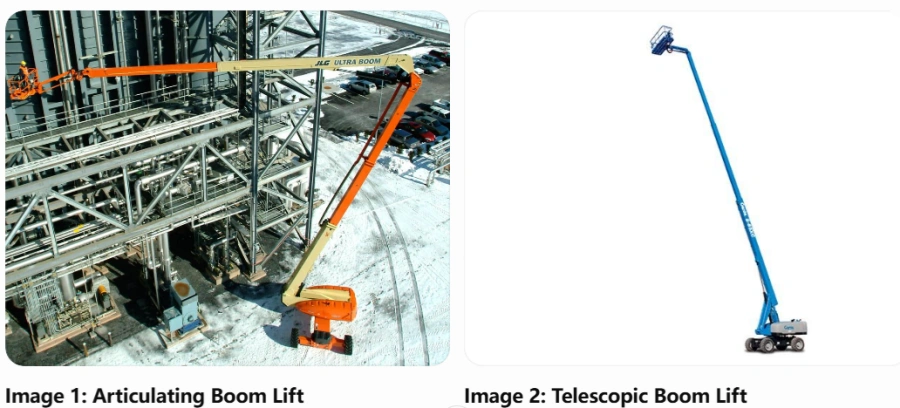
An articulating boom lift uses multiple hinged sections to move workers up, over, and around obstacles. A telescopic boom lift uses straight, extendable sections to provide direct vertical and horizontal access, particularly on open job sites where longer outreach is required.
For construction contractors, equipment rental companies, industrial maintenance teams, and aerial lift distributors, selecting the wrong machine can result in additional repositioning, lower productivity, or an inability to reach the required work area.
This guide compares articulating and telescopic boom lifts from a practical purchasing perspective, including boom design, working envelope, horizontal outreach, platform capacity, power options, terrain requirements, maintenance, and total ownership considerations.
Table of Contents
- Quick Answer: Articulating or Telescopic Boom Lift?
- What Is an Articulating Boom Lift?
- What Is a Telescopic Boom Lift?
- Articulating vs Telescopic Boom Lift: Key Differences
- Working Height vs Platform Height vs Horizontal Outreach
- Which Boom Lift Is Better for Different Applications?
- Electric vs Diesel Boom Lifts
- Self-Propelled, Towable, and Crawler Boom Lifts
- How to Choose the Right Boom Lift for Your Project
- Safety and Maintenance Considerations
- Specifications to Request Before Buying
- JNHC Lift Boom Lift Solutions
- Frequently Asked Questions

Quick Answer: Articulating or Telescopic Boom Lift?
The best choice depends on the position of the work area, the obstacles between the machine and the target, and the amount of horizontal outreach required.
Choose an articulating boom lift when:
- Workers need to reach over pipes, walls, machinery, roof edges, or other obstructions.
- The work area has complicated access routes or limited positioning space.
- The platform needs to approach the work point from different angles.
- Maintenance is required inside factories, warehouses, industrial facilities, or buildings with overhead equipment.
Choose a telescopic boom lift when:
- The work area is relatively open and has a clear access path.
- Longer horizontal outreach is more important than navigating around obstacles.
- Workers need to reach high building facades, steel structures, bridges, or large outdoor installations.
- Fast, direct positioning is a priority.
The main difference is the boom’s movement geometry. An articulating boom is designed to maneuver around obstacles, while a telescopic boom is designed to extend directly toward the work area.
Neither type is automatically better. The correct machine is the one whose working envelope can safely reach the required position without exceeding its rated capacity.
What Is an Articulating Boom Lift?
An articulating boom lift, also known as a knuckle boom lift, is a mobile elevated work platform equipped with multiple boom sections connected by pivot joints.
These joints allow the boom to bend at different angles. Instead of simply extending in a straight line, the boom can rise vertically, fold at a joint, and extend horizontally to position the platform around an obstruction.
This makes articulating boom lifts especially useful when workers cannot position the machine directly underneath or beside the work area.
How Does an Articulating Boom Lift Work?
An articulating boom lift generally consists of:
- A mobile chassis that supports and transports the equipment.
- A rotating turntable that allows the upper structure to change direction.
- A lower boom section that provides initial lifting movement.
- One or more articulated sections that change the boom angle.
- A platform or basket that carries workers and tools.
- A hydraulic and electrical control system for lifting, rotation, and positioning.
When operating, the lower boom raises the platform, while the articulated sections allow the operator to adjust its position around an obstacle.
Some models also include an additional jib at the end of the boom. A jib provides extra positioning flexibility, although its movement range and capacity depend on the specific model.
Main Advantages of Articulating Boom Lifts
1. Excellent obstacle clearance
The biggest advantage is the ability to reach up and over objects.
For example, a maintenance technician working above a production line may need to access a ventilation duct located behind overhead pipes. A straight boom may not provide the correct approach path, but an articulating boom can bend around the pipes and position the platform near the maintenance point.
2. Flexible platform positioning
Multiple joints allow the operator to adjust the platform’s position in several directions. This is useful for complex maintenance work where the target cannot be approached from one straight direction.
3. Useful for confined or congested work areas
Many articulating models are designed with compact chassis options. Depending on their dimensions and turning characteristics, they can be suitable for factory floors, indoor maintenance, and industrial sites with limited space.
4. Multiple power and chassis configurations
Articulating boom lifts are available in different configurations, including electric, diesel, hybrid, towable, and crawler-mounted designs. The actual options depend on the manufacturer and model.
Limitations of Articulating Boom Lifts
Articulating boom lifts also have several purchasing considerations:
- Multiple joints and hydraulic cylinders can increase mechanical complexity.
- Their maximum horizontal outreach may be lower than that of a comparable telescopic model.
- Operators must understand the boom’s changing working envelope.
- Maintenance involves inspecting pivot joints, pins, bushings, cylinders, hoses, and related components.
Not every articulating model has the same obstacle-clearance capability. Buyers should request a working-envelope drawing rather than relying only on the maximum working height.

What Is a Telescopic Boom Lift?
A telescopic boom lift, also known as a straight boom lift or stick boom lift, uses several boom sections that slide outward from one another.
Unlike an articulating model, its boom does not rely on multiple folding joints to navigate around obstacles. The sections extend in a relatively straight line to position the platform at a distant or elevated work point.
Telescopic boom lifts are widely used in construction, infrastructure, steel installation, outdoor maintenance, and other applications requiring long horizontal reach.
How Does a Telescopic Boom Lift Work?
A typical telescopic boom lift includes:
- A chassis with wheels or tracks.
- A rotating upper structure.
- A main boom section.
- Inner telescopic boom sections.
- A hydraulic extension and lifting system.
- A work platform with operator controls.
- Safety and monitoring systems.
The operator raises the boom and extends its sections to move the basket toward the target area.
Some models also have an end-mounted jib that provides limited additional positioning flexibility. However, an end jib does not make a conventional telescopic boom equivalent to a multi-jointed articulating boom.
Main Advantages of Telescopic Boom Lifts
1. Long horizontal outreach
Telescopic boom lifts are particularly suitable for projects that require workers to access elevated areas from a distance.
For example, a construction team may need to install steel components along a large building facade where the machine cannot be positioned directly below the work area.
2. Direct positioning
The straight boom structure provides a relatively direct path between the chassis and platform. When the approach path is clear, the operator can often reach the work area without complicated joint movements.
3. Suitable for large outdoor projects
Many telescopic models are built for demanding outdoor environments, with diesel power, four-wheel drive, rough-terrain tires, and other site-specific configurations.
4. Productive for repetitive high-reach work
On open job sites where the machine can repeatedly approach the work area along a clear line, a telescopic boom can reduce unnecessary repositioning.
Limitations of Telescopic Boom Lifts
Before purchasing a telescopic model, consider the following:
- A straight boom cannot normally fold around a substantial obstruction like a multi-jointed articulating boom.
- The equipment may require more space for positioning, turning, and boom movement, depending on the model.
- Long outreach does not mean the platform can carry its maximum rated load at every boom extension.
- Large machines can create transportation, ground-bearing, and access challenges.
A telescopic boom is most effective when the machine has a clear route to the work point and the required outreach falls within its approved operating envelope.

Articulating vs Telescopic Boom Lift: Key Differences
The following comparison highlights the most important differences buyers should evaluate before selecting a machine.
| Comparison Factor | Articulating Boom Lift | Telescopic Boom Lift |
|---|---|---|
| Common Alternative Name | Knuckle boom lift | Straight boom lift, stick boom lift |
| Boom Structure | Multiple hinged sections | Straight, extendable sections |
| Main Movement | Folding and extending | Linear telescopic extension |
| Obstacle Clearance | Excellent up-and-over flexibility | Limited for substantial obstacles |
| Horizontal Outreach | Model-dependent; often shorter than comparable straight-boom designs | Often offers longer direct horizontal outreach |
| Platform Positioning | Multiple boom angles and approach directions | More direct positioning along the boom line |
| Working Height | Available in various height ranges | Available in various height ranges, including high-reach models |
| Typical Worksite | Congested, industrial, or obstacle-filled sites | Open construction and infrastructure sites |
| Indoor Applications | Available in suitable electric models | Available in selected electric models |
| Outdoor Applications | Diesel, electric, hybrid, or crawler options | Commonly available in diesel rough-terrain configurations |
| Maintenance Focus | Joints, pins, cylinders, hoses, and boom sections | Telescopic wear pads, extension system, cylinders, hoses, and boom sections |
| Best Purchasing Priority | Obstacle clearance and positioning flexibility | Direct reach and maximum outreach |
Important: The table describes general design tendencies, not guaranteed specifications for every machine. Maximum height, horizontal outreach, rated platform capacity, chassis size, and gradeability must be checked against the manufacturer’s technical data for the exact model.
Which Type Offers Better Reach?
The answer depends on what the buyer means by reach.
If the goal is to extend directly outward toward a work area without obstacles, a telescopic boom often provides a longer and more efficient reach path.
If the target is above or behind an obstruction, an articulating boom may reach it more effectively even when its maximum horizontal outreach is shorter.
For example, a machine with a 20-meter working height may still be unsuitable for a 15-meter-high work point if its boom cannot pass over the building edge or pipe rack.
This is why a reach diagram is more useful than a single maximum-height figure when comparing two models.
Working Height vs Platform Height vs Horizontal Outreach
One of the most common mistakes in boom lift purchasing is comparing machines based only on working height.
Three measurements should be evaluated separately.
1. Platform Height
Platform height is the vertical distance from the ground to the platform floor when the boom is fully raised under the specified operating conditions.
For example, if a platform reaches 18 meters, the platform height is 18 meters.
2. Working Height
Working height is a manufacturer-published measurement representing the height at which an operator can perform work from the platform.
Some suppliers calculate it using an assumed operator reach above the platform floor. However, calculation conventions can vary.
Therefore, buyers should always confirm the actual platform height instead of comparing marketing working-height figures alone.
3. Horizontal Outreach
Horizontal outreach indicates how far the platform can extend horizontally from the machine’s reference point.
It is especially important when:
- The machine cannot park directly beside the building.
- A road, drainage channel, fence, or equipment zone separates the machine from the work area.
- Workers need to access structures over water or other restricted ground.
- A crane, scaffold, or fixed structure prevents direct access.
The reference point used to measure outreach may differ between manufacturers, so request a dimensioned working-envelope diagram.
Why the Working Envelope Matters More Than One Number
A boom lift does not achieve every maximum specification simultaneously.
For example, the maximum working height, maximum outreach, and rated platform load may occur at different boom positions.
A machine might reach its highest vertical point with limited horizontal extension, while maximum horizontal outreach may be available only at a lower boom angle.
Before selecting equipment, confirm that the required height, horizontal reach, and platform load are achievable at the same working position.
This is one of the most important steps when comparing boom lifts for commercial or industrial projects.
Which Boom Lift Is Better for Different Applications?
The working environment should determine the machine type. The following examples illustrate how to match boom structure to the actual task.
1. Building Construction
Recommended: Telescopic boom lift for open facade work; articulating boom lift for obstructed access.
Telescopic models are suitable for:
- Exterior steel structure installation.
- High-rise facade work.
- Roofing and exterior building maintenance.
- Large construction sites.
- Sign installation where direct access is available.
Articulating models are more appropriate when the platform must pass over a roof edge, canopy, or other obstruction.
2. Factory and Warehouse Maintenance
Recommended: Articulating boom lift in many congested layouts.
Factories often contain ventilation ducts, overhead pipes, cables, machinery, and production lines.
An articulating boom can position the basket around these obstacles, making it useful for:
- HVAC maintenance.
- Lighting replacement.
- Overhead pipe inspection.
- Equipment installation.
- Warehouse ceiling maintenance.
However, indoor buyers must also check machine width, turning radius, floor loading, stowed height, tire type, and permitted emissions.
3. Bridge and Infrastructure Maintenance
Recommended: Depends on the access geometry.
Telescopic boom lifts can be suitable for reaching bridge components from a clear access position.
Articulating boom lifts can be more suitable when workers must reach over guardrails, structural beams, or other obstacles.
For bridge maintenance, buyers should also consider ground access, working radius, platform load, terrain, and whether the machine can be transported to the required location.
4. Power and Utility Maintenance
Recommended: Application-specific articulating or telescopic boom lift.
Utility projects may involve poles, cables, trees, transformers, and other structures that restrict machine positioning.
An articulating boom can help navigate around certain obstacles, while a telescopic boom can provide direct reach when the access path is clear.
Where electrical hazards exist, buyers must verify the equipment’s actual insulation rating and suitability for the intended work. A standard boom lift should never be assumed to be insulated simply because it is used for utility maintenance.
5. Tree Care and Landscaping
Recommended: Articulating boom lift or an application-specific crawler model.
Tree branches often create irregular access paths. An articulating boom may help the operator position the platform around branches and other obstacles.
For soft ground, slopes, or restricted access routes, a tracked machine may be worth evaluating.
The choice should depend on tree height, working radius, ground pressure, machine dimensions, and the required cutting or maintenance tools.
6. Port, Shipyard, and Industrial Construction
Recommended: Often telescopic for open, long-reach work; articulating where obstructions dominate.
Large industrial sites may require access to ship structures, steel frameworks, storage facilities, and equipment installed at different elevations.
Telescopic machines are useful for direct long-range access. Articulating machines provide more positioning options around complex structures.
The rated platform load must include workers, tools, and all materials carried in the basket.
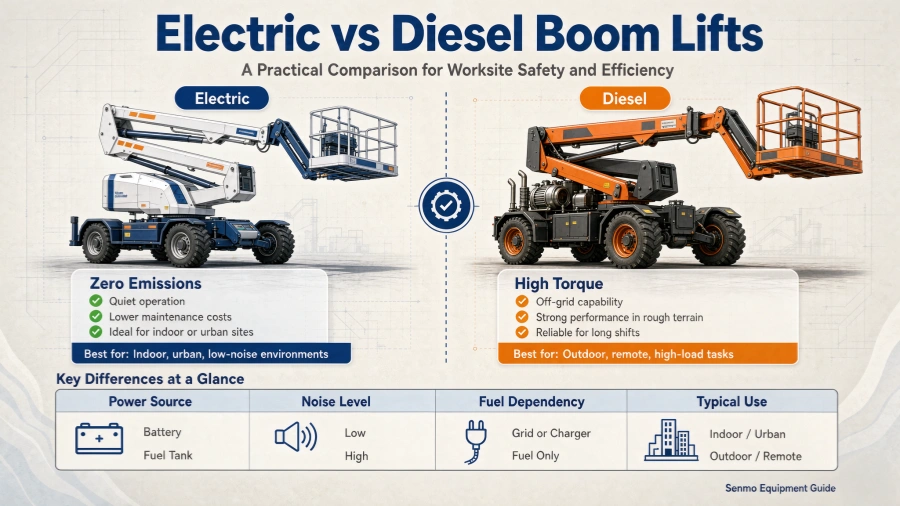
Electric vs Diesel Boom Lifts: Does the Boom Type Determine the Power Source?
No. Boom structure and power source are two different selection criteria.
Both articulating and telescopic boom lifts may be available in different power configurations, depending on the manufacturer and machine size.
| Factor | Electric Boom Lift | Diesel Boom Lift |
|---|---|---|
| Typical Environment | Indoor and emission-sensitive sites | Outdoor and demanding job sites |
| Local Emissions | No exhaust emissions during battery-powered operation | Produces engine exhaust |
| Noise | Generally quieter | Generally louder |
| Ground Requirements | Model-dependent; indoor models may have non-marking tires | Often available with rough-terrain tires |
| Operating Time | Depends on battery capacity and charging arrangements | Depends on fuel tank and engine consumption |
| Maintenance | Battery, motor, electrical controls, and hydraulic system | Engine, fuel system, hydraulic system, and drivetrain |
| Main Consideration | Charging infrastructure and working duration | Fuel supply, ventilation, and engine maintenance |
When Should You Choose an Electric Boom Lift?
Consider electric equipment when the machine will operate in:
- Warehouses and factories.
- Shopping centers.
- Indoor commercial buildings.
- Facilities with strict emission-control requirements.
- Areas where low operating noise is important.
When Should You Choose a Diesel Boom Lift?
Diesel models may be suitable for:
- Outdoor construction sites.
- Large industrial facilities.
- Rough-terrain environments.
- Long operating shifts where charging access is limited.
- Projects requiring suitable four-wheel-drive configurations.
Before buying, evaluate not only the engine or battery but also the hydraulic system, drive mode, tire configuration, charging requirements, and local operating restrictions.
Self-Propelled, Towable, and Crawler Boom Lifts: Another Important Difference
There is another classification that buyers should not confuse with articulating and telescopic boom structures.
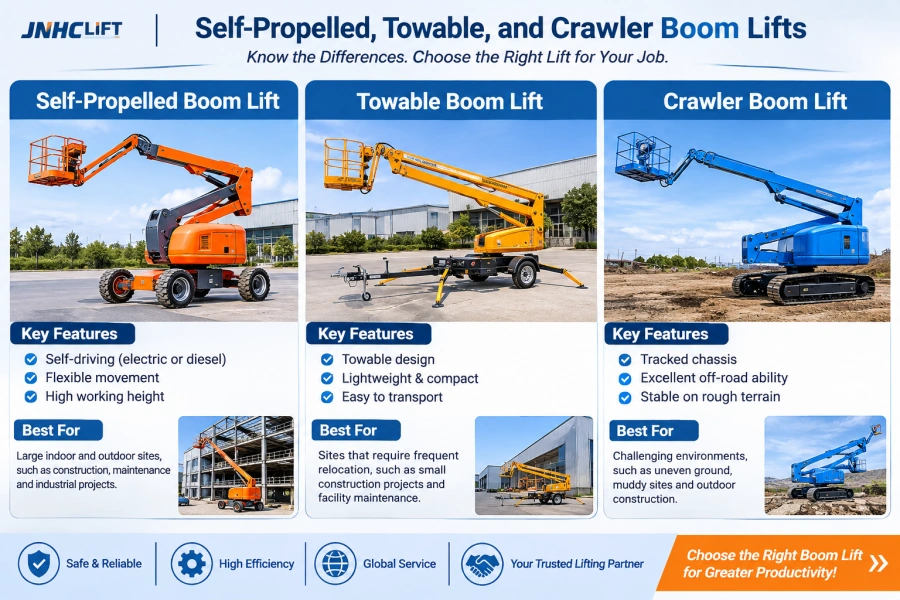
Articulating and telescopic describe how the boom moves. Self-propelled, towable, and crawler describe how the machine is supported and transported.
These are two separate purchasing decisions.
Self-Propelled Boom Lifts
Self-propelled machines have their own drive system and can travel around the job site under their own power.
They are suitable for contractors and rental companies that need equipment to move between working positions without being towed by another vehicle.
Explore JNHC Self-Propelled Boom Lift Solutions.
Towable Boom Lifts
Towable boom lifts are mounted on a trailer-style chassis and transported between sites using a compatible towing vehicle.
They can be a practical choice for maintenance contractors, landscaping companies, property service providers, and rental businesses operating across multiple locations.
See JNHC’s 50ft Towable Articulating Boom Lift for an example of a towable articulated configuration.
Crawler Boom Lifts
Crawler boom lifts use tracked undercarriages rather than conventional wheels.
They may be useful on selected uneven or restricted-access sites, depending on the machine’s design, ground pressure, slope limits, and operating conditions.
For projects where standard wheeled equipment cannot easily enter, explore JNHC Crawler Boom Lift Options.
The most suitable machine may therefore be an articulating self-propelled lift, a towable articulating lift, or another configuration designed around the site conditions.
How to Choose the Right Boom Lift for Your Project
Before placing an order or requesting a quotation, evaluate the following seven factors.
1. Identify the Exact Working Position
Start by measuring the actual location where the worker needs to perform the task.
Record:
- Required platform height.
- Required horizontal distance.
- Position of the work surface.
- Distance from the possible machine parking location.
- Height and location of any obstacles.
Do not use the total building height as the only reference. The equipment must reach the actual work point.
2. Identify Obstacles Between the Chassis and Platform
Draw a simple side-view or plan-view diagram of the work area.
Include walls, pipes, roof edges, machinery, fences, trees, structural beams, and overhead cables.
If the platform must pass above or around these obstacles, an articulating design may be more suitable.
If there is a clear direct path, a telescopic design may offer a more practical solution.
3. Check the Working Envelope
Ask the manufacturer for the working-envelope diagram of the exact model.
Compare the required platform height and horizontal outreach against the operating diagram.
This helps prevent a common purchasing problem: ordering a machine that reaches the advertised maximum height but cannot reach the actual work point.
4. Confirm Platform Capacity
Calculate the total weight carried on the platform.
A practical calculation is:
Total Platform Load = Workers + Tools + Materials + Other Permitted Accessories
For example:
| Load Item | Example Weight |
|---|---|
| Worker 1 | 80 kg |
| Worker 2 | 75 kg |
| Tools | 25 kg |
| Materials | 20 kg |
| Total | 200 kg |
This is an illustrative calculation, not a recommendation to use a particular machine.
Always select a model whose rated capacity is sufficient for the complete working load at the required boom position.
Also confirm whether platform capacity changes with the boom configuration or extension.
5. Evaluate Ground and Access Conditions
Before selecting the chassis, confirm:
- Ground bearing capacity.
- Maximum permitted slope.
- Surface condition.
- Turning and operating clearance.
- Gate and access-road dimensions.
- Machine weight and transportation limits.
- Whether outriggers or stabilizers are required.
A crawler chassis does not automatically make a machine suitable for every soft-ground application. Ground pressure and manufacturer-approved operating limits must still be checked.
6. Select the Correct Power System
Consider battery charging time, diesel consumption, noise restrictions, ventilation, operating hours, and local regulations.
For indoor work, an electric configuration may be more suitable. For demanding outdoor operations, a diesel configuration may provide the required working duration and mobility.
The best power system should support the planned daily operating schedule rather than simply minimize the initial purchase price.
7. Compare Total Ownership Cost
Purchase price is only one part of the investment.
A realistic comparison should include:
| Cost Factor | What to Evaluate |
|---|---|
| Initial Purchase | Machine configuration, accessories, and optional features |
| Transportation | Shipping dimensions, weight, loading, and unloading |
| Energy | Electricity or fuel consumption |
| Maintenance | Hydraulic, electrical, mechanical, and engine maintenance |
| Spare Parts | Availability, delivery time, and component cost |
| Operator Training | Local training requirements and operating procedures |
| Downtime | Technical support and repair response |
| Resale Value | Brand reputation, model demand, and service history |
For equipment rental businesses, machine utilization and the number of projects it can serve may be just as important as the original purchase cost.
Safety and Maintenance Considerations
Both articulating and telescopic boom lifts operate at height. Their safety depends on correct machine selection, operator training, site preparation, and routine maintenance.
Essential Safety Checks Before Operation
Before using a boom lift:
- Inspect the platform, guardrails, access gate, and designated fall-protection anchor points.
- Check the hydraulic hoses, cylinders, joints, pins, and visible structural components.
- Confirm that the ground is stable and within the machine’s permitted slope limits.
- Identify overhead obstacles and electrical hazards.
- Check the manufacturer’s wind-speed limit and weather restrictions.
- Confirm that the total platform load is within the rated capacity.
- Test emergency stop and emergency lowering functions.
- Ensure operators are trained and authorized for the equipment.
Never use the boom lift outside the operating conditions specified by the manufacturer.
Maintenance Focus for Articulating Boom Lifts
Pay particular attention to:
- Boom pivot pins and bushings.
- Articulated joints.
- Hydraulic cylinders and seals.
- Hoses and electrical connections.
- Turntable rotation components.
- Platform leveling and control systems.
Maintenance Focus for Telescopic Boom Lifts
Important inspection areas include:
- Telescopic boom sections.
- Wear pads and sliding surfaces.
- Extension cylinders and hoses.
- Boom alignment.
- Hydraulic leakage.
- Turntable and chassis components.
- Platform leveling and safety controls.
Maintenance intervals should follow the machine’s operation manual and actual working conditions. Dust, mud, salt, heavy usage, and harsh weather may require more frequent inspections.
Specifications to Request Before Buying
For B2B buyers, equipment rental businesses, and international distributors, the following information should be confirmed before comparing quotations.
| Specification | Why It Matters |
|---|---|
| Boom Type | Confirms articulating or telescopic structure |
| Working Height | Confirms the advertised operating height |
| Platform Height | Provides a more direct vertical measurement |
| Maximum Horizontal Outreach | Confirms the potential horizontal working distance |
| Working Envelope Drawing | Shows whether the machine can reach the actual work area |
| Platform Capacity | Defines the permitted working load |
| Platform Dimensions | Determines available workspace |
| Platform Rotation | Affects final positioning |
| Turntable Rotation | Determines upper-structure movement |
| Overall Dimensions | Confirms access and storage requirements |
| Machine Weight | Affects transportation and ground loading |
| Power System | Determines indoor and outdoor suitability |
| Drive and Steering | Affects mobility and turning |
| Gradeability | Indicates approved travel capability on slopes |
| Tire or Track Type | Affects terrain suitability |
| Safety Devices | Confirms available protection and emergency functions |
| Applicable Certifications | Supports compliance review in the destination market |
| Warranty and Spare Parts | Helps evaluate long-term ownership costs |
A good quotation should include a detailed specification sheet, product drawings, optional equipment list, warranty terms, and available technical documentation.
For importers and distributors, it is also useful to confirm packaging dimensions, loading arrangements, spare parts recommendations, and OEM branding options before ordering.
JNHC Lift Boom Lift Solutions for Different Working Conditions
JNHC Lift, operated by Jinan Huichuang Machinery Manufacturing Co., Ltd., is a lifting equipment manufacturer based in Jinan, Shandong, China.
The company develops and manufactures hydraulic aerial work equipment and provides customized lifting solutions for contractors, equipment distributors, industrial users, and international buyers.
Its Boom Lift Product Range includes different aerial access configurations for construction, industrial maintenance, and outdoor operations.
Articulating Boom Lift Options
For applications that require flexible platform positioning, JNHC offers fold-arm articulating boom lift configurations.
The published 8–20m Fold Arm Articulating Boom Lift range includes models with different working heights, platform dimensions, and rated capacities.
For customers looking for electric power configurations, JNHC also provides 30–65ft Electric Articulated Boom Lift Options.
The actual configuration should be selected according to the job site’s available space, access route, required outreach, load, and power requirements.
Diesel Self-Propelled Boom Lift Options
For outdoor projects and applications that require self-propelled mobility, JNHC offers diesel boom lift configurations.
Buyers can review the 14m Diesel Self-Propelled Boom Lift as a model reference and request confirmation of the exact boom geometry, working envelope, platform capacity, and chassis specifications for their project.
The company can also discuss customized configurations based on operating conditions and customer requirements.
OEM and Customization Support
Different countries and industries may require different machine configurations.
Depending on the selected model, customization discussions can include:
- Working height and platform height.
- Platform dimensions and rated load.
- Boom configuration and working envelope.
- Electric, diesel, or other available power options.
- Chassis and drive configuration.
- Control system and safety accessories.
- Product color, logo, and OEM branding.
- Destination-market documentation and technical support.
Learn more about JNHC Lift and its manufacturing capabilities, or contact the engineering and sales team with your project requirements.
When requesting a quotation, provide the required working height, horizontal distance, obstacle layout, platform load, access conditions, and preferred power source. These details help the manufacturer recommend a suitable configuration rather than simply quoting a machine based on height alone.
Frequently Asked Questions
1. What is the main difference between an articulating boom lift and a telescopic boom lift?
An articulating boom lift uses multiple hinged boom sections to move around obstacles, while a telescopic boom lift uses straight extending sections to reach directly outward and upward.
Articulating models are generally better for complex access paths. Telescopic models are often preferred when long direct reach is the priority.
2. Is a telescopic boom lift the same as a straight boom lift?
Yes. Telescopic boom lift and straight boom lift are commonly used as alternative names for the same basic boom configuration.
Some suppliers also use the term stick boom lift.
3. Is an articulating boom lift the same as a knuckle boom lift?
Yes. An articulating boom lift is commonly called a knuckle boom lift because its boom sections are connected through pivot joints that allow the arm to fold and change direction.
4. Which boom lift has greater horizontal outreach?
Telescopic boom lifts often provide greater direct horizontal outreach than comparable articulating models.
However, the actual distance depends on the model, boom length, platform load, machine configuration, and permitted operating envelope.
Always compare the official reach charts rather than relying on general classifications.
5. Can an articulating boom lift reach over a building?
Some articulating boom lifts can reach over roof edges, parapets, and other obstacles, depending on their boom geometry and available working envelope.
The buyer should confirm the required clearance and platform position using the manufacturer’s technical drawings.
6. Are articulating boom lifts suitable for indoor use?
Yes, selected articulating boom lifts are available with electric or battery-powered systems.
For indoor applications, buyers should also check machine dimensions, floor loading, tire type, turning radius, stowed height, and operating noise.
7. Are telescopic boom lifts suitable for rough terrain?
Many telescopic boom lifts are designed for outdoor rough-terrain applications.
Depending on the model, they may offer four-wheel drive, rough-terrain tires, oscillating axles, and other mobility features.
Check the approved gradeability, ground conditions, and operating limits before using the machine.
8. Which boom lift is easier to maintain?
Neither type is universally easier to maintain.
Articulating models require attention to pivot joints, pins, and multiple cylinders. Telescopic models require inspection of boom sections, sliding wear pads, extension mechanisms, and hydraulic components.
Maintenance requirements depend on the specific equipment design and working conditions.
9. How do I choose the right boom lift working height?
Start by measuring the actual height of the work point and the required platform position.
Then confirm the platform height, working height, and horizontal outreach from the manufacturer’s specifications. Make sure all three requirements can be achieved within the same approved working envelope.
10. Can JNHC Lift customize articulating and telescopic boom lifts?
JNHC Lift provides customized aerial work platform solutions, with options depending on the selected product and technical requirements.
Buyers can discuss working height, platform size, rated load, power system, chassis, control configuration, and OEM requirements with the sales and engineering teams before ordering.
Final Thoughts: Which Boom Lift Should You Choose?
The decision between an articulating boom lift and a telescopic boom lift should begin with the actual work position, not simply the maximum working height.
An articulating boom lift is usually the better choice when obstacles, restricted access, and flexible platform positioning are the main challenges.
A telescopic boom lift is often the better choice when the job requires long horizontal outreach, direct access, and efficient operation on open sites.
For contractors and equipment buyers, the most reliable selection process is to compare the working envelope, platform capacity, chassis dimensions, ground conditions, power system, and total operating cost.
If you are sourcing equipment for a construction project, rental fleet, or industrial facility, JNHC Lift can help evaluate the required specifications and discuss a suitable boom lift configuration for your application.
Jnhclift (Huichuang Lift), based in Jinan, China, is a professional manufacturer of scissor lifts, home elevators, and lift platforms. With our own dedicated factory, we deliver high-quality, reliable lifting solutions tailored to meet diverse industrial and residential needs.
 Room 203, Second Floor, Building 8, Phase Ⅱ, Zhizao Town, Jibei Street, Jiyang District, Jinan City, Shandong Province
 +86 152 5319 3706
 admin@jnhclift.com