
Hydraulic Home Lift Price: 2026 Cost Guide
If you search for hydraulic home lift prices, you will quickly find there is no single number that applies to every country or every home.
You may see a small hydraulic lift advertised for less than $10,000, while a homeowner in the US or Australia may receive an installed quotation of $25,000–$50,000 or more.
Both numbers can be real.
The reason is simple: they may be describing completely different things.
One price may be the factory equipment price. Another may include the elevator, shaft, installation, permits, local labor and finishing work.
For a typical low-rise residential project, a useful global budgeting range is approximately:
- $8,000–$15,000 for a basic factory-level or simple configuration
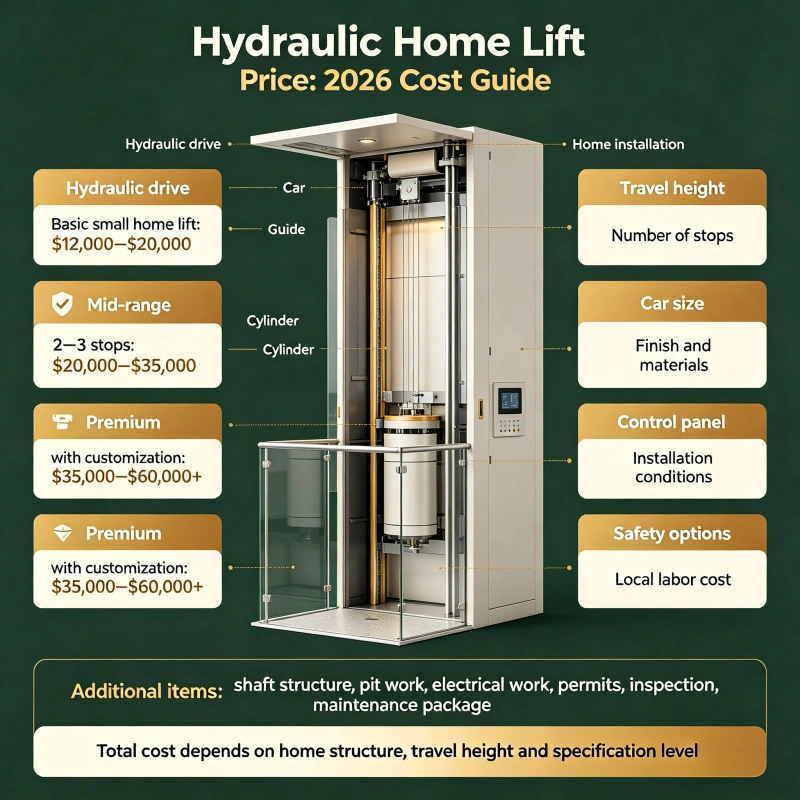
- $15,000–$30,000 for a standard residential project
- $25,000–$50,000+ for a locally installed system in higher-cost markets
- $50,000+ for luxury, highly customized or complicated retrofit projects
These are budgeting ranges rather than universal retail prices. In 2026, published market data illustrates just how large the regional difference can be: US sources put hydraulic home elevators around $25,000–$50,000 installed, while an Australian cost guide gives approximately $20,000–$50,000 for hydraulic home lifts.
So, if you are comparing hydraulic home lift prices, the first question should not be “Which company is cheaper?”
It should be:
“What exactly is included in the price?”
Hydraulic Home Lift Price at a Glance
Here is a practical way to think about the market.
| Project Type | Approximate Budget in USD | Typical Situation |
|---|---|---|
| Basic hydraulic lift | $8,000–$15,000 | Simple low-rise home or factory-direct purchase |
| Standard residential project | $15,000–$30,000 | 2–3 stops, standard cabin and installation |
| Higher-cost local installation | $25,000–$50,000+ | US, Australia and other high-labor-cost markets |
| Premium residential lift | $40,000–$70,000+ | Larger cabin, glass, luxury finishes |
| Complex custom project | $50,000+ | Retrofit, architectural customization or difficult site |
The ranges overlap because the country is only one part of the price.
A compact hydraulic lift manufactured in China and sold on an FOB basis can have a very different price from the same type of lift installed by a licensed contractor in California or Sydney.
For example, one current US cost guide places hydraulic home elevators at around $25,000–$50,000, while another 2026 US guide puts installed hydraulic/traction residential elevators around $35,000–$70,000 depending on the configuration.
Why Do Hydraulic Home Lift Prices Vary So Much?
This is where most of the confusion comes from.
A home lift is not simply a cabin and a motor.
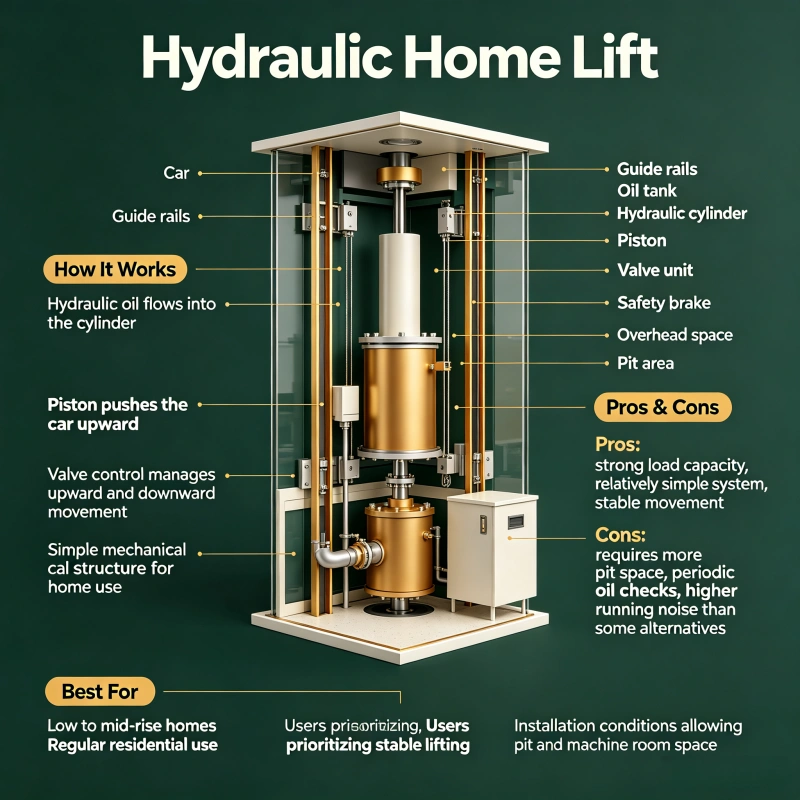
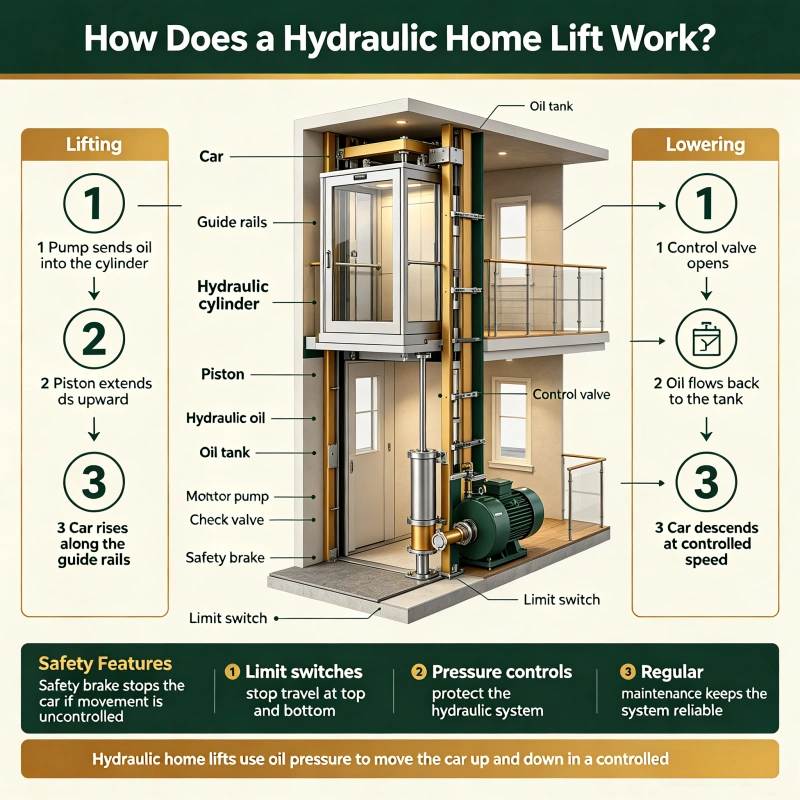
A hydraulic system can include:
- Hydraulic cylinder
- Hydraulic pump
- Motor
- Oil tank
- Controller
- Guide rails
- Cabin
- Landing doors
- Cabin door
- Safety devices
- Emergency lowering system
- Battery backup
- Shaft or hoistway
- Electrical system
- Installation and commissioning
Then there are costs outside the elevator itself:
- Building work
- Structural reinforcement
- Pit construction
- Electrical preparation
- Permits
- Inspection
- Local transportation
- Import duties
- Taxes
- Finishing work
- Maintenance
This explains why an online advertisement saying “Hydraulic Home Lift $9,000” should never be treated as your final project price.
The real question is whether that $9,000 includes everything you need.
Factory Price vs Installed Price
This distinction matters especially for international buyers.
Imagine you receive this quotation from a manufacturer:
Hydraulic home lift: $9,500 FOB China
That may be a perfectly legitimate equipment price.
But your final cost could look more like this:
| Cost Item | Example |
|---|---|
| Hydraulic lift equipment | $9,500 |
| Ocean freight and insurance | $1,000–$2,000 |
| Import/customs costs | Varies |
| Local transportation | Varies |
| Shaft construction | $2,000–$8,000+ |
| Installation | $2,000–$8,000+ |
| Electrical/civil work | Varies |
| Local inspection/permits | Varies |
The final installed cost can therefore be substantially higher than the factory quotation.
This is not necessarily because the manufacturer or dealer is adding an excessive margin. Labor, construction, certification and compliance are expensive in some markets.
For example, current US cost information shows that site preparation alone can range from hundreds to more than $15,000, depending on structural modifications, electrical work and the existing building.
How Much Does a Hydraulic Home Lift Cost by Configuration?
Instead of searching for one universal price, it is more useful to compare configurations.
2-Person Hydraulic Home Lift
A compact 2-person lift is generally one of the simplest residential configurations.
Typical applications include:
- Small villas
- Duplex homes
- Townhouses
- Elderly homeowners
- Private residences with limited space
A factory-level configuration may fall around $8,000–$12,000, while a complete locally installed project can be considerably more expensive.
The key specifications are not just “2-person.”
Check the:
- Rated load
- Cabin dimensions
- Door opening
- Shaft dimensions
- Number of stops
- Emergency system
If you are planning for wheelchair use, do not choose the lift based only on passenger capacity.
3-Person Hydraulic Home Lift
A 3-person configuration gives the homeowner more flexibility.
It can be useful when:
- An elderly person needs an attendant
- Three people may use the lift together
- A wheelchair or mobility equipment needs additional space
- The lift will be used frequently
A typical factory-level price may be around $9,000–$15,000, while the installed project price depends heavily on the market and site.
In a high-cost installation market, the total can easily move beyond $20,000.
4–5 Person Hydraulic Home Lift
A larger cabin usually means:
- Higher rated load
- Larger platform
- More material
- Larger shaft
- Higher hydraulic capacity
- More expensive doors and finishes
A reasonable global budgeting range is approximately $15,000–$30,000+ for standard configurations, with premium installations potentially reaching $40,000 or more.
Hydraulic Home Lift Price by Number of Floors
The number of stops is another major price factor.
A two-stop lift serving the ground and first floors is much simpler than a four-stop lift serving a four-story villa.
A rough equipment-level budgeting guide might look like this:
| Configuration | Typical Factory-Level Budget |
|---|---|
| 2 stops | $8,000–$13,000 |
| 3 stops | $10,000–$17,000 |
| 4 stops | $13,000–$22,000 |
| 5 stops | $16,000–$25,000+ |
These numbers are intended for early budgeting rather than final quotations.
Once installation, shaft construction, local labor and certification are included, the total can be substantially higher.
In the US, for example, current cost guides indicate that additional floors can add thousands of dollars because of additional equipment and labor.
How Much Does Installation Add to the Price?
This is one of the biggest differences between countries.
In a new house, the architect can plan the shaft, pit and structural support from the beginning.
In an existing house, the situation can be completely different.
You may need to:
- Cut through existing floors
- Build a shaft
- Reinforce structural elements
- Relocate electrical wiring
- Move plumbing or HVAC
- Create a pit
- Repair walls and flooring
- Install new landing doors
One 2026 US source estimates site preparation at approximately $500–$15,000+, depending on the amount of structural and electrical work required.
That is why two homeowners buying essentially the same elevator can receive very different final quotations.
New Construction vs Retrofit
If you are building a new house, tell your architect that you are considering an elevator before construction starts.
This can make a surprisingly large difference.
The shaft can be reserved in the structural design, electrical connections can be planned properly, and the elevator dimensions can be coordinated with the floor plan.
A retrofit is more complicated.
For example, a homeowner may have a suitable location for the cabin but discover that a structural beam, staircase, plumbing line or electrical system is in the way.
The elevator price itself may not change much.
The building work around it can.
My practical advice
For a new build:
Design the elevator into the house.
For an existing house:
Get a site survey before negotiating the elevator price.
Don’t buy the elevator first and try to solve the building problem afterward.
What Makes a Hydraulic Home Lift More Expensive?
Cabin Size
A larger cabin requires more materials and usually a higher capacity.
If two people will use the lift, there is little reason to buy a very large cabin unless you are planning for wheelchair access or future needs.
Rated Load
A 250 kg system and a 500 kg system should not be compared simply because both are called “home elevators.”
Always ask for the actual rated capacity.
Number of Stops
Every additional stop adds equipment and installation work.
Door Type
Manual doors are generally simpler.
Automatic doors offer greater convenience but increase equipment costs.
Cabin Finish
Standard stainless steel is normally more economical than:
- Panoramic glass
- Decorative wood
- Stone finishes
- Custom lighting
- Designer ceilings
- Premium control panels
Shaft
If the house already has a suitable shaft, you can avoid some construction costs.
If you need a new steel, concrete or glass shaft, the project budget can change significantly.
Safety and Backup Systems
Do not try to save money by removing essential safety equipment.
Depending on the design and local requirements, buyers may need systems such as:
- Emergency stop
- Door interlocks
- Overload protection
- Emergency lowering
- Battery backup
- Alarm
- Manual rescue system
- Safety gear
The exact requirements depend on the elevator design and local regulations.
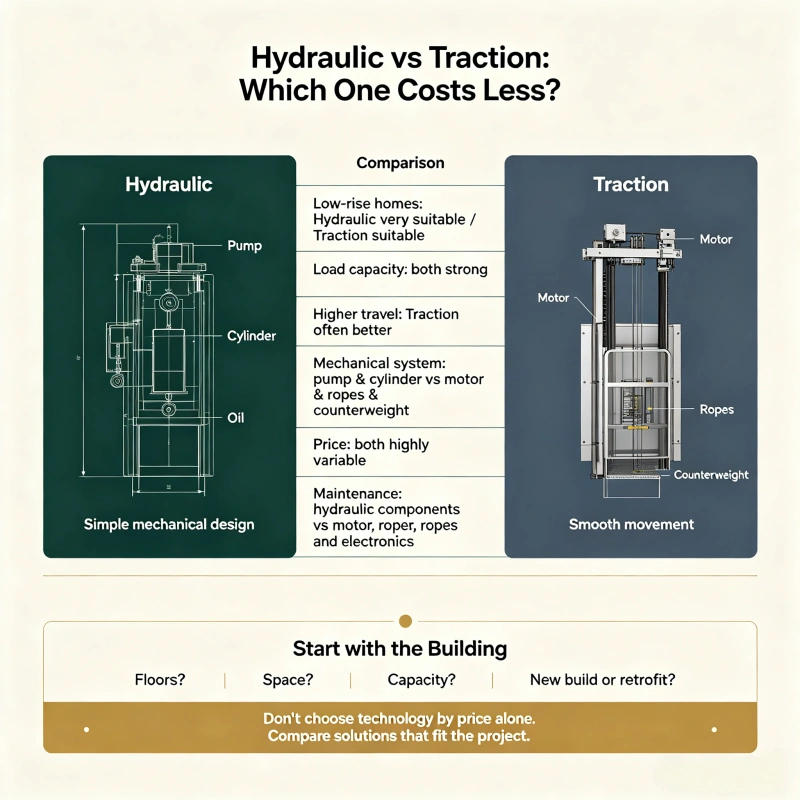
Hydraulic vs Traction: Which One Costs Less?
This is a common search after someone learns the hydraulic home lift price.
There isn’t a universal winner.
For a low-rise home, hydraulic technology can be attractive because of its load capacity and relatively straightforward mechanical design.
Traction systems can be attractive where higher travel, speed or particular building layouts are involved.
A simplified comparison:
| Factor | Hydraulic | Traction |
|---|---|---|
| Low-rise homes | Very suitable | Suitable |
| Load capacity | Strong | Strong |
| Higher travel | Less ideal | Often better |
| Mechanical system | Pump/cylinder | Motor/ropes/counterweight |
| Cabin options | Many | Many |
| Retrofit | Site dependent | Site dependent |
| Price | Highly variable | Highly variable |
| Maintenance | Hydraulic components | Motor/ropes/electronics |
Don’t select the technology based on price alone.
Start with the building.
How many floors? How much space? What capacity? New build or retrofit?
Then compare technologies that actually fit the project.
Global Hydraulic Home Lift Price Differences
If you are researching the global market, don’t assume a $15,000 quote in one country means a $15,000 installed project everywhere.
United States
Current 2026 US sources put hydraulic residential elevators around $25,000–$50,000 installed, while some broader installed-market guides give approximately $35,000–$70,000 for hydraulic or traction home elevators depending on configuration.
Labor, permits, site preparation and code requirements are important parts of the total cost.
Australia
An Australian 2026 cost guide gives approximately $20,000–$50,000 for a hydraulic home lift, generally including installation. It also notes that retrofit projects can cost more because of the additional building work required.
Europe and Other Markets
European prices vary significantly by country because labor, certification, VAT, installation practices and local regulations are different.
The same applies to the Middle East, Southeast Asia, Africa and Latin America.
For an international buyer, the most useful figure is therefore not a supposed “global average.”
It is the landed and installed cost in your own market.
Three Typical Buyer Cases
Here are three examples that show why the same search term can lead to very different budgets.
Case 1: Small Family Home
A couple has a two-storey home.
They want a lift mainly because one family member has difficulty using stairs.
Their requirements:
- 2 stops
- 2–3 passengers
- Compact cabin
- Standard finish
- Emergency lowering
- No luxury customization
A factory-level quotation around $9,000–$12,000 may be reasonable to investigate.
If the project is being installed in a high-labor-cost country, however, the final installed price may be much higher.
What matters most: compact dimensions, reliability, safety and local service.
Case 2: Three-Storey Villa
The second buyer owns a three-storey villa.
The lift will be used every day by a family of four.
Requirements:
- 3 stops
- 4-person capacity
- Automatic doors
- Larger cabin
- Battery backup
- Better interior finish
The equipment budget might be around $13,000–$20,000, before considering the differences between markets.
What matters most: cabin size, capacity, door configuration and long-term service.
Case 3: Existing Luxury Home
The third customer owns a finished four-storey property.
The desired elevator has:
- 4–5 stops
- Panoramic glass cabin
- Automatic doors
- Premium interior
- Customized landing doors
The elevator equipment may represent only part of the project.
Structural modifications, shaft construction and finishing work can push the total project well beyond $30,000–$50,000.
What matters most: site engineering.
This is the kind of project where three cheap online quotations are far less useful than one accurate site survey.
What Experienced Buyers Check Before Ordering
After looking at many types of equipment quotations, there is one simple lesson:
Never compare the first page of the quotation. Compare the specifications.
I would check these items first:
1. Rated Capacity
Is it 250 kg, 300 kg, 400 kg or 500 kg?
2. Cabin Size
Can the intended users actually fit comfortably inside?
3. Shaft Size
Does the quoted cabin fit your available building space?
4. Number of Stops
Is the price for two stops, three stops or more?
5. Door Configuration
Are manual or automatic doors included?
6. Safety System
Ask the supplier to provide a complete safety component list.
7. Power Failure Operation
What happens if the house loses electricity?
8. Installation
Is installation included?
If not, who will install the equipment?
9. Warranty
Ask:
- What is covered?
- How long is the warranty?
- Are labor and spare parts included?
10. Spare Parts
A home elevator may operate for many years.
You don’t want to discover five years later that a controller or hydraulic component is difficult to source.
Factory Direct: When Does It Make Sense?
Buying directly from a factory can be attractive for:
- Developers
- Villa builders
- Elevator distributors
- Contractors
- Real estate projects
- Multi-unit residential projects
- Importers
The main advantage is usually the ability to discuss specifications directly with the manufacturer and avoid some distributor layers.
But factory-direct purchasing is not automatically cheaper after installation.
You still need to consider:
FOB price + freight + insurance + customs + local installation + certification + service
For a one-off homeowner, a local supplier may therefore make more sense even if the equipment price is higher.
For a distributor or project buyer ordering multiple units, direct factory purchasing can be much more interesting.
How to Ask for a Hydraulic Home Lift Quotation
Don’t send a supplier only:
“Please send hydraulic home lift price.”
Give them enough information to price the project properly.
A useful inquiry would look like this:
We need a hydraulic home elevator for a private villa. The building has 3 floors and 3 stops. Required capacity is 400 kg. The available shaft area is approximately 1,500 × 1,500 mm. We prefer automatic doors, stainless-steel cabin panels and battery emergency lowering. Please quote the FOB price and provide the complete technical specification.
That kind of inquiry can save several rounds of emails.
8 Questions to Ask the Manufacturer
Before placing an order, ask:
- What is the rated load?
- What are the cabin and shaft dimensions?
- How many stops are included?
- What is the lifting speed?
- What hydraulic components are used?
- What safety devices are included?
- What is included in the FOB or EXW price?
- What installation and after-sales support is available?
If the supplier cannot clearly explain what is included, don’t rush to compare the price.
Hydraulic Home Lift Maintenance Cost
The purchase price is only part of the total cost of ownership.
Hydraulic systems contain pumps, valves, cylinders, seals, and hydraulic fluid, so regular inspection and maintenance are important.
Maintenance costs vary significantly by country.
For example, an Australian 2026 guide estimates annual home elevator maintenance packages at roughly $500–$1,500, before unexpected repairs.
In higher-cost markets, service contracts can cost more.
When comparing maintenance quotations, check what the contract actually covers:
- Routine inspections
- Emergency call-outs
- Labor
- Hydraulic oil
- Seals
- Door components
- Electrical components
- Spare parts
A cheap maintenance contract may cover inspections but charge separately for almost every repair.
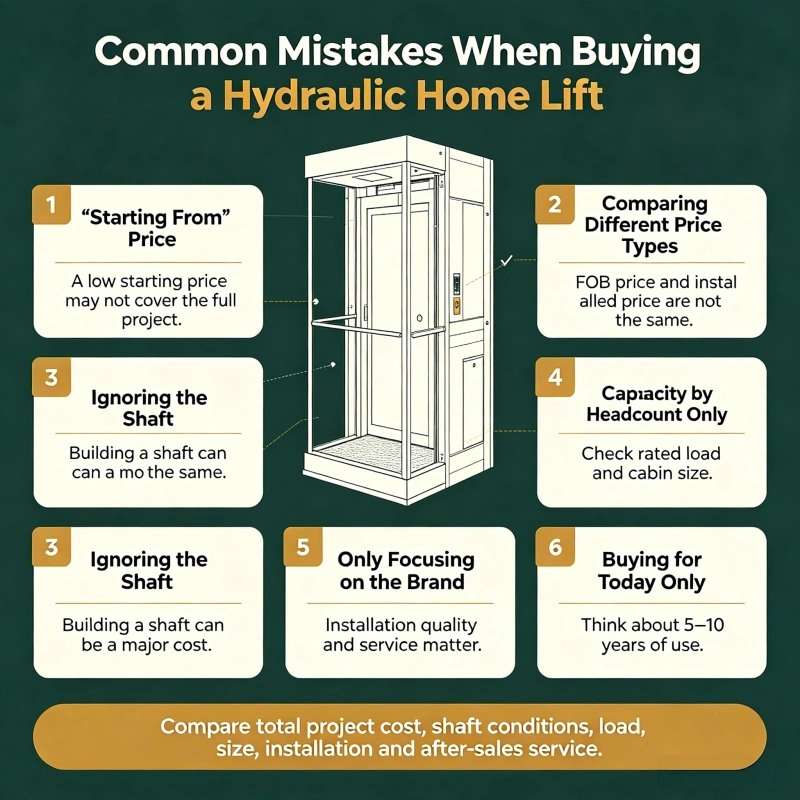
Common Mistakes When Buying a Hydraulic Home Lift
Mistake 1: Believing the “Starting From” Price
A $9,000 starting price doesn’t mean your complete project costs $9,000.
Mistake 2: Comparing Factory and Installed Prices
A $10,000 FOB quotation should not be compared directly with a $30,000 installed quotation.
They are different price categories.
Mistake 3: Ignoring the Shaft
The elevator needs somewhere to travel.
If the shaft doesn’t exist, building it can become a major part of the project.
Mistake 4: Choosing Capacity by Passenger Number Only
“3-person lift” is less useful than knowing the actual rated load and cabin dimensions.
Mistake 5: Looking Only at the Elevator Brand
A good elevator installed poorly can still become a headache.
Installation quality and after-sales service matter.
Mistake 6: Buying for Today’s Needs Only
If you are installing the lift because of an elderly family member, think about how the elevator will be used five or ten years from now.
A slightly larger cabin may be worth the additional investment.
Frequently Asked Questions
How much does a hydraulic home lift cost?
Globally, a hydraulic home lift can range from approximately $8,000 to $50,000+, depending on whether you are looking at factory equipment or a fully installed residential project. In high-cost markets such as the US and Australia, current 2026 guides commonly place installed hydraulic home lifts around $20,000–$50,000 or more.
What is the cheapest hydraulic home lift?
A compact, standard two-stop hydraulic lift with a basic cabin and limited customization is usually among the lower-cost configurations. Factory-direct equipment can sometimes be available below $10,000, but shipping, installation, construction and local compliance can significantly increase the final cost.
How much does a 2-person hydraulic home lift cost?
A basic factory-level 2-person hydraulic lift may fall around $8,000–$12,000. The installed price depends heavily on the country, shaft and building conditions.
How much does a 3-person hydraulic home lift cost?
A 3-person hydraulic home lift may cost around $9,000–$15,000 at the equipment level, while a complete installed project can be considerably higher.
Is a hydraulic home lift cheaper than a traction lift?
Not necessarily. Both technologies cover a wide price range. The better choice depends on the number of floors, available space, capacity, speed, installation conditions, and local requirements.
How much does a hydraulic lift cost for a two-story house?
A basic two-stop system may cost around $8,000–$13,000. A complete installed project may cost considerably more, especially in high-labor-cost markets.
Does a hydraulic home lift require a shaft?
The exact design depends on the product. Many hydraulic home elevators require a suitable shaft or hoistway, although the construction method can vary between steel, concrete, glass and other systems.
Is hydraulic technology suitable for villas?
Yes. Hydraulic systems are commonly used for low-rise residential applications where the lift does not need to travel many floors.
How much does a home elevator cost in the USA?
Current 2026 US sources put hydraulic home elevators around $25,000–$50,000, while broader installed residential elevator guides can reach $35,000–$70,000 depending on the elevator type and project.
How much does a hydraulic home lift cost in Australia?
A current Australian 2026 cost guide gives approximately $20,000–$50,000 for a hydraulic home lift, generally including installation. Retrofit work can increase the total.
Is buying a home lift directly from China cheaper?
The equipment price can be lower because of manufacturing and supply-chain costs, but the final project price depends on freight, import duties, installation, certification, local labor and after-sales support.
For international buyers, compare FOB price with landed and installed cost, not FOB price with local retail price.
Final Advice: Focus on the Total Project Cost
When someone asks me “What is the hydraulic home lift price?”, I would not give them one number without asking a few questions first.
I would want to know:
How many floors?
How many people?
What cabin size?
New house or existing house?
Which country?
Standard or customized cabin?
Who is installing it?
Those seven answers can change the price dramatically.
As a broad starting point, you can think of:
$8,000–$15,000 — basic/factory-level configuration
$15,000–$30,000 — standard residential project
$25,000–$50,000+ — installed project in many higher-cost markets
$50,000+ — premium or complex custom project
The most important lesson is simple:
Don’t buy based on the advertised hydraulic home lift price. Buy based on the complete specification and total installed cost.
A $10,000 elevator that eventually costs $20,000 after construction and installation may be a worse deal than a $13,000 quotation that already includes most of the work.
For homeowners, the safest way to compare suppliers is to request an itemized quotation covering the lift, cabin, shaft requirements, installation, electrical work, safety equipment, warranty and after-sales service.
For international B2B buyers, add one more layer: compare EXW/FOB price, landed cost and local installation cost separately.
That gives you a much more realistic picture of what your hydraulic home lift will actually cost.

Jnhclift (Huichuang Lift), based in Jinan, China, is a professional manufacturer of scissor lifts, home elevators, and lift platforms. With our own dedicated factory, we deliver high-quality, reliable lifting solutions tailored to meet diverse industrial and residential needs.
 Room 203, Second Floor, Building 8, Phase Ⅱ, Zhizao Town, Jibei Street, Jiyang District, Jinan City, Shandong Province
 +8615628811021
 admin@jnhclift.com