
Scissor Lift vs Forklift: Key Differences & Uses
When choosing lifting equipment for a warehouse, factory, construction site, or industrial facility, two machines often come into consideration: the scissor lift and the forklift.
At first glance, they may appear to serve a similar purpose. Both can raise loads, improve workplace efficiency, and help businesses handle tasks that would otherwise require significant manual effort.
However, a scissor lift vs forklift comparison is not simply about which machine can lift higher or carry more weight. These two types of equipment are designed around different operating principles and work requirements.
A forklift is primarily used to transport, lift, and position materials. A personnel scissor lift is designed to provide a stable elevated platform for workers performing tasks at height. An industrial scissor lift table, meanwhile, can raise goods to a suitable working or transfer level without being intended for personnel access.
Understanding these differences can help businesses avoid unnecessary equipment costs, improve workflow efficiency, and select a lifting solution that matches their actual application.
In this guide, we compare scissor lifts and forklifts in terms of function, lifting mechanism, load capacity, working height, mobility, applications, safety, and purchasing considerations.
1. What Is a Scissor Lift?
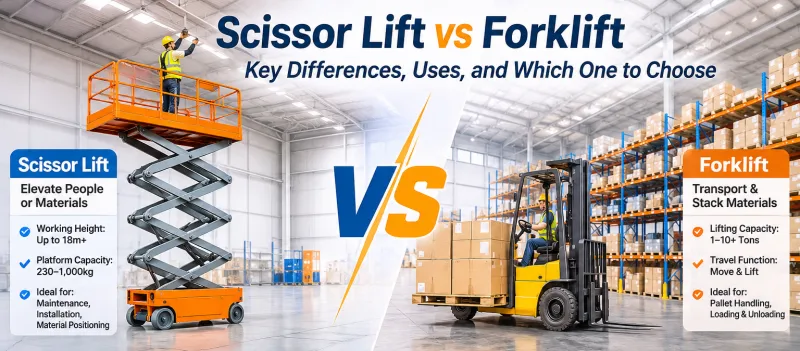
A scissor lift is a lifting platform that uses interconnected folding arms arranged in a crossed, scissor-like structure to raise and lower a platform vertically.
Depending on its design, a scissor lift may be used to elevate authorized personnel and their tools, or to raise materials and equipment in industrial applications.
There are two important categories to distinguish.
Personnel Scissor Lift
A personnel scissor lift is designed to provide an elevated working platform for trained operators.
It is commonly used for:
- Ceiling installation
- Warehouse maintenance
- Electrical and lighting work
- Factory equipment servicing
- Construction and renovation
- HVAC installation
- Commercial building maintenance
The platform generally provides more working space than a compact vertical mast lift, allowing workers to perform tasks with approved tools and materials.
For a closer look at available configurations, explore the Huichuang lift Scissor Lift Product Range.
Industrial Scissor Lift Table
An industrial scissor lift table uses a similar lifting mechanism but is generally designed to raise goods, pallets, or materials.
Typical applications include:
- Production line feeding
- Loading and unloading
- Pallet positioning
- Assembly workstations
- Material transfer between levels
A scissor lift table should not automatically be treated as a personnel lifting platform. Its intended use must be confirmed from the manufacturer’s design, rated specifications, and safety documentation.
2. What Is a Forklift?
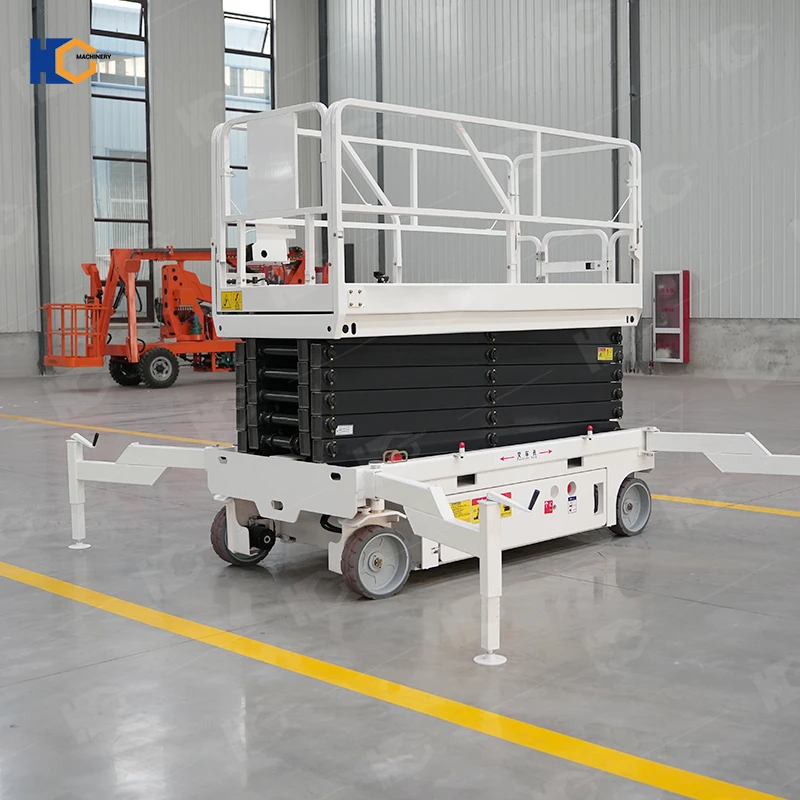
A forklift is a powered industrial truck designed primarily for lifting, transporting, and positioning materials.
It typically uses two forks mounted on a mast to lift palletized goods, containers, crates, and other compatible loads.
Forklifts are widely used in:
- Warehouses
- Distribution centers
- Manufacturing facilities
- Loading docks
- Construction material yards
- Logistics operations
Their main advantage is the ability to combine horizontal transportation with vertical load handling.
A forklift can pick up a pallet, move it across a facility, and place it at a suitable storage or loading position. Depending on the truck type and configuration, it may also handle specialized loads using approved attachments.
Unlike a personnel scissor lift, a standard forklift is not designed to provide a dedicated elevated working platform for routine personnel access.
3. Scissor Lift vs Forklift: Key Differences
Although both machines are used in industrial environments, their designs reflect different priorities.
| Comparison | Scissor Lift | Forklift |
|---|---|---|
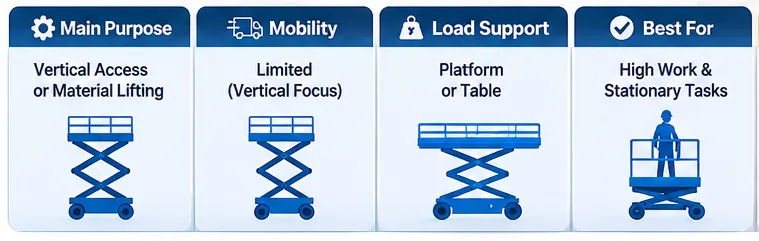
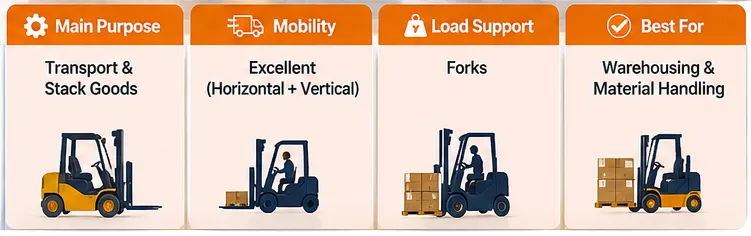
| Primary purpose | Elevating personnel or positioning materials, depending on design | Transporting, lifting, and stacking materials |
| Lifting mechanism | Crossed scissor arms | Mast, carriage, and forks |
| Main movement | Primarily vertical platform movement | Horizontal travel with vertical load lifting |
| Load support | Platform or lifting table | Forks or approved attachments |
| Personnel access | Personnel models are designed for this purpose | Standard forklifts are not designed for routine personnel lifting |
| Typical load | Workers, tools, approved materials, or goods on a lift table | Pallets, crates, containers, and other compatible loads |
| Working height | Determined by platform lifting specifications | Determined by mast height and load configuration |
| Horizontal outreach | Generally limited | Travels horizontally with the load |
| Common applications | Maintenance, installation, elevated work, material positioning | Pallet transport, stacking, loading, unloading |
| Typical operating environment | Indoor or outdoor, depending on model | Warehouses, yards, loading areas, and industrial sites |
The most important difference is not the lifting height or rated capacity.
It is what the equipment is designed to lift and how that load is handled during operation.
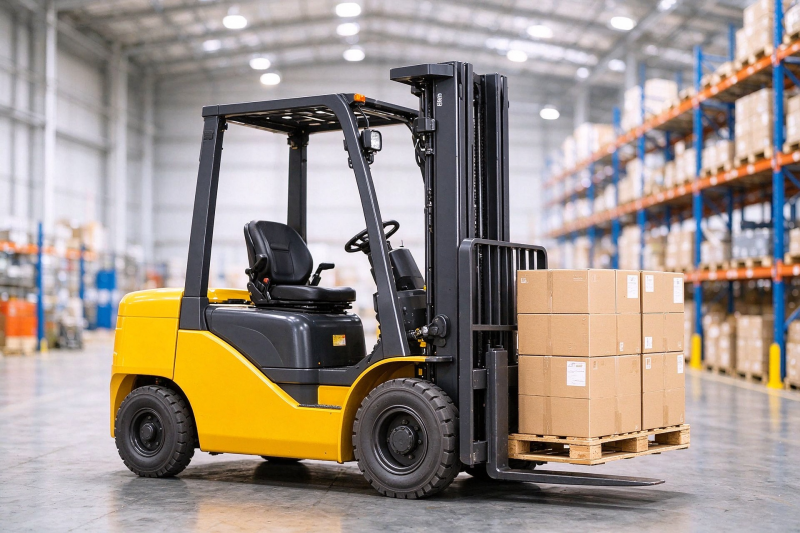
A forklift carries a load on forks while traveling. A personnel scissor lift raises workers on a platform so they can perform a task at an elevated position.
This distinction determines which machine is suitable for a particular job.
4. Scissor Lift vs Forklift for Warehouse Applications
Warehouses often use both types of equipment, but they serve different stages of the operation.
4.1 Moving and Stacking Pallets
When a warehouse needs to move pallets from receiving areas to storage racks, a forklift is usually the more appropriate choice.
Its mast and forks are designed to lift compatible loads and transport them through designated travel routes.
A scissor lift is generally not a replacement for this operation because it is not designed to carry palletized loads across a warehouse in the same way.
4.2 Reaching High Storage Areas
The correct equipment depends on what needs to reach the elevated position.
If the task involves placing a pallet on a rack, a suitable forklift may be required.
If the task involves repairing lights, inspecting overhead systems, or installing equipment, a personnel scissor lift may be more appropriate.
For warehouse access requirements, a Self-Propelled Electric Scissor Lift can be considered when the floor conditions, aisle dimensions, working height, and operating restrictions are suitable.
4.3 Positioning Materials at a Workstation
A warehouse or factory may need to raise materials to a convenient working height during assembly, packaging, or processing.
In this situation, an industrial scissor lift table can be useful.
For example, a forklift may transport a pallet to a workstation. Once the pallet arrives, a scissor lift table can raise or lower the material to the required working level.
This arrangement can improve material handling without requiring the forklift to remain at the workstation throughout the entire process.
5. Scissor Lift vs Forklift: Load Capacity and Lifting Height
Load capacity is one of the most frequently misunderstood aspects of this comparison.
A forklift’s rated capacity is generally associated with its ability to lift a load at a specified load center and configuration.
A personnel scissor lift’s rated platform capacity refers to the combined weight of the permitted occupants, tools, and materials on the platform.
These ratings cannot be compared directly as if they described the same lifting task.
Forklift Load Capacity
Forklift capacity is affected by:
- Rated load capacity
- Load center distance
- Mast configuration
- Lift height
- Attachment type
- Load dimensions
- Truck stability
A load that is heavier, longer, or positioned farther from the specified load center may reduce the forklift’s available lifting capacity.
Buyers should always refer to the truck’s capacity plate and manufacturer documentation.
Scissor Lift Platform Capacity
Scissor lift capacity is affected by:
- Platform dimensions
- Rated platform load
- Number of permitted occupants
- Platform extension configuration
- Maximum platform height
- Operating conditions
The total load must remain within the manufacturer’s specified limits.
A larger platform does not automatically mean unlimited load capacity, and additional height does not automatically indicate greater lifting strength.
Which Machine Lifts Higher?
There is no universal answer.
Forklifts are available with different mast heights, while personnel scissor lifts are manufactured with different platform heights.
The correct comparison should consider the actual task:
- For placing goods on storage racks, evaluate the forklift’s rated capacity at the required lift height.
- For overhead maintenance, evaluate the scissor lift’s platform height and working height.
- For raising goods between production levels, evaluate the scissor lift table’s rated capacity and lifting range.
The equipment should be selected according to the required load, height, and operating conditions rather than one specification alone.
6. Can a Scissor Lift Replace a Forklift?
In most material handling applications, a personnel scissor lift cannot replace a forklift.
A scissor lift is primarily designed to raise a platform vertically. It does not provide the same fork-based load handling and horizontal transportation capabilities as a forklift.
A forklift is generally more suitable for:
- Moving pallets across a warehouse
- Loading and unloading trucks
- Stacking materials
- Transporting goods between departments
- Handling compatible industrial loads
A personnel scissor lift is more suitable for:
- Raising workers to overhead areas
- Supporting maintenance tasks
- Providing an elevated working platform
- Carrying approved tools and materials during elevated work
However, an industrial scissor lift table may complement a forklift in material handling operations.
The two machines can work together rather than compete directly.
For example, a forklift can move a pallet to a production area, while a fixed scissor lift table raises the pallet to an ergonomic working height.
This distinction is especially important for buyers evaluating Hydraulic Cargo Lift Solutions, where the correct equipment depends on whether the project requires transportation, vertical material transfer, or workstation positioning.
7. Can a Forklift Be Used as a Scissor Lift?
A standard forklift should not be used as a substitute for a personnel scissor lift.
Forklifts are designed primarily for material handling, not for providing a stable, dedicated platform for workers to perform elevated tasks.
Using the forks to lift a person directly is unsafe.
If a forklift is used for an approved personnel-lifting application, the equipment, work platform, operating procedure, and safety requirements must comply with the applicable regulations and manufacturer instructions.
A forklift attachment does not automatically make the truck equivalent to a purpose-built personnel lift.
OSHA’s forklift safety guidance warns operators not to use the forks to lift people. Its scissor lift guidance also emphasizes proper equipment selection, guardrails, stability, inspection, and trained operation.
For elevated maintenance work, a properly selected personnel scissor lift is generally the more suitable equipment category.
8. Which Equipment Is Better for Different Applications?
The best choice depends on the job rather than the machine’s general reputation.
| Application | Recommended Equipment | Reason |
|---|---|---|
| Moving pallets across a warehouse | Forklift | Designed for horizontal material transportation |
| Loading and unloading trucks | Forklift | Efficient handling of compatible loads |
| Stacking goods on warehouse racks | Forklift | Mast and forks support pallet placement |
| Ceiling maintenance | Personnel scissor lift | Provides an elevated working platform |
| Installing overhead lighting | Personnel scissor lift | Supports workers and approved tools at height |
| Factory workstation feeding | Scissor lift table or forklift, depending on workflow | One positions materials; the other transports them |
| Raising goods between levels | Cargo lift or suitable scissor lift table | Designed for vertical material transfer |
| Outdoor elevated maintenance | Suitable personnel scissor lift | Depends on terrain, ground conditions, and working height |
| Repetitive pallet movement | Forklift | Designed for frequent load transport |
| Long-duration elevated work | Personnel scissor lift | Provides a dedicated platform for workers |
For projects requiring elevated access, buyers may also compare a scissor lift with other personnel lifting equipment.
Our guides to Cherry Picker vs Scissor Lift and Mast Lift vs Scissor Lift explain how different access machines serve different work requirements.
9. Scissor Lift vs Forklift: Safety Considerations
Both machines require trained operators, proper inspections, and safe working procedures.
However, their safety risks differ because their structures and operating tasks are different.
Forklift Safety
Forklift operators should pay attention to:
- Load stability
- Rated capacity
- Load center
- Visibility
- Pedestrian traffic
- Travel speed
- Turning and braking
- Fork position during travel
- Overhead clearance
A forklift carrying an unstable or oversized load may create serious tipping or collision hazards.
Operators should follow the truck manufacturer’s instructions and applicable powered industrial truck requirements.
Scissor Lift Safety
Personnel scissor lift operators should pay attention to:
- Platform capacity
- Guardrails and access gates
- Ground stability
- Permitted slope
- Overhead obstructions
- Electrical hazards
- Emergency lowering
- Travel restrictions at elevation
- Pre-operation inspection
Workers should remain on the platform floor and never stand on guardrails or use unauthorized objects to increase working height.
The U.S. Occupational Safety and Health Administration provides detailed guidance on Scissor Lift Safety and Safe Forklift Operation.
Safety requirements vary by country, equipment type, and application. Buyers should confirm the relevant local regulations and manufacturer documentation before operating either machine.
10. What Should Buyers Consider Before Purchasing?
For distributors, contractors, rental companies, and industrial buyers, choosing lifting equipment involves more than comparing the initial price.
The following factors can help determine the right investment.
10.1 Define the Main Task
Start by identifying whether the equipment will primarily:
- Transport materials
- Stack pallets
- Raise personnel
- Position goods at a workstation
- Transfer materials between levels
This is the most important decision because it determines the equipment category.
10.2 Confirm the Required Capacity
Calculate the actual load, including workers, tools, materials, or goods.
For forklifts, confirm the rated capacity at the required load center and lifting height.
For scissor lifts, confirm the total platform load and permitted occupancy.
For scissor lift tables, confirm the load distribution and rated lifting capacity.
10.3 Measure the Working Environment
Check the dimensions and conditions of the operating area.
Important measurements include:
- Aisle width
- Doorway clearance
- Turning space
- Floor condition
- Ground slope
- Ceiling height
- Loading area dimensions
These factors can determine whether a machine can enter, move, and operate safely.
10.4 Evaluate Operating Frequency
A machine used several times a day may require a different configuration from one used occasionally.
Consider:
- Daily operating hours
- Number of lifting cycles
- Travel distance
- Charging or refueling requirements
- Maintenance intervals
- Operator training
- Spare parts availability
The total cost of ownership is often more useful than the purchase price alone.
10.5 Consider Customization and Supplier Support
Some industrial projects require non-standard platform sizes, lifting heights, load capacities, voltage configurations, or control systems.
Working directly with a manufacturer may help buyers evaluate these requirements before production.
Huichuang lift provides a range of Scissor Lift Products and customized lifting equipment solutions for different industrial and commercial applications.
Buyers can also review the company’s Factory and Manufacturing Capabilities when evaluating a potential supplier.
11. Scissor Lift vs Forklift: Purchase Price and Operating Cost
It is difficult to determine which machine is cheaper without understanding the intended application.
A forklift’s cost depends on its rated capacity, mast configuration, power source, tire type, attachments, and operating environment.
A scissor lift’s cost depends on its platform height, rated capacity, platform dimensions, mobility system, power configuration, and safety features.
A fixed scissor lift table or cargo lift may also require installation, structural preparation, or customized engineering.
When comparing quotations, buyers should consider:
- Equipment purchase price
- Shipping and packaging
- Installation requirements
- Operator training
- Energy consumption
- Maintenance and spare parts
- Warranty coverage
- Expected service life
- Local compliance requirements
For scissor lift buyers, our guide How Much Does a Scissor Lift Cost? provides additional purchasing considerations.
12. Frequently Asked Questions
Is a scissor lift the same as a forklift?
No. A personnel scissor lift is designed to raise workers and approved tools to an elevated work area. A forklift is designed primarily to lift, transport, and position materials.
Which is better for warehouse use, a scissor lift or a forklift?
A forklift is generally better for moving and stacking pallets. A personnel scissor lift is better for overhead maintenance and elevated work. A scissor lift table may be useful for positioning materials at a workstation.
Can a scissor lift carry pallets?
A personnel scissor lift should only carry loads permitted by its rated platform capacity and intended design. It is not a replacement for a forklift in routine pallet transportation.
An industrial scissor lift table may be designed to raise pallets or other goods, subject to its rated specifications.
Can a forklift lift workers?
A standard forklift is not designed for routine personnel lifting. Workers should not be lifted directly on the forks.
Any approved personnel-lifting arrangement must comply with the applicable regulations, equipment design, and manufacturer instructions.
Which machine is better for high-level maintenance?
A personnel scissor lift is often suitable when workers need a stable platform for tasks directly above the machine.
If the work requires horizontal outreach around obstacles, another type of personnel lifting equipment may be more appropriate.
Do warehouses need both a forklift and a scissor lift?
Many warehouses benefit from using both because they serve different functions.
A forklift can move and stack materials, while a scissor lift can support maintenance and installation work at height. A scissor lift table can also help position materials at a workstation.
Conclusion: Scissor Lift or Forklift — Which One Should You Choose?
The comparison between a scissor lift and a forklift comes down to the purpose of the job.
A forklift is the preferred choice for transporting, lifting, and stacking compatible materials. A personnel scissor lift is designed to provide a stable elevated platform for workers performing maintenance, installation, and other tasks at height.
An industrial scissor lift table serves another important role by raising goods to a suitable working or transfer level.
Rather than asking which machine is universally better, buyers should identify the task, load, height, working environment, and operating frequency before making a decision.
For many industrial facilities, the most efficient solution is not to replace one machine with another, but to use the right equipment at each stage of the workflow.
Huichuang lift manufactures scissor lifts and customized lifting platforms for distributors, contractors, and industrial buyers.
If you are evaluating equipment for a warehouse, factory, construction project, or material handling application, share your required lifting height, load capacity, platform dimensions, and operating environment with our team.
Contact Huichuang lift for Equipment Selection and Quotation.

Huichuang Lift, based in Jinan, China, is a professional manufacturer of scissor lifts, home elevators, and lift platforms. With our own dedicated factory, we deliver high-quality, reliable lifting solutions tailored to meet diverse industrial and residential needs.
 Room 203, Second Floor, Building 8, Phase Ⅱ, Zhizao Town, Jibei Street, Jiyang District, Jinan City, Shandong Province
 +86 152 5319 3706
 admin@jnhclift.com