Mast Lift vs Scissor Lift: Complete Guide
Choosing the right aerial work platform (AWP) is essential for improving productivity, maintaining workplace safety, and controlling project costs. Among the most popular lifting equipment on today’s market are Mast Lifts and Scissor Lifts. Although both are designed to lift workers vertically to elevated work areas, they differ significantly in structure, working principle, lifting capacity, maneuverability, applications, and operating costs.
Many buyers ask questions such as:
- Is a mast lift better than a scissor lift?
- Which lift is more suitable for indoor maintenance?
- Which machine offers the best return on investment?
- Should I choose a single mast lift, double mast lift, or self-propelled scissor lift?
The answer depends entirely on your working environment, platform height, load requirements, and budget.
This comprehensive guide compares mast lifts and scissor lifts in detail, covering their working principles, specifications, advantages, disadvantages, common applications, pain points they solve, and how to choose the best solution for your project.
What Is a Mast Lift?
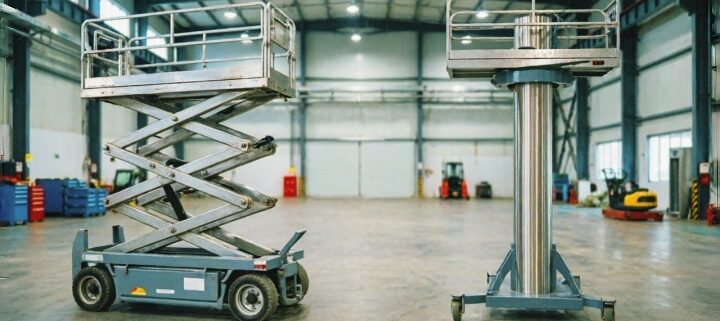
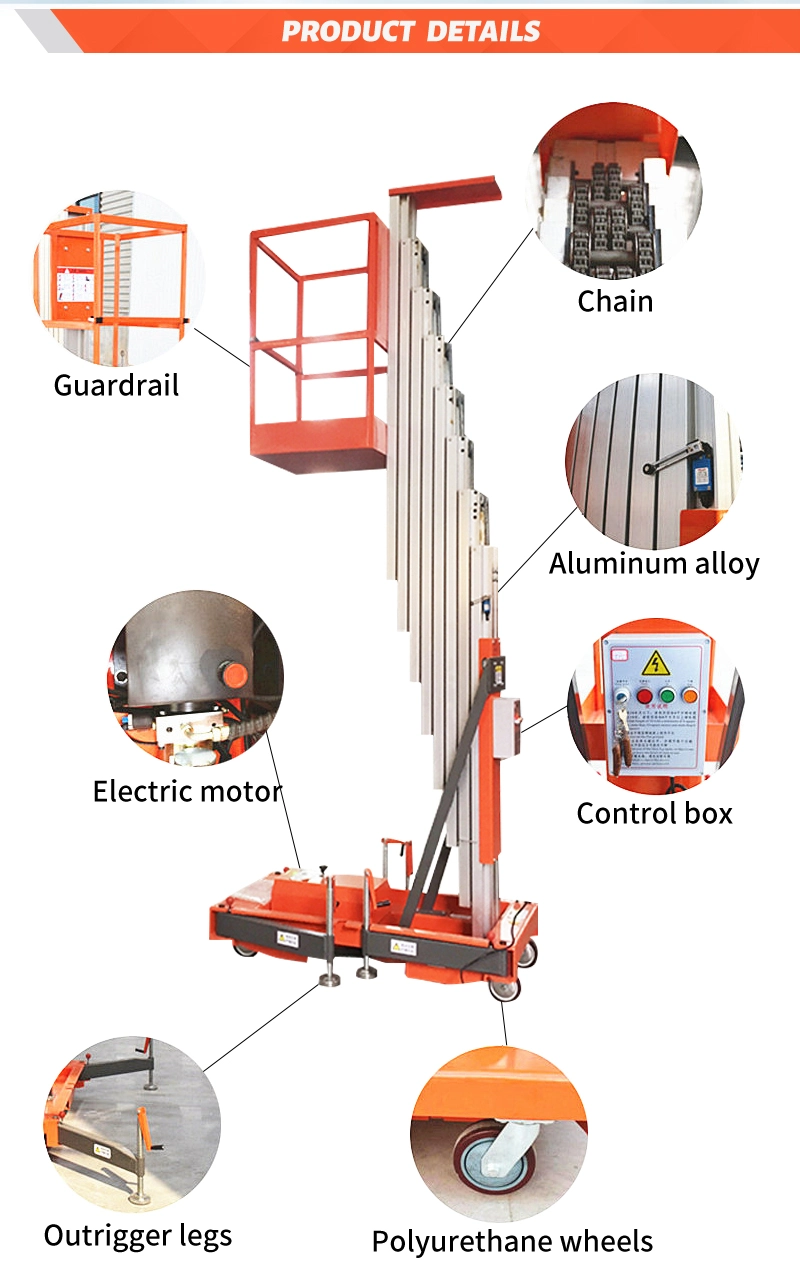
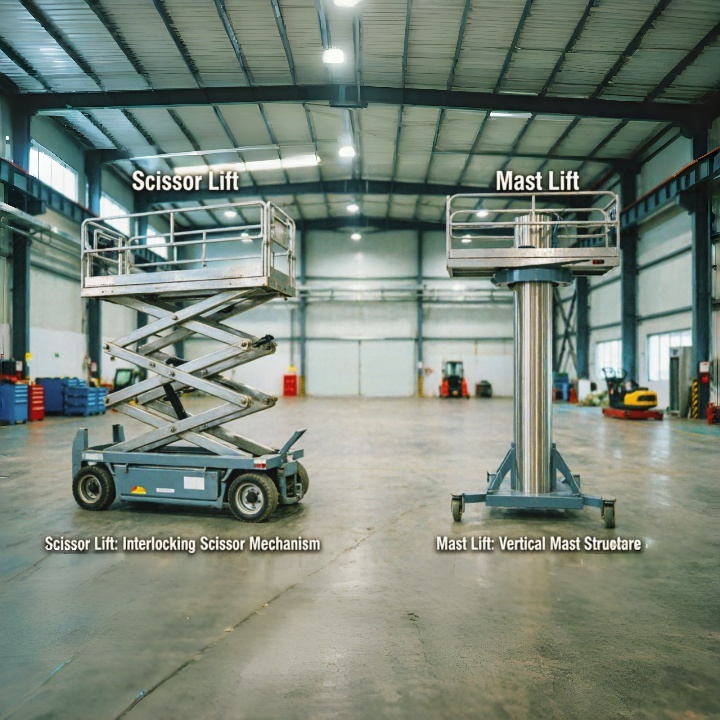
A mast lift, also called a vertical mast lift, is a compact aerial work platform that raises a small work platform vertically using one or more telescopic aluminum or steel mast sections.
Unlike scissor lifts that use crossing steel arms, mast lifts extend upward through nested mast profiles.
Depending on the design, mast lifts include:
- Single Mast Lift
- Double Mast Lift
- Dual-Person Mast Lift
- Self-Propelled Vertical Mast Lift
- Push-Around Mast Lift
- Lay-Down Mast Lift
Most mast lifts are designed for one or two operators and are ideal for narrow indoor spaces.
What Is a Scissor Lift?
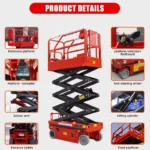
A scissor lift is a hydraulic aerial work platform that raises a work platform using a crisscross (“X”-shaped) steel support mechanism.
As hydraulic cylinders extend, the scissor arms unfold, lifting the platform vertically while maintaining excellent stability.
Common types include:
- Mobile Scissor Lift
- Self-Propelled Scissor Lift
- Electric Scissor Lift
- Hydraulic Scissor Lift
- Diesel Scissor Lift
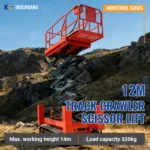
- Rough Terrain Scissor Lift
- Mini Scissor Lift
Scissor lifts are widely used where larger platforms and higher load capacities are required.
How Does a Mast Lift Work?
A mast lift uses telescoping mast sections powered by hydraulic cylinders or electric actuators.
Working Process
- The operator activates the control system.
- The hydraulic pump builds pressure.
- Hydraulic cylinders extend.
- Nested mast sections rise vertically.
- The platform reaches the desired working height.
- Hydraulic valves maintain platform stability.
- When lowering, hydraulic oil returns to the reservoir in a controlled manner.
The mast remains rigid throughout operation, allowing smooth and precise vertical movement.
How Does a  Work?
Work?
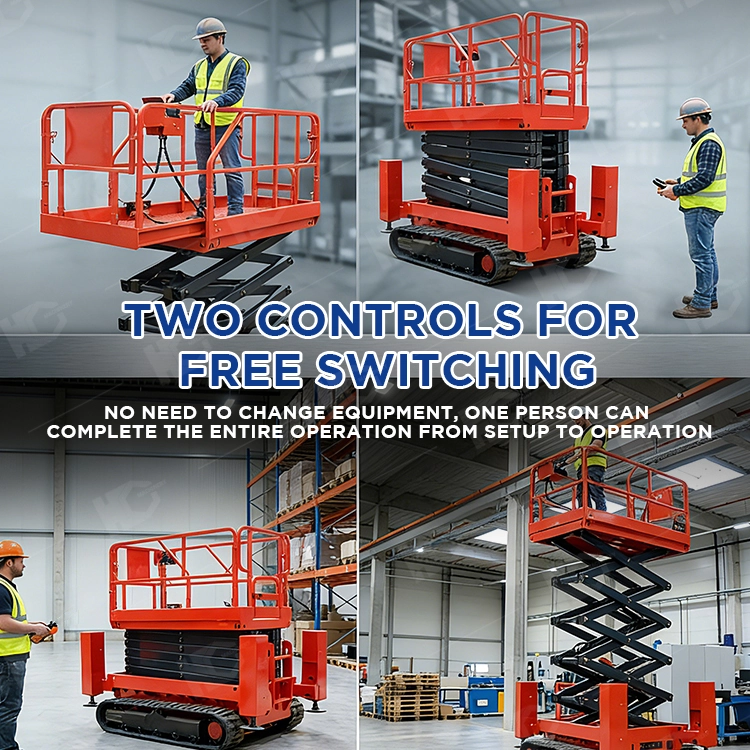 Work?
Work?A scissor lift operates using a hydraulic system and an “X”-shaped scissor mechanism.
Working Process
- A hydraulic pump generates pressure.
- Hydraulic cylinders extend.
- Scissor arms unfold.
- The platform rises vertically.
- Control valves regulate speed.
- Lowering occurs by releasing hydraulic pressure.
The crisscross structure distributes weight evenly, making scissor lifts highly stable under heavier loads.
Structural Differences
| Feature | Mast Lift | Scissor Lift |
|---|---|---|
| Lifting Mechanism | Telescopic Mast | Scissor Arms |
| Structure | Vertical Mast | X-shaped Steel Frame |
| Platform Size | Small | Large |
| Machine Width | Very Narrow | Wider |
| Weight | Lighter | Heavier |
| Transport | Easier | Requires Larger Vehicle |
Typical Specifications
Mast Lift
| Specification | Typical Range |
|---|---|
| Working Height | 6–18 m |
| Platform Capacity | 120–250 kg |
| Operators | 1–2 |
| Platform Width | 0.6–0.8 m |
| Machine Weight | 400–1,500 kg |
| Power | AC, DC, Battery |
Scissor Lift
| Specification | Typical Range |
|---|---|
| Working Height | 6–20 m |
| Platform Capacity | 230–1,000 kg |
| Operators | 2–4 |
| Platform Width | 0.8–1.5 m |
| Machine Weight | 1,200–4,500 kg |
| Power | Electric, Diesel, Hybrid |
Advantages of Mast Lifts
Compact Design
Mast lifts are designed to fit through standard doorways, elevators, and narrow warehouse aisles.
They are ideal for confined spaces where larger machines cannot operate.
Lightweight Construction
The aluminum mast structure reduces overall machine weight.
This makes transportation easier and minimizes floor loading, which is important in offices, hospitals, and shopping malls.
Excellent Maneuverability
Their compact footprint allows operators to navigate crowded indoor environments with ease.
Lower Operating Costs
Compared with larger scissor lifts, mast lifts generally consume less power and require fewer hydraulic components, reducing maintenance costs.
Fast Setup
Push-around and self-propelled mast lifts can often be positioned and made ready for work quickly.
Advantages of Scissor Lifts
Larger Working Platform
Scissor lifts provide enough space for:
- Multiple workers
- Tools
- Equipment
- Building materials
This improves efficiency for tasks requiring teamwork.
Higher Load Capacity
Scissor lifts typically support:
- 230 kg
- 320 kg
- 450 kg
- 680 kg
- Up to 1,000 kg on some industrial models
Superior Stability
The wide chassis and scissor mechanism provide excellent stability at full height.
Better for Heavy-Duty Work
Scissor lifts are commonly used in:
- Construction
- Steel installation
- Mechanical work
- Industrial maintenance
Rough Terrain Options
Diesel-powered rough-terrain models can operate safely on uneven outdoor surfaces where mast lifts are unsuitable.
Pain Points Solved by Mast Lifts
Mast lifts address several common workplace challenges:
Limited Indoor Space
Their narrow design allows access to tight aisles, corridors, and storage areas.
Lightweight Floor Requirements
Many indoor facilities have floor load limits. Mast lifts exert less pressure than heavier scissor lifts.
Frequent Relocation
Their compact size makes them easy to move between work locations.
Lower Equipment Costs
For light-duty maintenance, mast lifts offer an economical alternative to larger aerial platforms.
Pain Points Solved by Scissor Lifts
Scissor lifts are designed for more demanding applications.
Heavy Material Handling
The large platform accommodates workers, tools, and bulky materials simultaneously.
High Productivity
Multiple workers can perform tasks together, reducing project completion time.
Outdoor Construction
Rough-terrain models maintain stability on gravel, dirt, and uneven ground.
Large Work Areas
Extended platforms reduce the need for frequent repositioning.
Common Applications
Mast Lift Applications
Mast lifts are ideal for:
- Warehouse maintenance
- Retail stores
- Shopping malls
- Office buildings
- Hotels
- Libraries
- Schools
- Hospitals
- Airports
- Electrical maintenance
- Lighting installation
- HVAC servicing
- Inventory management
Scissor Lift Applications
Scissor lifts are commonly used for:
- Building construction
- Factory maintenance
- Industrial installation
- Steel structure assembly
- Airport maintenance
- Stadium maintenance
- Warehouse operations
- Outdoor decoration
- Sign installation
- Mechanical repairs
Mast Lift vs Scissor Lift: Performance Comparison
| Feature | Mast Lift | Scissor Lift |
|---|---|---|
| Indoor Use | Excellent | Excellent |
| Outdoor Use | Limited | Excellent (Rough Terrain Models) |
| Narrow Spaces | Excellent | Moderate |
| Heavy Loads | Limited | Excellent |
| Multiple Workers | Limited | Excellent |
| Purchase Cost | Lower | Higher |
| Maintenance Cost | Lower | Moderate |
| Machine Weight | Lighter | Heavier |
| Productivity | Moderate | High |
| Platform Space | Small | Large |
Which One Is Easier to Transport?
Mast lifts are generally much easier to transport because they:
- Weigh less
- Occupy less space
- Fit inside elevators
- Pass through standard doors
- Require smaller trailers
Scissor lifts usually require forklifts, loading ramps, or flatbed trucks for transportation, especially larger self-propelled or rough-terrain models.
Price Comparison
Mast Lift
Typical China factory price:
| Type | Price (USD) |
|---|---|
| Single Mast Lift | $2,000–$4,500 |
| Double Mast Lift | $3,500–$6,500 |
| Self-Propelled Mast Lift | $6,000–$10,000 |
Scissor Lift
Typical China factory price:
| Type | Price (USD) |
|---|---|
| Mobile Scissor Lift | $3,000–$7,000 |
| Self-Propelled Scissor Lift | $6,500–$16,000 |
| Rough Terrain Scissor Lift | $15,000–$28,000 |
Scissor lifts generally cost more because of their larger chassis, higher load capacity, and more complex drive systems.
How to Choose Between a Mast Lift and a Scissor Lift
Choose a mast lift if you:
- Work primarily indoors.
- Need access through narrow aisles or standard doorways.
- Require lifting for one or two operators.
- Perform maintenance, electrical, or inspection work.
- Want a lightweight and cost-effective machine.
- Frequently transport equipment between job sites.
Choose a scissor lift if you:
- Need a larger working platform.
- Require higher lifting capacity.
- Work with multiple operators and heavy tools.
- Perform construction or industrial maintenance.
- Operate outdoors on uneven terrain.
- Need higher productivity for large-scale projects.
Future Trends in Aerial Work Platforms
The aerial work platform industry continues to evolve with new technologies that improve safety, efficiency, and sustainability. Emerging trends include:
- Lithium-ion battery systems offer faster charging, longer service life, and maintenance-free operation.
- Telematics and IoT connectivity for remote fleet monitoring, diagnostics, and predictive maintenance.
- Electric rough-terrain lifts that combine zero-emission performance with off-road capability.
- Advanced safety technologies, including intelligent overload detection, tilt monitoring, and operator assistance systems.
- Lightweight high-strength materials that reduce machine weight while maintaining structural integrity.
- Compact designs that maximize working height while minimizing machine footprint for increasingly space-constrained environments.
These innovations are helping contractors, rental companies, and facility managers improve productivity while reducing operating costs and environmental impact.
Conclusion
Both mast lifts and scissor lifts are highly effective aerial work platforms, but they are designed to solve different operational challenges. Mast lifts excel in confined indoor environments where compact size, lightweight construction, and easy maneuverability are essential. They are an excellent choice for maintenance, inspection, electrical work, and facilities management where one or two operators need safe vertical access.
Scissor lifts, on the other hand, are built for higher productivity, offering larger platforms, greater load capacities, and superior stability. They are the preferred solution for construction sites, industrial maintenance, warehouses, and projects requiring multiple workers, heavy tools, or outdoor operation on uneven terrain.
When selecting between the two, consider your working height, platform capacity requirements, operating environment, transportation needs, and budget. Choosing the right lift not only improves safety and efficiency but also reduces downtime and maximizes your long-term return on investment.

Jnhclift (Huichuang Lift), based in Jinan, China, is a professional manufacturer of scissor lifts, home elevators, and lift platforms. With our own dedicated factory, we deliver high-quality, reliable lifting solutions tailored to meet diverse industrial and residential needs.
 Room 203, Second Floor, Building 8, Phase Ⅱ, Zhizao Town, Jibei Street, Jiyang District, Jinan City, Shandong Province
 +86 152 5319 3706
 admin@jnhclift.com