Articulating Boom Lift vs Telescopic Boom Lift: A Comprehensive Comparison
Working at height is one of those jobs where the wrong equipment doesn’t just slow you down—it can create safety risks, increase costs, and turn simple tasks into logistical headaches. That’s why choosing between an articulating boom lift and a telescopic boom lift matters more than most people think.
Both machines are widely used in construction, maintenance, logistics, and industrial operations. They look similar from a distance, but their behavior on the job is very different.
This guide focuses on what really matters: how they work, where they’re used, what problems they solve, and how they compare in real-world scenarios—without unnecessary complexity.
What’s the Real Difference (Quick Overview)
Before going deep, here’s the simple version:
- Articulating Boom Lift (Knuckle Boom)
Flexible arm with joints → reaches up, over, and around obstacles - Telescopic Boom Lift (Straight Boom)
Straight extendable arm → reaches farther and faster in a straight line
If your job site is crowded and complex, go articulating.
If it’s open and you need distance, go telescopic.

Working Principle: How Each Machine Actually Operates
Understanding how these machines work explains everything else—their strengths, weaknesses, and ideal use cases.
Articulating Boom Lift Working Principle
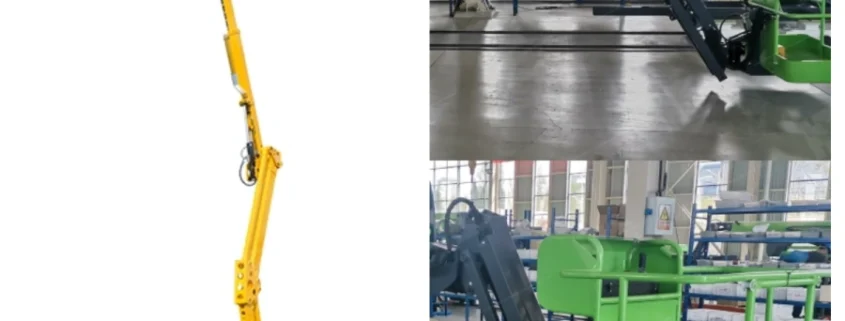
An articulating boom lift uses multiple hinged sections connected by pivot joints. Hydraulic cylinders power these joints.
How it moves:
- The base rotates (usually 360°)
- The first boom section lifts upward
- Additional sections bend at joints (“knuckles”)
- The platform adjusts position with fine control
What makes it special:
- Each joint can move independently
- The operator can “navigate around” obstacles
Think of it like a robotic arm—precise, flexible, and adaptable.
Telescopic Boom Lift Working Principle
A telescopic boom lift uses nested straight sections that extend outward using hydraulic force.
How it moves:
- The base rotates
- The boom raises at an angle
- Sections slide out linearly (like a telescope)
- The platform reaches the target position directly
What makes it special:
- Fast extension
- Long horizontal reach
- Fewer moving joints = simpler motion
Think of it like a spear—direct, powerful, and efficient.

Real-World Applications
Where each machine shines becomes obvious when you look at actual job sites.
Where Articulating Boom Lifts Excel
1. Complex Construction Sites
- Steel structures
- Renovation projects
- Sites with obstacles
You can reach behind beams, over walls, and into tight corners.
2. Industrial Maintenance
- Inside factories
- Equipment repair
- Pipe systems
Machines, conveyors, and structures don’t leave much room—flexibility matters.
3. Indoor Operations
- Warehouses
- Shopping malls
- Airports
Electric articulating lifts are quiet and emission-free.
4. Utility Work
- Electrical wiring
- HVAC systems
- Ceiling maintenance
Precision positioning is critical.
Where Telescopic Boom Lifts Excel
1. Large Construction Projects
- High-rise buildings
- Bridge construction
- Infrastructure work
You need reach, not flexibility.
2. Exterior Building Work
- Facade installation
- Glass curtain walls
- Painting
Straight-line access saves time.
3. Open Job Sites
- Oil & gas fields
- Mining operations
- Wind farms
No obstacles, just distance.
4. Heavy Lifting at Height
- Structural installation
- Equipment placement
Telescopic lifts often support higher load capacities at reach.
Pain Points Solved by Each Machine
Let’s talk about real problems—because that’s what drives equipment decisions.
Problem 1: “We Can’t Reach the Work Area”
- Articulating lift solution: Navigate around obstacles
- Telescopic lift solution: Extend farther in open space
Problem 2: “The Site Is Too Crowded”
- Articulating lifts shine here
- Telescopic lifts struggle due to straight movement
Problem 3: “We Need Speed”
- Telescopic lifts are faster
- Fewer adjustments, direct reach
Problem 4: “Setup Takes Too Long”
Both lifts are faster than scaffolding, but:
- Telescopic = quicker positioning
- Articulating = more adjustments
Problem 5: “Safety Concerns at Height”
Both machines improve safety by:
- Providing stable platforms
- Reducing ladder/scaffold use
- Offering controlled movement
Problem 6: “Labor Costs Are Too High”
Boom lifts reduce:
- Manual labor
- Setup crews
- Project time

Head-to-Head Comparison (What Actually Matters)
| Feature | Articulating Boom Lift | Telescopic Boom Lift |
|---|---|---|
| Movement | Multi-directional | Straight-line |
| Flexibility | Very high | Low |
| Horizontal Reach | Moderate | Very long |
| Precision | Excellent | Good |
| Speed | Moderate | Fast |
| Best Environment | Tight, complex | Open, wide |
| Cost | Higher | Slightly lower |
| Learning Curve | Higher | Easier |
Efficiency in Real Jobs
Let’s be honest—no one buys equipment for theory. It’s about getting work done faster and cheaper.
Scenario 1: Factory Maintenance
- Pipes overhead
- Machines blocking access
- Limited space
Winner: Articulating Boom Lift
You need flexibility, not distance.
Scenario 2: High-Rise Exterior Work
- Open air
- No obstacles
- Long reach required
Winner: Telescopic Boom Lift
Straight, fast, efficient.
Scenario 3: Warehouse Lighting Repair
- Narrow aisles
- Indoor use
- Precision needed
Winner: Articulating (electric model)
Scenario 4: Bridge Construction
- Large open space
- Long horizontal reach
Winner: Telescopic Boom Lift
Competitive Analysis: Beyond Just These Two
Boom lifts don’t exist in isolation. Let’s see how they compare to alternatives.
Boom Lifts vs Scissor Lifts
| Feature | Boom Lift | Scissor Lift |
|---|---|---|
| Movement | Multi-directional | Vertical only |
| Flexibility | High | Low |
| Reach | Extended | Limited |
| Cost | Higher | Lower |
Reality:
Scissor lifts are cheaper—but useless if you need horizontal reach.
Boom Lifts vs Scaffolding
| Feature | Boom Lift | Scaffolding |
|---|---|---|
| Setup Time | Minutes | Hours or days |
| Mobility | High | None |
| Safety | Controlled | Depends on setup |
| Labor | Low | High |
Reality:
Scaffolding is still used—but mainly when continuous access is needed.
Articulating vs Telescopic (Final Verdict)
| Situation | Best Choice |
|---|---|
| Tight spaces | Articulating |
| Obstacles present | Articulating |
| Long distance reach | Telescopic |
| Open environments | Telescopic |
| Fast positioning | Telescopic |
| Precision work | Articulating |
Cost vs Value (What People Often Misjudge)
A common mistake is choosing based on purchase price alone.
Articulating Boom Lift
- Higher upfront cost
- Saves time in complex jobs
- Reduces repositioning
Telescopic Boom Lift
- Lower complexity
- Faster for large-scale work
- Better ROI in open environments
Key insight:
The cheapest machine can become the most expensive if it slows your project.
Safety Considerations
Both machines are designed with safety in mind, but usage matters.
Key safety features:
- Tilt sensors
- Emergency stop systems
- Load limit protection
- Guardrails
Real-world tip:
Most accidents don’t come from machine failure—they come from misuse.
Future Trends
The industry is evolving fast, and both types are improving.
1. Electrification
- More battery-powered models
- Ideal for indoor and urban environments
2. Smart Controls
- Remote diagnostics
- Real-time monitoring
- Predictive maintenance
3. Lightweight Materials
- Better efficiency
- Easier transport
4. Automation Potential
- Semi-autonomous positioning
- Integration with digital jobsite systems
How to Choose (Practical Decision Guide)
If you’re still unsure, ask these questions:
- Are there obstacles?
Yes → Articulating
No → Telescopic - Do you need long reach?
Yes → Telescopic - Is space limited?
Yes → Articulating - Is speed critical?
Yes → Telescopic - Is precision required?
Yes → Articulating
Conclusion
Articulating boom lifts and telescopic boom lifts are not competitors in the traditional sense—they are tools designed for different problems.
- Articulating boom lifts are about flexibility, precision, and access in complex environments.
- Telescopic boom lifts are about speed, distance, and efficiency in open spaces.
Choosing the right one isn’t about which is “better.” It’s about which one fits your job.
Get that right, and everything else—time, cost, safety—falls into place.
If you want to get wholesale prices from the source factory, don’t hesitate to get in touch with our experts.

Jnhclift (Huichuang Lift), based in Jinan, China, is a professional manufacturer of scissor lifts, home elevators, and lift platforms. With our own dedicated factory, we deliver high-quality, reliable lifting solutions tailored to meet diverse industrial and residential needs.
 Room 203, Second Floor, Building 8, Phase Ⅱ, Zhizao Town, Jibei Street, Jiyang District, Jinan City, Shandong Province
 +86 152 5319 3706
 admin@jnhclift.com