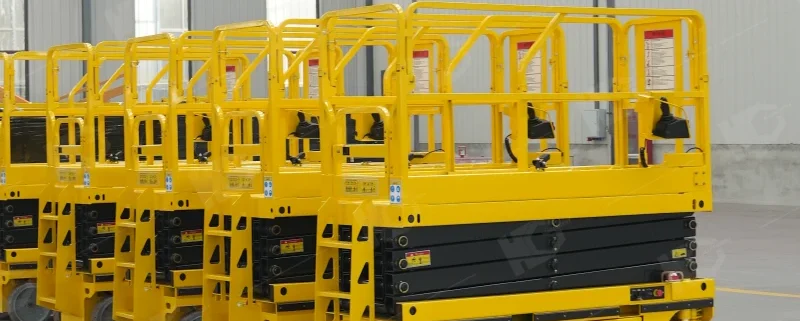
Scissor Lift Price in Saudi Arabia
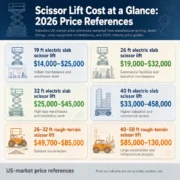
The price of a scissor lift in Saudi Arabia depends on its working height, rated platform capacity, power system, terrain capability, brand, and delivery arrangements. For preliminary budgeting, new electric scissor lifts may cost approximately SAR 16,900–67,500, while heavy-duty diesel rough-terrain models may range from around SAR 56,200 to SAR 131,000 or more. High-reach and specialized models can exceed SAR 168,000.
These are indicative planning ranges rather than fixed market quotations. A factory price from China is not the same as the final cost of receiving a machine in Riyadh, Jeddah, Dammam, or another Saudi destination.
At Huichuang Lift, we recommend comparing equipment specifications, total landed cost, service requirements, and expected utilization before making a purchasing decision. A lower initial price is attractive, but a scissor lift must also meet your site’s working-height, load, access, and safety requirements.
This guide explains current price references, rental costs, import considerations, equipment selection, and the information you should prepare when requesting a quotation.
How Much Does a Scissor Lift Cost in Saudi Arabia?
For most buyers, the first step is to set a realistic budget based on the required machine type. The following table provides indicative price bands for preliminary comparisons.
| Scissor lift type | Indicative purchase price (USD) | Approximate price (SAR) |
|---|---|---|
| Mini or compact electric scissor lift | $4,500–$8,000 | SAR 16,900–30,000 |
| Standard electric scissor lift | $6,000–$12,000 | SAR 22,500–45,000 |
| Higher-platform electric scissor lift | $7,500–$18,000 | SAR 28,100–67,500 |
| Diesel rough-terrain scissor lift | $15,000–$35,000+ | SAR 56,200–131,000+ |
| High-reach or heavy-duty scissor lift | $30,000–$45,000+ | SAR 112,500–168,800+ |
| Used electric scissor lift | $3,000–$9,000 | SAR 11,200–33,800 |
| Used rough-terrain scissor lift | $10,000–$22,000 | SAR 37,500–82,500 |
Price methodology: indicative category-level budget estimates, not statistically verified averages for all Saudi suppliers. SAR conversions use approximately SAR 3.75 per USD. Actual prices depend on configuration, supplier, equipment condition, delivery terms, taxes, and applicable import requirements.
The ranges overlap because two lifts with similar heights can have substantially different specifications. For example, a compact electric model for a smooth warehouse floor may cost considerably less than a rough-terrain machine with four-wheel drive, high ground clearance, and a higher load capacity.

Published Huichuang Lift Factory Reference Prices
For a more specific starting point, our product pricing page lists the following reference prices.
| Platform height | Reference load capacity | Power or configuration | Factory reference price |
|---|---|---|---|
| 6–8 m | 230–320 kg | Electric | $6,899 / approx. SAR 25,870 |
| 8–10 m | 320 kg | Electric / hydraulic configuration | $8,200 / approx. SAR 30,750 |
| 10–12 m | 320–450 kg | Hydraulic | $9,800 / approx. SAR 36,750 |
| 12–14 m | 450 kg | Heavy-duty configuration | $11,999 / approx. SAR 44,996 |
These figures are factory reference prices, not guaranteed offers for every model. They exclude shipping, customs duties, and local certification costs, and should be reconfirmed against the exact specifications, order quantity, and delivery terms.
When comparing these prices with a Saudi distributor’s quotation, check whether the quoted amount includes freight, customs clearance, VAT, local transport, warranty coverage, and commissioning. Otherwise, the apparently cheaper option may not have the lower final cost.
What Factors Affect Scissor Lift Prices in Saudi Arabia?
Evaluate a quotation against the machine’s actual capabilities, not just its advertised height. Six factors are particularly important.
1. Platform Height and Working Height
A scissor lift’s platform height and working height are not necessarily the same measurement. Working height is often presented using an assumed operator reach, so buyers should verify the manufacturer’s definitions before comparing models.
Common selection considerations include:
6–8 m platform height: Suitable for many indoor maintenance and installation tasks.
8–12 m platform height: Often considered for warehouses, factories, commercial buildings, and overhead installation work.
12–14 m platform height: Useful where higher access is required and the site can accommodate the machine’s dimensions and operating conditions.
Higher-reach models: Require closer attention to machine stability, rated capacity, access routes, and site limitations.
These categories are general planning guides rather than universal application limits. The required height should be based on the actual task, not an assumption that a taller machine is always better.
An oversized lift can increase purchase price, transport costs, and operating restrictions without improving productivity on a job that only requires a lower platform.
2. Platform Load Capacity
The rated platform capacity determines how much combined weight the lift can safely carry within its specified operating conditions.
Common capacity categories include approximately 230 kg, 320 kg, 450 kg, and 680 kg, with heavier-duty machines available in some configurations.
Before selecting a machine, calculate the combined weight of:
Workers on the platform.
Tools and installation equipment.
Materials and components.
Any other permitted loads.
For example, two workers weighing a combined 170 kg, tools weighing 45 kg, and materials weighing 80 kg produce a total load of 295 kg.
A machine rated for 230 kg would not be appropriate for that load. Even a machine rated for 320 kg must be checked against its operating instructions, platform-extension limits, load distribution requirements, and the capacity of the specific platform configuration.
Choosing a suitable capacity is more important than paying extra for an unnecessarily large lift.
3. Electric vs. Diesel Power
Power source affects both the initial purchase price and the cost of operating the equipment.

Electric scissor lifts
Electric models are commonly used in warehouses, factories, shopping malls, logistics centers, and other indoor work areas. They generally offer quiet operation and zero exhaust emissions at the point of use.
Their main price variables include platform height, battery type and capacity, charging equipment, platform dimensions, and safety features. Check floor conditions, operating hours, and charging arrangements before purchase.

Diesel rough-terrain scissor lifts
These machines are designed for applications that require suitable outdoor mobility, including specified rough-ground construction and industrial work.
Four-wheel drive, larger tires, ground clearance, chassis design, and load capacity can increase the price. Operating budgets should also account for fuel, engine servicing, and wear associated with the work environment.
For Saudi projects, also confirm the manufacturer’s permitted ambient temperature range, battery operating limits, dust protection, cooling requirements, and maintenance recommendations. High ambient temperatures and dusty conditions make it especially important to select equipment with appropriate operating specifications.
4. Brand, Components, and Customization
Brand reputation influences pricing, but brand origin alone is not a reliable measure of quality.
When comparing Chinese, European, and American manufacturers, evaluate the actual model and its documentation. A lower-cost machine with suitable specifications, documented testing, available spare parts, and dependable technical support may offer better value than a more expensive model that is difficult to maintain locally.
Customization can also affect cost. Typical options include:
Non-marking tires for suitable indoor flooring.
Different platform dimensions and extension arrangements.
Alternative batteries and charging systems.
Additional alarms, sensors, or specified protection systems.
Customized power or control configurations where technically supported.
Special packaging, documentation, or delivery arrangements.
Request an itemized quotation so you can distinguish essential specifications from optional upgrades.
5. New vs. Used Equipment
Used scissor lifts generally cost less upfront, but their condition can significantly affect the total cost.
The following items deserve particular attention:
| Inspection item | What to verify |
|---|---|
| Battery | Condition, charging performance, available test results, and expected remaining service life |
| Hydraulic system | Leaks, unusual movement, damaged hoses, and maintenance records |
| Scissor mechanism | Pins, rollers, structural damage, wear, and signs of previous repairs |
| Controls | Ground controls, platform controls, emergency stops, and emergency lowering |
| Safety equipment | Guardrails, interlocks, alarms, brakes, and model-specific protective devices |
| Operating history | Hours, maintenance history, fault records, and previous working environment |
| Documentation | Manufacturer data plate, manuals, inspection records, and applicable conformity documents |
For used equipment, a professional inspection may be worth considerably more than a small reduction in purchase price. An inexpensive lift with a worn battery or damaged lifting mechanism can quickly become an expensive asset.

6. Spare Parts, Warranty, and After-Sales Support
A scissor lift is a working asset, not simply a piece of machinery delivered once and forgotten.
Ask the supplier to specify the warranty period and coverage, including exclusions for batteries, wear parts, misuse, and environmental damage. Also verify the availability of hydraulic components, control switches, chargers, tires, and other model-specific spare parts.
For remote sites or time-sensitive projects, response times and parts availability may be just as important as the purchase price. A minor fault can create disproportionate costs if it leaves a work crew waiting.
What Is the Total Cost of Importing a Scissor Lift to Saudi Arabia?
When importing from China or another overseas market, the factory quotation is only the beginning of the purchasing calculation.
A realistic budget should include all costs required to bring the equipment to the intended Saudi destination and make it ready for use.
Main Cost Components
| Cost component | What it covers |
|---|---|
| Factory price | The agreed machine model, configuration, and quantity |
| Export and origin charges | Applicable packing, origin transport, and export handling |
| International freight | Sea or other freight based on shipment requirements |
| Cargo insurance | Insurance for the shipment, according to the agreed coverage |
| Customs duty | The applicable duty determined by the correct tariff classification |
| Import VAT | Standard VAT of 15% where applicable, subject to Saudi tax rules |
| Port and clearance charges | Handling, customs clearance, documentation, and applicable inspections |
| Conformity and documentation | Applicable product compliance documents and certification costs |
| Saudi inland delivery | Transport from the port or local storage point to the project |
| Unloading and commissioning | Site delivery, unloading, setup, inspection, or training if required |
Not every shipment will have the same costs. The destination, shipping method, equipment dimensions, order volume, customs classification, and contract terms can all change the final amount.

How to Calculate the Landed Cost
Use this structure when comparing an overseas quotation with a local offer:
Landed cost before operation = factory price + origin charges + freight and insurance + applicable customs duty + applicable import VAT + clearance and conformity expenses + inland delivery and unloading.
Then consider any additional costs for commissioning, operator training, maintenance, and spare parts to estimate the total ready-to-work investment.
For customs planning, Saudi Arabia’s Zakat, Tax and Customs Authority provides an Integrated Customs Tariff Inquiry that allows users to search tariff information by description or customs tariff code. Do not assume that every scissor lift has the same duty rate; confirm the correct classification for the specific equipment.
Saudi Arabia VAT and Compliance Requirements
Saudi Arabia applies a standard VAT rate of 15% where applicable, including applicable taxable imports. The final tax calculation should follow the applicable rules and the actual import documentation. See the official ZATCA VAT guidance.
Equipment conformity is another consideration. The Saudi Standards, Metrology and Quality Organization (SASO) publishes a Certificate of Conformity for Lifting Equipment service for equipment covered by the relevant machinery safety technical regulation. The service description states that it does not cover used lifting equipment.
Before paying a deposit or shipping a machine, ask the supplier and Saudi importer to establish which conformity documents and import procedures apply to the exact model and shipment. Do not assume that a CE marking or another overseas certificate automatically satisfies every Saudi requirement.

Scissor Lift Rental Prices in Saudi Arabia
Buying a lift is not always the best financial decision. For a temporary project, renting may reduce initial capital expenditure and avoid the need to manage long-term ownership.
A published equipment-rental price listing provides the following example rates in Saudi Arabia. These are listing benchmarks, not guaranteed offers or a nationwide average.
| Listed lift size | Electric lift: daily | Electric lift: monthly |
|---|---|---|
| 6 m | SAR 300 | SAR 2,500 |
| 8 m | SAR 300 | SAR 3,500 |
| 10 m | SAR 350 | SAR 4,000 |
| 12 m | SAR 400 | SAR 4,500 |
| 14 m | SAR 400 | SAR 5,000 |
| 16 m | SAR 500 | SAR 6,000 |
| 18 m | SAR 800 | SAR 9,000 |
| 22 m | SAR 1,000 | SAR 13,000 |
The same published listing shows reference prices of SAR 500 per day and SAR 7,000 per month for a 12 m diesel scissor lift, and SAR 600 per day and SAR 7,500 per month for a 14 m diesel model.
Actual quotations can vary by location, machine condition, equipment availability, rental duration, transportation, and contractual terms. Confirm whether maintenance, breakdown replacement, delivery, collection, and operator services are included.
Should You Buy or Rent a Scissor Lift?
The best choice depends on how often the machine will be used.
| Consideration | Buying | Renting |
|---|---|---|
| Upfront expenditure | Higher | Generally lower |
| Availability | Machine can be reserved for your own operations | Depends on supplier availability and rental terms |
| Maintenance | Owner must budget and arrange maintenance | Responsibility depends on contract |
| Long-term utilization | Potentially attractive for regular use | Repeated rental fees can accumulate |
| Short-term projects | May leave unused equipment after completion | Often practical for temporary demand |
| Asset value | May retain resale value | No ownership or resale proceeds |
Consider a simple illustration: if a suitable purchased machine costs SAR 45,000 and an equivalent rental costs SAR 4,500 per month, the purchase price equals approximately 10 months of rental charges.
This is a simple price comparison, not a complete break-even calculation. It excludes shipping and other acquisition expenses if they are not already included in the purchase price, as well as ownership maintenance, downtime, insurance where applicable, financing, and resale value. Also check rental contracts for included services and additional charges.
The correct comparison is between equivalent machines and equivalent service conditions, not simply between a factory invoice and a rental rate.
How to Choose the Right Scissor Lift for a Saudi Project
Before requesting a quotation, define the work environment and the machine’s required capabilities.
For Warehouses and Indoor Facilities
An electric model may be a good starting point where the floor is suitable, exhaust emissions must be avoided, and quiet operation is preferred.
Check the following:
Required working height and platform height.
Total machine width and turning radius.
Doorway, aisle, and elevator dimensions.
Platform capacity and extension requirements.
Floor condition and allowable floor loading.
Battery runtime and charging arrangements.
Tire requirements, including whether non-marking tires are needed.
A taller machine that cannot pass through a warehouse doorway or turn within an aisle is not a practical solution, regardless of its price.
For Outdoor Construction and Industrial Work
For outdoor work, confirm whether a standard electric slab lift or a rough-terrain model is suitable for the actual ground conditions.
Check:
Ground firmness, slope, and surface condition.
Required gradeability and traction.
Four-wheel-drive requirements where applicable.
Tire type and ground clearance.
Rated capacity and permitted operating conditions.
Wind limits and restrictions on elevated outdoor use.
Temperature, dust, and maintenance requirements.
Do not assume that every diesel model is suitable for sand, loose ground, or uneven construction terrain. Its capabilities must be verified from the manufacturer’s specifications.
Safety and Inspection
Price comparisons should never replace safety checks. Before delivery and operation, verify the model’s operating manual, rated capacity, guardrails, control functions, emergency-lowering system, brakes, and other equipment-specific safety features.
Workers should receive suitable training and follow the manufacturer’s operating and inspection requirements. For general technical guidance on scissor lift safety practices, see the US Occupational Safety and Health Administration’s Scissor Lifts guidance. It is a technical reference, not a substitute for applicable Saudi requirements or the equipment manufacturer’s instructions.
How to Get an Accurate Scissor Lift Quotation from a Manufacturer
A useful quotation request should provide enough detail for the supplier to select a technically suitable model and calculate the correct delivery terms.
At Huichuang Lift, we recommend preparing the following information before comparing offers:
1. Required height: State the required working height and any known platform-height requirement.
2. Rated load: Specify the combined weight of workers, tools, and materials.
3. Working environment: Identify indoor or outdoor operation, floor or ground conditions, access restrictions, and expected ambient conditions.
4. Power source: Specify electric or diesel requirements and any preferences for batteries, tires, or charging equipment.
5. Order quantity: State how many units are needed and whether this is a one-time order or part of a recurring procurement plan.
6. Delivery destination: Provide the Saudi destination city or port and confirm the preferred delivery terms.
7. Documentation and support: Identify the required technical documents, applicable conformity requirements, warranty expectations, spare parts, and training needs.
When comparing suppliers, request an itemized offer that states the model, rated capacity, platform and working heights, power system, included options, warranty, lead time, and exclusions. Ask each supplier to quote on the same basis so that the comparison is meaningful.
If the equipment is being imported, confirm who is responsible for freight, insurance, customs clearance, taxes, and the documentation needed for the shipment.
Request a tailored scissor lift quotation from Huichuang Lift: Visit our website or contact us at admin@jnhclift.com or +86 152 5319 3706. Providing the intended application, required height, load capacity, quantity, and Saudi delivery destination will help us identify the appropriate configuration and prepare a more useful price estimate.
Frequently Asked Questions About Scissor Lift Prices in Saudi Arabia
How much does a 10 m scissor lift cost in Saudi Arabia?
For preliminary budgeting, a new 10 m-class electric scissor lift may fall around SAR 28,100–45,000, depending on the model and configuration. This is an indicative purchase-price range, not a confirmed quotation for a specific machine. Shipping, taxes, applicable conformity costs, and Saudi delivery may increase the total.
Is an electric scissor lift cheaper than a diesel model?
Electric models are generally less expensive in many comparable standard configurations and can offer lower operating costs for suitable indoor work. Diesel rough-terrain lifts may cost more because of their chassis, tires, traction systems, and outdoor capabilities. The actual difference depends on the selected models and specifications.
How much does it cost to rent a scissor lift in Saudi Arabia?
Published rental examples range from approximately SAR 300 per day for some smaller electric models to SAR 1,000 per day for a listed 22 m model. Monthly examples range from SAR 2,500 to SAR 13,000. These are listing prices rather than guaranteed market rates; check equipment availability, delivery, VAT, and rental terms before budgeting.
Is it better to buy or rent a scissor lift?
Renting often suits short projects or irregular demand, while buying may be more attractive when the equipment is needed regularly for an extended period. Compare equivalent machines using total ownership costs, rental charges, maintenance responsibilities, utilization, downtime, and resale value.
What costs should I include when importing a scissor lift from China?
Include the factory price, origin charges, freight, insurance, applicable customs duty, import VAT, customs clearance, applicable conformity expenses, inland transport, unloading, and any commissioning or training costs. Confirm the customs classification and applicable requirements before treating an imported factory price as the final budget.
What documents should I request before ordering a scissor lift?
Request the machine’s technical specifications, operating and maintenance manuals, rated-capacity information, applicable test and conformity documents, warranty terms, and spare-parts information. Confirm the documents required for the particular model and shipment under applicable Saudi requirements rather than relying on a generic list of certificates.
Are Chinese scissor lifts a good option for Saudi buyers?
A Chinese manufacturer can be a competitive sourcing option when the equipment specifications, manufacturing quality, documentation, warranty, and spare-parts arrangements meet the buyer’s requirements. Compare individual models and suppliers rather than judging suitability by country of origin alone.
Conclusion
Finding the right scissor lift price in Saudi Arabia requires more than comparing two numbers on a quotation. Platform height, rated capacity, power source, terrain capability, safety provisions, and service arrangements all influence the value of the equipment.
For a reliable purchasing decision, start with the required application and technical specifications, establish a realistic purchase budget, calculate the landed cost, and compare buying against renting over the expected usage period. Verify applicable Saudi import and conformity requirements before placing an order.
At Huichuang Lift, our goal is to help customers identify suitable lifting equipment and evaluate the specifications and costs behind each quotation. With a clear description of your project, you can obtain a more accurate price and avoid paying for equipment that does not match your operational needs.
Sources and Further Verification
Saudi Zakat, Tax and Customs Authority (ZATCA) — VAT Guidance — standard VAT rate and applicable tax guidance.
ZATCA — Integrated Customs Tariff Inquiry — tariff lookup by goods description and customs code.
Saudi Standards, Metrology and Quality Organization (SASO) — Certificate of Conformity for Lifting Equipment — official service scope and application information.
Moedatech — Light Equipment Rental Prices in Saudi Arabia — published rental price references.
US Occupational Safety and Health Administration (OSHA) — Scissor Lifts — general equipment safety practices.
Pricing note: Purchase figures are indicative reference values, not binding offers or independently verified nationwide averages. Rental rates are published listing examples. Confirm current prices, equipment specifications, taxes, customs classification, and compliance requirements before making a purchasing decision.
Scissor lift prices in Saudi Arabia vary widely depending on lift height, power system, automation level, and brand reputation. Electric scissor lifts generally range from $4,500–$18,000 USD (SAR 16,900–67,500), while heavy-duty diesel rough terrain lifts can exceed $35,000 USD (SAR 131,000+).
Chinese manufacturers currently dominate the mid-range market because they offer competitive pricing and good functionality, while European and American brands continue leading the premium industrial sector.
For buyers, understanding the total ownership cost — including maintenance, spare parts, batteries, VAT, and transportation — is far more important than focusing only on the initial purchase price.
As Saudi Arabia continues investing heavily in infrastructure, logistics, and industrial development, demand for scissor lifts is expected to remain strong for many years ahead.
Jnhclift (Huichuang Lift), based in Jinan, China, is a professional manufacturer of scissor lifts, home elevators, and lift platforms. With our own dedicated factory, we deliver high-quality, reliable lifting solutions tailored to meet diverse industrial and residential needs.
 Room 203, Second Floor, Building 8, Phase Ⅱ, Zhizao Town, Jibei Street, Jiyang District, Jinan City, Shandong Province
 +86 152 5319 3706
 admin@jnhclift.com