
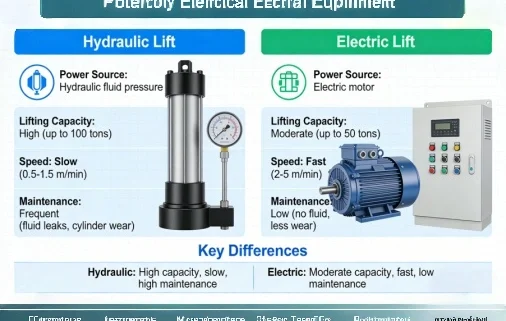
Hydraulic Lift vs Electric Lift: A Complete Buyer’s Guide
What Is a Hydraulic Lift?
A hydraulic lift is a lifting system that uses fluid pressure to raise and lower loads. It operates based on Pascal’s Law, where pressure applied to a confined fluid is transmitted equally in all directions.
How Hydraulic Lifts Work
The system consists of:
- Hydraulic cylinder
- Piston
- Hydraulic pump
- Oil reservoir
- Control valves
When the pump pushes hydraulic fluid into the cylinder, it forces the piston upward, lifting the platform. To lower the lift, the fluid is released back into the reservoir.
Key Characteristics
- High load capacity
- Smooth and stable lifting
- Suitable for heavy-duty operations
- Typically slower than electric systems
What Is an Electric Lift?
An electric lift uses an electric motor to drive mechanical components such as gears, belts, or screw systems to move the platform.
How Electric Lifts Work
Common drive mechanisms include:
- Lead screw systems
- Rack and pinion
- Cable and pulley systems
The electric motor converts electrical energy into mechanical motion, which lifts or lowers the platform.
Key Characteristics
- Fast and precise operation
- Energy-efficient
- Cleaner (no hydraulic oil)
- Suitable for light to medium loads

Hydraulic Lift vs Electric Lift: Core Differences
1. Lifting Capacity
Hydraulic Lift:
- Can handle extremely heavy loads (often several tons)
- Ideal for industrial machinery, vehicles, and cargo
Electric Lift:
- Typically designed for lighter loads
- Limited by motor power and mechanical structure
Winner: Hydraulic Lift
2. Speed and Efficiency
Hydraulic Lift:
- Slower lifting speed
- Depends on fluid flow rate
Electric Lift:
- Faster response time
- Precise speed control
Winner: Electric Lift
3. Precision and Control
Hydraulic Lift:
- Smooth but less precise
- Slight drift may occur over time
Electric Lift:
- High precision positioning
- Ideal for automation systems
Winner: Electric Lift
4. Installation Requirements
Hydraulic Lift:
- Requires space for hydraulic system
- May need a machine room or pit
Electric Lift:
- Compact design
- Easier installation
Winner: Electric Lift
5. Maintenance
Hydraulic Lift:
- Requires regular oil checks
- Potential for leaks
- More maintenance-intensive
Electric Lift:
- Lower maintenance
- Fewer moving fluid components
Winner: Electric Lift
6. Safety
Hydraulic Lift:
- Very safe for heavy loads
- Built-in overload protection
- Risk of oil leakage
Electric Lift:
- Advanced control systems
- Emergency stop and sensors
- Less risk of environmental contamination
Tie (depends on use case)
7. Environmental Impact
Hydraulic Lift:
- Uses oil (potential environmental hazard)
- Risk of spills
Electric Lift:
- Cleaner operation
- More environmentally friendly
Winner: Electric Lift
8. Cost Comparison
| Factor | Hydraulic Lift | Electric Lift |
|---|---|---|
| Initial Cost | Lower (for heavy-duty) | Higher |
| Maintenance Cost | Higher | Lower |
| Energy Consumption | Moderate | Low |
| Lifespan | Long | Long |
Best Value: Depends on application

Advantages of Hydraulic Lifts
1. Superior Load Capacity
Hydraulic lifts excel in heavy-duty environments where large loads need to be lifted safely and efficiently.
2. Smooth Operation
The fluid-based mechanism ensures stable and vibration-free lifting.
3. Cost-Effective for Heavy Loads
For high-capacity lifting, hydraulic systems are more economical than electric alternatives.
4. Durability
Hydraulic systems are robust and can withstand harsh working conditions.
Disadvantages of Hydraulic Lifts
- Slower speed
- Oil leakage risk
- Higher maintenance
- Larger installation space
Advantages of Electric Lifts
1. High Precision
Electric lifts offer exact positioning, making them ideal for automated systems.
2. Energy Efficiency
They consume less power and reduce operating costs over time.
3. Low Maintenance
No hydraulic oil means fewer maintenance requirements.
4. Compact Design
Perfect for tight spaces and modern facilities.
Disadvantages of Electric Lifts
- Limited load capacity
- Higher initial cost
- Less suitable for heavy-duty environments
Application Scenarios
When to Choose a Hydraulic Lift
Hydraulic lifts are best for:
- Warehouses handling heavy pallets
- Automotive workshops (car lifts)
- Construction sites
- Freight elevators
- Industrial manufacturing
When to Choose an Electric Lift
Electric lifts are ideal for:
- Office buildings
- Retail environments
- Automated production lines
- Light material handling
- Home elevators
Industry-Specific Comparison
Warehouse & Logistics
- Hydraulic: Best for heavy cargo
- Electric: Best for fast, repetitive operations
Construction
- Hydraulic: Preferred for durability and load capacity
- Electric: Limited use
Manufacturing
- Hydraulic: Heavy machinery lifting
- Electric: Precision assembly lines
Performance Comparison Table
| Feature | Hydraulic Lift | Electric Lift |
|---|---|---|
| Load Capacity | Very High | Medium |
| Speed | Moderate | Fast |
| Precision | Medium | High |
| Maintenance | High | Low |
| Installation | Complex | Easy |
| Environmental Impact | Moderate | Low |
Cost Analysis Over Time
While hydraulic lifts may have a lower upfront cost for heavy-duty applications, their maintenance and energy costs can add up over time.
Electric lifts, although more expensive initially, often provide better ROI due to:
- Lower maintenance
- Reduced downtime
- Higher efficiency
How to Choose the Right Lift
Consider These Factors:
- Load Requirements
- Heavy → Hydraulic
- Light/medium → Electric
- Usage Frequency
- High frequency → Electric
- Occasional heavy lifting → Hydraulic
- Budget
- Limited upfront → Hydraulic
- Long-term savings → Electric
- Space Availability
- Limited space → Electric
- Large facility → Hydraulic
- Environmental Concerns
- Eco-friendly priority → Electric
Future Trends in Lift Technology
- Smart electric lifts with IoT integration
- Energy-efficient hydraulic systems
- Hybrid lift technologies
- AI-based predictive maintenance
Common Mistakes Buyers Make
- Choosing based on price alone
- Ignoring maintenance costs
- Overestimating load requirements
- Not considering future scalability
ROI Analysis: Which Lift Saves More Money Long-Term?
When comparing hydraulic lift vs electric lift, initial cost is only part of the equation. Smart buyers focus on total cost of ownership (TCO).
Hydraulic Lift ROI
- Lower upfront investment (especially for heavy-duty systems)
- Higher maintenance costs (oil replacement, seals, leakage repair)
- Moderate energy consumption
- Longer downtime during maintenance
Typical ROI cycle: 3–5 years (depending on usage intensity)
Electric Lift ROI
- Higher initial cost
- Lower maintenance requirements
- Energy savings of 20%–40% in high-frequency operations
- Minimal downtime
Typical ROI cycle: 2–4 years in automated environments
ROI Verdict
- Heavy-duty + low frequency → Hydraulic Lift
- High frequency + automation → Electric Lift
Failure Rate & Maintenance Cycle Comparison
One of the most overlooked factors in lift selection is system reliability.
Hydraulic Lift
Common issues:
- Oil leakage
- Seal wear
- Valve blockages
Maintenance cycle:
- Oil replacement every 6–12 months
- Seal inspection every 3–6 months
Estimated failure rate: Medium
Electric Lift
Common issues:
- Motor wear (after long-term use)
- Electrical control faults
Maintenance cycle:
- Motor inspection annually
- Minimal routine servicing
Estimated failure rate: Low
Downtime Cost Analysis
In industrial environments, downtime is often more expensive than the equipment itself.
Hydraulic Lift
- Repair time: Longer (fluid system troubleshooting)
- Spare parts: Readily available but labor-intensive
- Impact: Production delays in heavy industries
Electric Lift
- Repair time: Shorter (modular components)
- Diagnostics: Faster with smart systems
- Impact: Minimal disruption in automated lines
Hydraulic vs Electric Lift for Different Industries
1. Automotive Workshops
- Frequent heavy lifting (vehicles)
- Requires stability and load capacity
Best Choice: Hydraulic Lift
2. High-Frequency Logistics Centers
- Continuous operation (24/7)
- Fast lifting cycles required
Best Choice: Electric Lift
3. Cold Storage Warehouses
- Low temperature environment
- Oil viscosity may be affected
Best Choice: Electric Lift
4. Clean Rooms & Pharmaceutical Facilities
- Strict environmental standards
- No contamination allowed
Best Choice: Electric Lift
5. Heavy Manufacturing Plants
- Large machinery handling
- Extreme load requirements
Best Choice: Hydraulic Lift
Decision Table: Quick Selection Guide
| Scenario | Recommended Lift Type |
|---|---|
| Heavy load (>5 tons) | Hydraulic Lift |
| High-frequency use | Electric Lift |
| Limited budget | Hydraulic Lift |
| Low maintenance requirement | Electric Lift |
| Precision positioning needed | Electric Lift |
| Harsh industrial environment | Hydraulic Lift |
Can Electric Lifts Replace Hydraulic Lifts?
This is a common question among modern buyers.
Short Answer:
Partially, but not completely.
Explanation:
Electric lifts are rapidly improving and can replace hydraulic systems in:
- Light to medium load applications
- Smart factories
- Automated warehouses
However, hydraulic lifts still dominate in:
- Ultra-heavy lifting
- Harsh environments
- Cost-sensitive heavy-duty operations
Future trend: Hybrid systems combining both technologies
Lifespan Comparison
| Factor | Hydraulic Lift | Electric Lift |
|---|---|---|
| Average Lifespan | 10–15 years | 10–20 years |
| Wear Components | Seals, oil system | Motor, gearbox |
| Longevity Driver | Maintenance quality | Usage frequency |
With proper maintenance, both systems can exceed 15 years.
How to Choose the Right Lift Supplier
Choosing the right equipment is only half the battle—the supplier matters just as much.
1. Certifications
Ensure the supplier provides:
- CE Certification
- ISO Standards
- Safety compliance documents
2. Customization Capability
A reliable supplier should offer:
- Load customization
- Platform size adjustment
- Control system options
3. After-Sales Support
Critical factors:
- Spare parts availability
- Technical support
- Installation guidance
4. Delivery Time
- Standard models: 2–4 weeks
- Customized lifts: 4–8 weeks
5. Industry Experience
Choose suppliers with:
- Proven case studies
- Export experience
- Industry-specific solutions
Hidden Costs Buyers Often Ignore
When evaluating hydraulic lift vs electric lift, many buyers overlook:
- Installation costs
- Operator training
- Spare parts inventory
- Energy consumption over time
- Downtime losses
These can account for 30%–50% of total lifecycle cost
Advanced FAQ: Hydraulic Lift vs Electric Lift
1. Is hydraulic lift cheaper than electric lift in the long run?
Not always. Hydraulic lifts have lower upfront costs but higher maintenance expenses. Electric lifts often provide better long-term value.
2. Which lift is better for 24/7 operation?
Electric lifts are better due to lower heat generation and higher efficiency.
3. Can electric lifts handle heavy loads?
Yes, but only up to a certain limit. Hydraulic systems are still superior for extremely heavy loads.
4. What is the biggest disadvantage of hydraulic lifts?
Maintenance and potential oil leakage.
5. Are electric lifts safer?
Both are safe, but electric lifts offer more advanced control systems.
6. Which lift is more environmentally friendly?
Electric lifts, as they do not use hydraulic oil.
Call to Action: Get the Right Lift Solution for Your Business
Choosing between a hydraulic lift and an electric lift requires a clear understanding of your operational needs, budget, and long-term goals.
If you are planning to source lifting equipment for industrial or commercial use, working with a professional manufacturer can help you:
- Select the right configuration
- Reduce long-term costs
- Improve operational efficiency
Contact us today for a customized hydraulic or electric lift solution tailored to your industry.
Final Insight
The real question is not “hydraulic vs electric lift,” but:
Which lift system delivers the highest efficiency and lowest cost for your specific application?
Answer that correctly—and your investment will pay for itself many times over.
FAQ: Hydraulic Lift vs Electric Lift
1. Which lift is better for heavy loads?
Hydraulic lifts are better due to their higher load capacity.
2. Are electric lifts more energy-efficient?
Yes, electric lifts consume less energy and are more efficient.
3. Which lift requires less maintenance?
Electric lifts generally require less maintenance.
4. Is hydraulic lift safer?
Both are safe, but hydraulic lifts are better for heavy-duty applications.
5. Which lift lasts longer?
Both have long lifespans, but maintenance plays a key role.
Conclusion
When comparing hydraulic lift vs electric lift, there is no one-size-fits-all answer. The right choice depends on your specific operational needs.
- Choose hydraulic lifts for heavy-duty, high-capacity applications.
- Choose electric lifts for precision, speed, and energy efficiency.
Ultimately, the best lift is the one that aligns with your workload, environment, and long-term business goals.
If you are sourcing lifts for industrial or commercial use, working with a reliable manufacturer that offers customization and after-sales support can significantly improve your ROI and operational efficiency.

Jnhclift (Huichuang Lift), based in Jinan, China, is a professional manufacturer of scissor lifts, home elevators, and lift platforms. With our own dedicated factory, we deliver high-quality, reliable lifting solutions tailored to meet diverse industrial and residential needs.
 Room 203, Second Floor, Building 8, Phase Ⅱ, Zhizao Town, Jibei Street, Jiyang District, Jinan City, Shandong Province
 +86 152 5319 3706
 admin@jnhclift.com