How Much Does a Shaftless Home Elevator Cost?
A shaftless home elevator typically costs $6,000–$15,000 for selected factory-supplied equipment configurations, while the total installed price in overseas residential markets can range from approximately $19,000 to $60,000 or more. The final cost depends on the elevator design, number of floors, rated load, cabin dimensions, building preparation, shipping, installation, and local compliance requirements.
Unlike a traditional home elevator, a shaftless model uses an integrated supporting frame or another compact structural arrangement instead of relying on a separately constructed concrete or masonry elevator shaft. This can make it an attractive option for homeowners who want to add vertical transportation without undertaking extensive building renovations.
However, not every shaftless elevator works in the same way. Some through-the-floor models are designed for two stops, while other self-supporting residential elevator systems can be configured for three, four, or even five floors.
In this guide, we explain how much a shaftless home elevator costs, what affects the price, how it compares with traditional home elevators, and what buyers should check before ordering from a manufacturer.
If you are comparing different residential lift configurations, start with JNHC Lift’s home elevator solutions.
1. How Much Does a Shaftless Home Elevator Cost?
The price of a shaftless home elevator depends on whether you are purchasing the equipment directly from a manufacturer or hiring a local company to supply and install the complete system.
For an initial budget, the following ranges provide a useful starting point.
Shaftless Home Elevator Price Overview
| Cost category | Indicative price range |
|---|---|
| Chinese factory equipment price | $6,000–$15,000 |
| Basic overseas installed project | $19,000–$30,000 |
| Mid-range residential installation | $30,000–$45,000 |
| Premium or complex installation | $45,000–$60,000+ |
These ranges are not directly interchangeable. The factory price generally refers to elevator equipment, while the installed price may include local labor, site preparation, electrical work, transportation, and other project expenses.
For example, JNHC Lift publishes an indicative factory equipment price of $6,000–$15,000 for its small shaftless home elevator designed for 2–5 floors, with a standard 400 kg rated load. The exact quotation depends on the selected configuration and customization requirements.
By comparison, US home improvement and installation guides report higher installed costs. Angi’s 2026 guide places typical shaftless elevator installation at approximately $19,250–$24,750, while other providers publish broader ranges depending on model and project scope.
The key point is simple: a $10,000 factory quotation and a $30,000 local installation quotation may describe different parts of the same project.
What Does the Factory Price Usually Include?
A manufacturer’s equipment quotation may include:
- Elevator lifting mechanism
- Supporting frame or integrated enclosure
- Cabin and operating controls
- Guide rails and related components
- Landing access and safety components according to the selected design
- Standard electrical and control equipment
- Export packing, depending on the agreed quotation terms
Items that may be charged separately include:
- International freight and insurance
- Import duties and local taxes
- Floor opening or structural preparation
- Local electrical work
- Installation labor
- Inspection and commissioning
- Local maintenance and service agreements
Before comparing suppliers, confirm exactly what each quotation covers.
For a broader residential elevator comparison, read our small home elevator cost guide.
2. What Is a Shaftless Home Elevator?

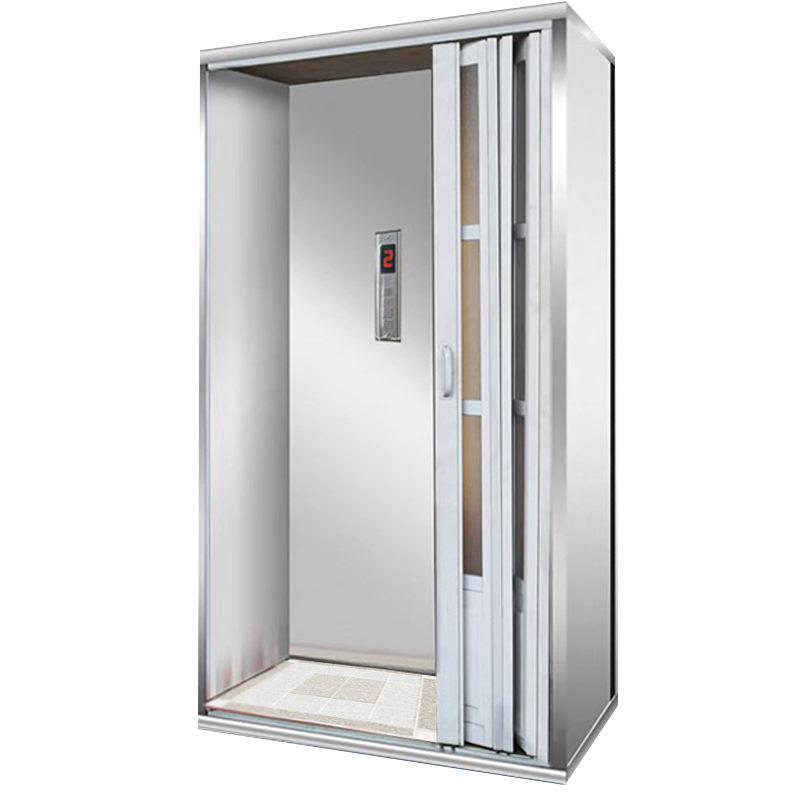
A shaftless home elevator is a residential lifting system that does not require a separately constructed conventional elevator shaft.
Traditional elevators usually need a dedicated hoistway with structural walls, a pit, and sometimes a machine room. A shaftless design reduces or changes these construction requirements by integrating the supporting structure into the elevator system.
Depending on the model, the elevator may use a self-supporting steel frame, compact guide rail arrangement, or a through-the-floor configuration.
This makes shaftless elevators particularly interesting for:
- Existing houses that were not designed for an elevator
- Duplex homes and townhouses
- Small villas with limited floor space
- Renovation projects
- Multi-generational households
- Homes where extensive concrete shaft construction is impractical
Does Shaftless Mean No Construction Work?
No. This is one of the most important points buyers should understand.
A shaftless elevator may eliminate the need for a conventional concrete shaft, but the building still needs to support the elevator and accommodate its travel path.
Depending on the model, preparation may involve:
- Checking floor load-bearing capacity
- Creating or preparing floor openings
- Installing an integrated supporting frame
- Providing electrical connections
- Preparing landing access
- Checking overhead and clearance requirements
- Protecting the opening and surrounding areas
A self-supporting elevator is not a completely construction-free product. It is a system designed to reduce or simplify certain types of building work.
3. Shaftless Home Elevator Cost by Number of Floors
The number of floors is one of the main factors affecting the equipment price.
A two-stop elevator generally requires less guide rail, fewer landing interfaces, and a shorter travel distance than a four- or five-floor system.
However, buyers should distinguish between a compact through-the-floor lift and a multi-floor self-supporting residential elevator. Their designs and operating limits can be very different.
Two-Floor Shaftless Home Elevator
A two-floor configuration is usually the most straightforward option.
It is suitable for:
- Two-story houses
- Duplex properties
- Split-level homes
- Residential accessibility upgrades
A basic equipment budget may start around $6,000, depending on the design and configuration. The final installed cost depends on local construction and installation conditions.
For a compact two-floor home, the main purchasing priorities are footprint, cabin access, rated load, and the amount of structural work required.
Three-Floor Shaftless Home Elevator
A three-floor configuration needs a longer travel distance and additional landing access.
The equipment price may increase because of:
- Longer guide rails
- Additional landing doors or access arrangements
- Greater travel height
- More installation work
- Different safety and control requirements
JNHC Lift lists a three-floor shaftless home elevator with an indicative factory equipment price of $6,000–$14,800. This is a reference range rather than a fixed price for every project.
Explore the three-floor shaftless home elevator for its product configuration.
Four-Floor Shaftless Home Elevator
A four-floor elevator is more demanding than a typical through-the-floor two-stop lift.
Before ordering, buyers should confirm that the selected model is specifically engineered for the required travel height and number of stops.
Important considerations include:
- Rated load
- Total lifting height
- Guide rail configuration
- Supporting frame design
- Landing protection
- Required overhead clearance
- Installation and maintenance access
A multi-floor self-supporting elevator may be a practical solution for a private villa, but the building structure and local regulations must be checked before confirming the design.
Five-Floor Shaftless Home Elevator
A five-floor configuration is intended for larger multi-level residences and selected low-rise residential projects.
The equipment and installation requirements can be more substantial because of the longer travel distance and additional stops.
At this height, buyers should pay particular attention to the elevator’s technical limits, drive system, rated load, speed, and safety configuration.
JNHC Lift offers a small shaftless home elevator for 2, 3, 4, and 5 floors. Its published product information specifies a standard 400 kg rated load and customization options.
Not every product marketed as a shaftless elevator can serve five floors. Always check the manufacturer’s actual model specifications rather than assuming that all shaftless designs have the same travel capability.

4. What Factors Affect the Cost of a Shaftless Home Elevator?
Two elevators may both be described as shaftless, but their prices can be very different.
The following factors explain why.
1. Number of Floors and Travel Height
More floors usually mean a longer travel distance, additional landing arrangements, and more installation work.
The actual vertical travel height matters as much as the number of floors. A house with unusually high ceilings may require a different configuration from a standard building with the same number of stops.
2. Rated Load Capacity
A compact single-person lift and a 400 kg residential elevator are not equivalent products.
The rated load affects the lifting mechanism, supporting structure, cabin size, and safety design.
For a family home, buyers should consider whether the elevator needs to accommodate:
- One or two passengers
- Several family members
- A wheelchair user and caregiver
- Shopping bags and luggage
- Daily household items
A larger rated load can increase the equipment price, but choosing a capacity that is too small may make the elevator inconvenient.
3. Cabin Dimensions
A compact cabin can help reduce the overall footprint.
However, the smallest possible cabin is not always the best choice. The required clear entrance width and internal dimensions should match the intended users.
If wheelchair access is important, do not assume that a standard shaftless elevator will accommodate every wheelchair. Confirm the usable cabin dimensions, entrance width, turning space, and rated load.
4. Drive System
Different shaftless elevator designs use different lifting technologies.
Common options include:
- Hydraulic drive
- Traction drive
- Screw drive
- Pneumatic vacuum technology
Each has different requirements for installation space, travel height, speed, energy consumption, and maintenance.
The drive system should be selected according to the actual product design rather than the word “shaftless” alone.
5. Frame and Cabin Materials
The supporting frame and cabin enclosure influence both appearance and cost.
Standard steel structures and finishes are generally more economical than premium decorative configurations.
Optional features may include:
- Panoramic glass panels
- Stainless steel finishes
- Custom cabin colors
- Decorative ceiling panels
- Special lighting
- Custom landing doors
If the elevator will be installed in a prominent living area, appearance may be an important part of the buying decision.
6. Building Preparation
An existing house may need structural assessment, floor opening work, electrical preparation, or interior finishing.
A new home can often accommodate elevator planning earlier in the construction process, which may reduce later modification costs.
7. Shipping and Local Installation
For international buyers, the destination country has a major influence on the final project budget.
Freight, customs duties, local labor, permits, inspection, and commissioning are not necessarily included in a Chinese factory quotation.
This is why a realistic budget should separate equipment cost from local project cost.

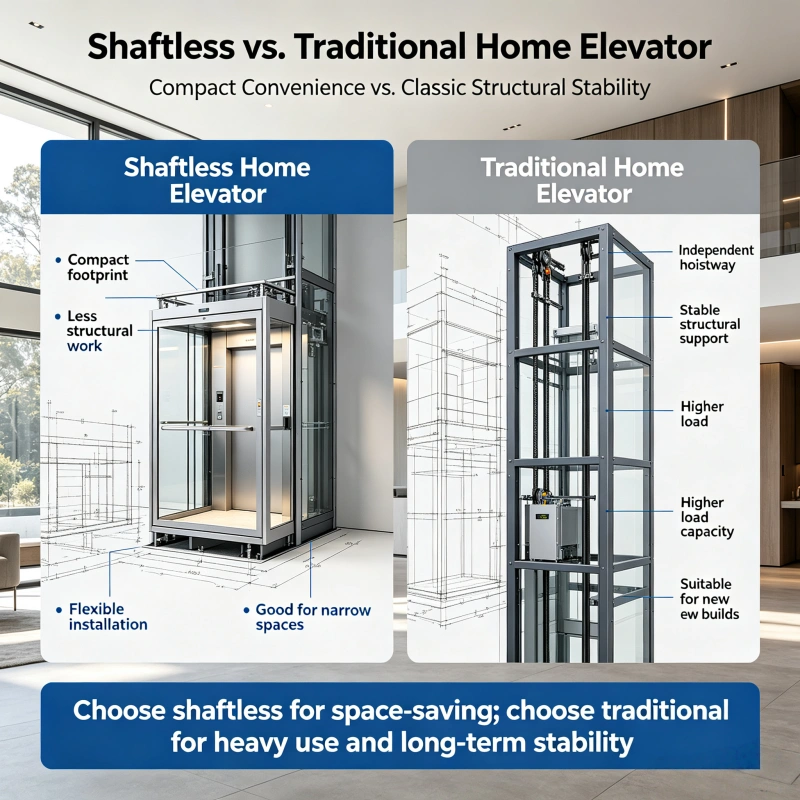
5. Shaftless vs. Traditional Home Elevator: Which Is More Affordable?
A shaftless home elevator can reduce certain construction requirements, but it is not automatically cheaper in every project.
The best option depends on the building design and the amount of construction work required.
| Comparison | Shaftless home elevator | Traditional home elevator |
|---|---|---|
| Separate concrete shaft | Usually not required for self-supporting designs | Usually required |
| Machine room | Depends on model; often not required | Depends on drive system |
| Pit requirement | Model-dependent; some need little or no pit | Often requires a pit |
| Installation space | Compact, model-dependent | Requires a dedicated hoistway |
| Retrofit suitability | Often attractive for existing homes | Can require more structural work |
| Floor capacity | Depends on the model | Wide range of configurations |
| Customization | Available, depending on manufacturer | Usually extensive |
| Initial project cost | Can be lower when shaft construction is avoided | Can be higher when major construction is needed |
When Is a Shaftless Elevator the Better Choice?
A shaftless design may be more practical when:
- The house has limited space for a conventional shaft.
- The owner wants to avoid extensive concrete construction.
- The elevator will be installed in an existing home.
- The required number of stops and travel height match the model.
- A compact supporting structure can fit the building layout.
When Is a Traditional Elevator Better?
A conventional residential elevator may be preferable when:
- The building already has a dedicated elevator shaft.
- A larger cabin is required.
- The project needs more extensive customization.
- The intended travel height exceeds the limits of a compact shaftless model.
- The building’s design already accommodates a conventional elevator system.
For more options, compare JNHC Lift’s villa lift solutions and traction home elevator options.
6. Shaftless Home Elevator vs. Vacuum Elevator
These two terms are sometimes used interchangeably in online discussions, but they describe different technologies.
A shaftless home elevator generally refers to a system that does not need a separately constructed conventional shaft. It may use a self-supporting frame or a through-the-floor arrangement.
A pneumatic vacuum elevator uses air pressure differences to move the cabin inside a cylindrical or tubular structure.
Main Differences
| Feature | Self-supporting shaftless elevator | Pneumatic vacuum elevator |
|---|---|---|
| Lifting method | Depends on the selected model | Air pressure difference |
| Structure | Integrated supporting frame or compact arrangement | Usually a cylindrical tube |
| Appearance | Can be customized with different finishes | Often transparent panoramic design |
| Capacity | Depends on model; some residential models offer higher capacity | Generally limited by model |
| Floor options | Depends on the manufacturer’s design | Depends on the vacuum model |
| Cost | Often lower at factory-equipment level | Commonly a premium product |
A vacuum elevator may be visually attractive, especially in a modern villa, but it should not be assumed to be the same product as a self-supporting shaftless elevator.
If your main priority is minimizing construction work and purchasing cost, compare the technical specifications and installed budget of both options before deciding.
7. Does a Shaftless Home Elevator Need a Pit or Machine Room?
One reason homeowners consider shaftless elevators is that many models reduce the need for conventional elevator infrastructure.
However, the exact requirements depend on the elevator design.
Does It Need a Pit?
Some shaftless residential elevators are designed without a traditional deep pit. Others may require a shallow recess or specific floor preparation.
The manufacturer should provide the exact pit or floor-level requirements in the installation drawings.
Does It Need a Machine Room?
Many compact residential shaftless models integrate their drive components into the elevator structure or use a compact arrangement.
However, this does not mean that every model has identical equipment-space requirements.
Ask the manufacturer where the motor, controller, and other components will be located, and whether the proposed installation requires additional access space.
Does It Need a Concrete Shaft?
A self-supporting model may use its own frame as the primary supporting structure, eliminating the need for a separately built concrete or masonry shaft.
That does not remove the need for a properly engineered installation location. The building floor, supporting structure, openings, and safety clearances must still meet the manufacturer’s requirements.
8. How Long Does Shaftless Home Elevator Installation Take?
Installation time depends on the elevator model, building preparation, delivery schedule, and the local installation team’s experience.
A compact shaftless elevator may require less construction work than a traditional elevator, especially when the building is already prepared.
However, buyers should distinguish between:
- Factory production time
- International transportation time
- Site preparation time
- Mechanical and electrical installation
- Testing and commissioning
For example, JNHC Lift lists a reference delivery time of 15 working days for its small shaftless home elevator product, subject to order and configuration confirmation.
This is a factory delivery reference, not a promise that the complete project will be installed and ready for use within 15 days.
Before placing an order, request a project schedule covering production, shipment, installation, testing, and handover.
9. Is a Shaftless Home Elevator Safe?
Safety should be one of the first considerations when purchasing any residential elevator.
A shaftless design does not automatically make an elevator safer or less safe than a traditional system. The important factors are the engineering design, safety components, installation quality, and ongoing maintenance.
Before purchasing, ask about:
- Rated load and overload protection
- Landing door interlocks
- Emergency stop and alarm functions
- Emergency lowering or rescue arrangements
- Door protection and access control
- Electrical protection
- Safe floor-leveling performance
- Applicable product standards and local approval requirements
- Maintenance and inspection instructions
The elevator must be installed and commissioned by qualified professionals in accordance with the manufacturer’s instructions and applicable local requirements.
A supplier’s certificate or factory inspection report should not be treated as a substitute for local approval where that is required.
10. How Much Does It Cost to Maintain a Shaftless Home Elevator?
The annual maintenance cost depends on the elevator technology, operating frequency, local service rates, and the availability of spare parts.
A residential elevator used by one family generally has a different operating pattern from a commercial passenger elevator.
Maintenance may include:
- Checking guide rails and moving components
- Inspecting doors and safety interlocks
- Testing emergency functions
- Checking electrical connections and controls
- Lubricating components where specified
- Inspecting the lifting mechanism
- Confirming smooth starting, stopping, and floor leveling
Hydraulic models may also require inspection of the hydraulic system and oil condition according to the manufacturer’s service schedule.
The best way to estimate long-term costs is to request a maintenance schedule and spare-parts list before ordering.
Do not compare products only by purchase price. A model with convenient service access and readily available replacement parts may provide better value over its working life.

11. How to Buy a Shaftless Home Elevator Directly from a Manufacturer
Buying directly from a manufacturer can help international buyers understand the equipment cost and available customization options.
However, a reliable quotation requires more than telling the supplier that you need a shaftless elevator.
Prepare the following information before contacting a manufacturer:
| Information required | Why it matters |
|---|---|
| Number of floors | Determines the required configuration |
| Floor-to-floor height | Establishes total travel height |
| Rated load | Determines the lifting and cabin requirements |
| Available installation space | Helps confirm the supporting frame arrangement |
| Floor opening dimensions | Important for through-floor and multi-floor designs |
| Pit and overhead conditions | Determines installation feasibility |
| Power supply | Helps confirm electrical compatibility |
| Cabin and frame finish | Affects customization and price |
| Destination country | Determines shipping and local compliance considerations |
| Installation plan | Clarifies who handles site work and commissioning |
Questions to Ask Before Ordering
- Is the quoted price for equipment only or a complete installation?
- How many floors can this exact model serve?
- What is the maximum travel height?
- What is the rated load?
- Does the elevator need a pit or floor opening?
- What structural support is required?
- Which safety components are included?
- What technical documents are supplied?
- What is the production and delivery schedule?
- How are spare parts and after-sales support arranged?
A professional manufacturer should be able to explain the technical limitations of the selected model and identify any site conditions that need to be checked before production.
12. Why Consider JNHC Lift for a Shaftless Home Elevator?
JNHC Lift, operated by Jinan Huichuang Machinery Manufacturing Co., Ltd., supplies residential elevator and lifting equipment for international markets.
Its small shaftless home elevator range is designed for selected residential applications where a conventional concrete shaft is difficult or undesirable to construct.
According to the company’s published product information, the small shaftless home elevator range includes:
| Specification | Published product information |
|---|---|
| Floor configurations | 2, 3, 4, and 5 floors |
| Standard rated load | 400 kg |
| Equipment price reference | $6,000–$15,000 |
| Customization | Available |
| Published delivery reference | 15 working days |
| Intended applications | Villas, townhouses, duplexes, and multi-level homes |
The exact technical configuration should be confirmed for each project.
Factory-Direct Configuration Support
Instead of selecting a product based only on a published price, buyers can discuss the required floor count, rated load, cabin dimensions, and installation space with the manufacturer.
This helps determine whether the selected model is suitable for the building before the order is finalized.
Customization for Residential Projects
Cabin dimensions, finishes, and selected product details can be discussed according to the model and project requirements.
For a property where the elevator will be visible from the living room or stairwell, the supporting frame and cabin appearance may be important design considerations.
Export and Technical Coordination
International projects require more than manufacturing the elevator. Buyers also need to coordinate technical drawings, export packing, shipping, installation responsibilities, and local commissioning.
JNHC Lift can provide product information and technical documentation for project coordination. Local installation and compliance arrangements should be confirmed with the responsible professionals in the destination market.
Explore the following product and information pages:
- Small shaftless home elevator for 2–5 floors
- Three-floor shaftless home elevator
- Small home elevator cost guide
- Villa lift cost guide
If you are planning a new installation or renovating an existing house, send the building height, number of floors, available installation dimensions, and destination country to the JNHC Lift team to request a configuration review.

13. Frequently Asked Questions About Shaftless Home Elevator Costs
How much does a shaftless home elevator cost?
A selected shaftless home elevator may cost around $6,000–$15,000 for factory-supplied equipment. A complete installed project in overseas markets may cost approximately $19,000–$60,000 or more, depending on the model, installation conditions, and local labor costs.
Is a shaftless elevator cheaper than a traditional home elevator?
It can be cheaper when the design avoids substantial concrete shaft construction and other structural work. However, the elevator equipment itself is not always less expensive. Compare the complete project cost rather than just the equipment price.
Can a shaftless elevator serve three floors?
Yes, some self-supporting shaftless residential elevators are designed for three floors. However, many compact through-the-floor models are limited to two stops. Confirm the number of floors and maximum travel height of the exact model.
Can a shaftless elevator serve four or five floors?
Selected multi-floor self-supporting residential elevator systems can be configured for four or five floors. Not every shaftless elevator has this capability. The rated load, drive system, supporting structure, and technical limits must be checked.
Does a shaftless home elevator need a machine room?
Many compact shaftless models do not require a separate conventional machine room. However, the drive system and controller still need an appropriate location and maintenance access. Requirements vary by model.
Does a shaftless elevator need a pit?
Some models require no traditional deep pit, while others need a shallow recess or specific floor preparation. Always request the manufacturer’s installation drawings before modifying the building.
Can I install a shaftless elevator in an existing house?
Yes, many shaftless models are designed for retrofit applications. The building must still be assessed for structural support, floor openings, electrical supply, clearances, and local safety requirements.
Is a shaftless elevator suitable for wheelchair users?
Some larger residential models can be configured for wheelchair access, but many compact through-the-floor elevators have limited cabin dimensions. Confirm the usable cabin size, entrance width, rated load, and accessibility requirements before buying.
How long does a shaftless home elevator last?
Service life depends on product quality, usage, installation, maintenance, and replacement of wear components. Ask the manufacturer for its recommended inspection schedule, warranty terms, and spare-parts support.
Can I buy a shaftless home elevator from China?
Yes. International buyers can purchase shaftless residential elevator equipment directly from Chinese manufacturers. Before ordering, confirm the product specifications, shipping terms, destination-country requirements, installation responsibilities, warranty, and after-sales arrangements.
Final Thoughts: Is a Shaftless Home Elevator Worth the Cost?
A shaftless home elevator can be a practical investment for homeowners who want convenient access between floors without constructing a conventional concrete elevator shaft.
For selected models, factory equipment prices may start around $6,000, while a complete overseas installation can cost considerably more. The difference comes from shipping, building preparation, local installation, inspection, and other project expenses.
The most important decision is not simply choosing the cheapest elevator. It is finding a model that matches the building’s number of floors, travel height, rated load, available space, and intended users.
If you are comparing shaftless home elevators, request a quotation based on your actual building dimensions rather than relying on a generic online price.
Contact JNHC Lift with your floor count, travel height, rated load, installation space, and destination country. The team can help you review a suitable shaftless elevator configuration and prepare an equipment quotation for your project.

Jnhclift (Huichuang Lift), based in Jinan, China, is a professional manufacturer of scissor lifts, home elevators, and lift platforms. With our own dedicated factory, we deliver high-quality, reliable lifting solutions tailored to meet diverse industrial and residential needs.
 Room 203, Second Floor, Building 8, Phase Ⅱ, Zhizao Town, Jibei Street, Jiyang District, Jinan City, Shandong Province
 +86 152 5319 3706
 admin@jnhclift.com