
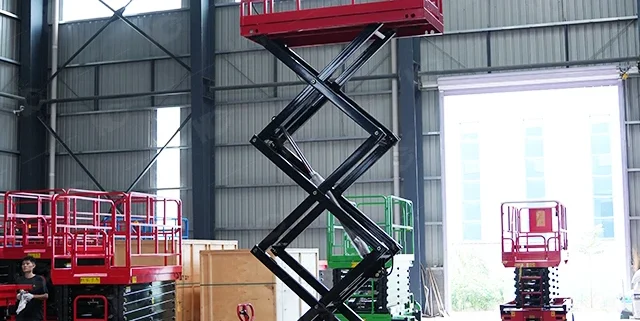
Electric Scissor Lift Price in 2026: New, Used, Rental & Factory Cost Guide
How much does an electric scissor lift cost in 2026? The answer depends on platform height, working height, lifting capacity, battery configuration, brand, and whether you buy from a local dealer or directly from a manufacturer.
For equipment buyers, contractors, rental companies, and warehouse operators, the challenge is not simply finding the lowest price. It is identifying a lift that meets the job requirements without creating unnecessary costs for maintenance, transportation, or downtime.
As a general reference, published 2026 U.S. market guides put new electric scissor lifts in the following approximate price ranges:
- 19 ft electric scissor lift: $17,500–$35,000
- 26 ft electric scissor lift: $22,000–$45,000
- 32 ft electric scissor lift: $32,000–$55,000
- 40 ft electric scissor lift: $42,000–$75,000
These are broad market estimates, not universal prices. Actual quotations vary by brand, specification, dealer, and included services.
For buyers sourcing equipment directly from China, published supplier listings show a different price structure. Some self-propelled electric scissor lift models are advertised at approximately US$4,800–$5,800 FOB, while other configurations, including higher-capacity and higher-reach models, can cost considerably more. Treat these supplier listings as quotation benchmarks, not guaranteed prices for equivalent machines.
This guide explains electric scissor lift prices, compares purchasing options, and shows how to evaluate total cost of ownership.
1. Electric Scissor Lift Price by Platform Height
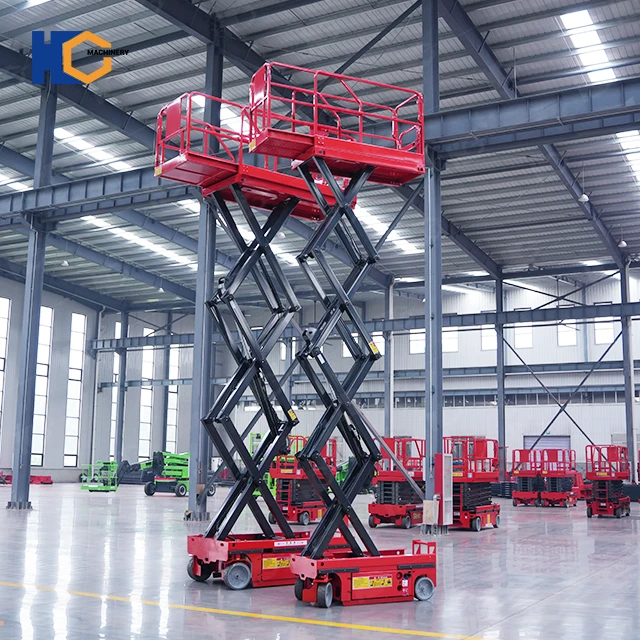
Platform height is one of the most important factors affecting the purchase price. Higher lifts generally require longer lifting structures, different chassis configurations, and additional engineering considerations.
| Platform Height | Approximate New U.S. Market Price | Typical Applications |
|---|---|---|
| 19 ft | $17,500–$35,000 | Retail maintenance, indoor repairs |
| 26 ft | $22,000–$45,000 | Warehouses, commercial buildings |
| 32 ft | $32,000–$55,000 | Industrial maintenance, high ceilings |
| 40 ft | $42,000–$75,000 | High-bay facilities, specialized maintenance |
Prices are indicative 2026 market estimates from published guides. They are not manufacturer quotations for identical specifications.
The price differences are not caused by height alone. A narrow electric scissor lift designed for indoor aisles may cost less than a wider model with a larger platform, higher rated capacity, and more advanced drive functions.
Platform Height vs. Working Height
Don’t confuse these two specifications.
- Platform height: The vertical distance from the ground to the platform floor when elevated.
- Working height: An estimated maximum height at which an operator can perform work, commonly calculated as platform height plus approximately 6 ft (1.8 m).
For example, a lift with a 19 ft platform height may be advertised as having approximately 25 ft of working height.
Actual working-height conventions vary by manufacturer and market. Always confirm the specification sheet before comparing models.
2. How Much Does an Electric Scissor Lift Cost From a Chinese Factory?
For importers, equipment distributors, rental fleets, and contractors purchasing multiple machines, factory-direct sourcing can offer a different price point from established North American brands.
The following public supplier listings provide useful reference points:
| Equipment Type | Published Price Reference | Important Qualification |
|---|---|---|
| Self-propelled electric scissor lift | $4,800–$5,800 per unit | Supplier listing; exact model must be confirmed |
| 6 m electric scissor lift | Approximately $6,491–$6,537 | Published listing from Gather Power |
| 8 m electric scissor lift | Approximately $6,940–$6,989 | Published listing for a specified configuration |
| 12 m electric scissor lift | Approximately $9,980–$12,970 | Published supplier range |
| 10 m self-propelled electric scissor lift | Approximately $10,800–$11,800 | Published listing for a specified model |
These prices are not directly comparable with U.S. dealer prices unless the machines have equivalent specifications and the quotation terms are the same. A factory listing may exclude freight, import duties, local delivery, commissioning, and after-sales services.
What Does FOB Mean?
FOB stands for Free On Board under the agreed Incoterms. In a typical FOB shipment, the seller delivers the goods on board the vessel at the named port, and the buyer assumes specified costs and risks from that point according to the agreed terms.
Therefore, evaluate a factory price separately from the landed cost.
Landed cost = Equipment price + international freight + insurance where applicable + import charges + port handling + destination transportation.
Budget installation, training, spare parts, and local compliance expenses separately.
3. New vs. Used Electric Scissor Lift Price
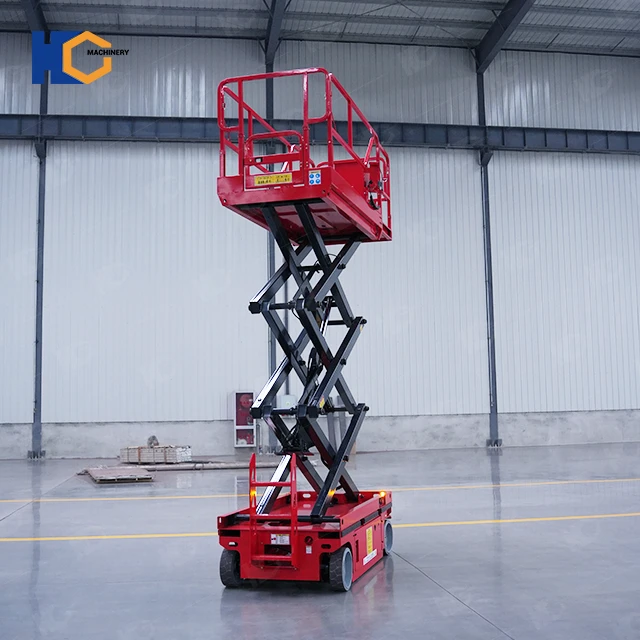
A used electric scissor lift can reduce the initial investment, especially for contractors who need equipment for occasional projects.
Published 2026 market estimates suggest the following approximate U.S. purchase ranges:
| Platform Height | New Lift | Used Lift in Good Condition |
|---|---|---|
| 19 ft | $17,500–$35,000 | $8,500–$18,000 |
| 26 ft | $22,000–$45,000 | $11,000–$25,000 |
| 32 ft | $32,000–$55,000 | $15,000–$32,000 |
| 40 ft | $42,000–$75,000 | $20,000–$45,000 |
The used price depends heavily on machine age, operating hours, battery condition, maintenance records, and inspection status.
When Is a Used Lift Worth Buying?
A used unit may be attractive when:
- The machine will be used infrequently.
- The buyer has qualified maintenance personnel.
- Replacement parts are readily available.
- The battery and hydraulic systems have been inspected.
- The purchase includes reliable service records.
However, a low purchase price can become expensive if the batteries require replacement soon after delivery or if the machine needs extensive electrical repairs.
Before buying used equipment, request a functional test, inspection records, battery assessment, and a list of known faults.
4. Buying vs. Renting an Electric Scissor Lift
Not every project requires ownership.
According to DOZR’s March 2026 rental guide, based on 4,460 marketplace rental transactions, the average scissor lift rental cost was reported at approximately $223 per day, $495 per week, or $984 per month. Actual prices vary by location, machine size, rental terms, and delivery arrangements.
Source: DOZR Scissor Lift Rental Cost Guide.
For electric models, published rental estimates commonly fall within these ranges:
| Platform Height | Daily Rental | Weekly Rental | Monthly Rental |
|---|---|---|---|
| 19 ft | $100–$150 | $225–$350 | $450–$700 |
| 26 ft | $150–$250 | $350–$600 | $700–$1,200 |
| 32 ft | $200–$300 | $475–$700 | $950–$1,400 |
| 40 ft | $250–$400 | $575–$900 | $1,100–$1,800 |
These are indicative published ranges, not guaranteed rates. Delivery, pickup, damage waivers, taxes, and other fees can increase the final rental bill.
A Simple Buy-or-Rent Calculation
Suppose a suitable electric scissor lift costs $20,000 to purchase, while a comparable machine rents for $1,000 per month.
Ignoring financing, maintenance, resale value, delivery, and taxes, the simple price-to-rent comparison is:
$20,000 ÷ $1,000 = 20 months of rental.
This does not mean buying is automatically better after 20 months. Ownership also involves servicing, battery replacement, storage, inspections, and eventual resale. Conversely, a rental fee may include maintenance or replacement support.
For a short project, renting is often more practical. For regular, year-round work, purchasing may offer better long-term value.
5. What Factors Affect Electric Scissor Lift Price?
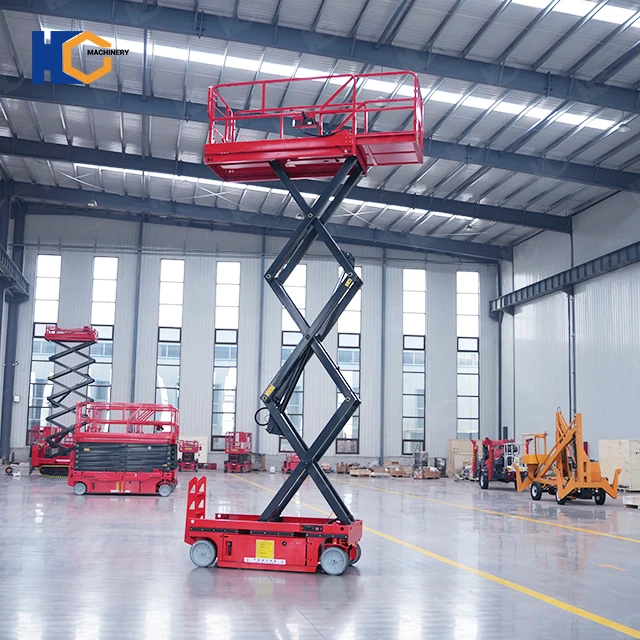
Platform Height and Working Height
Higher reach usually increases the machine’s size and engineering requirements. Buyers should specify the actual work height rather than choosing a lift by its advertised height alone.
Rated Load Capacity
Rated capacity determines the combined weight of operators, tools, and materials that the platform may carry. Higher-capacity configurations may require a different platform, scissor structure, chassis, or hydraulic system.
Never assume that two lifts with the same working height have the same capacity.
Self-Propelled vs. Push-Around
A push-around lift is moved manually and is generally designed for simpler applications. A self-propelled electric scissor lift uses a powered drive system, allowing the operator to reposition the machine more efficiently when the manufacturer’s operating conditions permit.
The self-propelled configuration usually costs more because it includes additional drive, control, and braking components.
Battery Type and Capacity
Battery configuration affects operating time, charging requirements, maintenance, and replacement costs. When comparing quotations, ask for battery chemistry, rated voltage, capacity, charging time, and replacement availability.
A cheaper machine with an undersized battery may not meet the needs of a full work shift.
Platform Extension
An extension deck can provide additional reach across a work area without moving the entire machine. However, extension design and capacity restrictions vary, so buyers should check the permitted load and operating instructions.
Indoor vs. Outdoor Configuration
Standard electric slab lifts are generally intended for firm, relatively level surfaces. Outdoor or rough-terrain applications may require different tires, ground-clearance provisions, chassis design, or other equipment.
Do not assume a standard indoor electric scissor lift is suitable for muddy, sloped, or uneven construction sites.
Brand and After-Sales Support
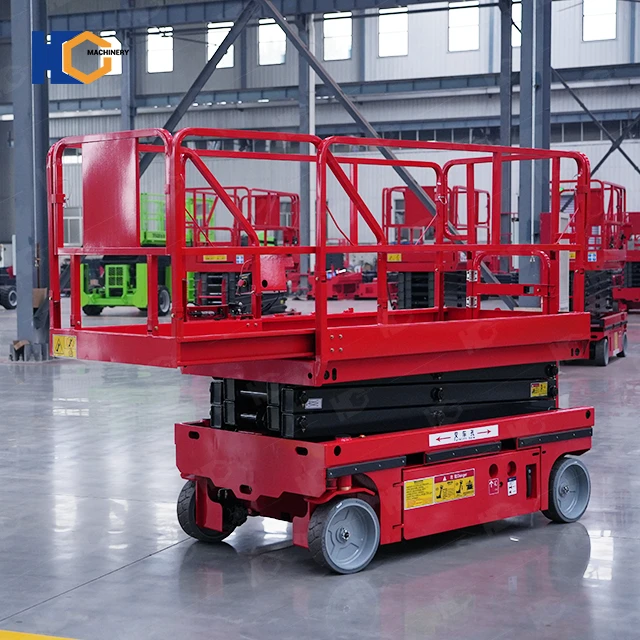
Established brands such as Genie, JLG, and Skyjack have substantial market recognition and established dealer networks in many regions. Alternative manufacturers may offer lower initial equipment prices.
The meaningful comparison is not just brand reputation or purchase price. Buyers should examine service availability, spare-parts lead time, diagnostic support, warranty conditions, and expected downtime.
6. Electric Scissor Lift Brand Comparison
For B2B buyers, a useful comparison separates established-brand equipment from factory-direct alternatives.
| Comparison Factor | Established Brands | Factory-Direct Alternatives |
|---|---|---|
| Initial purchase price | Often higher in published U.S. pricing | May be lower, depending on specification |
| Local service network | Often established in major markets | Depends on distributor and regional support |
| Spare parts | Availability depends on model and location | Confirm stock and shipping lead times |
| Customization | Model-specific options | OEM/ODM options may be available |
| Warranty | Confirm dealer and manufacturer terms | Confirm written coverage and claim procedure |
| Import and logistics | May be supplied through local distribution | Buyer may need to coordinate international shipping |
| Resale value | Can benefit from brand recognition | Depends on local demand and parts support |
Example: Skyjack vs. Factory-Direct Purchasing
Skyjack’s published 2025 U.S. list price for the SJ4726 E was $35,295, with a raised platform height of approximately 7.82 m and a rated capacity of 454 kg. Its SJ4732 E was listed at $42,490, with a raised platform height of approximately 9.65 m and a rated capacity of 318 kg.
Source: Skyjack DC Electric Scissor Lift List Pricing.
These are dated list prices, not current dealer quotations. They are useful as published reference points, but they should not be compared with a factory listing unless platform dimensions, capacity, drive functions, compliance, and included equipment are aligned.
For example, comparing a low-cost 6 m mobile lift with a higher-capacity 7.8 m self-propelled lift would not be a fair comparison simply because both are described as electric scissor lifts.
7. The Hidden Cost of a Cheap Electric Scissor Lift
A purchase quotation can look attractive while leaving important ownership expenses unresolved.
Consider a distributor purchasing five machines for a rental fleet. A $1,000 saving per unit reduces the initial invoice by $5,000. But if the lower-priced machines have longer parts lead times or require more downtime, lost rental days may offset the initial saving.
A practical total-cost-of-ownership review should include:
- Purchase price
- Freight and import costs
- Battery replacement
- Routine servicing
- Tires and wear parts
- Inspection and compliance
- Operator training
- Spare-parts inventory
- Downtime
- Resale value
This leads to an important procurement principle:
The best-value scissor lift is the one that completes the required work safely and reliably at the lowest realistic lifecycle cost—not necessarily the one with the lowest factory invoice.
8. How to Get an Accurate Electric Scissor Lift Factory Quote
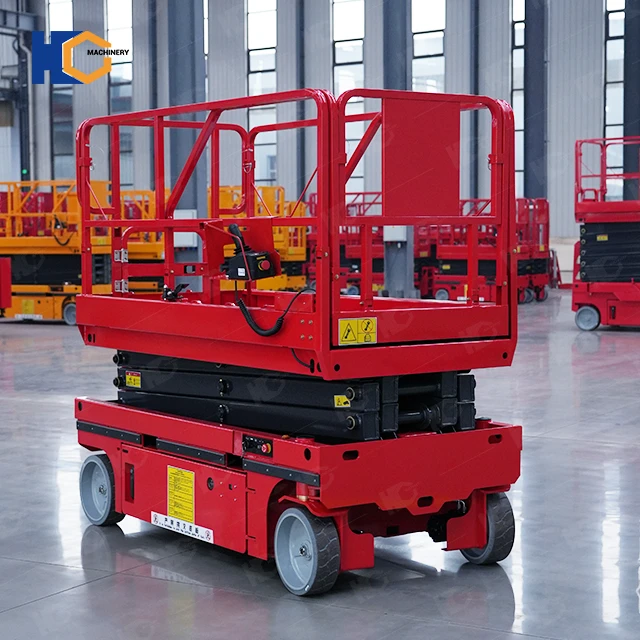
To obtain comparable quotations from manufacturers, prepare a specification sheet before contacting suppliers.
Step 1: Define the Work Height
State the required platform height or working height, and confirm which measurement you are using.
Step 2: Specify the Load Capacity
Include the combined weight of operators, tools, and materials.
Step 3: Confirm the Working Environment
Specify indoor warehouse use, finished floors, outdoor paving, or rough terrain.
Step 4: Select the Drive Configuration
Confirm whether you need a push-around lift, self-propelled electric model, or another configuration.
Step 5: Confirm Dimensions
Provide maximum machine width, stowed height, platform dimensions, and any doorway or aisle restrictions.
Step 6: Check Battery and Charging Requirements
Specify the intended working shift, available charging voltage, and preferred battery configuration.
Step 7: Confirm Safety and Documentation Requirements
Request the applicable declarations, test reports, operating manuals, maintenance instructions, and documentation needed for the destination market. Verify certification claims against the exact model and configuration.
Step 8: Compare the Complete Quotation
Ask each supplier to identify the included accessories, warranty, packaging, delivery terms, spare parts, and lead time.
For international procurement, confirm whether the quote is EXW, FOB, CIF, or another agreed Incoterm. Do not assume freight or local delivery is included.
9. Safety and Compliance Considerations
Electric power does not eliminate the risks of working at height.
Before purchasing, verify that the lift has appropriate guarding, emergency-lowering provisions, braking systems, controls, and other safety features required for its design and intended market.
In the United States, relevant requirements can include OSHA rules for aerial lifts and applicable ANSI/SAIA standards, including ANSI/SAIA A92.20 for design, calculations, safety requirements, and test methods for mobile elevating work platforms. The specific requirements depend on the equipment classification and application.
Buyers should verify the applicable rules with the manufacturer and qualified local safety personnel. Operators must be trained, conduct pre-use inspections, observe load limits, and operate only on surfaces and slopes permitted by the manual.
Safety compliance should be a purchasing requirement—not an optional upgrade selected after comparing prices.
10. Frequently Asked Questions
How much does a new electric scissor lift cost?
Published 2026 U.S. market guides place many new electric models in broad ranges of approximately $17,500–$35,000 for 19 ft machines and $32,000–$55,000 for 32 ft machines. Exact prices depend on specifications, brand, and dealer terms.
How much does an electric scissor lift cost from China?
Public factory and supplier listings show some electric scissor lift configurations advertised around $4,800–$5,800 FOB, with other models costing more. The price depends on height, capacity, configuration, quantity, and the exact quotation terms.
Is a used electric scissor lift worth buying?
It can be, especially for occasional work or buyers with maintenance capabilities. Battery health, inspection status, service history, and spare-parts availability are critical to evaluating the actual value.
Is renting cheaper than buying?
Renting is often more practical for short-term projects. Buying may be more economical for frequent, long-term use, but the calculation should include maintenance, financing, downtime, and resale value.
What is the difference between a 19 ft platform height and a 19 ft working height?
A 19 ft platform-height lift may have an advertised working height around 25 ft. Always check the manufacturer’s definitions and specification sheet before purchasing.
What should I ask a factory before placing an order?
Confirm the platform height, working height, rated capacity, machine dimensions, battery specification, drive configuration, applicable safety documentation, warranty, spare parts, shipping terms, and delivery time.
Conclusion: How to Choose the Right Electric Scissor Lift Price
Electric scissor lift prices vary widely because the market includes compact mobile lifts, self-propelled warehouse machines, higher-reach electric platforms, and premium equipment from established brands.
For buyers in 2026, the most effective purchasing strategy is to compare equivalent specifications across three options: new equipment from a local dealer, used equipment with verified service history, and factory-direct equipment with clearly defined export terms.
A low factory price can be attractive for distributors and fleet buyers, but the final decision should also account for safety documentation, local service support, spare parts, battery life, and the cost of downtime.
Before requesting a quotation, define the required working height, rated capacity, operating environment, machine dimensions, and destination market. This will help suppliers provide more accurate offers and make your comparison genuinely useful.
Looking for an electric scissor lift for your warehouse, factory, or rental fleet? Send your required platform height, load capacity, quantity, and destination country to a qualified manufacturer for a quotation matched to your specifications.
If you are looking to purchase an electric scissor lift, you can contact our scissor lift factory directly to get factory-direct pricing.

Jnhclift (Huichuang Lift), based in Jinan, China, is a professional manufacturer of scissor lifts, home elevators, and lift platforms. With our own dedicated factory, we deliver high-quality, reliable lifting solutions tailored to meet diverse industrial and residential needs.

 Room 203, Second Floor, Building 8, Phase Ⅱ, Zhizao Town, Jibei Street, Jiyang District, Jinan City, Shandong Province
 +86 152 5319 3706
 admin@jnhclift.com
Leave a Reply
Want to join the discussion?Feel free to contribute!